
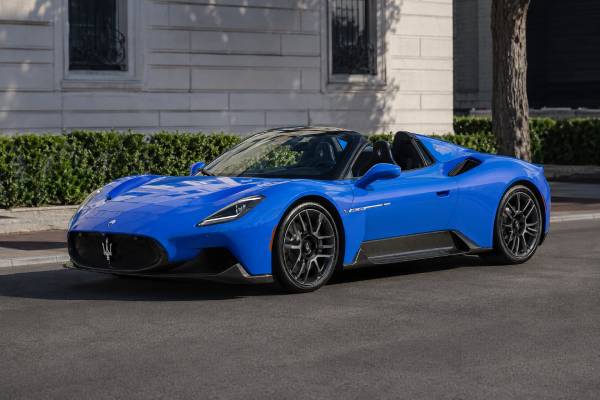
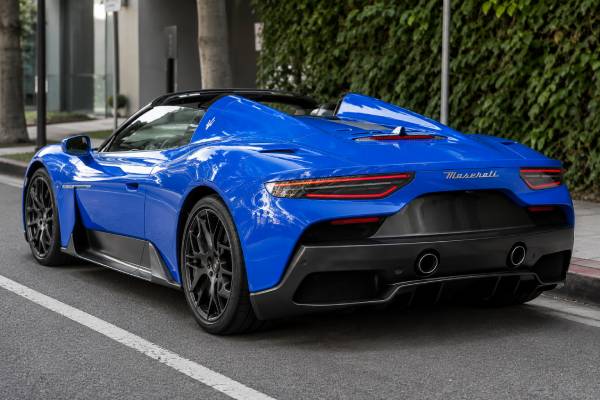
The 2024 Maserati MC20 Cielo Limited Blu Infinito is an exceptionally scarce Japanese-market interpretation of Maserati’s open-roof supercar. It combines the production MC20 Cielo’s carbon-fiber structure, 630-CV Nettuno V6, eight-speed dual-clutch transmission, and electrochromic folding glass roof with a heritage-driven blue livery that was not simply selected from the normal configurator. The edition’s graphics connect the modern car with Maserati competition imagery associated with the 250F era and the marque’s celebrated “Birdcage” visual language. Only two Blu Infinito examples were allocated to Japan, making documentation, originality, and paintwork condition especially important.
Mechanically, the car remains close to the regular Cielo, which is useful for service access and parts identification. Its collector value, however, depends on details that ordinary maintenance records do not capture: the correct exterior treatment, market-specific paperwork, undamaged carbon body panels, an operating retractable roof, and proof that the car is one of the original limited examples. This guide explains the model’s background, engineering, performance, ownership needs, and the checks that matter before purchase.
Table of Contents
- Why the Blu Infinito Edition Exists
- Nettuno Power and Cielo Chassis Specifications
- Two-Car Production and Authentication
- Heritage Graphics and Glass-Roof Engineering
- Open-Air Speed and Road Manners
- Service Risks, Storage, and Recall Checks
- How to Buy a Blu Infinito Cielo
Why the Blu Infinito Edition Exists
The Blu Infinito edition exists to give the MC20 Cielo a distinctly Japanese, competition-inspired identity rather than merely adding another catalog color. Maserati presented it alongside a Rosso Vincente counterpart as a modern reinterpretation of historic racing liveries, with each treatment produced in extremely small numbers for Japan.
The standard MC20 Cielo was already a significant model. It translated the MC20 coupe into a retractable-hardtop format without abandoning the carbon-fiber monocoque, mid-engine balance, or butterfly doors that define the platform. The roof added visual drama and open-air driving while retaining a rigid glass panel above the occupants when closed. Maserati then used the limited Japanese edition to connect that new technology with a much older racing identity.
“Blu Infinito” translates naturally as “infinite blue.” On this car, the name describes a complete visual composition rather than one paint code in isolation. The deep blue body is interrupted by special graphics that evoke Maserati’s mid-century single-seater heritage and the patterns associated with its Birdcage-era competition machines. The result is recognizable without depending on modern sponsor decals or oversized branding. It looks historical in concept but remains clean enough to suit the MC20’s minimalist shape.
The edition arrived during a period when Maserati was using the Fuoriserie personalization program and tightly controlled special series to build a clearer link between current road cars and the company’s racing archive. That strategy also produced models such as the MC20 Icona and Leggenda, but the Japanese Cielo pair follows a different idea. Instead of celebrating one famous road or GT1 car with a global run, it applies a local-market commission to the open version of the MC20.
For an owner, the historical narrative matters because it explains why a seemingly cosmetic package can command collector interest. A regular Cielo can be repainted blue, wrapped, or striped. It cannot become an original Blu Infinito limited car without the correct factory identity, sales documentation, and market provenance. The value therefore sits at the intersection of the underlying supercar and the authenticity of the special finish.
The model year is also important. The assignment covers 2024 only, so a claimed example should align with the production, registration, and documentation timeline of the Japanese release. A later import, a standard Cielo with similar colors, or a car carrying recreated graphics must not be represented as the limited edition without decisive evidence.
Nettuno Power and Cielo Chassis Specifications
Under its unique livery, the Blu Infinito uses the regular MC20 Cielo’s 2,992 cc twin-turbocharged Nettuno V6 and rear-wheel-drive chassis. Output is 630 CV, commonly quoted as 621 hp, with 730 Nm of torque delivered through an eight-speed dual-clutch transaxle.
| Specification | 2024 MC20 Cielo Limited Blu Infinito |
|---|---|
| Engine | 2,992 cc 90-degree twin-turbo V6 |
| Power | 630 CV (approximately 621 hp) at 7,500 rpm |
| Torque | 730 Nm from approximately 3,000 rpm |
| Transmission | Eight-speed dual-clutch automatic |
| Drive | Rear-wheel drive with electronically controlled differential |
| Structure | Carbon-fiber monocoque with aluminum subframes |
| Roof | Retractable electrochromic glass hardtop |
| Claimed 0–100 km/h | About 3.0 seconds |
| Claimed top speed | More than 320 km/h |
| Dry weight | Approximately 1,540 kg, depending on specification |
Nettuno is unusual because its cylinder heads use a pre-chamber combustion system derived conceptually from high-performance racing practice. A small chamber above the main combustion space contains an additional spark plug. Jets of burning mixture pass into the cylinder, helping the flame spread rapidly under high load. A second conventional spark plug supports operation across different engine speeds and loads. The engine also combines direct and port fuel injection, twin turbochargers, dry-sump lubrication, and a compact 90-degree layout suited to a mid-engine car.
The eight-speed dual-clutch gearbox places the mass near the rear axle and shifts with little interruption in acceleration. Lower ratios are closely spaced for response, while the upper gears support high-speed cruising and fuel consumption. Manual control is available through steering-column paddles. A launch-control function is tied to the more aggressive drive settings, but repeated starts impose heat and mechanical stress that should be reflected in a pre-purchase inspection.
The carbon monocoque is central to both performance and ownership risk. It forms the passenger cell, supports the dramatic door apertures, and gives the suspension a stiff foundation. Aluminum front and rear subframes carry the crash structures, suspension, engine, and transmission. This mixed construction is light and effective, but accident assessment cannot be handled like an ordinary steel-bodied car. Carbon damage may be hidden, and repairs require model-specific measurement, bonding, and authorization.
Suspension is by double wishbones with adaptive dampers. The steering is electrically assisted, and braking is handled by large ventilated discs with multi-piston calipers; carbon-ceramic brakes were available depending on specification. Typical wheel and tire sizes are 245/35 ZR20 at the front and 305/30 ZR20 at the rear. Tire brand, Maserati approval marking, age, pressure, and matching construction all affect stability.
The drive-mode selector provides Wet, GT, Sport, Corsa, and ESC Off settings. These modes alter accelerator response, shift strategy, damper behavior, exhaust character, and stability-control thresholds. Wet is useful on low-grip Japanese roads, while Corsa is intended for controlled high-performance use rather than routine traffic.
Two-Car Production and Authentication
The Blu Infinito was a two-car Japanese-market edition, so authentication must go beyond checking that the paint looks correct. A buyer should establish the vehicle identification number, original selling dealer, factory build specification, Japanese registration history, and the documents connecting that exact chassis to the limited program.
The first useful record is the factory or dealer build sheet. It should list the exterior configuration, trim, wheels, brakes, options, and market coding. The Japanese sales invoice, warranty-start record, inspection documents, and maintenance booklet should form a consistent chain. Exported cars also need customs and registration papers that preserve the original identity rather than merely describing the car as a blue MC20 Cielo.
Because only two examples exist, details from photographs of the official launch and documented cars can be compared carefully. The placement, proportions, color transitions, and termination points of the graphics should agree. Panel gaps and graphic alignment should also remain consistent across doors, front clamshell sections, roof surrounds, and rear bodywork. A replacement panel may be legitimate after minor damage, but the reason and repair method need to be documented.
The phrase “Blu Infinito” can cause confusion because blue has appeared elsewhere in the MC20 range. Color alone does not prove the edition. A standard Cielo ordered through Fuoriserie, a wrapped car, or an aftermarket tribute may be visually convincing. The decisive question is whether Maserati’s original records identify the car as one of the limited Japanese examples.
Options may differ between the two cars. Carbon-ceramic brakes, carbon-fiber exterior pieces, audio equipment, driver-assistance features, seat type, and front-axle lift should be checked against the individual build rather than assumed from general publicity. A special series can have a defined visual package while still allowing selected equipment choices.
Mileage should be evaluated together with time. A two-car edition may cover very little distance, but low use is not the same as perfect condition. Tires can age, batteries can fail, seals can dry, fuel can deteriorate, and brake discs can corrode. Conversely, a carefully maintained car with modest regular use may be mechanically healthier than one stored for years without proper preparation.
Heritage Graphics and Glass-Roof Engineering
The edition’s defining feature is the way its historic blue graphics interact with the MC20 Cielo’s modern carbon-and-glass architecture. The livery emphasizes the car’s long, low surfaces, while the retractable electrochromic roof lets the driver change the cabin from enclosed coupe to open roadster in roughly 12 seconds.
Maserati’s official Japanese presentation linked the special colors to 1950s competition cars, including the 250F and 350S. The Blu Infinito treatment uses blue as the dominant field and adds a Birdcage-associated graphic idea that is not presented as a normal Fuoriserie catalog selection. That distinction matters: the livery is part of the edition’s identity, not an accessory that can be replaced casually.
The MC20 body itself was shaped around low drag, cooling, and stability. Air enters through carefully placed openings rather than a large decorative grille. The upper surfaces remain relatively pure, while much of the aerodynamic management occurs underneath through a flat floor, channels, and rear diffuser. The limited graphics draw attention to those forms without adding a fixed rear wing or changing the fundamental aero package.
Butterfly doors hinge upward and forward, exposing a wide section of the carbon sill. They create an impressive arrival but need overhead and side clearance. Gas struts, hinges, latches, wiring, glass indexing, and seals all deserve inspection. A door that drops, rattles, or requires extra force can indicate adjustment, worn support hardware, or prior body repair.
The roof panel uses polymer-dispersed liquid-crystal technology. At the press of a control, the glass can change between a clear state and an opaque-looking state in about one second. The complete roof panel then retracts beneath the rear deck. Maserati allows roof operation at low road speed, quoted up to approximately 50 km/h, though operating it while stationary reduces load and makes abnormal noises easier to hear.
A correct roof test should cover more than one open-close cycle. Check the glass-state switch, header latches, rear-deck movement, side-window drop and rise, warning messages, water channels, seals, and final panel alignment. Listen for scraping, hydraulic or electric strain, and wind noise. Inspect the headliner and luggage areas for dampness. Any calibration issue should be diagnosed before purchase because roof access and adjustment can be labor intensive.
Paint care is equally specialized. The graphic boundaries should not be aggressively machine-polished, and edge lifting under paint-protection film can damage delicate finishes. A paint-depth gauge may not interpret carbon panels in the same way as metal, so visual inspection, infrared or specialist assessment, and original records are more useful than relying on one numerical reading.
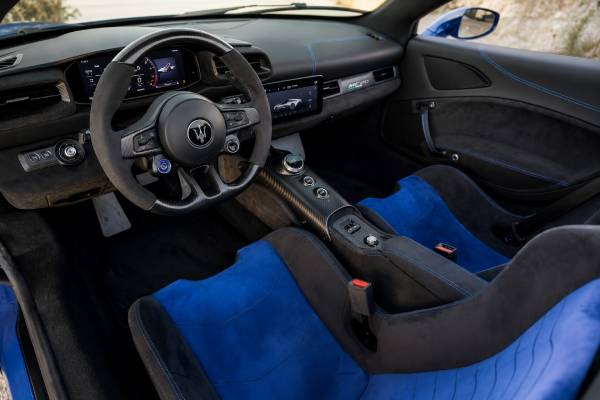
Inside, the Cielo combines a compact digital instrument display with a central touchscreen and a deliberately simple console. The view rearward is limited, making the camera and parking sensors important in daily use. Cabin carbon, Alcantara, leather, switchgear, and seat bolsters should be protected from ultraviolet exposure when the roof is open, especially in hot climates.
Open-Air Speed and Road Manners
The Blu Infinito drives like a standard MC20 Cielo: explosively fast, rear-driven, and more compliant in GT mode than its appearance suggests. Maserati claims roughly three seconds from 0 to 100 km/h and a top speed above 320 km/h, performance that demands careful tire and brake preparation.
At low engine speeds, the Nettuno V6 responds cleanly enough for traffic. The gearbox can select higher ratios early in GT mode, and the adaptive suspension takes the sharp edge off ordinary road imperfections. Visibility forward is good for a low supercar, although the nose remains difficult to judge and the car’s width becomes obvious in narrow lanes, parking structures, and toll areas.
Opening the roof increases sound and sensation without changing the basic control layout. Turbo intake, wastegate, exhaust, and transmission noises become more obvious, while airflow is reasonably managed at road speeds. At very high speed, buffeting and wind noise naturally increase. The roof-open experience is strongest on flowing roads where the driver can use the engine’s midrange rather than chase maximum velocity.
Sport mode gives the accelerator and transmission a sharper character. Corsa reduces intervention, firms the dampers, holds gears, and enables the quickest launch strategy. The engine builds force rapidly after the turbos are working, and the rear tires carry a substantial torque load. Cold tires, painted road markings, standing water, and abrupt throttle inputs can therefore produce a quick loss of grip.
The steering is fast and places the car accurately, but it should feel consistent around center and load progressively. Pulling, vibration, a crooked wheel, or nervous behavior on a smooth road may point to tire damage, alignment issues, bent wheels, or accident repairs. Wide performance tires can follow road grooves, so diagnosis should compare behavior across more than one surface.
Braking should be powerful and straight. Iron discs may show surface rust after storage but should clean with use; persistent judder, deep scoring, cracking, or a long pedal needs investigation. Carbon-ceramic discs offer reduced unsprung mass and strong track resistance, yet replacement cost is high. Their condition should be assessed by a specialist using thickness, wear limits, surface inspection, and the car’s usage history.
Track use is possible, but the limited livery makes risk management particularly important. Debris can damage the nose, graphics, windshield, and exposed carbon, while heat cycles consume tires, pads, fluid, and engine oil life. A prospective buyer should review telemetry or event records where available and inspect tow points, underbody panels, wheel barrels, and brake cooling areas for evidence of repeated circuit work.
Service Risks, Storage, and Recall Checks
The Blu Infinito does not have a unique mechanical service schedule, but its scarcity makes preventive maintenance and correct documentation unusually important. Owners should follow the VIN-specific Maserati schedule, verify open campaigns with an authorized retailer, and avoid allowing low annual mileage to justify skipped time-based service.
Annual or scheduled work may include engine oil and filter replacement, inspections of fluid levels and leaks, brake checks, tire assessment, cabin and engine-air filters, diagnostic scans, and software verification. Spark plugs, belts, gearbox filters, and other items appear at specified age or mileage points depending on market documentation. Exact intervals can change by country and build date, so the owner’s manual and dealer system take priority over generalized lists.
The dry-sump engine needs the correct oil specification and checking procedure. Oil level may depend on temperature, running condition, and a prescribed sequence. Overfilling can be as harmful as underfilling. A workshop unfamiliar with Nettuno should not improvise based on another Maserati V6.
Cooling-system condition deserves attention because a mid-engine package has long coolant paths and multiple joints. Look for dried residue, odors, low level, hose damage, and evidence of repeated topping up. Service information for early MC20-family cars has included checks involving coolant or breather plumbing and transmission software, reinforcing the need to search by VIN rather than assume every car is affected.
Electrical health is another priority. The roof, door indexing, alarms, telematics, cameras, control modules, and electronic differential all rely on stable voltage. A weak 12-volt battery can generate several warnings that disappear after charging but still leave stored faults. A quality maintainer is sensible during storage, yet the battery should be load-tested rather than declared healthy merely because the car starts.
Recall status must be checked in the country where the car is registered and, for an imported example, against its original market. MC20-family campaigns have included items such as tire-information labels and rear-camera software. A limited Japanese car may not appear in every public database, so the Maserati network should confirm completion from the chassis number. Printed evidence should remain with the history file.
Storage should include a clean, dry, ventilated environment, correct tire pressures, fuel management, rodent protection, and periodic inspection. Long stationary periods can flat-spot tires and mark brake discs. Starting the engine briefly without reaching full temperature is less useful than a proper drive under suitable conditions, because moisture may remain in the oil and exhaust.
Cosmetic maintenance needs restraint. Preserve photographs before installing or removing paint-protection film. Use a detailer experienced with matte, metallic, graphic, and carbon surfaces as applicable. Replacement graphics should come through an authenticated source, and any paint repair should reproduce the original texture and alignment rather than merely matching a blue color sample.
How to Buy a Blu Infinito Cielo
Buy this model only after proving that it is one of the original two Blu Infinito Japanese cars and that its carbon structure, special livery, folding roof, and service history are sound. Rarity should increase the depth of inspection, not reduce it.
Begin with identity. Match the VIN on the body, windshield area, documents, diagnostic report, and factory records. Ask a Maserati retailer or qualified specialist to confirm the original build specification and limited-edition status. The seller should provide Japanese paperwork or a documented chain from the original dealer to the current registration. Unexplained gaps are serious because there are so few comparable cars.
Next, inspect the exterior in strong diffuse light. Check the blue finish and graphics for overspray, edge mismatch, lifting, sanding marks, or inconsistent gloss. Compare both sides and use period launch photographs as a reference. Examine the front bumper, hood, doors, roof cover, rear quarters, diffuser, and undertray. Confirm that replacement paint-protection film has not hidden poor repairs.
A carbon-structure inspection is essential after any reported accident. Request body measurements, repair invoices, photographs taken before and during work, and proof that approved methods were used. Cosmetic perfection does not establish structural integrity. Uneven door action, changing gaps, unusual sealant, or disturbed fasteners can justify deeper investigation.
Operate every system from cold. Test both keys, door windows, roof transparency, roof retraction, front lift, air conditioning, cameras, parking sensors, infotainment, drive modes, dampers, seat controls, and charging ports. Perform a diagnostic scan before clearing any codes. Stored undervoltage faults may be innocent, but repeated communication, roof, gearbox, or differential faults need a cause.
On the road, verify cold start, idle, boost delivery, shifts, steering alignment, brake feel, and temperature stability. The car should not smoke, hesitate, flare between gears, or display warning messages. Repeat the roof check after driving because heat and body movement can reveal sealing or calibration problems not obvious in the showroom.
Consumables can change the real purchase price substantially. Budget for four correct tires if age or mismatch is questionable, brake work if wear is advanced, annual service, battery replacement, paint-film renewal, and import-related software or compliance issues. A bargain that immediately needs carbon-ceramic discs, roof repair, or graphic restoration may be more expensive than the best documented car.
Collector value is strongest when the vehicle is complete. Confirm books, keys, tools, tire inflator, charger, covers, original accessories, plaques or edition-specific materials, and delivery items. Keep removed original components if reversible upgrades have been fitted. Exhaust, wheel, suspension, and software modifications should be disclosed and evaluated for warranty, emissions, noise, and drivability consequences.
A sensible purchase process ends with a written specialist report and an agreed remedy for unresolved findings. This is a usable supercar, but it is also a two-example regional commission. The best car is not automatically the one with the fewest kilometers; it is the one whose identity, condition, and care can be demonstrated without guesswork.
References
- MC20 Cielo limited 202411 (2024, official model presentation)
- Maserati MC20 Cielo – Model Overview: Info, Performance, Design | Maserati (2024, official specifications)
- New Maserati MC20 Cielo Global Premiere | Maserati | Stellantis Media (2022, official press release)
- Vehicle Detail Search – 2023 MASERATI MC20 CIELO | NHTSA (accessed 2026, recalls and complaints)
- MC20 Prepaid Maintenance programs | Maserati US (accessed 2026, official maintenance scope)
Disclaimer
This article is for general informational and educational use and is not a substitute for professional diagnosis, repair, inspection, or legal and import advice. Specifications, torque values, service intervals, procedures, software, recalls, and equipment can vary by VIN, market, production date, and installed options. Verify all work and purchase decisions against current official Maserati service documentation, the vehicle’s documentation, and a qualified specialist. Share this guide with other MC20 Cielo enthusiasts who may find it useful.