
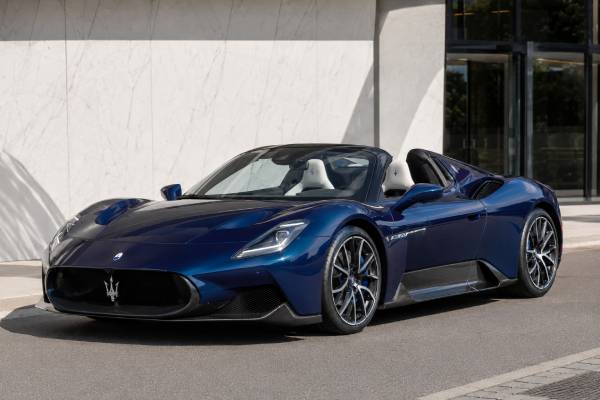
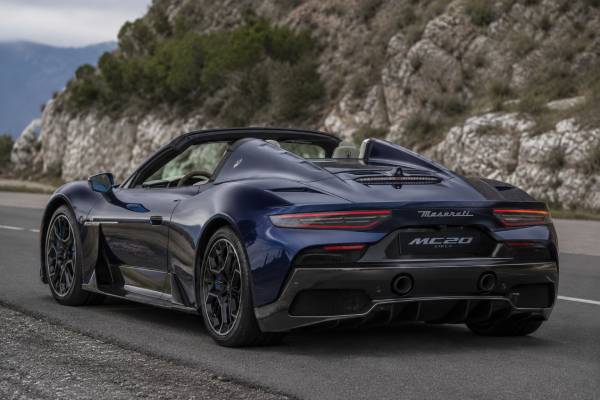
The 2024 Maserati MC20 Cielo Limited Rosso Vincente is a two-car Japanese-market special edition built around one of the most advanced road cars produced in Modena. Its name means “victorious red,” and its red body with blue-and-white striping deliberately recalls the Maserati 350S sports-racing car. Beneath that heritage treatment is the complete MC20 Cielo package: a carbon-fiber monocoque, mid-mounted 3.0-liter Nettuno twin-turbo V6, eight-speed dual-clutch transmission, rear-wheel drive, butterfly doors, and a retractable electrochromic glass roof.
This is not simply a red Cielo with optional stripes. Its limited identity depends on factory provenance, the correct Japanese-market configuration, and an accurately preserved livery. The car’s mechanical components are largely shared with other MC20 and Cielo models, but its body finish, documentation, and rarity require a more exacting ownership approach. Paint repair, roof faults, accident damage, or missing records can affect both usability and collector credibility. The following guide examines the model’s origin, specifications, limited production, engineering, driving experience, maintenance requirements, and the evidence a buyer should demand.
Table of Contents
- A Two-Car Tribute in Red
- The Cielo Platform Beneath the Livery
- Japanese Allocation, Options, and Authenticity
- 350S Stripes and Modern Aerodynamics
- How the Rosso Vincente Drives
- Roof, Software, and Long-Term Care
- Collector Inspection and Purchase Strategy
A Two-Car Tribute in Red
The Rosso Vincente was created as an ultra-low-volume Japanese tribute to Maserati’s 1950s sports-car racing heritage. Its red, blue, and white composition references the 350S, while the companion Blu Infinito edition draws on a different competition theme.
Maserati introduced the MC20 as a return to the mid-engine super-sports-car category and later developed the Cielo to add open-air capability. The company then used local-market projects and the Fuoriserie personalization program to show how that modern platform could carry historical stories. Rosso Vincente is one of the most concentrated examples: only two cars were assigned to the Japanese edition, so each example represents half of the complete production.
The name is descriptive. “Rosso” is red, and “Vincente” means winning or victorious. That language reflects Maserati’s long association with red Italian competition cars, but the blue-and-white striping makes the reference more specific. The 350S was a powerful front-engine sports racer from the 1950s, a period when Maserati competed internationally with purpose-built machinery rather than adapting luxury road cars. The Cielo does not imitate the 350S’s form; instead, it translates the racing colors onto a carbon-bodied, mid-engine shape.
This approach gives the edition a different character from a conventional commemorative badge package. The livery is visible from a distance, crosses body forms that are expensive to repair, and makes originality easy to question when panel alignment is wrong. It also creates a useful visual tension. The historic stripe concept comes from an era of exposed exhausts, wire wheels, and mechanical simplicity, while the Cielo uses active electronics, a glass roof, carbon composites, turbocharging, and digital controls.
The edition’s Japanese destination is part of its identity. Maserati has a long enthusiast following in Japan, where limited imports and carefully specified dealer cars often develop strong documentary histories. Japanese inspection and registration records can be valuable, but exported examples may later acquire translated documents, altered electronics, or market-compliance modifications. Those changes should be traced rather than treated as routine.
The Cielo Platform Beneath the Livery
The Rosso Vincente uses the standard MC20 Cielo’s core mechanical specification, led by a 2,992 cc, 90-degree, twin-turbocharged Nettuno V6. It produces 630 CV and 730 Nm, drives the rear wheels through an eight-speed dual-clutch gearbox, and delivers a claimed 0–100 km/h time of about 2.9 seconds.
| Component | Specification |
|---|---|
| Engine | Mid-mounted 2,992 cc twin-turbo V6 |
| Maximum power | 630 CV (approximately 621 hp) at 7,500 rpm |
| Maximum torque | 730 Nm from about 3,000 rpm |
| Transmission | Eight-speed wet dual-clutch transaxle |
| Driven wheels | Rear, with electronically controlled limited-slip differential |
| Passenger cell | Carbon-fiber monocoque |
| Suspension | Double wishbones with adaptive dampers |
| Claimed acceleration | 0–100 km/h in approximately 2.9 seconds |
| Claimed maximum speed | More than 320 km/h |
| Approximate dry weight | 1,540 kg, subject to equipment |
The Nettuno engine is the technical centerpiece. Its pre-chamber combustion system places a small auxiliary chamber above each main combustion chamber. Under appropriate operating conditions, a spark ignites mixture in the pre-chamber, and flame jets enter the cylinder through small passages. A second spark plug supports combustion across the broader operating range. Direct and port injection, dry-sump lubrication, and two turbochargers complete an engine designed for high specific output without a large displacement.
Dry-sump lubrication helps maintain oil control under acceleration, braking, and cornering forces. It also allows compact engine packaging. The oil level must be checked using the prescribed temperature and operating procedure, however. An incorrect method can create a misleading reading and lead to overfill or underfill.
The dual-clutch transmission integrates closely with the drive-mode system. In GT, shifts are calmer and the car selects taller gears. Sport increases response, while Corsa holds gears longer, speeds shifts, and relaxes electronic intervention. Wet mode provides a more conservative calibration for rain or cold tires. ESC Off is intended for drivers who understand the consequences of removing the final stability-control safety net.
A carbon monocoque forms the main cabin structure. Aluminum subframes attach at the front and rear to carry the suspension, powertrain, and crash structures. This construction provides rigidity despite the large roof opening and butterfly-door apertures. The Cielo gained weight over the coupe because of its retractable roof mechanisms and structural requirements, but it retained nearly all of the coupe’s acceleration.
Double-wishbone suspension controls each corner, and adaptive dampers alter their response with the selected mode. The standard braking system uses large ventilated discs and multi-piston calipers; carbon-ceramic brakes may appear on an individual build. Twenty-inch wheels typically carry 245/35 ZR20 front tires and 305/30 ZR20 rear tires. A mismatched or aged set can compromise the electronic systems and the car’s high-speed behavior.
The optional front suspension lifter is particularly useful in Japan, where steep ramps and parking entrances can threaten the splitter and floor. Its presence should be verified from the build sheet, and it should raise and lower evenly without warning messages or fluid leakage.
Japanese Allocation, Options, and Authenticity
Authenticating a Rosso Vincente requires evidence that the specific VIN belongs to the original two-car Japanese allocation. Paint, stripes, or a seller’s description are not enough because the appearance can be recreated after production.
Start with the Maserati build record. It should identify the original market, exterior specification, interior trim, wheels, brakes, driver-assistance equipment, audio system, and other options. Compare that information with the physical car. A special series may have a fixed exterior concept while the two cars differ in selected equipment, so do not assume that a feature shown in publicity was fitted to both.
The original sales invoice is especially valuable. It may name the limited model directly and identify the Japanese dealer. Warranty-registration data, maintenance-book stamps, Japanese periodic-inspection records, and insurance documents can then establish continuity. For an exported car, the customs declaration, deregistration certificate, bill of lading, and first foreign registration should connect cleanly to the same VIN.
Photographs from delivery or early ownership can help verify the stripe layout. Check where the blue and white bands begin, how their widths change across curved panels, and how they align at shut lines. Inspect the hood, front bumper, windshield base, roof cover, rear deck, and diffuser area. A factory livery should look intentional from every angle; uneven spacing or abrupt terminations can suggest panel replacement or recreation.
Red paint is difficult to match after repair because color, metallic content, clearcoat thickness, and ultraviolet aging affect its appearance. View the car indoors and outdoors, from several directions. A panel can look acceptable under showroom lighting but appear orange, dark, or cloudy in daylight. Carbon-fiber panels also require a different inspection approach from steel. A conventional magnetic paint gauge will not provide the same information, and excessive sanding can damage the composite surface.
The cabin and market equipment should be consistent with a Japanese-delivery Cielo. Check right-hand-drive layout, labels, infotainment region, radio operation, navigation, connected services, lighting, and speed display. Exporters sometimes alter modules or install frequency converters. These changes are not automatically unacceptable, but they should be reversible, documented, and free of diagnostic conflicts.
Finally, search for ownership claims involving both cars. With an edition this small, duplicate serial descriptions, conflicting photographs, or two sellers claiming the same provenance can expose errors. A careful buyer should create a timeline rather than accept a short auction catalog statement as the complete history.
350S Stripes and Modern Aerodynamics
The Rosso Vincente’s blue-and-white stripes are its defining design feature, but they sit on a body shaped primarily by aerodynamic and cooling requirements. The MC20 Cielo’s upper surfaces remain clean while the floor, diffuser, intakes, and controlled airflow do much of the functional work.
The historical 350S was a front-engine racing barchetta with a very different shape and purpose. Maserati therefore avoided a literal replica. The special Cielo uses color to create the connection while preserving the MC20’s low nose, cab-forward cabin, muscular rear haunches, and short rear body. The red field expresses Italian racing tradition; the contrasting bands provide the recognizable 350S cue.
Because the stripes cross or approach multiple panel boundaries, accident repair becomes unusually visible. The hood and front bumper must align both physically and graphically. So must the rear deck and adjoining bodywork. A few millimeters of error can be more obvious than a small change in panel gap. Any repaint should be supported by photographs of the original layout and by invoices from a specialist capable of reproducing the finish.
The front end directs cooling air without relying on an oversized grille. Side intakes feed the powertrain, and the underside manages airflow toward the rear diffuser. The Cielo’s retractable-roof packaging required careful control of turbulence and engine-bay ventilation. No large fixed wing is needed for the standard road-car balance, so the livery remains the primary visual distinction.
The roof is a glass hard panel rather than a fabric top. Polymer-dispersed liquid-crystal technology lets the driver switch the glass between transparent and opaque-looking states in about one second. The full panel retracts beneath the rear cover in roughly 12 seconds and can operate at low speed, quoted up to 50 km/h. The system gives three experiences: a closed shaded cabin, a closed cabin with a view upward, and a fully open cockpit.
Butterfly doors preserve the MC20’s theatrical entry. They reduce the outward swing compared with a long conventional door, but they require overhead clearance and place mechanical loads on hinges, struts, latches, and wiring looms. The side glass must drop slightly when the door or roof moves, then seal correctly. Slow indexing, wind noise, or water entry can be an adjustment or voltage problem.
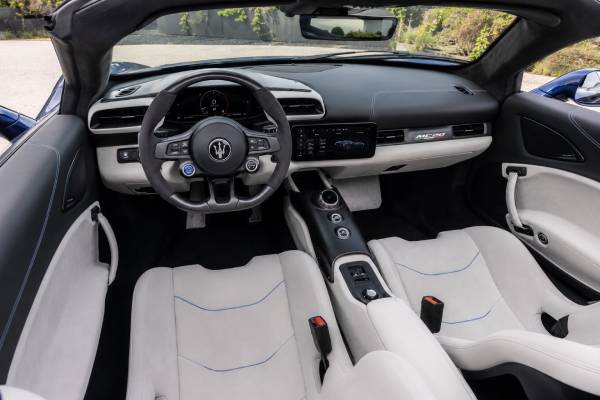
The cabin keeps controls relatively restrained. A digital instrument screen and central touchscreen handle most functions, while the drive-mode control gives quick access to the car’s personalities. Carbon-fiber surfaces, leather, Alcantara, and metal details create the atmosphere. With the roof open, red paint and striped rear bodywork remain visible in the mirrors, reinforcing the edition’s identity from the driver’s seat.
How the Rosso Vincente Drives
The Rosso Vincente delivers the same core performance as other MC20 Cielos: immediate steering, forceful turbocharged acceleration, and a chassis that can feel surprisingly civilized in its softer mode. Its special paint does not change the drivetrain, but the edition’s rarity should influence where and how it is used.
In normal traffic, the gearbox moves through ratios early and the V6 produces ample torque without high revs. The view over the nose is clearer than the low seating position suggests. Rearward visibility is restricted, so cameras and sensors should be treated as essential aids rather than conveniences. The car’s width is the greater challenge on narrow urban roads.
With the roof closed and opaque, the cabin feels much like a compact coupe. Switching the glass clear introduces light without added wind. Retracting it exposes the occupants to the engine’s induction, turbo, exhaust, and shift sounds. The V6 note is more technical than the naturally aspirated sound of older Maseratis, but open-roof operation makes its changing texture easier to hear.
GT mode suits uneven roads. The dampers remain controlled without making every surface joint harsh, and throttle response is manageable. Sport brings stronger reactions and more assertive shifts. Corsa is best reserved for a dry, open road or circuit because it keeps the powertrain alert and allows more movement before stability control intervenes.
The quoted 2.9-second 0–100 km/h result depends on launch control, grip, temperature, and a properly prepared car. Repeated launches can heat the clutch, rear tires, and driveline. A used example with unusually frequent launch records or track history should receive closer fluid, gearbox, differential, tire, and mount inspection.
Steering should be precise without looseness or vibration. The chassis is stiff, and the front tires respond quickly, so bent wheels or poor alignment become apparent. Some tramlining can occur on grooved surfaces, but a persistent pull is not normal. Inspect the inner tire shoulders because aggressive alignment and low ride height can hide wear from a casual glance.
The brakes should deliver a firm, consistent pedal. Iron discs tolerate road use and are generally less expensive to replace, while carbon-ceramic discs resist heat and reduce unsprung mass but can create a major bill. A specialist should evaluate ceramic discs for surface damage, wear, and prior track use rather than judging them only by mileage.
Driving with the roof open does not turn the Cielo into a relaxed touring convertible. Acceleration remains extreme, and wind can conceal speed. The rear tires must manage 730 Nm with no driven front axle. Cold rubber, rain, dust, paint markings, and abrupt throttle can overcome traction rapidly. Wet mode and conservative inputs are appropriate when conditions are uncertain.
Roof, Software, and Long-Term Care
Long-term care centers on time-based servicing, stable battery voltage, roof maintenance, correct fluids, and VIN-specific campaign checks. Low mileage does not remove these obligations, and a two-car edition benefits from unusually complete records.
Follow the service schedule for the exact market and build date. Typical MC20 program items include engine oil and filter, engine-air and cabin filters, spark plugs at prescribed intervals, drive belts, brake-fluid checks or replacement, gearbox filters, diagnostic scans, and detailed inspections. The owner’s documentation and Maserati service system must settle the interval because packages vary by country.
Use only oil and fluids meeting the required approvals. The Nettuno’s dry-sump arrangement has a specific level-check procedure, and the dual-clutch transmission requires the correct fluid, filter, fill temperature, and diagnostic process. A general repair shop can cause expensive problems by applying familiar procedures from a conventional automatic or wet-sump engine.
Run the roof through a complete test at every inspection. Start with sufficient battery charge, open and close it, switch the glass state, and watch the side windows. Check the header seal, rear cover, drains, alignment, warning display, and cabin for moisture. A roof that works once may still fail when warm, on an incline, or after repeated cycles, so a pre-purchase test should be thorough.
Battery condition affects the whole vehicle. Long storage can lower voltage and trigger faults in the doors, roof, cameras, transmission, dampers, differential, and infotainment. Use an appropriate maintainer, inspect the battery age, and perform a real load test. Clearing undervoltage codes without confirming the cause makes the history less useful.
Cooling-system checks should include the reservoir level, joints, underbody lines, radiators, and signs of dried residue. The low front openings can collect debris, and damaged cooling fins reduce efficiency. Engine-bay smells, unexplained top-ups, or temperature variation need diagnosis before hard driving.
Campaign and recall status must be searched by VIN. MC20-family vehicles have had market-specific actions involving labels, software, cameras, and selected mechanical checks. Imported Japanese cars may not appear clearly in a destination-country public database. Obtain written confirmation from a Maserati service point that all applicable actions are complete.
Tires age even when tread depth remains high. Check the four-digit date codes, Maserati approval, matching model, repairs, flat spots, and sidewall condition. A car stored on underinflated tires may vibrate despite very low mileage. Replace a questionable set before using the performance available.
Preserve the exterior with careful washing, clean drying tools, and products compatible with the exact finish. Do not polish stripe edges aggressively. Record paint-protection-film installation with photographs and material details. If film must be removed, a specialist should control heat and pulling angle so the underlying graphics do not lift.
Collector Inspection and Purchase Strategy
A safe purchase requires simultaneous proof of limited-edition identity and normal supercar mechanical health. The best Rosso Vincente is the car with an unbroken history, correct livery, undamaged carbon structure, fully working roof, and service records that can be verified independently.
Before viewing, request the VIN, build sheet, original invoice, service history, recall status, tire dates, photographs of the underside, and details of any paint or film work. A seller unwilling to identify one of only two cars creates unnecessary risk. Check that advertisements and documents use the same model description and mileage.
At the inspection, begin with a cold car. A pre-warmed engine can hide starting noises, smoke, weak battery behavior, or rough idle. Scan all control modules before anyone deletes faults. Review active, stored, and historical codes, then repeat the scan after the road test and roof operation.
Inspect the carbon tub and aluminum subframes with the car raised at the correct points. Look for scrapes, crushed jacking areas, disturbed fasteners, cracked panels, replaced undertrays, corrosion at hardware, and evidence of alignment work. Ask for structural measurements after any collision. A clean exterior is not proof that the monocoque is untouched.
Study the red panels and stripes under neutral lighting. Compare color across adjacent components and inspect boundaries for masking lines or lifting. Check the windshield frame, door hinges, latch areas, front clamshell, rear deck, and diffuser. Misaligned graphics can reveal repairs that ordinary paint inspection misses.
Test every costly feature: roof transparency and movement, front lift, butterfly doors, window indexing, air conditioning, cameras, parking sensors, seats, infotainment, audio, drive modes, dampers, lights, and both keys. Listen for roof rattles and wind leakage on the road. Confirm that warning lights complete their self-test and go out normally.
The road test should include low-speed maneuvering, gentle full-lock turns, steady cruising, moderate acceleration, manual shifts, and controlled braking. Watch coolant and oil indications. There should be no clutch shudder, gear flare, differential binding, steering pull, vibration, or repeated warning. Maximum-performance testing is unnecessary for a purchase decision and can be unsafe on public roads.
Prepare a realistic first-year budget. Even a sound car may need annual service, tires due to age, a battery, fresh fluids, paint-film correction, import compliance, and transport to an authorized center. Roof, carbon-body, gearbox, or ceramic-brake work can be much more expensive. Insurance should reflect the special edition rather than the value of a standard Cielo.
Originality should not prevent sensible protection, but modifications need scrutiny. Wheels, suspension, exhaust, engine software, and electronic modules can affect warranty, emissions, handling, and resale. Keep original parts and documentation for reversible changes. Avoid software tunes when the calibration source, heat management, and gearbox torque limits cannot be demonstrated.
Finally, put all representations in writing. The purchase agreement should identify the VIN, mileage, limited-edition status, included accessories, known repairs, and any conditions discovered by inspection. With only two cars, there may be no second example available immediately. That scarcity is a reason to negotiate patiently, not a reason to accept uncertainty.
References
- MC20 Cielo limited 202411 (2024, official Japanese special-edition page)
- Maserati MC20 Cielo – Model Overview: Info, Performance, Design | Maserati (2024, official model overview)
- New Maserati MC20 Cielo Global Premiere | Maserati | Stellantis Media (2022, official launch information)
- Vehicle Detail Search – 2023 MASERATI MC20 CIELO | NHTSA (accessed 2026, recall information)
- MC20 Prepaid Maintenance programs | Maserati US (accessed 2026, official maintenance coverage)
Disclaimer
This article is for general informational and educational use and is not a substitute for professional diagnosis, repair, structural inspection, or import advice. Specifications, torque values, intervals, procedures, software, recalls, and equipment vary by VIN, market, production date, and option content. Confirm all technical work and purchase decisions with current official Maserati service documentation and qualified specialists. Share this guide with other Maserati owners and collectors who may benefit from it.