
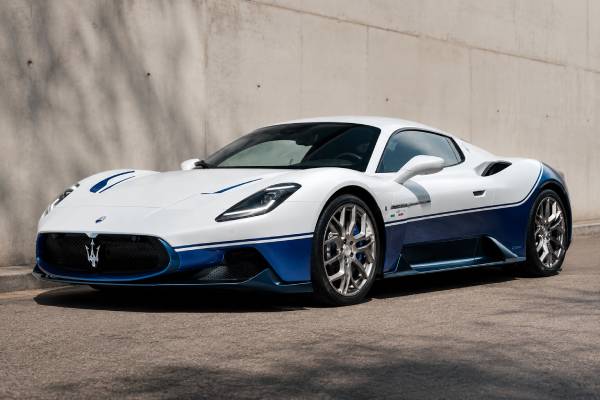
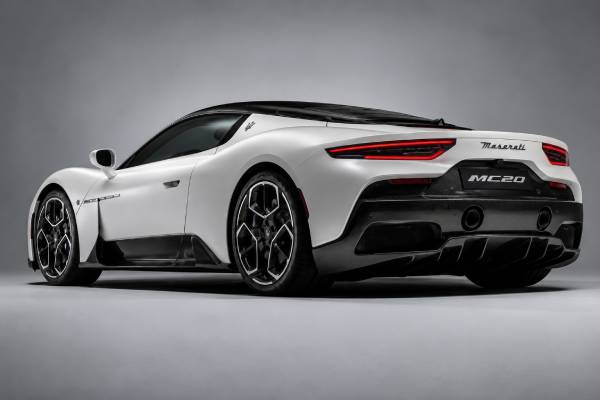
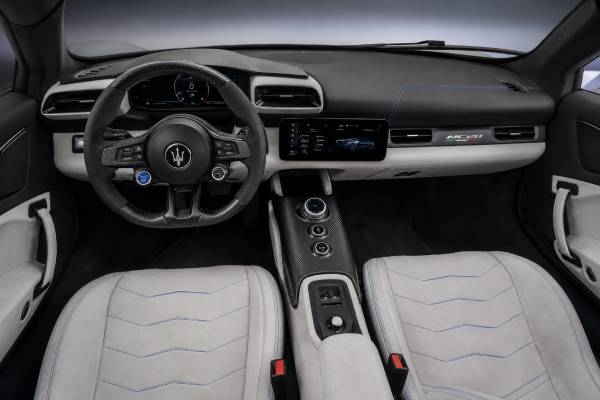
The 2024 Maserati MC20 Icona is a 20-car Fuoriserie special series created to celebrate two decades since the MC12 returned Maserati to the supercar and international racing stage. Icona takes its visual direction from the road-going MC12 Stradale: Bianco Audace Matte bodywork, Blu Stradale graphics, chrome-finished wheels, blue brake calipers, and a black-and-blue competition-style cabin. It retains the production MC20’s carbon-fiber monocoque, 630-CV Nettuno twin-turbo V6, eight-speed dual-clutch transmission, and rear-wheel-drive layout.
The car is mechanically familiar but historically specific. Its value depends not only on performance and mileage but also on the survival of its matte finish, original graphics, numbered engine-bay badge, lightweight seats, carbon details, and complete documentation. With only 20 examples, cosmetic recreation cannot substitute for factory identity. The right inspection must therefore combine normal MC20 checks—carbon structure, transmission, brakes, tires, electronics, and campaign status—with a detailed authenticity review. This guide explains the Icona’s origin, technical specification, production content, design, driving character, maintenance needs, and the buying strategy appropriate to such a rare model.
Table of Contents
- From MC12 Stradale to MC20 Icona
- Nettuno V6, Carbon Tub, and Key Specs
- Twenty-Car Build and Factory Content
- Bianco Audace, Blu Stradale, and Cabin Details
- Road and Track Behavior
- Maintenance, Matte Paint, and Known Campaigns
- Authenticating and Buying an Icona
From MC12 Stradale to MC20 Icona
The MC20 Icona was designed as a direct visual tribute to the MC12 Stradale, the homologated road car that accompanied Maserati’s 2004 return to top-level GT competition. Maserati limited the Icona to 20 cars, matching the 20th-anniversary theme announced in 2024.
The MC12 was a major turning point. Maserati had been absent from factory-backed international racing for 37 years before its return in 2004. The long, wide MC12 road car gave the program a homologation foundation, while the GT1 version developed into one of the era’s most successful grand tourers. Between 2004 and 2010, the MC12 GT1 program accumulated 27 FIA GT victories, three Spa 24 Hours wins, six teams’ titles, five drivers’ titles, and two constructors’ championships.
Icona does not copy the MC12’s body. The earlier car used a very long tail, a roof scoop, a fixed rear wing, and a naturally aspirated V12. The MC20 is shorter, turbocharged, and shaped around a new carbon tub. Maserati instead carried the road-going MC12’s most recognizable color relationship into the current car: a light matte body with strong blue sections and stripes.
The name “Icona,” meaning icon, identifies the road-car side of the anniversary pair. Its sister model, MC20 Leggenda, celebrates the black-and-green Vitaphone MC12 GT1 race cars. This distinction is important when authenticating either edition. Icona should have the white-and-blue Stradale theme and its specified interior details; black and Digital Mint belong to Leggenda.
The 2024 launch also placed Icona within Maserati Fuoriserie, the factory personalization program. Fuoriserie can create one-off color and trim combinations, but Icona remains a defined special series rather than an owner-designed standard MC20. Its limited badge, prescribed livery, and grouped equipment make it a recognized model with a fixed production ceiling.
Mechanically, Maserati claimed no power increase. An authentic Icona does not require modified engine software, an aftermarket exhaust, or altered suspension.
The anniversary story gives the car collector significance, but it does not eliminate the need to assess it as a functioning supercar. A well-preserved livery on a poorly maintained chassis is not a good Icona, and a perfectly serviced standard MC20 cannot become one through paintwork. The most desirable example satisfies both sides of the model’s identity.
Nettuno V6, Carbon Tub, and Key Specs
The Icona uses the regular MC20 coupe’s 2,992 cc Nettuno V6, rated at 630 CV and 730 Nm. An eight-speed dual-clutch transmission sends power to the rear wheels, while the carbon-fiber monocoque keeps dry weight below roughly 1,500 kg depending on equipment.
| Specification | 2024 MC20 Icona |
|---|---|
| Engine | 2,992 cc, 90-degree, twin-turbocharged V6 |
| Power | 630 CV (approximately 621 hp) at 7,500 rpm |
| Torque | 730 Nm from approximately 3,000 rpm |
| Transmission | Eight-speed dual-clutch transaxle |
| Drive | Rear-wheel drive with electronic limited-slip differential |
| Structure | Carbon-fiber monocoque and aluminum subframes |
| Suspension | Double wishbones with adaptive dampers |
| Claimed 0–100 km/h | Less than 2.9 seconds |
| Claimed top speed | More than 325 km/h |
| Typical dry weight | Approximately 1,475 kg, specification dependent |
Nettuno’s signature technology is its pre-chamber combustion arrangement. Each cylinder has a small chamber containing a spark plug above the main chamber. Flame jets pass through small openings and promote fast combustion when conditions require it. A second spark plug operates in the main chamber. Maserati combines this system with direct and port fuel injection, dry-sump lubrication, two turbochargers, and variable valve control.
The engine’s broad torque band gives the MC20 strong acceleration before the 7,500-rpm power peak. Dry-sump lubrication supports oil control during high lateral and longitudinal loads and allows tight packaging. It also requires the correct oil and level-check routine. A technician should follow the factory procedure rather than checking it like a conventional wet-sump engine.
The dual-clutch gearbox is mounted behind the engine. It can shift automatically or respond to the fixed steering-column paddles. Wet, GT, Sport, Corsa, and ESC Off modes alter throttle response, shift behavior, damper calibration, exhaust character, and electronic intervention. Launch control is available in the performance setting, but repeated use increases thermal and driveline loads.
The passenger cell is a one-piece carbon structure developed to provide high stiffness with low mass. Aluminum front and rear subframes carry suspension and powertrain components. This design supports precise handling and butterfly doors, yet it changes accident repair. Damage to a carbon tub cannot be evaluated or straightened by ordinary steel-body methods. Any collision history needs measurement, specialist imaging where appropriate, and evidence of approved repair.
Double-wishbone suspension is used at each corner. Adaptive dampers allow a more compliant road setup than the car’s shape suggests, while Corsa gives firmer body control. Large ventilated brakes are standard, and carbon-ceramic discs may be fitted. The Icona’s blue calipers are part of the visual package, so refinishing or replacement should match the original shade and markings.
Twenty-inch wheels use staggered tires, normally 245/35 ZR20 front and 305/30 ZR20 rear. Matching construction, correct load and speed ratings, Maserati homologation, and age matter more than tread depth alone. A mixed set can disturb steering feel and electronic-control behavior.
Twenty-Car Build and Factory Content
Maserati produced 20 MC20 Iconas, each identified by edition-specific content and a numbered engine-bay badge. A buyer must confirm the exact car’s original specification because the limited livery is only one part of the package.
The official exterior combines Bianco Audace Matte and Blu Stradale. A Fuoriserie logo appears in Bianco Audace near the rear wheel area, and an Italian flag is positioned below the MC20 lettering on the door. Chrome-finished Trident wheels carry silver hubcaps with a blue Trident, while blue brake calipers reinforce the MC12 Stradale connection. Auto-dimming exterior mirrors and a carbon-fiber engine cover were included in the announced specification.
Inside, the Icona uses four-way lightweight monocoque racing seats. Their black-and-blue upholstery sits over a silver-colored seat shell or backing, and “Icona” with the Trident is embroidered into the headrests. A leather-and-carbon steering wheel, carbon-fiber paddle shifters, and the interior carbon package continue the theme. The numbered engine plate reads “ICONA. UNA DI 20,” meaning one of 20.
Maserati also announced equipment such as the Sonus faber sound system, electronic limited-slip differential, suspension lifter, blind-spot monitoring, rear cross-path assistance, and specific floor mats. Market packaging can vary, so the build sheet remains the authority. A missing feature should not be explained away without checking whether the individual chassis was originally configured differently.
Numbering deserves careful interpretation. A badge stating one of 20 confirms the intended series size but may not necessarily show a simple production sequence unless a separate number is present. Do not infer that the tenth car built must carry “10/20.” Photograph the badge, compare its typography and mounting with known originals, and ask Maserati to connect it to the VIN.
The production date, model year, warranty start, and registration date may not be identical. A 2024 series car could be registered later, particularly if it entered a collection or moved between countries. What matters is a coherent documentary chain that begins with the factory build and official sale.
Because the Icona uses distinctive but externally reproducible colors, cloned appearances are possible. A standard MC20 can be wrapped or painted in white and blue, fitted with chrome wheels, and given embroidered seats. Such a tribute may be attractive, but it is not one of the 20. Factory records and original invoices are decisive.
Completeness includes loose items. Confirm the two keys, owner documentation, service book or digital history, charger, tire-inflation equipment, covers, tools, sales literature, certificates, and any presentation pieces. Special-series buyers often store these separately, so their absence at a dealership may reflect poor handover rather than permanent loss; resolve it before purchase.
A modification history is equally important. Aftermarket exhausts, wheel spacers, suspension changes, engine tunes, paint protection, and replacement seats should be documented. Original parts should accompany the car. A reversible change is easier to accept when the edition components remain intact and the factory software can be restored.
Bianco Audace, Blu Stradale, and Cabin Details
The Icona’s design is defined by the contrast between matte Bianco Audace and Blu Stradale, supported by chrome wheels and blue cabin accents. Preserving the texture, boundaries, and factory placement of those elements is essential because the livery carries most of the model’s visual identity.
Matte paint behaves differently from conventional gloss. Local polishing can create a shiny patch, and aggressive stain removal can alter the surface permanently. Scratches cannot always be corrected by compounding. Repairs often require refinishing a larger panel so texture and color remain uniform. The blue graphics add another layer of difficulty because stripe width and position must align across complex carbon panels.
Inspect the car in soft daylight, not only under spotlights. Look along both sides for inconsistent sheen, overspray, tape edges, sanding marks, or graphics that change width at panel gaps. Compare the hood, front bumper, doors, roof, rear quarters, and rear deck with official images. Paint-protection-film edges should be clean and should not pull at the matte or blue boundaries.
The chrome wheels provide a bright contrast that is unusual on modern track-inspired cars. Check for curb damage, corrosion, incorrect refinishing, and mismatched center caps. A wheel can be structurally bent without obvious face damage, so vibration or excess balancing weight deserves investigation. The blue calipers should have consistent color and markings; heat-darkened paint may indicate substantial track use.
The MC20 body was designed to keep the upper surfaces visually simple while placing much of the aerodynamic work underneath. Cooling inlets, a flat floor, channels, and a rear diffuser manage air without a large fixed wing. The Icona graphics therefore remain clear rather than competing with added aero devices. An aftermarket wing or splitter changes both originality and aerodynamic balance.
Butterfly doors expose wide carbon sills and make the blue side graphics prominent. Check hinge action, gas struts, latch alignment, window indexing, wiring, and seals. The doors should remain raised securely and close without being dropped or forced. Scuffed sills and seat bolsters are common entry-wear areas even on low-mileage cars.
The lightweight seats fit the tribute’s racing theme but need a practical assessment. Confirm that both shells are undamaged, adjustment works, upholstery is original, and embroidery remains sharp. Replacement shells or retrimming may be difficult to match. A prospective owner should also verify personal fit because these seats may feel more restrictive than comfort-oriented alternatives.
Carbon interior trim should have even weave and finish. Clouding, lifting clearcoat, cracks around fasteners, or poorly fitted replacement panels reduce quality. Test the steering-wheel controls, paddles, screens, drive selector, climate control, cameras, and Sonus faber audio. The cabin is digitally integrated, and a cosmetic collector car can still carry expensive electronic faults.
Road and Track Behavior
The Icona drives like the standard 630-CV MC20 coupe, with very rapid acceleration, low mass, direct steering, and a surprisingly usable GT mode. Its special-series status changes the owner’s risk tolerance, not the fundamental performance.
From a cold start, the engine should settle cleanly without persistent smoke, metallic noise, or warning messages. In GT mode, the gearbox shifts early and the adaptive dampers allow reasonable compliance. The car remains wide and low, so the front lift, cameras, and careful positioning are important in cities and parking areas.
Acceleration builds with little delay once the turbos are active. The claimed sub-2.9-second sprint to 100 km/h requires launch control and favorable conditions, but ordinary overtaking already uses only a fraction of the available performance. The rear tires carry all propulsion, making temperature and surface condition critical.
Sport mode sharpens the accelerator and keeps gears engaged longer. Corsa makes the gearbox and dampers more aggressive and loosens stability-control thresholds. Drivers should learn the car progressively because boost can create a fast change in rear-tire load. ESC Off belongs on a controlled course with appropriate experience.
Steering should feel immediate and accurate. The light nose changes direction quickly, and the stiff tub gives the suspension a stable base. A steering wheel that sits off-center, a pull under braking, or vibration at speed suggests alignment, wheel, tire, or repair issues. Wide front tires can follow road grooves, but behavior should remain predictable.
The brakes deliver strong deceleration. Iron discs can be entirely suitable for road use and are easier to budget for. Carbon-ceramic brakes offer greater heat capacity and lower unsprung mass, yet replacement cost is high and surface damage can be serious. Ask about track use and inspect discs, pads, cooling ducts, and fluid condition accordingly.
On a circuit, the MC20’s mid-engine balance and low mass make it capable, but preparation matters. Check wheel torque using official data, fit fresh approved tires, renew brake fluid when required, confirm oil level by the correct procedure, and inspect all underbody panels. After the session, look for debris damage, fluid leaks, tire pickup, overheated pads, and wheel-barrel marks.
The Icona’s matte white finish is vulnerable to rubber, insects, fuel stains, and hot debris. Blue graphics and chrome wheels are also difficult to restore perfectly. Protective film may be worthwhile when correctly installed, but it should be documented and inspected for adhesive marks or edge lifting.
A road test during purchase does not need full-throttle launches. It should evaluate cold behavior, low-speed clutch engagement, automatic and manual shifts, steering center, damper changes, brake consistency, temperature stability, and warning-free operation. A healthy car proves itself through smoothness and consistency before maximum speed is considered.
Maintenance, Matte Paint, and Known Campaigns
The Icona follows the MC20’s mechanical maintenance requirements, while its matte livery and low production add preservation tasks. Service should remain time-based as well as mileage-based, and every applicable recall or campaign should be confirmed by VIN.
Official maintenance programs list items such as engine oil and filter, air and pollen filters, spark plugs, belts, inspections, transmission filters, and certain battery or telematics components at specified intervals. Exact content differs by country and service package. Use the owner documentation and dealer system for the individual chassis.
The dry-sump engine needs approved oil and a precise level check. Keep invoices that identify the oil specification and quantity. A vague “oil service” entry is less useful on a collector car than a detailed record showing date, mileage, parts, and diagnostic findings.
Cooling and intake systems should be inspected for leaks, loose connections, debris, and damage. Early MC20-family service activity has included selected checks involving hoses, cooling plumbing, and control software. These actions were not universal, so a service center should search the VIN rather than replacing parts based on internet lists.
The dual-clutch gearbox should engage smoothly and shift without flare, harsh impact, or repeated warnings. Fluid and filter procedures require correct temperature and diagnostic equipment. Software updates may improve operation, but the work order should record the original complaint and installed version.
Battery voltage is a frequent source of confusing faults in low-use exotics. Maintain the car with an appropriate charger, test battery capacity, and scan all modules after a low-voltage event. Doors, windows, cameras, infotainment, dampers, differential, and transmission can all report secondary errors when supply voltage falls.
Check public recall databases and the Maserati network. MC20 vehicles in different markets have had actions involving tire-information labels, rear-camera software, selected door or body checks, and other VIN-specific matters. Imported cars may need confirmation from both the original and current market. Keep proof of completion in the history file.
Tires should be replaced for age, damage, repair quality, or mismatch even if tread remains. Examine inner shoulders and date codes. Store the car at correct pressures, avoid long periods on damp floors, and move it enough to reduce flat spotting. Brief idling is not a substitute for bringing the engine and fluids fully to temperature during a suitable drive.
Matte paint should be hand washed with compatible products. Do not wax or machine-polish it unless Maserati’s finish instructions explicitly permit the product and method. Bird droppings, insects, fuel, and oily residue should be removed promptly without rubbing. Use a specialist for paint protection, repair, or graphic replacement, and photograph the surface before and after work.
Authenticating and Buying an Icona
Buy an Icona only after Maserati or a qualified marque specialist confirms its VIN, build specification, limited-series identity, and numbered components. The inspection should then prove that the carbon structure, powertrain, livery, interior, and electronics remain in condition consistent with the price.
Request the factory build sheet, original invoice, warranty-start data, service history, campaign completion, ownership chain, and photographs from delivery. Check that the car is described consistently as MC20 Icona and that the paperwork supports a 2024 special-series build. For an import, add export, customs, and registration records.
Verify all exterior identifiers: Bianco Audace Matte, Blu Stradale graphic placement, Fuoriserie marking near the rear wheel, Italian flag below the door’s MC20 lettering, chrome wheels, blue-center Trident details, blue calipers, and carbon engine cover. Confirm the “ICONA. UNA DI 20” badge and record its appearance without removing or damaging it.
Inside, inspect the black-and-blue lightweight seats with silver backing, Icona and Trident headrest embroidery, carbon steering wheel, paddles, trim package, mats, and audio equipment. Compare every component with the build sheet. A retrim can look excellent while still reducing originality.
A specialist body assessment should inspect the tub, bonded structures, aluminum subframes, suspension pick-up points, floors, jacking areas, and undertrays. Ask for pre-repair photographs and measurements if any accident is disclosed. Carbon repairs require proof of method, materials, and competence.
Scan the full vehicle before and after a road test. Do not accept recently cleared readiness monitors or an unexplained absence of history codes. Check battery health, roofless coupe seals, door indexing, front lift, cameras, air conditioning, infotainment, drive modes, adaptive dampers, electronic differential, and both keys.
Review consumables in monetary terms. Four correct tires, iron or ceramic brakes, annual service, battery, alignment, paint-film work, or a damaged wheel can alter the effective purchase price. Obtain written estimates for faults rather than negotiating from assumptions.
Mileage is only one measure. A static collection car may have old tires, dried seals, corroded brakes, and incomplete campaigns. A moderately driven example may be healthier if serviced correctly and protected from damage. Favor evidence over a low odometer.
Insurance and valuation should identify the car as one of 20, not as a standard MC20 with optional paint. Agree on how the limited status will be documented after a total loss. Transporters and workshops should understand the lift points, door clearance, ride height, and matte-finish handling requirements.
The strongest purchase is a complete, unmodified car with verifiable factory identity, continuous service, undamaged edition components, and no unresolved diagnostic or structural questions. Scarcity may limit choice, but it should never replace due diligence.
References
- MC20 Icona & MC20 Leggenda: two special series to celebrate the 20th anniversary of the timeless MC12 | Maserati Corse | Stellantis Media (2024, official press release)
- MC20 Special Series: Icona & Leggenda | Maserati (2024, official design details)
- Maserati MC20 – Model Overview: Info, Performance, Design | Maserati (accessed 2026, official specifications)
- Vehicle Detail Search – 2024 MASERATI MC20 | NHTSA (accessed 2026, recall information)
- MC20 Prepaid Maintenance programs | Maserati US (accessed 2026, official maintenance scope)
Disclaimer
This article is for general informational and educational use and is not a substitute for professional diagnosis, repair, structural assessment, or valuation. Specifications, torque values, intervals, procedures, software, recalls, and equipment can vary by VIN, market, production date, and options. Verify all technical work and purchase decisions using current official Maserati service documentation and qualified specialists. Share this guide with other MC20 owners and collectors who may find it helpful.