
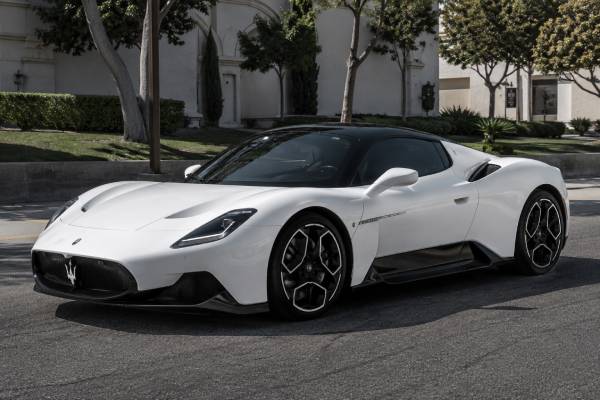
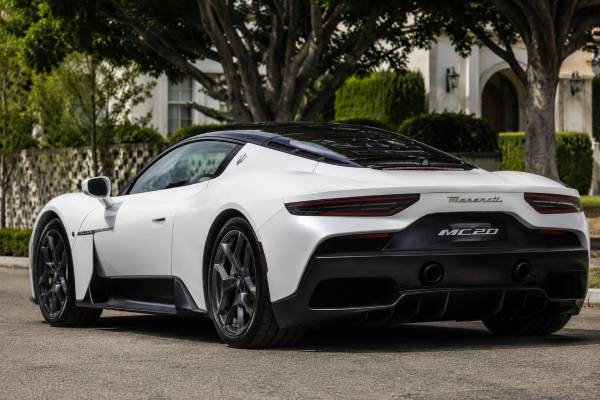
The Maserati MC20 launched in 2020 as the model that reset the company’s modern performance direction. Designed and built in Modena, it introduced the 3.0-liter Nettuno twin-turbo V6, a roughly 100-kg carbon-fiber monocoque, butterfly doors, and a clean mid-engine body developed with extensive aerodynamic work. Maserati rated the engine at 630 CV and 730 Nm, enough for a claimed 0–100 km/h time below 2.9 seconds and a top speed above 325 km/h. Production road cars reached customers after the reveal and continued through the 2025 model year before the evolved MCPURA took over the halo-car role.
The MC20 combines supercar speed with a more restrained appearance and usable GT mode, but it remains a complex low-volume machine. A proper ownership plan must account for dry-sump servicing, dual-clutch transmission care, wide performance tires, expensive brake choices, carbon-structure inspection, software campaigns, and battery management. Build specification also matters because carbon-ceramic brakes, suspension lift, carbon packages, seats, audio, and driver-assistance equipment can change both value and operating cost. This guide follows the coupe across its 2020–2025 lifecycle and explains what to verify before buying one.
Table of Contents
- How the MC20 Started a New Maserati Era
- Nettuno Engine, Transmission, and Chassis Specs
- Model Years, Options, and Special Versions
- Carbon Construction, Aerodynamics, and Packaging
- Performance, Driving Modes, and Road Use
- Reliability, Service, and VIN-Specific Actions
- Buying a Used MC20 Coupe
How the MC20 Started a New Maserati Era
The MC20 was Maserati’s first clean-sheet mid-engine road supercar in the modern era and the first production model to use the in-house Nettuno V6. Its 2020 debut signaled a return to lightweight, two-seat performance after years in which the range centered on grand tourers, sedans, and SUVs.
The name explains the program. “MC” stands for Maserati Corse, and “20” marks 2020, the reveal year. The initials also connect the car conceptually with the MC12, although the two vehicles share neither platform nor engine. The MC12 was a long V12 homologation special linked to GT1 racing; the MC20 was designed as a compact road supercar that could support future coupe, convertible, and competition derivatives.
Maserati developed the shape at Centro Stile and engineered the aerodynamics with substantial computational work, wind-tunnel testing, and collaboration with Dallara. The design separates an elegant upper body from a technical underside. Cooling openings, underfloor channels, a central floor “hump,” and a rear diffuser generate stability while allowing the top surfaces to remain free of a large fixed wing.
The carbon monocoque was planned from the beginning for more than one body style. The coupe version prioritizes low mass, while the later Cielo changes carbon layup to maintain stiffness without a fixed roof. That early planning helps explain why the coupe’s structure feels unusually rigid and why the platform could later support GT2 racing and the road-legal GT2 Stradale.
Production is centered at Maserati’s historic Viale Ciro Menotti plant in Modena, where Nettuno engines are also built. The “100% made in Modena” message became part of the car’s identity. This matters to collectors because the MC20 represents not merely a fast model but an attempt to rebuild Maserati’s engineering and manufacturing center around a halo product.
The assignment covers 2020 through 2025. The first year refers primarily to launch and specification, while customer cars are more commonly registered from 2021 onward depending on market. Across the run, the core 630-CV drivetrain and basic body remained stable. Changes were more likely to involve software, option availability, colors, packages, market equipment, and limited editions than major mechanical redesign.
Several derivatives appeared before the MC20 name gave way to MCPURA in 2025. The Cielo added a retractable glass roof in 2022. Notte, Icona, and Leggenda used special liveries and limited production. The GT2 race car led to GT2 Stradale. Those models broaden the family but do not make an ordinary MC20 less important: the original coupe established every major engineering theme.
Nettuno Engine, Transmission, and Chassis Specs
The MC20 uses a mid-mounted 2,992 cc, 90-degree twin-turbo V6 rated at 630 CV and 730 Nm. An eight-speed dual-clutch transaxle drives the rear wheels, and the complete car weighs less than 1,500 kg in Maserati’s quoted dry specification.
| Specification | MC20 Coupe |
|---|---|
| Engine | 2,992 cc twin-turbocharged 90-degree V6 |
| Bore and stroke | 88 mm × 82 mm |
| Compression ratio | 11:1 |
| Power | 630 CV at 7,500 rpm |
| Torque | 730 Nm at approximately 3,000–5,500 rpm |
| Transmission | Eight-speed dual-clutch |
| Drive | Rear-wheel drive |
| Claimed 0–100 km/h | Less than 2.9 seconds |
| Claimed 0–200 km/h | Less than 8.8 seconds |
| Claimed top speed | More than 325 km/h |
| Wheelbase | 2,700 mm |
| Fuel capacity | 60 liters |
Nettuno’s distinguishing feature is Maserati Twin Combustion. A small pre-chamber above each main combustion chamber has its own spark plug and communicates through precisely formed holes. Under suitable load, ignition in that chamber sends flame jets into the cylinder. A second conventional spark plug supports operation where the pre-chamber is unnecessary. The engine also combines 350-bar direct injection with lower-pressure port injection.
Two electronically controlled turbochargers supply boost, and dry-sump lubrication protects oil delivery during sustained acceleration, braking, and cornering. The external oil tank and scavenge pumps require a model-specific level check. Oil type, temperature, engine-running sequence, and measurement procedure should come from current service literature.
The dual-clutch gearbox uses eight forward ratios. Its lower gears support strong acceleration, while seventh and eighth reduce engine speed during cruising. The driver can leave it in automatic mode or shift with large fixed paddles. An electronic limited-slip differential helps distribute torque across the rear axle.
The carbon passenger cell weighs about 100 kg. Aluminum subframes carry the suspension, crash structures, engine, and transmission. Weight distribution is approximately 41 percent front and 59 percent rear. Double-wishbone suspension with a virtual steering-axis design is used at both ends, with adaptive dampers and an optional nose-lift system.
Standard brakes use 380 × 34 mm front discs with six-piston calipers and 350 × 27 mm rear discs with four-piston calipers. Optional carbon-ceramic brakes increase disc size to approximately 390 × 36 mm front and 360 × 28 mm rear. The road tires are usually 245/35 R20 front and 305/30 R20 rear.
Dimensions are compact by modern supercar standards: about 4,669 mm long, 2,700 mm between the axles, and 1,224 mm high. Width is approximately 1,965 mm without mirrors and 2,178 mm with them. Luggage volume is split between roughly 50 liters in front and 100 liters at the rear.
Model Years, Options, and Special Versions
The 2020–2025 MC20 coupe changed more through equipment, software, colors, and special series than through basic mechanical redesign. Buyers should identify the exact model year and build sheet rather than assume every car has the same brakes, seats, lift system, carbon content, or driver aids.
The 2020 reveal established the core specification. Early customer deliveries followed, with timing varying by country and supply conditions. Early cars are historically appealing but warrant careful confirmation that all factory campaigns and updates have been completed. Later examples may benefit from accumulated software revisions and more option combinations, though they can still have VIN-specific actions.
Common equipment choices include iron or carbon-ceramic brakes, suspension lift, carbon-fiber exterior and interior packages, different wheel finishes, comfort or lightweight seats, Sonus faber audio, and driver-assistance features. Fuoriserie added a wide range of colors and trim. A high original sticker price does not automatically make a configuration desirable; condition and coherent specification matter more.
The 2023 MC20 Notte was the first limited MC20 series, with 50 cars in Nero Essenza Matte, Matte White Gold details, dark wheels, and a black-and-gray Alcantara cabin. In 2024, Icona and Leggenda were each limited to 20. Icona referenced the MC12 Stradale in white and blue, while Leggenda used black and Digital Mint to recall the Vitaphone MC12 GT1.
One-off Fuoriserie commissions also exist. Their value depends on documented factory origin and the quality of the specification. A custom-painted or wrapped standard car should not be confused with an official one-off merely because it is unusual.
The Cielo, launched in 2022, is structurally related but has its own retractable electrochromic glass roof, different weight, and slightly lower maximum-speed claim. It should be evaluated as a separate variant rather than treated as a removable-roof option for the coupe.
The competition program created the Maserati GT2, followed by GT2 Stradale. Those cars use more aggressive aerodynamics, reduced mass, and a 640-CV calibration. A standard MC20 modified with a wing, exhaust, springs, and tune is not equivalent. Such changes may upset aerodynamic balance, emissions compliance, warranty status, and resale.
By 2025, Maserati introduced MCPURA as the aesthetic and material evolution of MC20. The original MC20’s lifecycle therefore closes with a clear place in history. It is the first Nettuno road car and the foundation for the family. For buyers, the final year can offer newer age and remaining coverage, while an early car can carry stronger launch significance.
Carbon Construction, Aerodynamics, and Packaging
The MC20’s key engineering advantage is the combination of a stiff carbon monocoque with an aerodynamically active underside and a simple upper body. That construction improves performance but makes collision inspection and repair quality critical.
The monocoque forms the cabin, door openings, sills, windshield base, and primary structural cell. Composite materials can be very strong in their intended load paths but may delaminate or crack after impact. Damage is not always visible from the painted surface. An accident assessment should include dimensional checks, inspection of bonded areas and mounting points, and specialist evaluation rather than a generic body-shop opinion.
Front and rear aluminum subframes are replaceable assemblies, but their deformation can reveal impact forces transmitted toward the tub. Check suspension pick-up points, fasteners, seam material, undertrays, jacking locations, and crash structures. A repaired bumper is less concerning than unexplained work around the monocoque.
Aerodynamic development focused heavily on the floor. The raised central section manages flow toward vortex generators and channels behind the front wheels. Air exits and underbody shaping help produce front load, while a large diffuser manages the rear. Cooling air reaches radiators and the engine through openings integrated into the body rather than decorative vents.
The lack of a large wing gives the car a timeless appearance and improves rear visibility, but it also means damaged or missing underbody panels can affect aero performance. Inspect fasteners, sealing strips, splitter edges, diffuser vanes, and flat-floor sections. Improvised repairs or absent panels are not merely cosmetic.
Butterfly doors provide access across wide carbon sills. They should rise smoothly, stay open, and close without force. The windows drop slightly during operation, so battery health, indexing, seals, hinges, gas struts, latches, and wiring are interconnected. Water leaks, wind noise, or uneven gaps can indicate adjustment or repair issues.
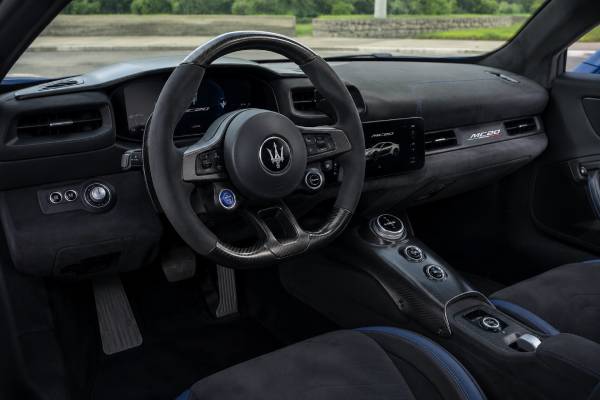
The cabin is minimal for a modern supercar. A 10.25-inch digital cluster and similar-size central screen handle information and controls. The drive-mode selector sits on the center tunnel, and the fixed paddles remain easy to find while steering. Materials range from leather and Alcantara to exposed carbon, depending on build.
Practicality consists of two small luggage compartments, usable climate control, phone connectivity, and available audio and assistance systems. Heat in the rear compartment can make it unsuitable for delicate items. The low splitter and wide body require planning in garages, car parks, and narrow roads.
Performance, Driving Modes, and Road Use
The MC20 is extremely fast but more approachable in GT mode than its numbers imply. Its character changes substantially through Wet, GT, Sport, Corsa, and ESC Off settings, so a driver can separate routine travel from maximum-response operation.
GT mode softens throttle and damper responses and lets the gearbox select higher ratios. Low-speed clutch take-up should be controlled, although dual-clutch behavior is not identical to a torque-converter automatic. Shudder, repeated hesitation, or harsh engagement once warm needs diagnosis.
Wet mode reduces the likelihood of abrupt rear-wheel slip. It is useful in rain, cold weather, or on unfamiliar tires. The system cannot create grip, and 730 Nm can still overcome the rear contact patches. Tire temperature, age, pressure, and standing water remain decisive.
Sport mode wakes the drivetrain, holds gears longer, and gives the car a more immediate response. Corsa further sharpens shifts and damper control, changes stability thresholds, and enables launch control. ESC Off should be used only in a controlled environment by a driver prepared to manage a mid-engine, high-torque car without the normal safety margin.
The steering is quick and accurate. A healthy car should track straight and load consistently through a corner. Tramlining on poor pavement can be normal with wide tires, but a crooked wheel, pull, or vibration suggests alignment, tire, wheel, bushing, or repair problems.
Acceleration is forceful from the midrange and continues toward the 8,000-rpm limit. The official 0–100 km/h and 0–200 km/h figures require proper conditions, launch control, and a prepared surface. Repeated launch demonstrations are unnecessary during inspection and add heat to the clutch, transmission, tires, and differential.
Brakes should provide a firm pedal and stable stopping. Iron discs may develop light storage corrosion; carbon-ceramics can make low-speed noise but should not show serious surface damage. Assess ceramic wear with specialist methods because replacement cost is high.
On track, check tire condition, oil level, brake fluid, pad thickness, wheel torque, coolant, and underbody security before use. Afterward, inspect the front body for debris damage, the wheel barrels for rubber or gravel impact, and all fluids for leakage. Track use is not automatically abuse if preparation and maintenance are documented.
The nose-lift system, when fitted, raises the front for obstacles. It should operate evenly and lower completely. Never rely on it to clear every ramp, and inspect the splitter and floor regardless of seller assurances.
Reliability, Service, and VIN-Specific Actions
MC20 reliability depends heavily on correct scheduled work, battery health, software status, and early response to leaks or warnings. There is no substitute for checking the exact VIN because recalls, campaigns, and technical updates vary by year and market.
Official prepaid-maintenance programs identify work such as engine oil and filter, air and pollen filters, spark plugs, belts, inspections, transmission filters, and selected battery or telematics items. Intervals differ by country and package. The owner’s manual and current dealer system take priority over a generalized online schedule.
The Nettuno engine should be inspected for oil or coolant residue, turbo plumbing concerns, unusual smoke, misfire, and evidence of repeated topping up. Early service activity in some markets included checks involving breather and coolant pipes. Those examples do not mean every car has the same defect; they show why campaign history matters.
Use approved engine oil and the dry-sump measurement method. Detailed invoices should state date, mileage, oil specification, filter, and findings. A low-use car still needs time-based service because oil, brake fluid, filters, and seals age.
The dual-clutch transmission should shift consistently in automatic and manual modes. Some vehicles have received transmission-control software updates or service campaigns. Adaptation values and stored codes should be interpreted by an experienced technician before parts are condemned.
The 12-volt battery supports many networked modules. Low voltage can trigger warnings for doors, windows, cameras, air conditioning, dampers, differential, transmission, and infotainment. An approved maintainer helps during storage, but battery capacity should be tested rather than assumed.
NHTSA and other market databases have listed VIN-specific MC20 actions involving matters such as tire-information labels, rearview-camera software, selected door-striker reinforcement, and various software or plumbing checks. Search the current national database and ask a Maserati retailer for the internal campaign printout. Keep completion records.
Tires often age before they wear out on collector cars. Check date codes, matching model, homologation marks, repairs, flat spots, and inner shoulders. Alignment should be measured after unusual wear or impact. Bent forged wheels may cause vibration even when cosmetic damage is minor.
Brakes, lift hydraulics, air conditioning, coolant circuits, and door mechanisms should be inspected at routine service. Clean debris from the front cooling openings carefully. Store the car dry, ventilated, and on correct tire pressures; avoid repeated short starts that never bring fluids to full temperature.
Buying a Used MC20 Coupe
The best used MC20 is the car with verified factory specification, continuous service, completed campaigns, healthy electronics, correct tires, and no unresolved carbon-structure questions. Mileage alone cannot establish condition.
Before viewing, request the VIN, build sheet, original invoice, service invoices, warranty and campaign history, tire dates, repair disclosure, and diagnostic reports. Confirm model year and market because registration date may differ from production. Check whether advertised options are actually present.
Inspect the body in neutral light. Look for paint mismatch, overspray, uneven panel gaps, changed fasteners, damaged exposed carbon, and paint-protection film hiding poor edges. Examine the nose, doors, rear quarters, engine cover, diffuser, floor, and jacking points. A specialist should evaluate any accident involving the tub or suspension mounts.
Start the car cold. Listen for abnormal mechanical noise, check smoke, watch the instrument self-test, and scan every module before clearing anything. Repeat the scan after driving. Recently erased faults, incomplete readiness information, or repeated communication codes need explanation.
Test both keys, doors, window indexing, front lift, climate control, cameras, parking sensors, infotainment, audio, seat functions, drive modes, dampers, paddles, lighting, and charging equipment. Inspect the cabin for water entry, worn carbon, damaged seat shells, and scuffed sills.
The road test should cover low-speed clutch engagement, smooth automatic shifts, manual operation, moderate boost, steering on several surfaces, controlled braking, and full warm-up. The car should not pull, vibrate, overheat, flare between gears, or produce persistent warnings. A maximum-speed test is neither necessary nor appropriate.
Price the consumables. Four correct tires, carbon-ceramic discs, pads, a battery, annual service, a damaged wheel, or paint-film replacement can create a large immediate bill. Obtain written estimates before negotiating.
Check modifications carefully. Exhausts, tunes, wheel spacers, lowering parts, and aero pieces can affect warranty, emissions, cooling, handling, and insurance. Original components and calibration should accompany reversible upgrades. An undocumented engine tune is a substantial risk on a low-volume powertrain.
For early cars, historical significance may offset age if records are excellent. Later cars may offer more remaining coverage and updated software. Special editions deserve separate authentication, but a thoughtfully optioned standard car can be the better driver’s purchase.
Complete the transaction with a written inspection report, verified title and lien status, and an agreement listing included accessories, original parts, and known repairs. Arrange transport with a carrier familiar with low ground clearance, butterfly doors, and correct tie-down points.
References
- Maserati MC20 – Model Overview: Info, Performance, Design | Maserati (accessed 2026, official specifications)
- MC20 | Maserati | Stellantis Media (2020–2025, official media archive)
- Vehicle Detail Search – 2022 MASERATI MC20 | NHTSA (accessed 2026, recalls and complaints)
- Vehicle Detail Search – 2024 MASERATI MC20 | NHTSA (accessed 2026, recalls and complaints)
- MC20 Prepaid Maintenance programs | Maserati US (accessed 2026, official maintenance scope)
Disclaimer
This article is for general informational and educational use and is not a substitute for professional diagnosis, repair, structural inspection, or legal advice. Specifications, torque values, intervals, procedures, software, recalls, and equipment can vary by VIN, market, model year, and installed options. Verify all technical work and purchase decisions using current official Maserati service documentation and qualified specialists. Share this guide with other MC20 owners and buyers who may find it useful.