
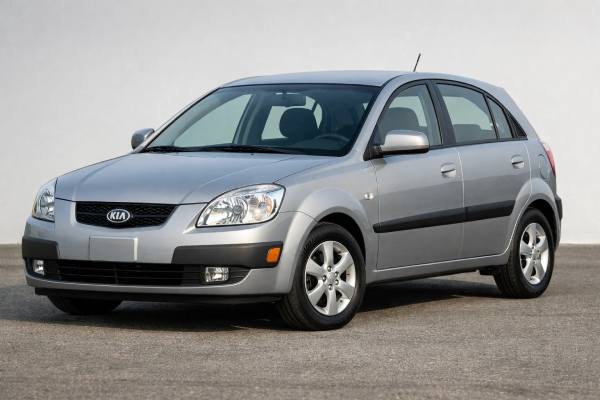
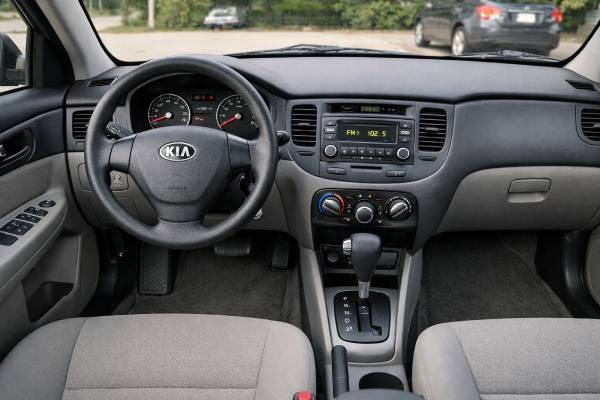
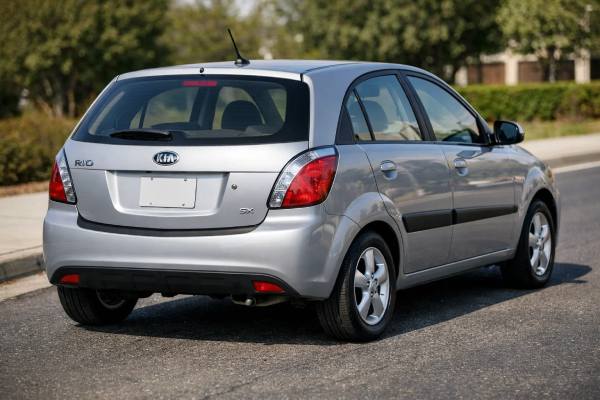
The 2005–2009 Kia Rio (JB) with the 1.6i 16V (112 hp) sits in a sweet spot for buyers who want simple, naturally aspirated engineering without the cost and complexity of later downsized turbo engines. It’s a lightweight supermini with straightforward front-wheel-drive packaging, a timing-belt DOHC four-cylinder, and parts that are usually affordable and widely available. In daily ownership, the Rio JB tends to reward routine fluids and rubber maintenance—especially cooling system condition, belts, and suspension wear items—more than it rewards “ignore it until it breaks” driving. The payoff is predictable running costs and an honest driving feel, with enough power for motorway merging when the car is healthy and correctly serviced. The key is buying on condition: a well-kept Rio JB can be a durable commuter, while a neglected one quickly becomes a chain of small repairs.
What to Know
- Simple, naturally aspirated 1.6 with good parts availability and generally low repair labor time.
- Light curb weight helps city drivability and keeps tyre and brake wear reasonable.
- Watch for rust protection gaps and underbody corrosion, especially in salted-winter regions.
- Change engine oil about every 10,000–15,000 km (6,000–9,000 mi) or 12 months, whichever comes first.
- Budget for a timing belt service on schedule; overdue belt work is the biggest “walk away” risk.
Quick navigation
- Kia Rio JB 1.6 facelift profile
- Kia Rio JB 1.6 specs and measurements
- Kia Rio JB 1.6 trims and safety gear
- Known weak points and recalls
- Service schedule and buyer advice
- Road manners and real economy
- Rivals and best alternatives
Kia Rio JB 1.6 facelift profile
The Kia Rio JB generation launched mid-2000s as a practical, budget-focused supermini offered in multiple body styles depending on market (commonly a 5-door hatch and a 4-door sedan). In 1.6i 16V form (112 hp), it’s the “sweet spot” engine for this platform: noticeably stronger than the smaller petrol options, but still simple—no turbocharger, no direct injection, and typically no complicated emissions hardware beyond the basics for the era.
From an engineering viewpoint, the Rio’s strengths come from restraint. The chassis is conventional: front strut suspension, a compact rear layout, and modest wheel and tyre sizes that keep costs low. The powertrain is equally straightforward: a belt-driven DOHC four-cylinder with multi-point fuel injection (in most markets), paired to a manual gearbox or a conventional automatic depending on region and year. It’s not a fast car, but it is “enough car”—especially when maintained so it can deliver its full output without misfires, vacuum leaks, or cooling-system weaknesses.
Ownership satisfaction tends to depend on three things:
- Maintenance history and timing-belt discipline. A Rio with documented belt work is a different proposition than one with unknown belt age.
- Rust exposure. Cars from salted roads need a careful underbody inspection; repairs can exceed the car’s value.
- Small-component condition. These cars often fail through many minor issues (bushings, sensors, hoses) rather than one dramatic failure.
If your goal is a low-cost commuter, a first car, or a simple second household vehicle, the Rio JB 1.6 works best when you treat it like an appliance that needs scheduled service. Do that, and it often delivers predictable running costs with a surprisingly usable cabin and easy parking manners.
Kia Rio JB 1.6 specs and measurements
Specs can vary by market, body style, and transmission, so the most useful approach is to list the typical ranges you’ll see on 2005–2009 1.6i 16V cars and highlight what changes with equipment.
Powertrain and efficiency
| Item | Typical spec (2005–2009 Rio JB 1.6i 16V) |
|---|---|
| Code | B6 / 1.6i 16V (market naming varies) |
| Engine layout and cylinders | Inline-4, DOHC, 16 valves (4 valves/cyl) |
| Bore × stroke | ~76.5 × 87.0 mm (3.01 × 3.43 in) |
| Displacement | 1.6 L (≈1599 cc) |
| Induction | Naturally aspirated |
| Fuel system | Typically MPFI |
| Compression ratio | ~10.0:1 (varies by market calibration) |
| Max power | 112 hp (82 kW) @ ~6,000 rpm |
| Max torque | ~145–150 Nm (107–111 lb-ft) @ ~4,500 rpm |
| Timing drive | Timing belt |
| Rated efficiency | Typically 6.5–8.0 L/100 km (35–29 mpg US / 43–35 mpg UK), depending on gearbox and body |
| Real-world highway @ 120 km/h | Often 7.0–8.5 L/100 km (34–28 mpg US / 40–33 mpg UK) when healthy, aligned, and on correct tyres |
Transmission and driveline
| Item | Typical spec |
|---|---|
| Transmission | 5-speed manual common; 4-speed automatic in some markets |
| Drive type | FWD |
| Differential | Open |
Chassis and dimensions
| Item | Typical spec (ranges reflect body/trim) |
|---|---|
| Suspension (front/rear) | MacPherson strut / torsion beam (typical for class) |
| Steering | Hydraulic power steering common; ratio varies |
| Brakes | Front discs; rear drums common (rear discs rare by market) |
| Wheels and tyres (popular sizes) | 175/70 R14 or 185/65 R14; some trims 195/55 R15 |
| Ground clearance | ~150–160 mm (5.9–6.3 in) |
| Length / width / height | ~3990–4240 / ~1695 / ~1470 mm (157–167 / 66.7 / 57.9 in) |
| Wheelbase | ~2500 mm (98.4 in) |
| Turning circle | ~10.0–10.4 m (32.8–34.1 ft) |
| Kerb weight | ~1050–1160 kg (2315–2557 lb) |
| Fuel tank | ~45 L (11.9 US gal / 9.9 UK gal) |
| Cargo volume | Often ~270 L seats up; ~1100+ L seats down (method varies) |
Performance and capability
| Metric | Typical result |
|---|---|
| 0–100 km/h (0–62 mph) | ~10.3–11.5 s (gearbox/body dependent) |
| Top speed | ~185–195 km/h (115–121 mph) |
| Braking 100–0 km/h | Commonly ~40–45 m (depends heavily on tyres and brake condition) |
| Towing capacity | Often not rated or low in some markets; if rated, check VIN plate and handbook |
| Payload | Typically ~400–500 kg (881–1102 lb) |
Fluids, service capacities, and key torques
| Item | Typical guidance (verify by VIN/market) |
|---|---|
| Engine oil | API SL/SM-era equivalent; 5W-30 or 5W-40 common; ~3.3–3.6 L (3.5–3.8 US qt) with filter |
| Coolant | Ethylene glycol long-life type; 50/50 mix; ~5–6 L (5.3–6.3 US qt) |
| Manual transmission | MTF/gear oil per spec; ~1.8–2.0 L (1.9–2.1 US qt) |
| Automatic transmission | ATF per spec; service approach varies; capacities depend on drain vs full fill |
| A/C refrigerant | Usually R134a; charge varies by system label |
| Wheel nuts | ~90–110 Nm (66–81 lb-ft) typical range |
| Spark plugs | ~20–25 Nm (15–18 lb-ft) typical range |
| Oil drain plug | ~25–35 Nm (18–26 lb-ft) typical range |
Use these tables as a planning baseline, but confirm exact capacities and torque values in the correct service documentation for your VIN. This matters most for transmissions and A/C charges, where “close” can still cause problems.
Kia Rio JB 1.6 trims and safety gear
Trim naming varies widely (LX/EX, base/mid/high, or local badge sets), so it’s more useful to think in terms of equipment clusters: basic commuter trims, comfort trims, and “top” trims with additional airbags and nicer wheels.
Trims and options that change ownership
What typically varies by trim on the 2005–2009 1.6i 16V:
- Transmission choice. Many markets paired the 1.6 with both manual and automatic options. The manual usually feels more responsive and can be cheaper to maintain long-term if the clutch and mounts are healthy.
- Wheels and tyres. Upgraded wheel sizes (often 15″) can improve steering response but may increase tyre cost and make pothole impacts harsher.
- Airbag count. Some cars are front-airbag only, while others add side airbags (and occasionally curtain airbags depending on market/year). This is one of the most important differences to confirm.
- ABS and stability control. ABS is common but not universal on early or base-market cars; stability control availability depends on region and year. Confirm by dash warning lights on ignition-on and by the presence of wheel-speed sensors and ABS pump hardware.
- Comfort equipment. A/C type (manual vs automatic climate), heated mirrors, fog lights, and audio upgrades are common differentiators.
Quick identifiers when inspecting
- Airbags: look for “SRS” tags on seat bolsters (side airbags) and headliner markings for curtains (if equipped).
- ABS: with ignition on, the ABS light should illuminate briefly then go out after start; persistent ABS light can mean sensor wiring or module faults.
- Factory wheel size: check the tyre placard and compare to fitted tyres; mismatched sizes can affect ABS behavior and fuel economy.
- Option packages: some markets used package codes; a dealer can sometimes decode by VIN even if badges are missing.
Safety ratings and what they mean
Because this car sits in the mid-2000s safety era, keep expectations realistic. Even when crash-tested well for its time, a small, light supermini typically offers less real-world protection than newer designs with more advanced structure, more airbags, and modern driver-assistance systems. When you read crash ratings, confirm:
- Test year and protocol version. Methods evolved; a “good” mid-2000s score does not equal a modern score.
- Body style and equipment. Side airbags can materially change side-impact outcomes.
- Tyre condition and brakes. For avoiding crashes, stopping distance and stability under emergency braking matter as much as the crash result itself.
Driver assistance (ADAS) reality check
Most Rio JB cars have no modern ADAS (no AEB, no adaptive cruise, no lane keeping). Safety relies on fundamentals: tyres, brakes, lighting, and driver attention. If you want a safer Rio JB, prioritize one with ABS, side airbags, and the best-condition tyres you can fit.
Known weak points and recalls
The Rio JB 1.6 tends to be more “many small issues” than “one catastrophic flaw,” but some items deserve special attention because they can strand the car or create expensive knock-on damage.
Common issues (high prevalence)
- Timing belt overdue (high severity).
Symptoms: unknown belt history, squeaks, cracked belt, no sticker or invoice proof.
Root cause: missed interval or age-based neglect.
Remedy: replace belt kit (belt, tensioner, idlers) and typically the water pump at the same time. Treat unknown history as overdue. - Ignition wear: coils, plugs, and leads (low–medium severity).
Symptoms: misfire under load, flashing MIL, rough idle, poor fuel economy.
Root cause: aged plugs, weak coils, moisture intrusion, or cracked boots.
Remedy: correct heat-range plugs, inspect coils and boots, fix oil leaks that contaminate plug wells. - Cooling system aging (medium severity).
Symptoms: temperature creep in traffic, coolant smell, low coolant, heater performance changes.
Root cause: thermostat sticking, radiator end-tank aging, hoses softening, cap not holding pressure.
Remedy: pressure test, replace suspect hoses, thermostat, and radiator as needed; use correct coolant mix. - Suspension bushings and drop links (low–medium severity).
Symptoms: clunks over bumps, vague steering, uneven tyre wear.
Root cause: rubber wear and pothole impacts.
Remedy: replace worn links/bushings, then align the car.
Occasional issues (medium prevalence)
- Crankshaft/camshaft position sensors.
Symptoms: intermittent no-start, stalling when hot, erratic tach.
Remedy: scan for codes, inspect wiring, replace sensor if confirmed. - Alternator and battery aging.
Symptoms: dimming lights, charging warning, slow crank.
Remedy: load test battery, verify alternator output under load. - Automatic transmission shift quality.
Symptoms: flare, delayed engagement, harsh shifts.
Root cause: aged fluid, wrong fluid type, neglected service.
Remedy: correct-spec fluid service strategy (drain/fill intervals rather than aggressive flushing on unknown history).
Rare but costly
- Severe rust and structural corrosion (high severity).
Symptoms: soft jacking points, flaky subframe areas, holes near suspension mounts, bubbling arches/sills.
Remedy: walk away unless you can verify professional repairs; rust can be a value-killer on this platform.
Recalls, service campaigns, and TSB-style guidance
Mid-2000s cars often have service actions that matter more today than when new. For the Rio JB, pay attention to:
- Corrosion-related service actions (underbody protection and inspection).
- Washer system updates (small parts, but annoying failures in winter).
- Transmission fluid guidance to ensure the correct ATF is used and serviced appropriately.
Always verify completion via dealer records and an official VIN lookup. A car with documented campaign completion and consistent servicing is worth paying extra for.
Service schedule and buyer advice
If you want the Rio JB 1.6 to stay inexpensive, treat maintenance as prevention. The car is tolerant, but it’s not forgiving of ignored basics like oil level, coolant condition, and belt age.
Practical maintenance schedule
Use this as a “real-world” plan; adjust for severe service (short trips, extreme heat/cold, dusty roads):
- Engine oil and filter: every 10,000–15,000 km (6,000–9,000 mi) or 12 months. Short-trip city cars do better on the shorter end.
- Air filter: inspect every oil change; replace about 20,000–30,000 km (12,000–18,000 mi) or sooner in dusty regions.
- Cabin filter (if fitted): every 15,000–30,000 km; more often if you drive in heavy traffic pollution.
- Spark plugs: typically 40,000–60,000 km (25,000–37,000 mi) depending on plug type; replace earlier if misfires occur.
- Coolant: every 4–5 years unless the official spec says longer; always change after major cooling repairs.
- Brake fluid: every 2 years; moisture buildup reduces braking performance and corrodes components.
- Manual gearbox oil: every 80,000–120,000 km (50,000–75,000 mi) if you want smooth shifting long-term.
- Automatic transmission fluid: conservative drain-and-fill intervals (often 50,000–80,000 km) are safer than aggressive flushing on unknown history.
- Timing belt kit: follow the manufacturer interval; if unknown, assume overdue. Replace tensioners and idlers with the belt.
- Aux belt(s) and hoses: inspect every oil service; replace at first cracking or glazing.
- Tyre rotation and alignment: rotate every 10,000–12,000 km, align if you see edge wear or after suspension work.
- 12 V battery: test yearly after 4 years of age; replace proactively around 5–6 years in cold climates.
Buyer checklist for a used Rio JB 1.6
Bring a flashlight and be picky:
- Timing belt proof: invoice or service sticker with date and mileage. No proof = budget for immediate belt service.
- Cold start behavior: should start quickly, idle smoothly, and not rattle excessively.
- Cooling system health: stable temperature, clean coolant, no oily residue in expansion tank.
- Rust inspection: check sills, rear arches, underbody seams, subframe areas, and brake/fuel line condition.
- Transmission feel: manual should shift cleanly; automatic should engage smoothly with no flare.
- Brakes and tyres: uneven tyre wear suggests alignment or worn bushings; soft pedal suggests fluid neglect.
- Electrical basics: charging voltage, lighting, wipers/washer operation, blower speeds.
Best ownership strategy
These cars do best with “small and steady” spending: fluids, belts, and rubber parts on time. If you keep it tight—no leaks, no misfires, good tyres—the Rio JB is usually a predictable, low-drama daily driver.
Road manners and real economy
With 112 hp and a relatively light body, the Rio JB 1.6 feels brisk in city traffic when it’s running correctly. It’s not a hot hatch, but it does respond well to a healthy ignition system and clean airflow. Many “slow Rio” complaints trace back to maintenance: tired plugs/coils, dragging brakes, underinflated tyres, or a sticky thermostat keeping the engine outside its ideal temperature range.
Ride, handling, and NVH
- Ride: generally compliant at low speeds, especially on 14″ tyres. Larger wheels can add harshness over sharp edges.
- Handling: safe and predictable. The rear torsion beam favors stability over rotation, so it tends to understeer when pushed.
- Steering: light and easy for parking; feedback is modest. If steering feels notchy or heavy, suspect alignment, tyre issues, or hydraulic assist problems.
- Noise: wind and tyre noise rise noticeably at motorway speeds compared with newer superminis. Worn door seals and budget tyres make it worse.
Powertrain character
- Throttle response: typically clean and linear. Hesitation often points to ignition wear, vacuum leaks, or dirty throttle body components.
- Midrange: the engine usually needs revs for best pull; it’s happier above ~3,000 rpm for overtakes.
- Manual gearbox: simple and generally durable; worn mounts can make shifts feel vague.
- Automatic: calm for commuting, but performance depends heavily on fluid condition and correct ATF specification. Expect slower kickdown and more noise under load than a modern multi-speed automatic.
Real-world economy expectations
Assuming correct tyres and no mechanical drag:
- City: often 7.5–9.5 L/100 km (31–25 mpg US / 38–30 mpg UK), depending on traffic and temperature.
- Highway (100–120 km/h): often 6.8–8.5 L/100 km (35–28 mpg US / 42–33 mpg UK).
- Mixed: commonly 7.0–8.5 L/100 km (34–28 mpg US / 40–33 mpg UK).
Cold weather typically increases consumption through richer warm-up fueling, higher rolling resistance, and heater use. If your Rio’s consumption is far worse than these bands, look for: stuck-open thermostat, low tyre pressure, dragging brakes, or misfires.
Performance metrics that change the verdict
The Rio JB 1.6 feels “right” when it:
- pulls cleanly in 3rd and 4th without hesitation,
- holds a straight line at motorway speed with no steering shimmy, and
- brakes confidently with a firm pedal.
If it can’t do those three things, the fix is often maintenance—not a fundamental flaw of the model.
Rivals and best alternatives
The Rio JB 1.6 competes with mid-2000s superminis that focus on low running costs. Your best choice depends on what you value most: reliability reputation, cabin space, rust resistance, or driving feel.
Where the Rio JB 1.6 stands out
- Simplicity: naturally aspirated petrol + conventional drivetrain is easy to service and diagnose.
- Value: purchase prices are often lower than segment “icons,” leaving budget for preventative maintenance.
- Usability: power is adequate for motorway work, especially with the manual gearbox.
Where rivals can be better
- Cabin packaging: some competitors offer more rear space and smarter storage.
- Refinement: noise levels and ride polish are typically better in newer or more premium rivals.
- Rust resistance: depending on region and care, some alternatives hold up better underneath.
How to choose between them in practice
Use this decision filter:
- Buy condition first, brand second. A rust-free Rio with records beats a neglected “better” model.
- If you drive mostly city: prioritize smooth clutch/gearbox, A/C performance, and tight suspension.
- If you drive motorway often: prioritize tyre quality, alignment, and evidence of cooling system care.
- If winters are salted: prioritize underbody condition and documented corrosion protection.
Best-fit buyer profiles
- Great fit: low-cost commuter, first-time owner willing to follow a schedule, DIY-friendly household.
- Not ideal: drivers who want modern ADAS safety, ultra-quiet cruising, or “zero maintenance” ownership.
In short, the Rio JB 1.6 is a sensible choice when you select the right example. Pay for history and corrosion-free structure, then keep up with fluids and belts. That’s how this car becomes inexpensive rather than merely cheap.
References
- AUTOMATIC TRANSMISSION FLUID APPLICATION GUIDE 2012 (TSB)
- QUESTIONS AND ANSWERS FOR VOLUNTARY SERVICE CAMPAIGN SC122 – UNDERBODY – ADDITIONAL ANTI-CORROSION TREATMENT 2014 (Service Campaign)
- WINDSHIELD WASHER PUMP INLET FILTER REPLACEMENT 2013 (TSB)
- Find and Compare Cars 2026 (Official Fuel Economy Database)
Disclaimer
This article is for informational purposes only and is not a substitute for professional inspection, diagnosis, or repair. Specifications, torque values, fluid capacities, and service intervals can vary by VIN, market, model year, and installed equipment—always verify details using the correct official service documentation for your exact vehicle.
If you found this guide useful, consider sharing it on Facebook or X to help others maintain and buy responsibly.