
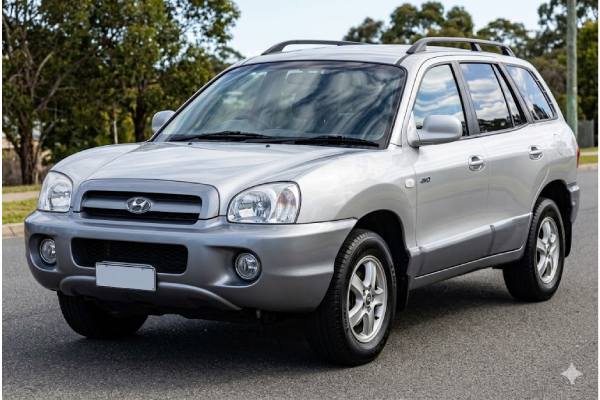
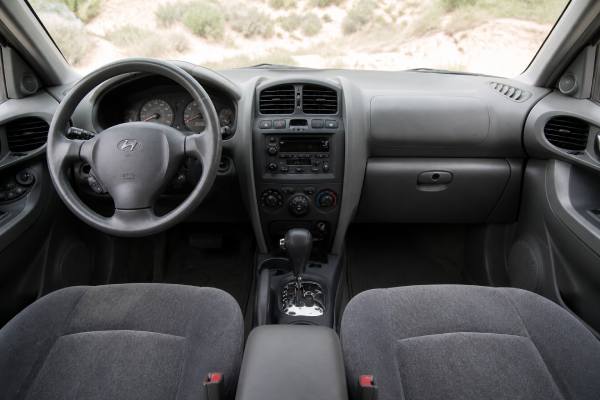
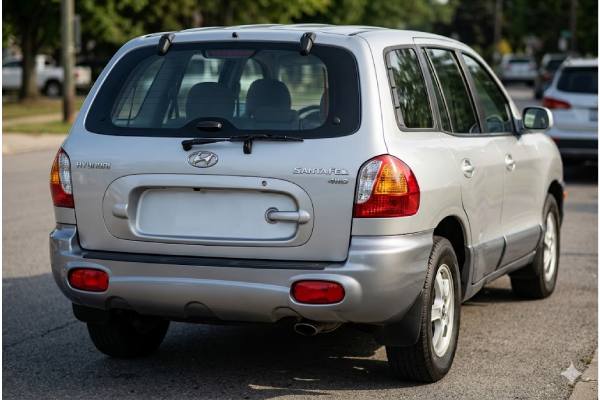
The 2004 Hyundai Santa Fe 4WD with the 3.5-liter V6 sits in an interesting place: it is an early car-based SUV with real all-weather usefulness, a stronger engine than the regular 2.4 and 2.7 models, and a simpler ownership profile than many newer crossovers. It is not a modern Santa Fe in refinement, safety technology, or fuel economy, but as a used vehicle it can still make sense when the structure is clean, the timing belt history is documented, and the 4WD system has been serviced properly.
This version is best understood as a practical five-seat SUV rather than a heavy-duty off-roader. Its strengths are comfort, visibility, cargo space, and winter-weather traction. Its main weaknesses are age-related corrosion, timing belt dependency, thirsty real-world fuel use, and the need to verify recall completion before purchase.
Quick Overview
- Strong 3.5-liter V6 gives the SM Santa Fe better highway passing and towing confidence than the smaller engines.
- On-demand 4WD improves wet-road and snow traction without driver switches or manual hubs.
- Check timing belt history carefully; replacement is typically due around 60,000 miles or 96,000 km, or by age.
- EPA-rated economy for the 3.5L 4WD automatic is about 15 mpg city, 19 mpg highway, and 17 mpg combined.
- Inspect front coil springs, brake lines, subframes, and rear suspension mounts closely on salt-belt vehicles.
Table of Contents
- Santa Fe SM Used Context
- Santa Fe SM Technical Specs
- Santa Fe SM Equipment and Safety
- Reliability Issues and Recalls
- Maintenance and Buying Advice
- Driving Feel and Efficiency
- Comparison With Period Rivals
Santa Fe SM Used Context
The 2004 Hyundai Santa Fe 4WD 3.5 V6 belongs to the first-generation Santa Fe, known by the SM platform code. In North American specification, it was a five-door, five-seat SUV built around a heavily revised passenger-car platform rather than a truck frame. That gives it a more settled ride and easier daily manners than body-on-frame SUVs of the same period, but it also means the Santa Fe should not be treated like a low-range 4×4.
The 3.5-liter V6 was the performance-focused version for 2004. Hyundai used the Sigma-series G6CU V6, a naturally aspirated, 24-valve DOHC engine shared in broad form with other Hyundai/Kia models of the era. Output was rated at 200 hp at 5,500 rpm and 219 lb-ft of torque at 3,500 rpm. The engine was paired with a five-speed Shiftronic automatic transmission rather than the four-speed automatic used with the smaller 2.7-liter V6.
The 4WD system is one of the key reasons this version matters. Unlike the mechanical 4WD arrangement associated with some earlier or smaller-engine models, the 3.5-liter 4WD Santa Fe used a BorgWarner-developed InterActive Torque Management system. In normal driving it behaves mostly like a front-drive vehicle, then sends torque rearward when wheel slip or driving conditions call for it. It does not have a low-range transfer case, locking differentials, or the ground clearance of a purpose-built trail vehicle.
For used buyers, the model’s appeal is straightforward. It has a roomy cabin for its exterior size, a simple control layout, a high seating position, and enough V6 power for highway use. The value equation depends heavily on condition. A well-maintained, rust-free example with proof of timing belt service can be a useful low-cost SUV. A neglected one can quickly become uneconomical because timing belt work, suspension repairs, brake hydraulics, exhaust leaks, and corrosion repairs can exceed the purchase price.
Market differences matter. Some non-U.S. SM Santa Fe versions used different engines, fuel tanks, tow ratings, transmissions, ride heights, and equipment. This article focuses on the 2004 model-year Santa Fe 4WD with the 3.5-liter V6 and five-speed automatic, especially the North American GLS and LX context where the 200 hp rating applies.
Santa Fe SM Technical Specs
Specifications for early-2000s Hyundai models can vary by market, trim, emissions package, and source. The figures below reflect the 2004 3.5L V6 4WD automatic configuration, with notes where official and market data differ.
| Item | 2004 Hyundai Santa Fe 4WD 3.5 V6 |
|---|---|
| Engine code | G6CU, Sigma-series V6 |
| Layout | Front transverse V6, 6 cylinders, DOHC, 24 valves, 4 valves per cylinder |
| Bore × stroke | 93.0 × 85.8 mm, 3.66 × 3.38 in |
| Displacement | 3.5 L, 3,497 cc |
| Induction | Naturally aspirated |
| Fuel system | Multi-point fuel injection |
| Compression ratio | About 10.0:1 |
| Maximum power | 200 hp, 149 kW, at 5,500 rpm |
| Maximum torque | 297 Nm, 219 lb-ft, at 3,500 rpm |
| Timing drive | Timing belt |
| Rated efficiency | 15 city / 19 highway / 17 combined mpg US; about 15.7 / 12.4 / 13.8 L/100 km |
| Real-world highway at 120 km/h / 75 mph | Typically about 12.5–14.5 L/100 km, or 16–19 mpg US, depending on tyres, load, terrain, and wind |
| Item | Specification |
|---|---|
| Transmission | 5-speed Shiftronic automatic, commonly associated with Hyundai/Kia A5-series applications |
| Drive type | On-demand 4WD / AWD with electronic clutch coupling |
| Differentials | Open front and rear differentials; no factory locking differential |
| Front suspension | MacPherson strut, coil spring, anti-roll bar |
| Rear suspension | Independent trailing-arm / multi-link layout with coil springs |
| Steering | Hydraulic power-assisted rack and pinion |
| Brakes | Four-wheel disc brakes; ABS fitted on 3.5L models in many North American trims |
| Popular tyre size | 225/70 R16 on 16-inch alloy wheels |
| Ground clearance | About 206 mm, 8.1 in, depending on market and tyre package |
| Approach / departure angles | About 28° / 26° in commonly listed specifications |
| Length / width / height | About 4,500 mm / 1,820–1,847 mm / 1,675 mm; 177.2 in / 71.7–72.7 in / 66.0 in |
| Wheelbase | 2,620 mm, 103.1 in |
| Turning circle | About 11.3 m, 37.1 ft |
| Curb weight | About 1,790 kg, 3,946 lb |
| GVWR | About 2,375–2,380 kg, 5,238 lb, depending on market label |
| Fuel tank | North American listings commonly show 72 L, 19.0 US gal, 15.8 UK gal; some non-U.S. data list 65 L |
| Cargo volume | About 864 L / 30.5 ft³ seats up and 2,200 L / 77.7 ft³ seats folded, SAE-style published volume |
| Item | Typical figure or note |
|---|---|
| 0–100 km/h / 0–62 mph | About 9–10 seconds when healthy, depending on trim, test method, and load |
| Top speed | About 180 km/h / 112 mph in many published specifications; theoretical estimates vary higher |
| 100–0 km/h braking distance | Not consistently factory-published; condition of tyres, pads, rotors, and ABS function matters more on used examples |
| Towing capacity | Commonly listed around 1,043–1,270 kg, 2,300–2,800 lb, for 4WD V6 depending on market and trailer equipment |
| Payload | About 586 kg, 1,292 lb, using common North American curb/GVWR figures |
| Engine oil | API SG or later-grade petrol engine oil; 5W-30, 5W-40, 10W-30, or 10W-40 depending on climate; about 4.3 L / 4.5 US qt with filter |
| Coolant | Ethylene-glycol coolant mixed about 50/50 with deionized water; about 8.2 L / 8.7 US qt listed for the 3.5L engine family |
| Automatic transmission fluid | Hyundai/Kia SP-III type ATF; total capacity commonly listed around 7.8 L / 8.2 US qt, with less replaced during a simple drain-and-fill |
| Transfer case / rear differential | Use the exact gear oil grade specified for the VIN and axle label; many service references list GL-5 gear oil for related SM AWD units |
| A/C refrigerant | R-134a; charge varies by market and compressor, so verify under-hood label before service |
| Key torque examples | Oil drain plug commonly listed around 39 Nm / 29 lb-ft; wheel lug torque should be verified from the owner’s manual or service data for the exact wheel |
| Crash ratings | IIHS: Good in original moderate overlap front test, Acceptable in original side test, Poor for head restraints and seats |
| ADAS | No modern AEB, ACC, lane keeping, blind-spot monitoring, or traffic-sign assist |
The most important technical takeaway is that the 3.5L Santa Fe is mechanically different from the 2.7L model in meaningful ways. It has more power, a five-speed automatic, and the electronic on-demand 4WD system. When buying parts, servicing the driveline, or comparing fuel economy, the exact engine and driveline matter.
Santa Fe SM Equipment and Safety
In the 2004 North American lineup, the 3.5-liter V6 was available mainly through GLS and LX configurations. The GLS was the value-oriented well-equipped trim, while the LX added more comfort and convenience equipment. Both could be found with the 3.5L V6 and 4WD, although used-market listings are often inconsistent, so a VIN check is more reliable than badge assumptions.
The quick identifiers are simple. A true 3.5L version should have the 3.5-liter V6 under the hood, the five-speed Shiftronic automatic, and—on the 4WD version—the electronic on-demand rear-drive coupling. Many 3.5L models also came with ABS and traction control, and Hyundai’s period material described ABS with electronic traction control as standard on 3.5-liter Santa Fe models. Exterior badges, alloy wheels, fog lamps, roof rack, leather seating on LX, heated front seats, automatic climate control, and Monsoon audio can help identify trim level, but they are not a substitute for verifying the VIN and build label.
Functional differences matter more than cosmetics. The 3.5L engine brings stronger acceleration and a different transmission. The 4WD system also changes service needs because the transfer case, rear differential, prop shaft, rear coupling, mounts, and rear axle components become part of the inspection list. A front-drive 3.5L can be cheaper to maintain, but it does not have the same poor-weather traction.
Safety equipment was respectable for its time but basic by modern standards. Dual front airbags and front seat-mounted side airbags were part of the period safety package, and the model used front belt pretensioners. Child-seat provisions include two rear outboard ISOFIX/LATCH anchor positions on many 2004 models. Stability control, curtain airbags, automatic emergency braking, lane support, adaptive cruise control, and blind-spot monitoring were not part of this generation’s safety technology package.
The IIHS results show the age of the design clearly. The Santa Fe performed well in the original moderate overlap front crash test, earning a Good overall rating for 2001–2006 models built after March 2001. In the original side test, 2002–2006 models built after March 2002 earned an Acceptable overall rating when equipped with the standard front seat-mounted head and torso airbags. The head restraints and seats rating was Poor, which is important for rear-impact whiplash protection.
For shoppers used to newer Santa Fe or Santa Cruz models, the contrast is large. Modern Hyundai products may include multi-airbag systems, stronger small-overlap structures, camera and radar assistance, and better headlight performance. The 2004 Santa Fe should be evaluated as an older SUV: structure, tyres, brakes, lighting, and seat-belt condition are more important than expecting modern driver-assistance features.
Reliability Issues and Recalls
The 2004 Santa Fe 3.5L can be durable when maintained, but age now matters as much as mileage. The strongest examples usually have complete timing belt documentation, clean underbody metal, smooth transmission shifts, dry engine seals, and proof that recalls were completed. The riskiest examples often look inexpensive because they need several deferred services at once.
| Issue area | Prevalence | Severity / cost tier | Typical signs |
|---|---|---|---|
| Timing belt, tensioners, idlers, water pump | Common maintenance risk | High if neglected | No service record, belt noise, coolant seepage, misfire after timing slip |
| Front coil spring corrosion | Common in salt regions | Medium to high | Broken spring, tyre rubbing, uneven ride height, clunking |
| Brake lines, fuel lines, subframes, rear suspension mounts | Common with age and road salt | Medium to high | Rust scaling, wet brake lines, soft pedal, MOT/state inspection failure |
| Automatic transmission wear | Occasional | Medium to high | Shift flare, delayed engagement, harsh 2–3 or 3–4 shifts, dark ATF |
| 4WD coupling, rear differential, mounts | Occasional | Medium | Binding, rear-end whine, vibration, clunk on takeoff |
| Oil leaks and valve-cover seepage | Common with age | Low to medium | Burning oil smell, wet covers, oil on exhaust area |
| Suspension bushings, ball joints, wheel bearings | Common on high-mileage vehicles | Low to medium | Knocking, wandering, tyre cupping, humming that changes with speed |
The timing belt is the first major reliability checkpoint. The 3.5L V6 is a belt-driven engine, and a neglected belt can lead to severe internal engine damage. A proper service should normally include the belt, tensioner, idlers, water pump, front cam/crank seals if leaking, accessory belts, and fresh coolant. A seller saying “the belt looks fine” is not the same as having a dated invoice.
The major recall to understand on 2003–2004 3.5L 4WD ABS Santa Fe models is the ABS electronic control unit reprogramming campaign. The issue involved possible unwanted ABS activation at low speeds in wet brake conditions, which could extend stopping distance. The remedy was an ABS ECU reprogramming. On a used vehicle, the correct action is not to assume it was done; check the VIN through an official recall tool and ask for dealer records.
Another important recall area is front coil spring corrosion. Certain 2001–2006 Santa Fe vehicles, especially those registered or operated in salt-belt states, were subject to a campaign involving inspection, replacement where necessary, and installation of a protective guide. This is not just a paperwork issue. A broken spring can contact a tyre, so visual inspection from underneath is essential.
Other age-related issues are less formal but still important. Look for coolant stains, oil seepage, exhaust corrosion, loose heat shields, power-steering leaks, weak alternators, failing oxygen sensors, misfires from ignition components, and brittle vacuum hoses. The 3.5L’s cast-iron block is robust, but any old V6 can become expensive if overheating, coolant neglect, or timing service neglect has been allowed.
Software and calibration concerns are limited compared with newer vehicles. There is no complex ADAS suite or battery management system to update. The key calibration-related item is the ABS recall reflash. Transmission control behavior should be assessed by road test rather than assumed fixable by software.
Maintenance and Buying Advice
A sensible maintenance plan for the 2004 Santa Fe 3.5L 4WD should be more conservative than the minimum schedule because most examples are now old enough for rubber, seals, hoses, and corrosion to matter. Mileage alone is not enough; time-based service is critical.
| Item | Practical interval | Notes |
|---|---|---|
| Engine oil and filter | 5,000–7,500 miles / 8,000–12,000 km, or 6–12 months | Use climate-appropriate viscosity and confirm level after refill. |
| Engine air filter | 15,000–30,000 miles / 24,000–48,000 km | Shorten interval in dust or unpaved-road use. |
| Cabin air filter | 12 months, if equipped | Some markets and trims vary; verify filter housing. |
| Timing belt kit | About 60,000 miles / 96,000 km, or by age | Replace belt, tensioner, idlers, water pump, and inspect seals. |
| Spark plugs | 60,000–100,000 miles / 96,000–160,000 km depending on plug type | Rear-bank access can add labor; replace intake gaskets as needed. |
| Coolant | Every 3–5 years | Use compatible ethylene-glycol coolant and correct mix. |
| Automatic transmission fluid | 30,000–60,000 miles / 48,000–96,000 km for used vehicles | Use SP-III type ATF; avoid universal fluid unless it explicitly meets the requirement. |
| Transfer case and rear differential oil | 30,000–60,000 miles / 48,000–96,000 km | Important on 4WD vehicles; check for leaks and metal debris. |
| Brake fluid | Every 2 years | Inspect brake lines carefully for corrosion. |
| Tyre rotation and alignment check | 5,000–7,500 miles / 8,000–12,000 km | Uneven wear can reveal worn bushings, bad alignment, or AWD mismatch. |
| 12 V battery | Test annually after 3 years | Weak voltage can cause starting and electrical complaints. |
A pre-purchase inspection should start underneath. The Santa Fe’s value depends heavily on structural condition, so inspect front spring seats, front subframe areas, rocker panels, rear suspension arms, rear trailing-arm mounts, brake pipes, fuel lines, exhaust hangers, and the lower radiator support. Surface rust is normal on many old SUVs, but flaking structural rust, swollen seams, patched brake lines, or soft mounting points are serious concerns.
On the road test, the 3.5L V6 should start cleanly, idle smoothly, and pull without hesitation. The five-speed automatic should engage Drive and Reverse promptly when warm, shift without flare, and kick down cleanly. During tight parking-lot turns, listen for drivetrain binding, clicking CV joints, rear coupling noise, or differential clunks. On a straight road, the vehicle should track without steering shake or brake pull.
The best examples to seek are stock, documented GLS or LX 3.5L 4WD models with clean underbodies, recent timing belt service, fresh ATF, matching tyres, working ABS, and no warning lights. Be cautious with cheap examples that have mismatched tyres, dark transmission fluid, overheating history, unknown timing belt age, or a failed inspection due to corrosion. At this age, the cheapest Santa Fe is rarely the least expensive one to own.
Driving Feel and Efficiency
The 2004 Santa Fe 3.5L 4WD feels like an early crossover: comfortable, upright, and easy to place, but not especially sharp. The ride is generally soft enough for broken pavement, and the independent rear suspension helps it feel more settled than many compact truck-based SUVs of the era. Body roll is present, steering feel is light, and quick direction changes remind you that the Santa Fe was tuned more for comfort and poor-weather confidence than for sport.
The 3.5L V6 is the right engine if the vehicle will be used on highways, hills, or with passengers and cargo. It does not feel modern-fast, but it has enough mid-range torque to avoid the strained feel common in smaller four-cylinder SUVs from the same period. Throttle response is smooth rather than urgent, and the five-speed automatic helps keep the engine calmer at speed than a four-speed would. A healthy transmission should shift unobtrusively in normal driving and respond without a long delay when asked to pass.
Noise levels are acceptable for the era. At city speed, the Santa Fe feels relaxed, with good visibility and easy parking for its size. At 70–75 mph, tyre noise, wind noise around the mirrors and roof rack, and engine revs become more noticeable than in newer Hyundai SUVs. Worn suspension bushings, cupped tyres, old engine mounts, or exhaust leaks can make an otherwise solid example feel much older, so condition affects refinement greatly.
The 4WD system works best as a traction aid. In rain, snow, gravel driveways, and slushy road conditions, it adds useful rear-axle assistance when the front tyres lose grip. It is not a substitute for winter tyres, and it should not be expected to crawl through deep mud or rocky trails. Matching tyre sizes and similar tread depths are important because mismatched rolling circumference can stress AWD components.
Fuel economy is the main daily-use drawback. The official revised EPA figure for the 3.5L 4WD automatic is 15 mpg city, 19 mpg highway, and 17 mpg combined. In real use, mixed driving often lands around 14–16 L/100 km, or roughly 15–17 mpg US. Gentle highway driving can do better, but cold weather, short trips, roof accessories, old oxygen sensors, dragging brakes, and underinflated tyres can push consumption noticeably higher.
Towing should be approached with restraint. The V6 has enough torque for a small trailer, but the Santa Fe’s wheelbase, cooling capacity, brakes, and age mean it is not a heavy tow vehicle. For any towing use, verify the market-specific tow rating, use the correct hitch, keep tongue weight within limits, service the ATF, inspect the cooling system, and avoid long climbs at full load in hot weather.
Comparison With Period Rivals
The 2004 Santa Fe 3.5L 4WD competed in a busy field that included the Toyota RAV4, Honda CR-V, Ford Escape/Mazda Tribute, Jeep Liberty, Subaru Forester, Mitsubishi Outlander, and larger alternatives such as the Toyota Highlander and Kia Sorento. Its personality sits between compact soft-roaders and heavier SUVs.
Compared with the Honda CR-V and Toyota RAV4 of the same period, the Santa Fe 3.5L offers stronger V6 power and a more substantial cabin feel. The Honda and Toyota usually have better fuel economy and stronger long-term resale reputations, but they can feel less powerful when loaded. The Santa Fe’s advantage is value: it often costs less to buy for the same model year and equipment level. The trade-off is that Hyundai parts support, corrosion condition, and deferred maintenance must be checked carefully.
Against the Ford Escape V6 and Mazda Tribute V6, the Hyundai feels similarly practical but often more softly tuned. The Escape can feel livelier, while the Santa Fe tends to favor comfort and a quieter powertrain character when maintained. Both need careful inspection for rust, transmission condition, and suspension wear.
Compared with the Jeep Liberty, the Santa Fe is more road-biased and more comfortable in daily use. The Liberty has greater off-road credibility when properly equipped, but it is less car-like and can be less pleasant as a commuter. Buyers who need trails, low-speed off-road work, or rugged tow use should not choose the Santa Fe first. Buyers who mostly need winter-road traction and cargo space may prefer the Hyundai.
The Toyota Highlander is arguably the more polished rival, with a smoother reputation and more family-oriented refinement. However, it is usually more expensive on the used market. The Santa Fe’s case is strongest when it is significantly cheaper yet clearly better maintained.
The final verdict is condition-dependent. A clean, documented 2004 Santa Fe 3.5L 4WD can be a practical low-cost SUV with useful power, good cargo space, and genuine all-weather traction. A rusty, neglected one should be avoided even at a tempting price. The model’s advantages are real, but only when the maintenance record and underbody condition support them.
References
- 2004 HYUNDAI SANTA FE – Releases 2003 (Manufacturer Release)
- Gas Mileage of 2004 Hyundai Santa Fe 2026 (Fuel Economy Database)
- 2004 Hyundai Santa Fe 2026 (Safety Rating)
- Vehicle Detail Search – 2004 HYUNDAI SANTA FE 4 DR | NHTSA 2026 (Recall Database)
- Part 573 Safety Recall Report 14V-435 2015 (Recall Report)
Disclaimer
This article is for informational purposes only and is not a substitute for professional diagnosis, repair, inspection, or official service instructions. Specifications, torque values, intervals, fluid capacities, towing limits, procedures, and safety equipment can vary by VIN, market, production date, trim, and installed equipment. Always verify critical information against the owner’s manual, under-hood labels, official service documentation, recall databases, and a qualified technician.
If this article helped you, please consider sharing it on Facebook, X/Twitter, or another platform to support our work.