
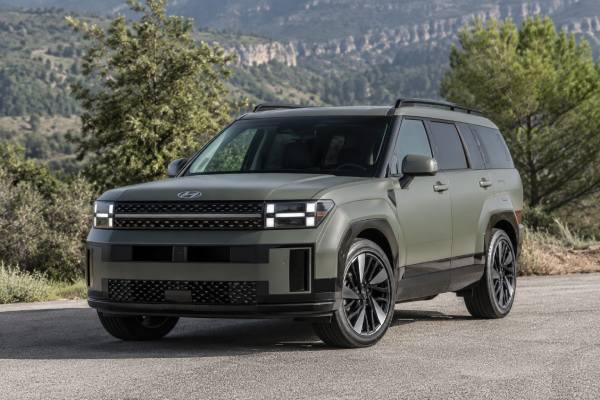
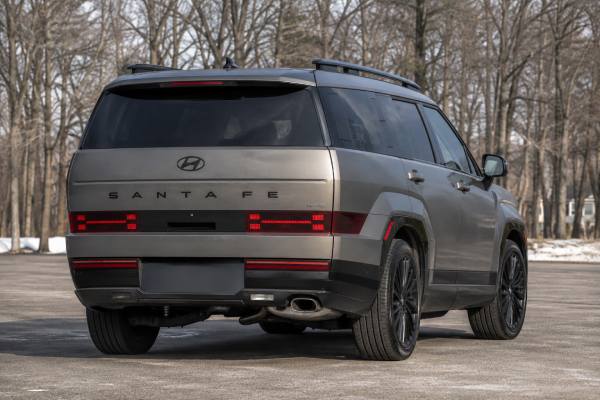
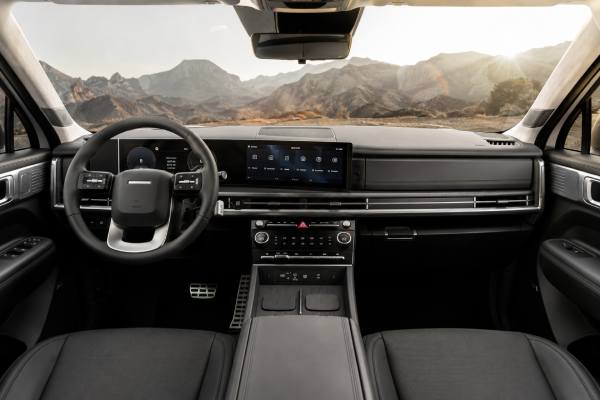
The MX5-generation Hyundai Santa Fe changed the character of the nameplate. Instead of a rounded five-seat crossover, the 2024-on model became a boxier three-row SUV with a longer wheelbase, a much larger cargo opening, and a standard turbocharged gasoline engine in many North American versions. In front-wheel-drive 2.5 T-GDi form, it is aimed at buyers who want more space and strong low-speed torque without the extra weight, cost, and fuel use of all-wheel drive.
The main appeal is clear: a roomy cabin, useful technology, a powerful 277 hp engine, and family-friendly packaging. The main caveat is also clear: early 2024–2025 gasoline models used an 8-speed wet dual-clutch transmission, and some vehicles were affected by recall and software actions. For buyers, the key is to confirm the exact model year, transmission type, recall completion, trim equipment, and service history before judging the vehicle.
At a Glance
- Strong 2.5-litre turbo engine with 277 hp and 311 lb-ft, giving the FWD Santa Fe relaxed highway and passing performance.
- Practical three-row layout, 14.6 cu ft behind the third row, and up to about 79.6 cu ft with rear seats folded.
- Good standard driver-assistance coverage, with strong IIHS results but rating details that vary by test year and build period.
- Early gasoline models need careful recall verification, especially for TCU software, transmission inspection, floor wiring harness routing, and starter terminal cover actions.
- Normal oil service is commonly around 8,000 miles or 12 months, with shorter intervals advisable for severe use such as repeated short trips, heat, towing, or heavy city driving.
Table of Contents
- Santa Fe MX5 FWD Profile
- Santa Fe MX5 Technical Data
- Santa Fe MX5 Trims and Safety
- Reliability Issues and Recalls
- Maintenance and Buying Advice
- Performance and Road Feel
- Rival Comparison
Santa Fe MX5 FWD Profile
The Hyundai Santa Fe MX5 is the fifth-generation Santa Fe, introduced for the 2024 model year in North America. The version covered here is the front-wheel-drive gasoline model with the Smartstream 2.5-litre turbocharged inline-four, rated at 277 hp and 311 lb-ft. It is not the hybrid, plug-in hybrid, diesel, or AWD/XRT version, although some safety, interior, and service points overlap across the broader MX5 family.
In the United States, the FWD 2.5T configuration is most commonly associated with SE, SEL, Limited, and Calligraphy trims. The XRT is AWD-focused and uses different tyres, ride height, and towing details, so it should not be treated as the baseline for this article. In other markets, the Santa Fe powertrain range can differ significantly. Europe, for example, focuses on hybrid and plug-in hybrid variants, while some global regions offer different gasoline outputs, equipment mixes, or seating layouts.
The MX5 body is a midsize SUV with standard three-row seating in the North American gasoline lineup. Its proportions are more upright than the previous TM generation. The long, flat roof, squared cargo area, and wide tailgate opening make it feel less like a soft crossover and more like a practical family hauler. It is not as large as a Palisade, Telluride, or Grand Highlander, but it is meaningfully more spacious and versatile than the older two-row Santa Fe sold in the U.S.
The FWD 2.5T model suits drivers who mainly use paved roads, live in mild climates, and want lower weight and slightly better highway economy than AWD. It also avoids the added driveline parts of HTRAC AWD. The trade-off is traction: with 311 lb-ft arriving low in the rev range, the front tyres can be asked to do a lot during wet uphill launches, quick merges, or loaded driving. Good tyres matter more than the drivetrain badge suggests.
For 2024 and 2025 gasoline models, the transmission is an 8-speed wet dual-clutch unit. It is designed for fast shifts and efficiency, but it does not behave exactly like a conventional torque-converter automatic at parking-lot speeds. For 2026-on U.S. gasoline models, Hyundai moved the non-hybrid Santa Fe to an 8-speed automatic, so buyers should verify the model year and transmission type by VIN, window sticker, or official build sheet.
The core advantages of this FWD version are space, equipment value, strong torque, a broad warranty in North America, and lower complexity than the AWD version. Its main ownership considerations are the turbo engine’s service discipline, early recall history, tyre wear on a heavy front-drive SUV, and the need to confirm that software and safety campaigns have been completed.
Santa Fe MX5 Technical Data
The following specifications focus on the North American Hyundai Santa Fe MX5 FWD 2.5T gasoline model. Exact values may vary by trim, wheel package, model year, market, and production date.
Powertrain and Efficiency
| Item | Specification |
|---|---|
| Engine code / family | Smartstream G2.5 T-GDi / GDI + MPI turbocharged gasoline inline-four |
| Engine layout | Transverse I-4, 4 cylinders, DOHC, 4 valves per cylinder |
| Bore × stroke | 88.5 × 101.5 mm (3.48 × 4.00 in) |
| Displacement | 2.5 L / 2,497 cc |
| Induction | Turbocharged, intercooled |
| Fuel system | Gasoline direct injection plus multi-port injection |
| Compression ratio | 11.0:1 for the North American 2024 Santa Fe specification |
| Maximum power | 277 hp (207 kW) @ 5,800 rpm |
| Maximum torque | 422 Nm (311 lb-ft) @ 4,000 rpm, with broad low-rpm delivery |
| Timing drive | Chain |
| Rated efficiency, FWD | 20 / 29 / 24 mpg US city/highway/combined; about 11.8 / 8.1 / 9.8 L/100 km; about 24 / 35 / 29 mpg UK |
| Real-world highway at 120 km/h / 75 mph | Typically mid-20s mpg US in gasoline form, with load, wind, tyres, temperature, and speed making a large difference |
Transmission and Driveline
| Item | Specification |
|---|---|
| Transmission, 2024–2025 gasoline | 8-speed wet dual-clutch automatic with shift-by-wire and manual shift mode |
| Transmission, 2026-on U.S. gasoline | 8-speed automatic; verify by VIN and market |
| Drive type | Front-wheel drive |
| Differential | Open front differential integrated with the transaxle; traction managed electronically through brake and stability systems |
Chassis, Dimensions, and Capacity
| Item | Specification |
|---|---|
| Front / rear suspension | MacPherson strut front; multi-link independent rear |
| Steering | Electric power steering; about 13.7:1 ratio, approximately 2.6 turns lock-to-lock |
| Brakes | Front ventilated disc / rear disc; about 325 mm (12.8 in) front and rear |
| Common tyre size | 235/60R18 on lower trims; 255/45R20 or 245/45R21 on higher trims, depending on package |
| Ground clearance | About 178 mm (7.0 in) for standard gasoline models; XRT differs |
| Approach / departure angles | About 17.4° / 20.3° on standard models |
| Length / width / height | 4,831 / 1,900 / 1,720 mm (190.2 / 74.8 / 67.7 in), height varies with roof rails and trim |
| Wheelbase | 2,815 mm (110.8 in) |
| Turning circle | About 11.6 m (37.9 ft) kerb-to-kerb |
| Curb weight | About 1,970 kg (4,343 lb) for FWD 2.5T, trim-dependent |
| GVWR | About 2,510 kg (5,534 lb) for FWD 2.5T |
| Fuel tank | 67 L (17.7 US gal / 14.7 UK gal) |
| Cargo volume | About 413 L (14.6 ft³) behind third row, 1,147 L (40.5 ft³) behind second row, 2,254 L (79.6 ft³) maximum; SAE-style published U.S. figures |
Performance, Capability, and Service Capacities
| Item | Specification |
|---|---|
| 0–100 km/h / 0–62 mph | Typically around 7 seconds, depending on trim, tyres, surface, load, and transmission year |
| Top speed | Generally about 205 km/h (127 mph) where published; market-limited values may vary |
| 100–0 km/h braking distance | Usually low-40-metre range on comparable 2.5T setups; tyre choice is a major variable |
| Towing capacity | 1,588 kg (3,500 lb) braked on most gasoline trims; about 748 kg (1,650 lb) unbraked. XRT AWD ratings differ. |
| Payload | About 540 kg (1,191 lb) from GVWR minus typical FWD curb weight; verify door-jamb payload label |
| Engine oil | SAE 0W-30 synthetic meeting Hyundai/API requirements; about 5.8 L (6.1 US qt) with filter |
| Coolant | Hyundai-approved long-life ethylene glycol coolant; about 9.1 L (9.6 US qt), mix and capacity vary by market |
| Transmission fluid | Hyundai-approved fluid only; DCT and 2026-on automatic specifications are not interchangeable |
| A/C refrigerant | R-1234yf on late-model North American vehicles; charge amount must be verified by under-hood label |
| Key torque values | Wheel nuts: 107–127 Nm (79–94 lb-ft). Oil drain plug commonly about 39 Nm (29 lb-ft), but verify service data. |
Safety and Driver Assistance Snapshot
| Item | Result or availability |
|---|---|
| IIHS, 2024 Santa Fe | Top Safety Pick; Good small overlap, Good original moderate overlap, Marginal updated moderate overlap for some early builds, Good updated side test, Acceptable headlights |
| Euro NCAP, 2024 Santa Fe | Standard equipment: 4 stars, 84% adult, 88% child, 70% vulnerable road users, 69% safety assist. With safety pack: 5 stars, 84% adult, 88% child, 77% vulnerable road users, 79% safety assist. |
| ADAS suite | Forward Collision-Avoidance Assist, lane support, blind-spot systems, rear cross-traffic assistance, adaptive cruise availability, driver attention monitoring, and parking/camera features depending on trim |
Santa Fe MX5 Trims and Safety
The FWD 2.5T Santa Fe lineup is best understood as a comfort and technology ladder rather than a series of major mechanical upgrades. In the U.S. gasoline range, SE and SEL provide the core powertrain and three-row layout, while Limited and Calligraphy add more driver-assistance displays, luxury seating materials, larger wheels, audio upgrades, and convenience features. The basic engine output is the same across the standard gasoline trims.
SE is the simplest FWD 2.5T version. It usually has 18-inch wheels, cloth seating, the large central display, LED lighting, and core safety systems. It is the easiest trim to recommend for buyers who value price, tyre comfort, and lower replacement costs. SEL adds convenience equipment such as upgraded upholstery, digital key features, heated front seats, wireless charging, and broader comfort features.
Limited is the practical luxury point in the range. It typically brings larger wheels, more camera and parking assistance, Blind-Spot View Monitor, a more advanced digital cockpit, upgraded seating, and more driver-assistance convenience. Calligraphy is the high-trim version, often identified by 21-inch wheels, premium cabin trim, Nappa leather seating, second-row captain’s chairs, dual wireless charging, and the most upscale interior treatment.
Quick identifiers include the wheel size, upholstery, second-row layout, exterior trim finish, audio branding, and instrument cluster setup. Calligraphy models are usually the easiest to identify because of their premium seat trim and captain’s-chair layout. SE and SEL are more likely to have seven seats with a second-row bench. Window stickers and VIN equipment reports are the safest way to confirm factory content because dealer-installed accessories and regional packages can blur visual clues.
Mechanically, FWD trims share the same main layout: front-wheel drive, turbocharged 2.5-litre gasoline engine, and electronically managed traction/stability systems. Tow ratings are generally 3,500 lb with trailer brakes for standard gasoline trims. The XRT’s higher tow figure and all-terrain tyre setup should not be applied to the FWD model.
Safety equipment is strong, but availability changes by trim and market. Core systems usually include forward collision assistance with pedestrian and cyclist detection, lane keeping or lane following support, driver attention warning, blind-spot and rear cross-traffic assistance, rear occupant alert, stability control, brake assist, and multiple airbags. Higher trims may add surround-view monitoring, Blind-Spot View Monitor, parking collision-avoidance functions, remote smart parking assistance, and more advanced highway driving assistance.
Child-seat provisions are an important advantage. The second row is the easiest place to install child restraints, and the third row is useful for occasional passengers. Families should physically test their child seats before purchase because access, tether routing, and second-row seat type affect daily convenience.
After windscreen, bumper, radar, suspension, or wheel-alignment work, ADAS calibration matters. A vehicle can appear normal yet have misaligned radar or camera inputs after collision repair or poor glass replacement. On a used example, ask for repair invoices, calibration records, and proof that any warning lights were resolved properly rather than simply cleared.
Reliability Issues and Recalls
The MX5 Santa Fe is still a young platform, so long-term reliability patterns are developing. Early information is most useful around recalls, software updates, owner reports, and known component exposure. The 2.5T engine itself is a familiar Hyundai/Kia Smartstream family unit, but the MX5 installation, transmission pairing, electronics, and new body architecture all matter for ownership.
| Area | Prevalence / severity | Symptoms | Likely remedy |
|---|---|---|---|
| TCU software / 8-speed DCT, certain 2024 vehicles | Recall-specific; high severity if affected | Transmission noise, hesitation, abnormal shift shock, rollaway concern, failure to hold Park | TCU software update, inspection, and DCT replacement if damaged |
| Rearview camera software, certain 2024 vehicles | Recall-specific; medium safety concern | Rear camera image obstructed by trailer parking assist message | Software update, sometimes over-the-air or dealer-performed |
| Main floor wiring harness, certain 2024 ICE and HEV vehicles | Recall-specific; high safety concern | Airbag warning lamp, possible airbag malfunction or unintended deployment risk | Harness inspection, securement, and replacement if damaged |
| Starter motor B+ terminal cover, certain 2024–2025 2.5T vehicles | Recall-specific; high severity in crash scenario | No normal warning expected | Dealer inspection and terminal-cover reinstallation as required |
| Turbo DI engine maintenance sensitivity | Common to modern turbo gasoline engines; medium cost if neglected | Oil degradation, roughness, deposits, turbo wear risk under severe use | Use correct oil, shorter intervals in severe service, quality filters, proper warm-up and cool-down habits |
| Large wheels and tyres | Occasional; low to medium cost | Road noise, impact harshness, sidewall damage, uneven wear | Rotate tyres, align if wear appears, inspect rims after pothole impacts |
The DCT recall is the most important early-gasoline issue. It involved certain 2024 Santa Fe vehicles equipped with the 8-speed dual-clutch transmission. The concern was transmission control logic that could damage the DCT and create a rollaway risk. A proper repair is not just a generic software update; affected vehicles require the specified inspection process and, where damage is found, transmission replacement. Buyers should ask for campaign documentation, not just verbal assurance.
The floor wiring harness recall is also important because it involves airbag system integrity. A harness routed or secured incorrectly near the second-row bench hinge can be damaged. An illuminated airbag warning lamp should never be dismissed as a minor electrical nuisance on this model.
The starter terminal cover recall affects certain 2024–2025 non-hybrid 2.5T vehicles. The issue is not a normal running fault but a crash-related electrical short risk if the terminal cover is not seated correctly. Because there may be no driver warning, VIN verification is essential.
For the 2.5T engine, there is no traditional timing-belt replacement interval because the engine uses a timing chain. That does not mean the system is lifetime under all conditions. Chain stretch, guide wear, tensioner issues, or cam/crank correlation faults should be investigated if there is cold-start rattle, check-engine light, poor running, or timing-related diagnostic codes. Correct oil viscosity and clean oil are especially important for chain tensioners, turbocharger lubrication, and variable valve timing.
Direct injection can contribute to intake-valve deposit formation over time, although the GDI + MPI setup helps reduce the risk compared with GDI-only designs. Short trips, low-speed use, poor fuel quality, and extended oil intervals can still promote deposits and crankcase contamination. Symptoms may include rough idle, hesitation, misfires, or reduced response at higher mileage.
A pre-purchase inspection should include an official VIN recall check, dealer campaign history, cold start, road test in stop-and-go traffic, transmission creep test, scan for stored powertrain and airbag codes, tyre wear review, brake inspection, underbody corrosion check, and confirmation that all fluids match the model year and transmission type.
Maintenance and Buying Advice
A turbocharged, direct-injected family SUV benefits from disciplined maintenance. The Santa Fe 2.5T is not unusually difficult to service, but it is sensitive to skipped oil changes, wrong fluids, neglected tyres, and incomplete recall work.
| Interval | Service items |
|---|---|
| Every 8,000 miles / 12 months, or sooner in severe use | Replace engine oil and filter; rotate tyres; inspect brakes, lights, wipers, fluid levels, suspension, steering, leaks, and underbody |
| Every 12,000–16,000 miles | Inspect or replace cabin air filter and engine air filter depending on dust, pollen, and climate |
| Every 24,000–32,000 miles | Inspect brake fluid condition, belts, hoses, cooling system, battery, parking brake function, and alignment if tyre wear is uneven |
| Every 48,000 miles / 4 years | Replace brake fluid if moisture content or schedule calls for it; inspect spark plugs, ignition coils, mounts, and driveline boots |
| Around 60,000 miles | Replace spark plugs if due; inspect coolant condition; consider transmission fluid service under severe use using only approved Hyundai fluid |
| Every service visit | Check open recalls, software campaigns, tyre condition, wheel-nut torque after wheel removal, and ADAS warnings |
For oil, use the specified synthetic 0W-30 grade and the correct Hyundai/API performance standard for the market. The approximate refill with filter is 5.8 L / 6.1 US qt, but the dipstick or electronic level procedure should always be used after filling. Overfilling a turbo engine can create problems, just as underfilling can.
The transmission fluid point is especially important. A wet DCT, a conventional automatic, and an AWD transfer/rear coupling system do not use the same fluids. FWD models have no rear differential or transfer case to service, but the transaxle fluid specification must match the transmission installed. For a 2024–2025 DCT vehicle, avoid quick-lube universal ATF services. For 2026-on automatic vehicles, do not assume the older DCT fluid applies.
Brake service is straightforward but should include guide-pin lubrication, rotor inspection, pad wear measurement, and fluid testing. The Santa Fe is heavy, and a loaded three-row SUV can work its brakes hard on hills. Front-drive models can also wear front tyres faster because the same axle handles steering, power delivery, and much of the braking load.
The 12 V battery should be tested from about year three, sooner in very hot or very cold climates. Many modern warning lights and electronic faults are made worse by weak batteries. A poor battery can also complicate software updates and diagnostic work.
For used buyers, the best examples are not necessarily the highest trim. A well-serviced SEL or Limited with complete recall proof may be a better purchase than a neglected Calligraphy with large wheels, uneven tyres, and vague service history. Look for:
- Official VIN recall printout showing all campaigns complete.
- Oil-service records with the correct viscosity and reasonable intervals.
- No airbag, transmission, ADAS, or camera warning lights.
- Smooth cold start and clean idle.
- Normal creep and shift behaviour during a low-speed DCT test drive on 2024–2025 models.
- Even tyre wear across all four tyres.
- No evidence of uncalibrated windscreen, bumper, or radar repair.
- Door-jamb payload label that fits your passenger and cargo needs.
Long-term durability should be good if the vehicle is serviced properly and recall work is documented. The 2.5T has enough output to make the Santa Fe feel relaxed, but turbo engines reward conservative maintenance. The most cautious buying approach is to prefer later builds or vehicles with clear campaign completion, then maintain them on time rather than stretching intervals.
Performance and Road Feel
The FWD Santa Fe 2.5T feels stronger than its size suggests in everyday driving. Peak output is not the whole story; the 311 lb-ft torque figure gives the SUV easy step-off response and confident mid-range acceleration. Around town, it does not need many revs to move with traffic. On the highway, it has enough reserve for passing without feeling strained, even with passengers aboard.
In 2024–2025 form, the 8-speed wet DCT is quick once moving. It can feel crisp and efficient during rolling acceleration, and it helps keep the turbo engine in its useful torque band. At very low speeds, it may not feel as fluid as a traditional automatic because a DCT is managing clutches rather than a torque converter. A slight mechanical feel during parking manoeuvres is not automatically a fault, but harsh engagement, loud thumps, hesitation, rolling in Park, or warning lights are not normal and require inspection.
The later 8-speed automatic used in newer gasoline models should feel more conventional in creeping traffic and parking-lot use. Buyers comparing model years should pay attention to this difference. The engine output is similar, but the transmission character changes the driving experience.
Ride quality depends heavily on wheel size. The 18-inch setup gives the best balance for families: more sidewall, lower tyre cost, and better isolation over broken pavement. The 20- and 21-inch wheels look sharper and can improve initial steering response, but they introduce more impact firmness and may raise replacement costs. On rough roads, the Santa Fe’s boxy body and large cabin can make tyre noise more noticeable than in smaller crossovers.
Steering is light and predictable rather than sporty. The Santa Fe is tuned for stability and ease, not aggressive cornering. The long wheelbase helps it track calmly on highways, and the square shape makes placing the vehicle easier than its size suggests. The trade-off is that it feels broad in tight garages and urban parking spaces.
Braking feel is generally reassuring for family use. The large disc brakes are suitable for the vehicle’s weight, but towing, mountain descents, and repeated high-speed stops will expose any weakness in pads, rotors, or fluid. A used example with steering shake under braking may need rotor service or suspension inspection.
Real-world economy is acceptable rather than outstanding. In mixed use, many drivers should expect the low-to-mid 20s mpg US if they drive smoothly. City-heavy use, winter warm-ups, short trips, and aggressive acceleration can pull the figure down sharply. Highway trips at 65–70 mph are much kinder than steady 75–80 mph running, especially with roof accessories, headwinds, or a full passenger load.
For towing, the standard FWD 2.5T rating is useful for small trailers, light utility use, and modest recreational loads, but it is not the configuration to choose for regular heavy towing. Trailer tongue weight reduces available payload, and passengers plus cargo can consume the payload allowance quickly. The Santa Fe feels best with moderate loads, proper trailer brakes, and conservative speeds.
Rival Comparison
The Santa Fe FWD 2.5T sits between compact three-row crossovers and larger family SUVs. It is roomier and more distinctive than many midsize two-row models, but it is not as wide or cargo-dominant as the biggest three-row choices.
| Model | Strengths | Trade-offs versus Santa Fe |
|---|---|---|
| Kia Sorento 2.5T FWD | Similar platform logic, available turbo power, efficient packaging, available hybrid choices | Usually less cargo volume and a less squared-off rear area; similar DCT concerns on comparable early turbo versions |
| Toyota Grand Highlander | More third-row and cargo space, strong family reputation, broad powertrain range | Larger, more expensive, less compact in urban use, and not as value-rich in some trims |
| Honda Pilot | V6 smoothness, practical cabin, strong resale, conventional automatic | Less turbocharged low-rpm punch and generally higher cost when similarly equipped |
| Mazda CX-90 | Premium feel, rear-drive-based dynamics, available inline-six and plug-in hybrid | More expensive, more complex, and not as boxy or cargo-friendly in the rear |
| Hyundai Palisade | Larger cabin, stronger three-row comfort, more traditional family-SUV feel | Bigger and usually costlier; Santa Fe is easier to park and has a fresher design |
The Santa Fe’s best argument is not that it beats every rival in one metric. Its appeal is the blend: three usable rows, strong standard turbo power, distinctive styling, good technology, and manageable exterior size. Compared with a Sorento, it feels more cargo-oriented. Compared with a Pilot or Grand Highlander, it feels smaller and more urban-friendly. Compared with a CX-90, it is less premium in driving feel but more straightforward as a family box.
The FWD version makes the most sense for drivers who do not need winter traction or light off-road capability. In snowy regions, AWD or a different tyre strategy may be worth the cost. In warm climates, the FWD model’s lower weight and simpler driveline are appealing.
The best rival for the Santa Fe depends on the buyer’s priority. For maximum third-row comfort, the larger SUVs win. For price, features, and torque-rich daily driving, the Santa Fe FWD 2.5T is very competitive. For long-term peace of mind, condition and recall completion matter more than the badge. A properly updated and well-maintained Santa Fe is a practical, comfortable, and distinctive family SUV; a neglected early-build example with incomplete campaign work should be treated carefully, no matter how attractive the price looks.
References
- 2024 Santa Fe Specifications 2024 (Specifications)
- SANTA FE 2024 – Car & User Manual 2024 (Owner’s Manual)
- 2024 Hyundai Santa Fe 2024 (Safety Rating)
- Hyundai SANTA FE 2024 (Safety Rating)
- HMA TSB 2024 (Recall / TSB)
Disclaimer
This article is for informational purposes only and is not a substitute for professional diagnosis, repair, inspection, or official service information. Specifications, torque values, service intervals, software campaigns, fluids, capacities, procedures, and safety equipment can vary by VIN, model year, market, trim, production date, and installed equipment. Always verify details against the official owner’s manual, service documentation, under-hood labels, recall databases, and dealer records for the specific vehicle.
Please share this article on Facebook, X/Twitter, or other platforms if it helped you compare, inspect, or maintain this Santa Fe.