
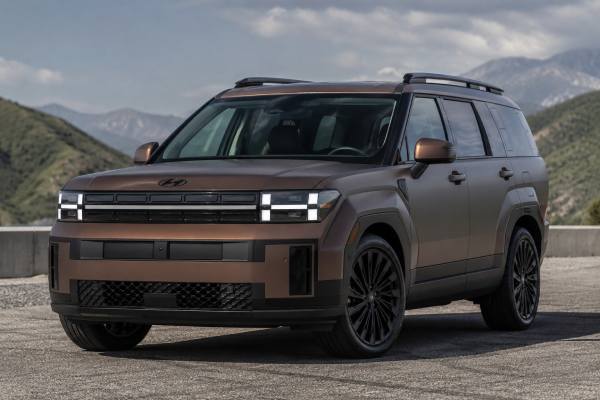


The MX5-generation Hyundai Santa Fe plug-in hybrid is a large, three-row family SUV built around a practical idea: short daily trips can be handled on electric power, while longer journeys still have a petrol engine, fast refuelling, and proper 4WD traction. For 2026, the European-market 1.6 T-GDi PHEV specification moves to a stronger 288 PS hybrid system, paired with a 6-speed automatic transmission and a 13.8 kWh battery.
Its main appeal is not outright sportiness. It is space, seven-seat usability, strong equipment, useful towing capacity, and the ability to reduce fuel use significantly when charged regularly. The main ownership caveat is that it remains mechanically complex: it has a turbo petrol engine, high-voltage battery system, charger, inverter, 4WD driveline, cooling loops, brakes, software, and conventional service items that all need correct maintenance.
Quick Overview
- The 288 PS PHEV system gives stronger acceleration than earlier Santa Fe PHEV versions while keeping a smooth 6-speed automatic.
- A 13.8 kWh battery and AC charging suit home or workplace charging; there is no DC rapid charging.
- The boxy MX5 body gives excellent passenger space, a wide tailgate opening, and up to about 1,942 L VDA cargo capacity with seats folded.
- Reliability risk is mostly tied to software updates, 12 V battery health, charging hardware, brake corrosion from low use, and correct hybrid-system servicing.
- Plan on oil and filter service at least every 10,000 miles or 12 months in many markets, or sooner where the local schedule or severe-use conditions require it.
Table of Contents
- Santa Fe MX5 PHEV Context
- Santa Fe MX5 PHEV Specs
- Santa Fe MX5 Trims and Safety
- Reliability and Service Actions
- Maintenance and Buying Advice
- Driving Performance and Range
- Rivals and Ownership Value
Santa Fe MX5 PHEV Context
The MX5 Santa Fe is a major change from the rounded previous-generation Santa Fe. It is longer, more upright, more cargo-focused, and visually closer to a large adventure-style family SUV than a conventional crossover. The plug-in hybrid version keeps the same basic family-car priorities but adds a meaningful electric-driving layer for owners who can charge regularly.
The 2026 1.6 T-GDi PHEV 4WD uses a turbocharged 1.6-litre four-cylinder petrol engine, an electric traction motor, a lithium-ion high-voltage battery, and a 6-speed automatic transmission. Unlike some plug-in hybrids that use an electric rear axle only, this Santa Fe is marketed as 4WD and uses a conventional driveline layout with electronic control to distribute traction. It is not a low-range off-roader, but it is much better suited to wet roads, snow, gravel tracks, steep driveways, and towing than a front-wheel-drive-only family SUV.
One accuracy point matters: many market sheets describe the car as “288PS” or “288 hp.” In strict metric conversion, 288 PS is about 284 mechanical horsepower, with system output listed at 211.8 kW. In normal showroom language, however, this variant is commonly identified as the 288 hp or 288 PS Santa Fe Plug-in Hybrid.
The model is especially relevant for drivers whose routine includes short commutes, school runs, urban journeys, and occasional longer motorway travel. Used correctly, it can spend much of the week running without the petrol engine. Used without charging, it behaves more like a heavy hybrid SUV carrying extra battery weight, so fuel economy becomes far less impressive.
The best buyer profile is someone who wants seven seats, a big boot with the third row folded, strong safety equipment, a quieter city drive, and occasional towing ability. It is less ideal for drivers who cannot charge at home or work, because the main PHEV advantage depends on replenishing the battery frequently.
Santa Fe MX5 PHEV Specs
Public specification data differs slightly by market. UK and Northern Ireland documents list 0–62 mph in 8.0 seconds and 128 mph top speed, while a Cyprus MY26 sheet lists 0–100 km/h in 9.8 seconds and 180 km/h. Treat those differences as market, homologation, or data-sheet variation, and verify against the VIN plate, certificate of conformity, or local Hyundai documentation.
| Item | 2026 Santa Fe MX5 1.6 T-GDi PHEV 4WD |
|---|---|
| Platform / model code | MX5 Santa Fe, 5-door SUV, 6- or 7-seat depending market and trim |
| Powertrain code | 1.6 T-GDi PHEV 4WD; exact engine code should be confirmed by VIN |
| Engine layout and cylinders | Inline-4, DOHC, 4 valves per cylinder, turbocharged petrol |
| Bore × stroke | 75.6 × 89.0 mm, 2.98 × 3.50 in |
| Displacement | 1.6 L, 1,598 cc |
| Induction and fuel system | Turbocharged, direct injection |
| Compression ratio | 11.0:1 |
| Timing drive | Timing chain |
| Petrol engine output | 180 PS, 177 hp, 132.4 kW at 6,000 rpm; 265 Nm, 195.5 lb-ft at 1,500–4,500 rpm |
| Hybrid system output | 288 PS, about 284 hp, 211.8 kW; 380 Nm, 280 lb-ft |
| Electric motor | Permanent-magnet synchronous traction motor, integrated with the hybrid transaxle; public market sheets do not consistently publish motor voltage |
| Battery | 13.8 kWh lithium-ion polymer high-voltage battery; chemistry details vary by supplier documentation |
| Onboard charger | 3.6 kW AC in published MY26 Cyprus data; no DC rapid charging |
| Rated efficiency | WLTP weighted combined figures around 3.8 L/100 km, 61.9 mpg US, 74.3 mpg UK in UK-style data; some market sheets show 7.1 L/100 km, 33.1 mpg US, 39.8 mpg UK |
| Electric range | About 33.6 miles, 54 km WLTP mixed; up to about 65 km city in some market data |
| Real-world highway at 120 km/h | Typically about 7.5–9.0 L/100 km, 26–31 mpg US, 31–38 mpg UK once the battery is depleted, depending temperature, tyres, load, wind, and terrain |
| Item | Specification |
|---|---|
| Transmission | 6-speed automatic, shift-by-wire; hybrid-specific calibration |
| Drive type | 4WD / AWD with electronic traction management |
| Differentials | Open differentials with brake-based traction and stability control; no locking differential listed |
| Suspension | Front MacPherson strut; rear multi-link |
| Steering | Rack-mounted motor-driven power steering, 2.53 turns lock-to-lock; steering ratio not consistently published |
| Brakes | Front 325 mm ventilated discs, 12.8 in; rear 325 mm discs, 12.8 in |
| Popular tyre size | 255/45 R20 on 8.5J × 20 wheels |
| Ground clearance | 177 mm, 7.0 in in Cyprus MY26 data |
| Length / width / height | 4,830 mm, 190.2 in / 1,900 mm, 74.8 in body width / 1,770–1,780 mm, 69.7–70.1 in depending market data |
| Width including mirrors | 2,206 mm, 86.9 in in UK-style data |
| Wheelbase | 2,815 mm, 110.8 in |
| Turning circle | 11.6 m, 38.1 ft kerb-to-kerb |
| Kerb weight | 2,090–2,145 kg, 4,608–4,729 lb |
| GVWR | 2,740 kg, 6,041 lb |
| Fuel tank | 47 L, 12.4 US gal, 10.3 UK gal |
| Cargo volume | 621 L, 21.9 ft³ seats up in published VDA data; 1,942 L, 68.6 ft³ seats down. Third-row-in-use space is much smaller. |
| Item | Published or Practical Figure |
|---|---|
| 0–100 km/h / 0–62 mph | Market-dependent published range: 8.0–9.8 seconds |
| Top speed | Market-dependent published range: 180–206 km/h, 112–128 mph |
| 100–0 km/h braking | Not consistently published; tyre choice, load, and road surface matter more than brochure trim |
| Towing capacity | 1,700 kg, 3,748 lb braked; 750 kg, 1,653 lb unbraked |
| Payload | 595–650 kg, 1,312–1,433 lb depending trim and equipment |
| Engine oil | SAE 0W-20, API SN PLUS/SP or current Hyundai-approved equivalent; about 4.8 L, 5.1 US qt with filter on related Smartstream 1.6 T-GDi data |
| Coolant | Hyundai-approved long-life ethylene-glycol coolant, normally 50/50 premix; PHEV battery/inverter loop service must follow VIN-specific documentation |
| Transmission fluid | Hyundai/Kia-approved hybrid automatic transmission fluid; capacity and fill procedure should be taken from the service manual |
| Transfer case / rear final drive | Hyundai-approved gear oil specification by VIN; replace sooner under towing, water exposure, or severe use |
| A/C refrigerant and compressor oil | Use the under-bonnet label. PHEV electric compressors require the specified non-conductive oil type only. |
| Key torque values | Wheel nuts are commonly in the 107–127 Nm, 79–94 lb-ft range on Hyundai SUVs; oil drain plug is commonly about 39 Nm, 29 lb-ft. Always verify by VIN before repair. |
| Euro NCAP | 2024 Santa Fe rating applies to Hybrid and Plug-in Hybrid 4×4 variants; published protection scores include 84% adult, 88% child, 70% vulnerable road users, 69% safety assist |
| IIHS | 2026 U.S.-market Santa Fe is listed as Top Safety Pick+ with Good small overlap, Good updated moderate overlap, Good updated side, Acceptable headlights, and Good front crash prevention ratings |
| ADAS | AEB, lane keeping, lane following, smart cruise with stop and go, speed-limit assist, driver monitoring, blind-spot systems, rear cross-traffic systems, parking collision avoidance, and HDA/HDA 2 depending trim and market |
Santa Fe MX5 Trims and Safety
The 2026 Santa Fe PHEV trim structure varies by country, but the pattern is consistent: the plug-in hybrid 4WD powertrain is usually paired with high equipment levels rather than entry-level trims. In UK-style material, the key grades are Premium, Ultimate, and Calligraphy. In Cyprus MY26 material, the grades are Premium, Premium Plus, and Calligraphy.
Mechanically, the trims are broadly similar. The same 1.6 T-GDi PHEV system, 6-speed automatic, 4WD layout, 20-inch wheel package, 47 L fuel tank, and 1,700 kg braked towing rating are typically listed across the range. The meaningful differences are comfort, safety, visibility, parking assistance, audio, seating, and exterior trim.
Premium is already well equipped. It typically includes LED lighting, 20-inch alloy wheels, dual-zone climate control, 12.3-inch digital displays, navigation, smart cruise control, lane assistance, forward collision avoidance, parking sensors, reversing camera, heated front seats, leather-style trim in some markets, roof rails, over-the-air update capability, and multiple USB-C charging points.
Ultimate or Premium Plus adds the equipment that makes the large body easier to use every day. Depending market, this includes upgraded forward collision avoidance, Highway Driving Assist 2, blind-spot view monitor, surround-view camera, reverse parking collision avoidance, head-up display, Bose audio, memory driver’s seat, heated rear seats, ventilated front seats, dual wireless charging, digital key, and in some markets rear self-levelling hardware.
Calligraphy is the more appearance-led top specification. It normally brings Nappa leather, black or dark exterior detailing, black alloy wheels, upgraded interior trim, additional convenience items such as a UV-C compartment in some markets, and a more premium cabin finish. It is the trim to choose for maximum equipment, but not necessarily the best value if the buyer mainly wants the PHEV driveline and core safety systems.
Quick identifiers include the left-rear charging door, PHEV badging, 4WD designation, 20-inch 255/45 R20 tyre package, shift-by-wire interior, and the large panoramic digital display. Buyers should also check the build plate and VIN, because safety equipment, seat layout, wheel design, and driver-assistance calibration can differ by market.
Safety equipment is a major part of the Santa Fe’s appeal. The structure is backed by modern restraint systems, multi-collision braking, electronic stability control, hill-start assist, downhill brake control, trailer stability assist, eCall in European markets, ISOFIX/LATCH child-seat provisions, and a broad camera/radar-based driver-assistance suite.
ADAS calibration matters after repairs. Windscreen replacement, bumper removal, suspension alignment changes, steering work, radar bracket damage, wheel-size changes, and accident repair can all require sensor checks or calibration. A car with excellent safety hardware can still perform poorly if the camera, radar, steering-angle sensor, or wheel-alignment data are wrong.
Reliability and Service Actions
The 2026 Santa Fe MX5 PHEV is still too new for a mature long-term reliability record. That means judgement should be based on early recall activity, the known demands of Hyundai’s 1.6 T-GDi hybrid family, and the practical weak points common to plug-in hybrids. The powertrain is not experimental, but the MX5 body, software, safety systems, and market-specific calibration are still relatively fresh.
| System | Prevalence | Severity | Symptoms and Remedy |
|---|---|---|---|
| Software and calibrations | Occasional | Low to medium | Warning lights, unusual hybrid transitions, infotainment glitches, ADAS messages. Check for ECU, BMS, infotainment, and ADAS updates before replacing parts. |
| 12 V battery | Common on low-use PHEVs | Low to medium | No-start condition, multiple warning messages, failed remote functions. Test battery state of health and charging logic, especially on cars driven mainly short distances. |
| High-voltage battery | Rare early in life | High if out of warranty | Reduced EV range, charging interruption, hybrid warning lights. Request battery state-of-health data and warranty status. |
| Onboard charger and charge port | Occasional | Medium | Slow or failed AC charging, hot plug, latch errors, moisture in port. Inspect pins, seals, cable, wallbox, and charger fault codes. |
| Regenerative braking and discs | Common in wet climates | Low to medium | Rusty rotors, pulsing, noisy braking. Regular friction-brake use and annual brake inspection help prevent corrosion. |
| 1.6 T-GDi petrol engine | Occasional over high mileage | Medium | Oil dilution, rough idle, carbon buildup, coolant leaks, or timing-correlation faults. Use correct oil, do not extend intervals, and investigate chain noise early. |
| AWD driveline | Rare to occasional | Medium | Whine, vibration, binding, fluid leaks, or shudder under load. Check tyres match, inspect transfer case and rear final drive, and change fluids under severe use. |
Known service actions should be checked by VIN rather than assumed from model year alone. A European Safety Gate alert for Santa Fe MX5 production in 2024 covered a rear-seat bench wiring harness that could be pinched by the seat hinge, potentially affecting curtain-airbag operation. That does not automatically mean every 2026 PHEV is affected, but it is a good example of why dealer recall records matter.
In North America, certain 2024–2026 Santa Fe and Santa Fe Hybrid vehicles have also appeared in safety-recall data for items such as seat-belt anchor or airbag-related concerns. Market applicability differs, and the European 288 PS PHEV is not the same as every U.S.-market Santa Fe. The practical advice is simple: run an official VIN recall check before purchase, then ask the dealer to print confirmation that all recalls, service campaigns, software updates, and customer-satisfaction actions are complete.
Pre-purchase inspection should include:
- A cold start and full hybrid-system scan with Hyundai-capable diagnostics.
- AC charging test from a known-good wallbox or portable EVSE.
- Battery state-of-health report if the seller or dealer can provide one.
- Confirmation that both keys, charging cable, tyre mobility kit, locking wheel-nut key, and service records are present.
- Inspection for rear-seat wiring damage, boot water leaks, charge-port damage, underbody impacts, tyre mismatch, brake corrosion, suspension noise, and evidence of towing abuse.
- Verification that ADAS systems operate without warnings and have been calibrated after any windscreen or bumper work.
The most important reliability habit is not complicated: keep the petrol engine serviced even if most mileage is electric. PHEVs can suffer from moisture and fuel dilution when the engine runs briefly and never fully warms. A car used only for short trips should be serviced by time as much as mileage.
Maintenance and Buying Advice
The Santa Fe PHEV needs hybrid-aware maintenance. It is not enough to treat it like an ordinary petrol SUV, and it is not correct to treat it like a full EV. It has both systems, and neglecting either side can become expensive.
| Interval | Maintenance Items |
|---|---|
| Monthly or before long trips | Check tyre pressures, tread, lights, washer fluid, coolant levels where visible, charge cable condition, charge-port seals, and warning messages. |
| Every 10,000 miles or 12 months, or sooner by local schedule | Replace engine oil and filter, inspect brakes, suspension, steering, cooling hoses, drive belts, tyres, underbody, and hybrid warning history. Some markets use 10,000 km or 6-month severe-use intervals. |
| Every 10,000–12,000 km | Rotate tyres if wear pattern allows, check wheel alignment if the vehicle pulls, tramlines, or wears shoulders unevenly. |
| Every 12–24 months | Replace cabin air filter, inspect engine air filter, test 12 V battery, check brake fluid moisture, inspect parking brake function and friction brakes. |
| Every 24 months | Brake fluid replacement is prudent in humid climates or where the official schedule calls for it. Inspect brake calipers, slide pins, rotors, and pads carefully because regenerative braking can hide corrosion. |
| Every 40,000–60,000 km under severe use | Inspect or replace automatic transmission fluid, transfer case fluid, rear final-drive oil, and related seals if used for towing, mountain driving, frequent short trips, or poor roads. |
| Around 70,000 km where specified | Replace spark plugs if required by the VIN-specific schedule for the 1.6 T-GDi. Misfires on a turbo hybrid should not be ignored. |
| Every 3–5 years | Test and usually replace the 12 V battery if capacity is low. A weak 12 V battery can trigger misleading hybrid and safety warnings. |
| By official coolant schedule | Service engine, inverter, and battery cooling loops only with Hyundai-approved coolant and procedure. Do not mix coolant types. |
Timing-chain maintenance is condition-based. There is no normal belt replacement interval because the engine uses a chain, but chain stretch, guide wear, tensioner problems, or timing-correlation faults should be diagnosed promptly. Cold-start rattle that lasts more than a moment, check-engine lights, poor running, or oil-pressure history all matter.
For a new or nearly new purchase, the strongest choices are usually mid-to-high trims with complete ADAS equipment but without unnecessary cosmetic extras. Ultimate or Premium Plus often gives the best blend because surround-view camera, blind-spot view, HDA 2, upgraded lighting, HUD, and parking assistance are useful on a vehicle this large. Calligraphy is worth considering if the price gap is reasonable and the buyer wants Nappa leather and the top cabin finish.
Avoid cars with incomplete charging equipment, unexplained warning lights, mismatched tyres, accident-repaired front bumpers or windscreens without calibration records, poor service history, or evidence of heavy towing without fluid-service documentation. A plug-in hybrid can hide abuse well because electric operation feels smooth even when the petrol engine, driveline fluids, or brakes have been neglected.
Long-term durability should be good if the car is serviced correctly and software updates are kept current. The expensive risk areas are high-voltage components, charger faults, ADAS hardware, automatic transmission issues, and accident damage. A remaining factory warranty and verified battery warranty are valuable, especially because the high-voltage battery warranty is often longer than the general vehicle warranty.
Driving Performance and Range
The Santa Fe PHEV drives like a large, comfort-biased SUV rather than a sporty crossover. The upright body, long wheelbase, and relatively high kerb weight are obvious, but they also give the vehicle a planted feel on faster roads. Ride quality is generally composed, especially on good surfaces, although 20-inch wheels and 255/45 tyres can make sharp urban edges more noticeable than smaller-wheel setups would.
Steering is light and accurate enough for family use. It does not provide much road feel, but the turning circle is manageable for a vehicle of this size, and the squared-off body makes the corners easier to judge than on many rounded SUVs. The rear-view camera and surround-view system, where fitted, are worth having because the Santa Fe is wide and the rear pillars are substantial.
The powertrain’s best trait is smoothness. In EV mode, low-speed driving is quiet and easy, with enough torque for traffic, parking, and suburban roads. When the petrol engine starts, the transition is usually smoother than in older hybrids, although a cold engine under sudden acceleration can still sound busy. The 6-speed automatic gives a more conventional feel than an e-CVT, with stepped shifts and less drone during hard acceleration.
Performance is strong enough for a loaded family SUV. Depending market data, acceleration to 100 km/h sits between about 8.0 and 9.8 seconds, which is adequate rather than aggressive. The extra system power is most useful in the middle of the speed range, where electric assistance helps the turbo engine respond cleanly for overtaking.
Real-world efficiency depends almost entirely on charging habits. With regular charging and a daily route within the electric range, petrol use can be very low. On a mixed route, 45–55 km of electric driving is realistic in mild weather, with city use sometimes doing better. In winter, expect a meaningful reduction due to battery temperature, heater use, wet roads, and denser air. A 25–35% reduction is not unusual in cold weather.
Once the battery is depleted, the Santa Fe behaves like a heavy hybrid SUV. Mixed fuel consumption in charge-sustaining use is commonly in the 6.5–8.5 L/100 km range, and motorway driving at 120 km/h can move toward 7.5–9.0 L/100 km. Heavy loads, roof boxes, winter tyres, towing, and strong headwinds can push it higher.
Charging is simple but not fast. With a 3.6 kW onboard charger, a 10–80% AC charge typically takes around three hours, while a deeper charge can take about four hours depending supply, losses, and temperature. That is fine overnight or at work but less convenient for opportunistic public charging. There is no DC fast charging, so long-distance driving should be planned around petrol refuelling rather than rapid charging.
For towing, the 1,700 kg braked rating is useful, but range and fuel economy will drop sharply. A moderate trailer can increase consumption by 30–60%, and a tall caravan can do worse at motorway speeds. The hybrid system can help with smooth launches, but owners should still monitor temperatures, load distribution, nose weight, tyre pressures, and service intervals.
Rivals and Ownership Value
The Santa Fe PHEV sits in a narrow but important space: it is a plug-in hybrid SUV with genuine family space, available seven-seat practicality, strong equipment, and useful towing ability. Many rivals match one or two of those strengths, but fewer combine all of them.
The Kia Sorento PHEV is the closest relation. It offers similar hybrid logic, three-row usefulness, and a practical cabin. The Santa Fe feels more distinctive and boxier, while the Sorento may appeal to buyers who prefer a more conventional SUV shape. Equipment and warranty terms vary by market, so the better buy often comes down to local pricing and trim.
The Toyota RAV4 Plug-in Hybrid is more efficient and quicker, but it is not a true three-row family SUV. It suits buyers who want maximum plug-in efficiency and strong reliability reputation more than seven-seat space. The Santa Fe is the more practical family hauler.
The Mitsubishi Outlander PHEV is another strong alternative, especially where its pricing is competitive. It offers good electric driving manners and a well-developed PHEV system, but third-row space and towing needs should be checked carefully against the Santa Fe.
Larger premium plug-in SUVs such as the Volvo XC90 T8, BMW X5 xDrive50e, or Mercedes-Benz GLE plug-in hybrid deliver more power, luxury, and often longer electric range, but they cost significantly more to buy, insure, repair, and maintain. The Santa Fe is positioned as a value-rich large family SUV rather than a luxury flagship.
Its main advantages are space, standard equipment, electric commuting ability, strong safety technology, distinctive design, and a useful 4WD towing package. Its disadvantages are weight, charging speed, limited DC-charging capability, market-specific specification variation, and the complexity of maintaining both petrol and electric systems.
For the right owner, the 2026 Hyundai Santa Fe 1.6 T-GDi PHEV 4WD is a compelling family SUV. It makes the most sense when charged often, serviced on schedule, and bought in a trim that includes the visibility and driver-assistance features needed for its size. It is not the simplest Santa Fe to own, but it may be the most versatile.
References
- SANTA FE Plug-in Hybrid Technical, Specifications and Pricing Model Year 26 2026 (Manufacturer Specifications)
- Hyundai SANTA FE PHEV MY26 2026 (Manufacturer Specifications)
- Euro NCAP | Hyundai SANTA FE 2024 (Safety Rating)
- 2026 Hyundai Santa Fe 2026 (Safety Rating)
- Safety Gate Alerts 2026 (Recall Database)
Disclaimer
This article is for informational purposes only and is not a substitute for professional diagnosis, repair, or manufacturer service information. Specifications, torque values, fluid capacities, service intervals, software updates, procedures, safety equipment, and recall applicability can vary by VIN, market, build date, and trim. Always verify details against official Hyundai service documentation, the owner’s manual, dealer records, and the vehicle’s VIN-specific data before buying, repairing, towing, or servicing the vehicle.
If this helped, please consider sharing it on Facebook, X/Twitter, or your preferred social platform to support our work.