


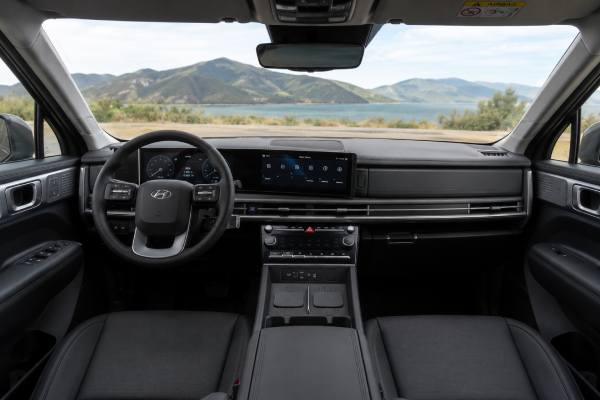
The MX5-generation Hyundai Santa Fe changed the model’s character more than a normal redesign. It became a boxier, roomier three-row SUV with a wider tailgate opening, a more upright cabin, and a stronger emphasis on family practicality, towing, outdoor use, and long-distance comfort.
This page focuses on the 2.5-liter turbocharged gasoline version with HTRAC all-wheel drive, rated at 277 hp in U.S.-market form and paired with Hyundai’s wet eight-speed dual-clutch transmission on early MX5 models. Exact equipment, ratings, service intervals, and even transmission availability can vary by market and model year, so VIN-specific documentation matters, especially for 2025–2026 vehicles.
Owner Snapshot
- Strong output for a three-row midsize SUV: 277 hp and 311 lb-ft give the Santa Fe confident merging and passing.
- The cabin is a major strength, with usable third-row seating and up to 79.6 cu ft of cargo volume with rear rows folded.
- HTRAC AWD and drive modes improve all-weather traction; XRT versions add more clearance and a higher tow rating.
- The wet DCT needs recall and software-history verification, especially on early 2024 production vehicles.
- Typical normal-use oil and tire service is about every 8,000 miles or 12 months; severe use often calls for shorter intervals.
Table of Contents
- Santa Fe MX5 AWD At A Glance
- Santa Fe MX5 Technical Data
- Santa Fe MX5 Trims and Safety
- Reliability, Issues and Recalls
- Maintenance and Buyer Checks
- Driving, Performance and Economy
- Rivals and Ownership Advantages
Santa Fe MX5 AWD At A Glance
The Hyundai Santa Fe MX5 HTRAC AWD with the 2.5 T-GDi engine is best understood as the more powerful gasoline version of Hyundai’s new-generation midsize SUV. It sits above the hybrid in output and towing ability, but below the hybrid in fuel economy. For buyers who want the strongest acceleration, the broadest tow rating, and the most traditional long-trip refueling convenience, this is the version that makes the most sense.
The engine is Hyundai’s Smartstream 2.5-liter turbocharged inline-four, commonly identified as G4KP. In U.S. trim it produces 277 hp at 5,800 rpm and 311 lb-ft of torque across the low-to-mid rpm range. The broad torque curve is important because the Santa Fe is not a small crossover. With three rows, a tall body, available 20- or 21-inch wheels, and AWD hardware, curb weight is typically around 4,486 lb in common AWD configurations.
The transmission is a wet-clutch eight-speed dual-clutch automatic on the early MX5 2.5T AWD specification. “Wet” means the clutch packs run in oil, improving heat tolerance compared with a dry-clutch DCT. In normal driving it can feel quick and efficient, especially once moving. At parking-lot speeds, on steep driveways, or while creeping in traffic, it can still feel different from a torque-converter automatic because clutch engagement is mechanically different.
HTRAC AWD is an electronically controlled all-wheel-drive system. It normally varies torque distribution based on throttle position, steering angle, road speed, wheel slip, and selected drive mode. It is not a body-on-frame 4×4 system and does not have a low-range transfer case, but it gives the Santa Fe useful snow, rain, gravel-road, and light-trail ability when paired with suitable tires.
The MX5 Santa Fe’s main advantages are packaging and practicality. The exterior length is about 190.2 in, while the wheelbase is 110.8 in. That creates generous second-row room and a third row that is more useful than the previous Santa Fe’s two-row layout. Cargo space is modest behind the third row, but very strong with the third row folded.
The main ownership caveat is not the engine itself but the early DCT recall and software history. A used example should not be judged only by mileage and condition; it should also have documented recall completion, no abnormal transmission noises, no parking-pawl symptoms, and a clean service record. For shoppers comparing the Santa Fe to the Toyota Highlander, Honda Pilot, Kia Sorento, and Mazda CX-90, that transmission history is one of the most important inspection points.
Santa Fe MX5 Technical Data
The following specifications describe the 2024–2025 U.S.-market Hyundai Santa Fe 2.5T HTRAC AWD where available, with notes for common trim differences. Some export markets use slightly different power ratings, brake hardware, fuel-consumption figures, wheel packages, or model-year equipment.
| Item | Hyundai Santa Fe MX5 2.5 T-GDi HTRAC AWD |
|---|---|
| Engine code | Smartstream G2.5 T-GDi, commonly G4KP |
| Layout | Transverse inline-4, aluminum block and head |
| Valvetrain | DOHC, 4 valves per cylinder, 16 valves total |
| Bore × stroke | 88.5 × 101.5 mm (3.48 × 4.00 in) |
| Displacement | 2.5 L (2,497 cc) |
| Induction | Turbocharged, intercooled |
| Fuel system | Gasoline direct injection with multi-port injection support, market dependent |
| Compression ratio | About 11.0:1 in U.S. Santa Fe specification; some G4KP applications list 10.5:1 |
| Maximum power | 277 hp (207 kW) @ 5,800 rpm |
| Maximum torque | 422 Nm (311 lb-ft) @ roughly 1,700–4,000 rpm |
| Timing drive | Chain |
| EPA efficiency, AWD | About 20 city / 28 highway / 23 combined mpg US; 11.8 / 8.4 / 10.2 L/100 km; 24.0 / 33.6 / 27.6 mpg UK |
| EPA efficiency, XRT AWD | About 19 city / 26 highway / 22 combined mpg US; 12.4 / 9.0 / 10.7 L/100 km; 22.8 / 31.2 / 26.4 mpg UK |
| Real highway at 120 km/h | Typically about 9.8–11.2 L/100 km (21–24 mpg US / 25–29 mpg UK), depending on tires, load, wind, and temperature |
| Item | Specification |
|---|---|
| Transmission | 8-speed wet dual-clutch automatic with manual shift mode and paddle shifters on many trims |
| Drive type | HTRAC AWD, electronically controlled |
| Differentials | Open differentials with brake-based traction control; no low-range gearing or mechanical locking differential |
| Drive modes | Normal/Comfort, Sport, Smart and terrain modes such as Snow, Mud, and Sand, depending on trim and market |
| Item | Specification |
|---|---|
| Front suspension | MacPherson strut |
| Rear suspension | Multi-link independent |
| Steering | Electric power steering; about 2.5–2.6 turns lock-to-lock, depending on market |
| Brakes | 4-wheel disc brakes; common U.S. fitment uses ventilated front discs and solid or larger rear discs by trim |
| Common tire sizes | 235/60 R18, 255/45 R20, 245/60 R18 on XRT, and 21-inch packages on some upper trims |
| Ground clearance | 178 mm (7.0 in) standard; about 211 mm (8.3 in) on XRT |
| Angles | Standard: about 17.4° approach / 20.3° departure / 17.0° breakover; XRT: about 19.3° / 21.8° / 19.1° |
| Length / width / height | 4,830 mm / 1,900 mm / about 1,720–1,770 mm (190.2 / 74.8 / 67.7–69.7 in) |
| Wheelbase | 2,815 mm (110.8 in) |
| Turning circle | About 11.6 m (37.9 ft) curb-to-curb |
| Curb weight | About 2,035 kg (4,486 lb) for common AWD 2.5T trims; varies by equipment |
| GVWR | About 2,575–2,650 kg (5,677–5,842 lb), market and trim dependent |
| Fuel tank | 67 L (17.7 US gal / 14.7 UK gal) |
| Cargo volume | About 413 / 1,147 / 2,254 L (14.6 / 40.5 / 79.6 ft³) behind third / second / first row, SAE-style U.S. figures |
| Item | Specification |
|---|---|
| 0–100 km/h (0–62 mph) | Typically around 8.0 seconds, depending on trim, tires, surface, and test method |
| Top speed | About 210 km/h (130 mph) in markets where listed |
| 100–0 km/h braking | Public test data varies; expect roughly 39–43 m (128–141 ft) depending on tires and load |
| Towing capacity | 3,500 lb (1,588 kg) on most U.S. 2.5T AWD trims; 4,500 lb (2,041 kg) on XRT where rated |
| Unbraked towing | Often 750 kg (1,653 lb) in markets that publish a separate unbraked figure |
| Payload | Typically about 540–650 kg (1,190–1,430 lb), depending on trim, seating, and market label |
| System | Specification or capacity |
|---|---|
| Engine oil | SAE 0W-30 synthetic, API SN Plus/SP or equivalent; about 5.8 L (6.1 US qt) with filter |
| Oil drain plug torque | About 39 Nm (29 lb-ft); replace sealing washer |
| Coolant | Ethylene-glycol long-life coolant, normally 50/50 premix; about 9.1 L (9.6 US qt), verify by VIN |
| DCT fluid | Hyundai wet-DCT fluid specification only; service fill and procedure are VIN-specific |
| Transfer case | GL-5 75W-85; about 0.5 L (1.1 US pt) |
| Rear differential | GL-5 75W-85; about 0.6 L (1.3 US pt) |
| Brake fluid | DOT 4 LV / SAE J1704 / ISO 4925 Class 6 compatible low-viscosity brake fluid |
| A/C refrigerant | R-1234yf; many Hyundai references list 450 ± 25 g (15.2 ± 0.84 oz) for similar current systems, but always use the under-hood label |
| A/C compressor oil | PAG oil; many Hyundai references list about 120 ± 10 mL (4.07 ± 0.33 fl oz), but label and service manual control |
| Wheel lug nut torque | Typically 108–127 Nm (80–94 lb-ft), depending on market manual; recheck after wheel service |
| Item | Result or availability |
|---|---|
| IIHS | 2024 Top Safety Pick; Good small-overlap and updated side ratings; Acceptable headlights on all trims |
| Euro NCAP | 5 stars in 2024 testing: 84% adult occupant, 88% child occupant, 70% vulnerable road users, 69% safety assist |
| ADAS | Forward Collision-Avoidance Assist, lane support, blind-spot systems, rear cross-traffic assistance, adaptive cruise, driver attention systems, trim dependent |
| Child-seat provisions | LATCH/ISOFIX provisions vary by seating configuration; always confirm anchor placement in the owner’s manual |
Santa Fe MX5 Trims and Safety
In the United States, the gasoline 2.5T Santa Fe has typically been sold in SE, SEL, XRT, Limited, and Calligraphy forms. HTRAC AWD is available across much of the range and standard on XRT. The basic body, engine, transmission, and seating concept are shared, but equipment and functional details change enough that buyers should inspect the trim carefully rather than relying only on the badge.
SE is the entry point and usually has the most straightforward equipment set: three-row seating, the 2.5T engine, core driver-assistance systems, alloy wheels, and the main infotainment screen. SEL adds comfort and convenience items that many private buyers want, such as upgraded upholstery, more connected features, heated front seats in many markets, and broader availability of packages.
XRT is the most functionally distinct gasoline trim. It keeps the 2.5T engine and HTRAC AWD but adds a more rugged tire and wheel package, extra ground clearance, different exterior details, and the higher 4,500 lb tow rating in U.S. specification. It is not a rock-crawling trim, but it is the most useful Santa Fe for gravel roads, snow access roads, camping tracks, and light towing.
Limited and Calligraphy are the comfort-oriented upper trims. They commonly add larger wheels, more premium interior materials, additional cameras, Bose audio, ventilated front seats, larger digital displays, blind-spot view features, surround-view monitoring, head-up display, dual wireless charging, and more advanced Highway Driving Assist features depending on market and model year. Calligraphy often has second-row captain’s chairs, which reduce seating count to six but improve comfort and access to the third row.
Quick identifiers are simple. XRT has the rugged exterior theme, all-terrain-style tires, and XRT badging. Calligraphy is usually identified by more upscale trim finishes, Nappa leather availability, larger wheels, and luxury interior details. VIN decoding and the window sticker remain the best ways to confirm factory equipment, especially for AWD, seating layout, tow package details, and wheel size.
Safety equipment is a major selling point. The MX5 Santa Fe structure was designed with modern crash tests in mind, and its driver-assistance suite is broad. Standard and available systems can include:
- Forward Collision-Avoidance Assist with vehicle, pedestrian, and cyclist detection
- Lane Keeping Assist and Lane Following Assist
- Blind-Spot Collision Warning or Avoidance Assist
- Rear Cross-Traffic Collision-Avoidance Assist
- Smart Cruise Control, including navigation-based functions on some trims
- Highway Driving Assist on upper trims
- Safe Exit Assist
- Driver Attention Warning and, in some markets, more advanced driver monitoring
- Surround View Monitor and Blind-Spot View Monitor on higher trims
Airbag coverage includes front airbags, side airbags, curtain airbags, and additional protection depending on seating configuration and market. LATCH or ISOFIX child-seat anchors are fitted, but the exact anchor layout matters if three child seats, second-row captain’s chairs, or third-row child-seat use is planned.
After windshield replacement, front-end repair, suspension work, bumper repair, or camera/radar replacement, ADAS calibration should be treated as a safety-critical job. A Santa Fe with a clean-looking repair but poorly calibrated sensors may brake late, misread lanes, or show inconsistent adaptive-cruise behavior.
Reliability, Issues and Recalls
Because the MX5 Santa Fe is still a relatively new generation, long-term reliability data is not as mature as it is for older Santa Fe models. The best current view is to separate the powertrain hardware, early software and recall issues, chassis wear items, and ownership conditions that increase stress.
The engine itself is a known Hyundai/Kia Smartstream turbo family unit rather than a completely unfamiliar design. It uses a timing chain, turbocharging, direct-injection hardware, and modern emissions controls. The main long-term risks are typical for modern turbocharged direct-injection engines: oil quality sensitivity, heat management, fuel-system deposits, ignition-coil or spark-plug wear under boost, and possible intake-valve deposits over high mileage. Short-trip driving, long oil intervals, poor-quality oil, and repeated hot shutdowns after heavy load can all increase wear.
Common or plausible symptoms and checks include:
| Prevalence | Symptom | Likely cause | Best response |
|---|---|---|---|
| Occasional, higher severity | DCT warning, harsh engagement, parking-pawl noise, refusal to shift properly | TCU software issue or internal DCT damage on affected early vehicles | Verify recall completion, scan TCU, inspect dealer records, replace transmission if required by campaign |
| Occasional, medium severity | Low-speed shudder or hesitation | Normal DCT clutch behavior, software adaptation, or clutch control issue | Compare with a known-good vehicle, check software version, avoid using throttle to hold position on hills |
| Occasional, medium severity | Misfire under load, rough cold start | Ignition, injector, fuel quality, or carbon-deposit issue | Scan for misfire counters, inspect plugs/coils, use correct fuel and oil service intervals |
| Rare to occasional, medium severity | Coolant smell, low coolant, temperature fluctuation | Hose, clamp, radiator, thermostat, or water-pump issue | Pressure-test cooling system and repair leaks before towing or long highway use |
| Common wear item, low to medium severity | Uneven tire wear, vibration, road noise | Large wheel packages, alignment drift, underinflation, tire design | Rotate regularly, align after impacts, choose replacement tires based on ride/noise priorities |
The most important early official action is the DCT-related recall for certain 2024 Santa Fe vehicles. The issue involves transmission-control software logic that could damage the DCT and parking pawl, creating noise, shift problems, or vehicle rollaway risk while in Park. The remedy includes a TCU software update and transmission inspection, with DCT replacement where necessary. A buyer should ask for proof that this campaign was completed, not just a verbal statement.
Other VIN-specific recall or campaign items can involve electronic systems, rear camera operation, wiring, sunroof/sunshade controls, or starter-related components depending on build date and market. The correct approach is simple: enter the VIN into Hyundai’s official recall lookup and the relevant national safety database, then ask the dealer for a printed service history showing completed campaigns.
For used-purchase inspection, request:
- Complete oil-change history with correct oil grade
- Proof of DCT recall completion and any TCU updates
- Any transmission replacement documentation, if applicable
- Brake-fluid, coolant, AWD, and differential service records if mileage is high or towing was frequent
- No warning lights after a full cold start and road test
- No abnormal DCT clunk, grinding, or Park engagement noise
- Clean underbody condition, especially around suspension mounting points and exposed fasteners
- Tire wear that is even across all four corners
- A scan report from all modules, not just the engine ECU
The long-term durability outlook is promising if the vehicle has been updated, serviced carefully, and not abused as a heavy-duty tow vehicle. The main reason to be selective is the DCT history. A clean, updated example with normal shift behavior is a much better buy than a cheaper one with vague records and “they all do that” transmission explanations.
Maintenance and Buyer Checks
Maintenance for the 2.5T HTRAC AWD should be treated as turbocharged, AWD-family-SUV maintenance, not economy-car maintenance. The engine is powerful for its size, the vehicle is heavy, and many owners use it for road trips, passengers, cargo, winter roads, and towing. Those uses make fluid quality and inspection intervals more important.
| Interval | Service items |
|---|---|
| Every 8,000 miles / 12 months, or sooner in severe use | Engine oil and filter, tire rotation, brake inspection, fluid-level check, battery and charging-system check, visual leak inspection |
| Every 12,000–16,000 miles | Cabin air filter, wiper inspection, brake hardware inspection, tire balance/alignment check if wear is uneven |
| Every 24,000–32,000 miles | Engine air filter inspection or replacement, brake-fluid condition check, driveshaft boots, suspension joints, steering components, AWD seals |
| Every 48,000 miles / 4 years | Brake fluid replacement is prudent; inspect coolant, belts, hoses, spark-plug condition, and DCT operation |
| Around 60,000 miles | Spark plugs if required by the service schedule, coolant service if due, AWD transfer case and rear differential fluid under severe/towing use |
| 60,000–100,000 miles | Inspect timing-chain noise, chain correlation faults, turbo oil/coolant lines, engine mounts, suspension bushings, wheel bearings, and DCT service requirements |
Severe service includes repeated short trips, extensive idling, dusty roads, very hot or very cold climates, mountain driving, towing, heavy traffic, and frequent low-speed operation. Many Santa Fe owners fall into at least one of those categories. In that case, shortening oil changes to roughly 5,000 miles or 6 months is a sensible ownership choice even when the normal schedule is longer.
The timing chain has no routine replacement interval like a belt. It should be inspected through symptoms and diagnostic data: cold-start rattle that persists, cam/crank correlation faults, rough running, abnormal wear debris, or known tensioner/guide issues. Replacement is condition-based, not mileage-based.
The wet DCT is the item that deserves the most owner attention. It should not be “flushed” casually by a quick-lube shop, and the fluid specification should not be guessed. If towing, mountain driving, or repeated stop-and-go use is common, ask a Hyundai dealer or qualified specialist about the correct inspection and service procedure for the VIN.
For a buyer’s inspection, prioritize:
- Cold start: Listen for timing-chain rattle, exhaust leaks, turbo whistle, belt noise, and rough idle.
- Low-speed DCT test: Creep in traffic, reverse uphill gently, and shift between Drive, Reverse, and Park.
- Highway test: Confirm smooth kickdown, no hesitation, no warning messages, and stable temperature.
- AWD check: Look for leaks at the transfer case and rear differential; listen for binding or bearing noise.
- Brake check: Confirm straight stops, no pulsation, and no grinding from corrosion or uneven pad deposits.
- Electronics check: Test cameras, blind-spot functions, adaptive cruise, lane systems, infotainment, USB ports, and keyless functions.
- Body and underbody: Inspect liftgate alignment, door seals, roof hardware, wheel-arch liners, rear suspension arms, and corrosion-prone fasteners.
The best versions to seek are updated, well-documented vehicles with the equipment you will actually use. XRT is attractive for towing and rough-road use, but its tires, ride, and fuel economy are different from Limited or Calligraphy. Calligraphy is the comfort choice, but larger wheels may cost more to replace and can ride more firmly. For long-term ownership, condition and service history matter more than the highest trim badge.
Driving, Performance and Economy
On the road, the 2.5T HTRAC AWD Santa Fe feels stronger than its boxy shape suggests. The turbocharged engine gives the SUV a broad midrange, so it does not need to rev hard for normal merging or passing. With 311 lb-ft available low in the rev range, it pulls confidently from city speeds and feels relaxed at highway pace.
The wet DCT is quick once rolling. Upshifts are crisp, and downshifts are usually decisive in Sport mode. In Normal or Smart mode, the calibration favors smoothness and fuel economy, so the transmission may upshift early and hold higher gears when the driver is gentle. Under sudden throttle, it can take a moment to choose the right gear, but the engine’s torque helps mask that delay.
At low speed, the DCT character is more noticeable. It may feel less fluid than a conventional torque-converter automatic when inching into a parking space, reversing on a slope, or creeping in bumper-to-bumper traffic. That is not automatically a defect, but harsh clunks, grinding noises, warning lights, or a refusal to engage Park are not normal and need diagnosis.
Ride comfort is generally good for a three-row SUV with a squared-off body. The long wheelbase helps stability, and the suspension is tuned more for family comfort than sporty handling. On 18-inch wheels, the Santa Fe has the most forgiving ride. Larger 20- and 21-inch packages sharpen responses visually and slightly dynamically, but they can add impact firmness and tire noise. XRT tires add sidewall and rough-road confidence, though they can reduce highway refinement and fuel economy.
Steering is light to moderate in weight, accurate enough for daily driving, and calm on the highway. The Santa Fe is not as athletic as a Mazda CX-90 and not as soft as some older family SUVs. Its handling balance is predictable, with stability control tuned to keep the vehicle secure rather than playful. In rain or snow, HTRAC AWD adds confidence by moving torque where it is useful, but tire quality remains the deciding factor.
Fuel economy is the tradeoff. In mixed driving, many owners should expect roughly 10–12 L/100 km, or about 20–23 mpg US. At a steady 100 km/h, the Santa Fe can do better, especially on standard tires and without roof cargo. At 120 km/h, consumption rises noticeably because the tall, upright body pushes more air. Cold weather, winter tires, short trips, remote start, roof boxes, and towing can reduce economy substantially.
For towing, the 2.5T is the right Santa Fe powertrain, especially in XRT form where the higher rating applies. The engine has enough torque for moderate trailers, and the wheelbase helps stability. Still, this is a unibody family SUV, not a full-size tow rig. Trailer brakes, tongue weight, cooling system health, tire load ratings, and conservative speed matter. Expect a large fuel-consumption penalty under load; a moderate trailer can raise fuel use by 30–60% depending on terrain and speed.
The main driving advantage over the hybrid is stronger passing and towing performance. The main disadvantage is fuel consumption. For city-heavy commuting, the hybrid is easier to justify. For AWD, passengers, cargo, mountain roads, and towing, the 2.5T has a clearer role.
Rivals and Ownership Advantages
The Santa Fe 2.5T HTRAC AWD competes in a crowded space, but its exact shape and mission are distinctive. It is not as large as a Hyundai Palisade or Kia Telluride, yet it offers three rows. It is more practical than many two-row midsize SUVs, but easier to park than the biggest family crossovers.
| Rival | Where the Santa Fe is strong | Where the rival may be better |
|---|---|---|
| Toyota Highlander | More distinctive design, strong turbo torque, modern cabin technology, often better value by equipment | Highlander has a conservative reliability reputation and efficient hybrid options |
| Honda Pilot | More compact exterior feel, stronger standard technology impression, distinctive cargo opening | Pilot is larger, has a V6, and offers more traditional transmission behavior |
| Kia Sorento | Santa Fe has a newer, roomier-feeling cabin and bolder utility-focused packaging | Sorento offers similar powertrain choices in a slightly different size and style |
| Mazda CX-90 | Santa Fe is easiergoing, more practical in shape, and usually simpler to use as a family cargo vehicle | CX-90 feels more premium to drive and has rear-drive-based handling balance |
| Subaru Outback Wilderness | Santa Fe has more passenger space, three rows, and stronger towing in XRT form | Outback Wilderness has better trail geometry for its size and a more established adventure-wagon identity |
The Santa Fe’s biggest ownership advantages are space efficiency, warranty coverage, equipment value, and real-world versatility. It can handle school runs, airport trips, light towing, winter commuting, and camping weekends without feeling oversized. The wide liftgate opening and squared cargo area are genuinely useful, especially compared with sleeker SUVs that sacrifice load shape for styling.
The disadvantages are equally clear. The 2.5T is not the economy choice. The DCT needs careful verification on early vehicles. The third row is useful but not full-size-SUV spacious. Large wheels can increase tire costs. And the upright body that makes the cabin practical also works against highway fuel economy.
For most buyers, the best Santa Fe 2.5T HTRAC AWD is not simply the most expensive one. It is the one with the right wheel and tire package, documented recalls, clean software history, no DCT symptoms, and the seating layout that fits daily life. Choose XRT for towing and rougher roads, Limited or Calligraphy for comfort and technology, and SEL if value matters more than luxury equipment.
A well-maintained example is a strong all-round family SUV. It is not the simplest vehicle in the class, but it offers a rare mix of power, space, safety technology, and practical design in a package that feels more useful than its footprint suggests.
References
- 2024 Santa Fe Specifications 2024 (Manufacturer Specifications)
- SANTA FE 2024 – Car & User Manual 2024 (Owner’s Manual)
- 2024 Hyundai Santa Fe 2024 (Safety Rating)
- Hyundai SANTA FE 2024 (Safety Rating)
- Part 573 Safety Recall Report 24V-529 2024 (Recall Database)
Disclaimer
This article is for informational purposes only and is not a substitute for professional diagnosis, repair, inspection, or official service information. Specifications, torque values, fluid capacities, service intervals, procedures, recalls, and safety equipment can vary by VIN, market, production date, trim, and installed options. Always verify details against the official owner’s manual, service documentation, under-hood labels, recall databases, and a qualified Hyundai technician.
If you found this helpful, consider sharing it on Facebook, X/Twitter, or your preferred automotive community to support our work.