

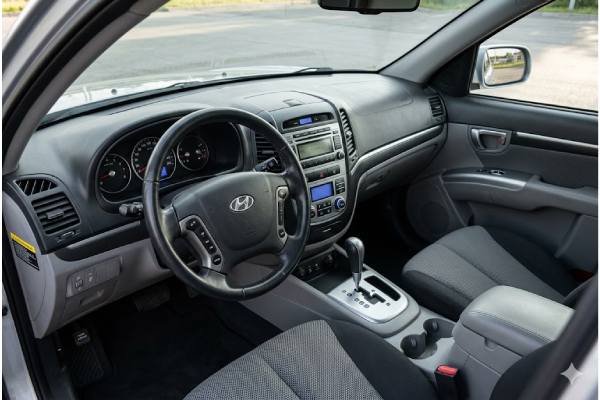

The 2005–2006 Hyundai Santa Fe FWD with the 2.7-liter V6 sits at an interesting point in Hyundai’s early crossover history. It is a first-generation SM Santa Fe, but with the later facelift styling and equipment updates, a naturally aspirated V6, a simple front-wheel-drive layout, and a mostly conventional mechanical package. For a used buyer, that combination can be appealing: fewer driveline parts than the 4WD version, good cabin space for its size, and a powertrain that is well understood by independent workshops.
It is also an older vehicle now, so condition matters more than trim badges. The strongest examples are the ones with documented timing-belt service, clean cooling systems, healthy automatic transmissions, completed recalls, and minimal corrosion around the suspension and underbody. The Santa Fe 2.7 V6 is not especially quick or fuel-efficient by modern standards, but it can still make sense as a practical, inexpensive SUV when bought carefully.
Owner Snapshot
- Comfortable five-seat cabin, useful cargo space, and a relaxed V6 character for daily use.
- FWD models avoid the added rear differential, transfer case, and prop-shaft maintenance of 4WD versions.
- Timing-belt history is critical; neglected belt service can turn an inexpensive SUV into a major repair.
- Typical engine oil service is every 7,500 miles / 12,000 km or 6 months under normal-use schedules.
- Check recall completion, especially front coil spring corrosion campaigns in salt-belt climates.
Table of Contents
- Santa Fe SM Used Context
- Santa Fe SM 2.7 V6 Specs
- Santa Fe SM Trims and Safety
- Reliability Issues and Recalls
- Maintenance and Buying Advice
- Road Manners and Performance
- Rival Comparisons and Verdict
Santa Fe SM Used Context
The 2005–2006 Santa Fe FWD 2.7 V6 belongs to the first-generation Hyundai Santa Fe, known by the SM platform code. It is a five-door unibody SUV/crossover with two rows of seating, a transverse front-mounted engine, and front-wheel drive in this version. The facelifted late-SM models kept the original Santa Fe’s rounded shape but added trim, interior, and equipment updates that made the vehicle feel more mature than the earliest 2001–2002 examples.
The engine is Hyundai’s Delta-family 2.7-liter V6, commonly identified as G6BA. It is an aluminum, naturally aspirated, 24-valve DOHC V6 with multi-point fuel injection. In North American specification, output is typically quoted at 170 hp and 181 lb-ft of torque. In some other markets, the same basic engine may be listed as 173 PS or 127 kW, with torque quoted around 245–250 Nm. Those differences are usually down to rating standards, market calibration, or unit conversion rather than a fundamentally different engine.
Most FWD 2.7 V6 examples use a 4-speed automatic transaxle. Some markets offered manual versions, but the automatic is the version most used buyers will encounter. Compared with the 4WD Santa Fe, the FWD model is mechanically simpler and usually lighter. It also avoids the maintenance burden of rear axle oil, transfer case oil, prop-shaft joints, and rear driveline vibration issues. The trade-off is reduced traction on snow, loose surfaces, and steep wet launches, especially with worn or low-quality tyres.
In daily use, the Santa Fe SM feels more like a tall wagon than a rugged truck. The seating position is upright, the doors are wide, and cargo access is easy. The V6 gives the vehicle smoother power delivery than the four-cylinder versions, although the old 4-speed automatic and the vehicle’s weight keep performance modest. It is best understood as a comfortable, practical, budget-minded SUV rather than a sporty crossover.
For used ownership, the main question is not whether the Santa Fe 2.7 V6 was a good design when new. It was competitive enough for its era. The real question is whether a particular example has survived two decades of heat cycles, winter salt, delayed maintenance, and inexpensive repairs. A well-kept FWD 2.7 V6 can still be useful. A neglected one can need timing-belt work, suspension parts, brake repairs, tyres, engine mounts, oxygen sensors, cooling system service, and corrosion repair all at once.
The best buyer profile is someone who values simple mechanicals and low purchase cost over modern efficiency, driver-assistance technology, and sharp handling. This Santa Fe is easy to understand, generally straightforward to service, and roomy for its footprint. It is not a modern Santa Fe in safety structure, crash-test coverage, infotainment, or fuel economy, so expectations need to match the vehicle’s age.
Santa Fe SM 2.7 V6 Specs
Specification data for this generation varies by market, trim, transmission, tyre package, and published standard. The tables below focus on the 2005–2006 facelift Santa Fe SM FWD with the 2.7 V6 and the common 4-speed automatic, using market-specific notes where necessary.
| Item | Hyundai Santa Fe FWD (SM) 2.7 V6 |
|---|---|
| Engine code | G6BA / Delta 2.7 V6 |
| Engine layout and cylinders | Transverse V6, 6 cylinders, DOHC, 4 valves per cylinder, 24 valves total |
| Bore × stroke | 86.7 × 75.0 mm (3.41 × 2.95 in) |
| Displacement | 2.7 L (2,656 cc / 162.1 cu in) |
| Induction | Naturally aspirated |
| Fuel system | Multi-point fuel injection |
| Compression ratio | About 10.0:1, market dependent |
| Max power | 170 hp (127 kW) @ 6,000 rpm |
| Max torque | 245 Nm (181 lb-ft) @ about 4,000 rpm |
| Timing drive | Timing belt |
| Rated efficiency | About 12.4 L/100 km city, 10.2 L/100 km combined, 7.6–8.6 L/100 km highway depending on EPA or market method; roughly 17 city / 23 highway mpg US for 2006 EPA adjusted data |
| Real-world highway at 120 km/h / 75 mph | Typically about 10.5–12.5 L/100 km (19–22 mpg US / 23–26 mpg UK), depending on tyres, load, wind, terrain, and engine condition |
| Item | Specification |
|---|---|
| Transmission | 4-speed torque-converter automatic transaxle, commonly F4A51 family; 5-speed manual in some non-U.S. markets |
| Drive type | FWD |
| Differential | Open front differential integrated with transaxle |
| Item | Specification |
|---|---|
| Front suspension | Independent MacPherson strut with coil springs and anti-roll bar |
| Rear suspension | Independent multi-link with coil springs |
| Steering | Hydraulic power-assisted rack and pinion; about 18.9:1 overall ratio in many specifications |
| Brakes | Front ventilated discs, rear solid discs; ABS availability varies by market and trim |
| Common brake disc sizes | Approx. 276–294 mm front and 284 mm rear, depending on market, wheel package, and parts listing |
| Wheels and tyres | Common size: 225/70 R16 on 16-inch wheels; some markets/trims differ |
| Ground clearance | About 206–207 mm (8.1 in), market dependent |
| Approach / departure angles | Approx. 28.4° / 26.0° in common published data |
| Length / width / height | 4,500 mm / 1,820 mm / 1,655–1,710 mm (177.1 in / 71.5 in / 65.2–67.3 in), height depending on roof rack and market |
| Wheelbase | 2,620 mm (103.1 in) |
| Turning circle | About 11.3 m (37.1 ft) kerb-to-kerb |
| Curb weight | Approx. 1,610–1,703 kg (3,549–3,752 lb), depending on market and equipment |
| GVWR | Often around 2,300–2,380 kg (5,070–5,247 lb) in published data; verify the door-label value by VIN |
| Fuel tank | 72 L (19.0 US gal / 15.8 UK gal) |
| Cargo volume | About 864 L (30.5 ft³) seats up and 2,200 L (77.7 ft³) seats folded in North American SAE-style listings; some VDA listings are lower |
| Item | Typical figure |
|---|---|
| 0–100 km/h / 0–62 mph | About 10.5–11.8 seconds, depending on transmission, test method, and load |
| Top speed | Approx. 175–182 km/h (109–113 mph) |
| 100–0 km/h braking distance | Not consistently published for the exact FWD 2.7; expect tyre and brake condition to dominate results on a used vehicle |
| Towing capacity | Approx. 1,000–1,360 kg (2,200–3,000 lb) braked depending on market, equipment, and cooling package; unbraked ratings are lower and market-specific |
| Payload | Approx. 380–680 kg (840–1,500 lb), depending on curb weight, GVWR, market label, and equipment |
| System | Specification and capacity |
|---|---|
| Engine oil | API SJ/SL or above, ILSAC GF-3 or above; SAE 5W-20 or 5W-30 all-temperature range. Capacity with filter: 4.5 L (4.76 US qt) |
| Coolant | Ethylene-glycol coolant for aluminum radiator, 50/50 mix recommended. Capacity: about 7.0 L (7.4 US qt) |
| Automatic transaxle fluid | Hyundai Genuine ATF SP-III or equivalent approved SP-III fluid. Total capacity about 8.5 L (8.98 US qt); drain-and-fill amount is usually lower |
| Differential / transfer case | Not applicable to FWD model; 4WD versions require separate service |
| Power steering | PSF-3 type fluid; about 0.9 L (0.95 US qt) |
| Brake fluid | DOT 3 or DOT 4; fill as required and renew by time/condition |
| A/C refrigerant | R-134a; commonly about 600 ± 25 g (21.2 ± 0.9 oz) for front A/C systems |
| A/C compressor oil | PAG 46; commonly about 150 mL (5.1 fl oz), verify by compressor and under-hood label |
| Key torque specs | Engine oil drain plug: 3.5–4.5 kgf·m, about 34–44 Nm (25–33 lb-ft). Oil filter: 1.2–1.6 kgf·m, about 12–16 Nm (9–12 lb-ft). Wheel nuts commonly about 88–108 Nm (65–80 lb-ft), depending on wheel and manual source |
| Item | Availability or rating |
|---|---|
| IIHS crashworthiness | Moderate overlap front: Good for applicable 2001–2006 models built after March 2001. Side: Acceptable for applicable 2002–2006 models built after March 2002. Head restraints and seats: Poor |
| Euro NCAP | No directly comparable modern percentage-style Euro NCAP result for this exact SM FWD 2.7 V6 configuration |
| Headlight rating | IIHS headlight ratings were not part of the rating format for this model year |
| ADAS | No AEB, ACC, lane keeping, blind-spot monitoring, rear cross-traffic alert, or traffic-sign assist on this generation |
| Passive and basic active safety | Dual front airbags, front side airbags on many later examples, 3-point belts, child-seat anchors, ABS/EBD depending on market and trim |
Santa Fe SM Trims and Safety
Trim names differ by country, but the 2.7 V6 FWD was commonly positioned as a mid-range or upper-mainstream Santa Fe rather than a bare fleet model. In North America, GLS was the most relevant trim for the 2.7 V6, while LX versions were often associated with the larger 3.5-liter V6. Canadian and other market names can vary, including GL, GL V6, GLS, Elite, and other local packages.
Typical equipment on a facelift-era 2.7 V6 can include alloy wheels, roof rails, air conditioning, cruise control, power windows and locks, keyless entry, split-folding rear seats, a CD audio system, and upgraded cloth trim. Higher trims or packages may add leather, sunroof, heated seats, automatic climate control, power driver’s seat, upgraded audio, privacy glass, or fog lamps. Because many of these vehicles are now old enough to have parts swapped between trims, equipment verification is more useful than relying only on badges.
Useful identifiers include the VIN, emissions label, under-hood engine family label, door certification label, and transmission tag where visible. The engine cover usually shows DOHC 24V, but that alone is not enough to distinguish every V6 variant across Hyundai/Kia applications. A buyer should confirm the 2.7 engine, FWD layout, transmission type, build date, and market specification before ordering parts.
The 2005 model year brought interior updates in several markets, including revised fabrics, trim finishes, and equipment changes. The 2006 model year was the last for the SM generation in many markets before the larger CM-generation Santa Fe arrived. This matters because parts listings sometimes blur late-SM and early-CM vehicles, especially for 2006. Always distinguish the rounded first-generation SM body from the larger second-generation CM body when buying brakes, suspension parts, lamps, body panels, and service items.
Safety equipment is age-sensitive. Many 2005–2006 examples have dual front airbags and front seat-mounted side airbags, but exact airbag count and availability depend on market, build date, and trim. ISOFIX/LATCH child-seat provisions are typically present for the rear seating positions in North American models. ABS may be standard on many V6 versions but should still be verified during inspection by checking the instrument cluster warning lamps and under-hood ABS hydraulic unit.
Crash-test interpretation needs care. The IIHS moderate-overlap front result is strong for the era, but it does not make the vehicle equivalent to a modern SUV. The side rating is acceptable, not excellent, and head restraint performance was poor in IIHS testing. Modern small-overlap tests, advanced side-impact tests, pedestrian tests, AEB tests, and headlight ratings either did not exist or were not applied to this vehicle in the same way.
There is no modern driver-assistance suite. No automatic emergency braking, adaptive cruise, lane centering, blind-spot monitoring, or rear cross-traffic alert should be expected. Stability control may be absent or market-specific, and even where traction-control-type systems exist, they are not substitutes for good tyres and careful driving. After steering, suspension, airbag, or body repairs, warning lights must be scanned properly. Older SRS and ABS systems can hide faults until the ignition bulb check or diagnostic scan reveals them.
Reliability Issues and Recalls
The 2.7 V6 Santa Fe is generally known as a serviceable, conventional vehicle, but age has become the main reliability issue. Most problems now come from deferred maintenance, worn rubber parts, heat-aged sensors, and corrosion rather than one single catastrophic design flaw. The table below maps common concerns by likelihood and potential cost.
| Issue | Prevalence | Severity / cost | Typical signs | Recommended response |
|---|---|---|---|---|
| Timing belt overdue | Common on poorly documented cars | High | No service record, belt age unknown, front engine covers disturbed, ticking/idler noise | Replace belt, tensioner, idlers, water pump where practical, and accessory belts |
| Front coil spring corrosion | Common concern in salt-belt areas | High safety risk | Broken spring end, uneven ride height, tyre rub, clunking | Check recall completion and inspect springs, struts, perches, and tyres |
| Automatic transmission shift flare or harsh shifts | Occasional | Medium to high | Delayed engagement, slipping, harsh 2–3 or 3–4 shift, dark ATF | Scan for codes, inspect mounts, service SP-III fluid, avoid universal-fluid mistakes |
| Oil leaks | Common with age | Low to medium | Burning-oil smell, wet valve covers, oil near timing cover or pan | Replace leaking gaskets and confirm timing-belt area is dry |
| Cooling system aging | Common | Medium | Coolant smell, crust at radiator seams, heater fluctuation, rising temperature | Pressure-test system, renew coolant, inspect radiator, hoses, cap, thermostat, and fans |
| Oxygen sensors / EVAP faults | Occasional | Low to medium | Check-engine light, fuel smell, failed emissions test, poor economy | Scan live data before replacing parts; inspect fuel cap, purge valve, hoses, and sensors |
| Suspension bushings and ball joints | Common with mileage | Medium | Knocks, vague steering, uneven tyre wear, wandering | Inspect control arms, stabilizer links, struts, rear links, and alignment |
| Wheel bearings | Occasional | Medium | Speed-related humming, vibration, ABS sensor faults | Confirm by road test and lift inspection; replace with quality hub/bearing parts |
| Underbody corrosion | Market dependent | Medium to high | Rust at subframes, brake lines, fuel lines, spring seats, sills, rear suspension mounts | Inspect on a lift before purchase; avoid severe structural corrosion |
The timing belt is the most important engine-specific maintenance item. The 2.7 V6 does not reward gambling on belt age. A complete timing service should include the belt, tensioner, idler pulleys, and a close look at the water pump and cam/crank seals. If coolant residue or oil contamination is present near the belt path, repair the leak before it shortens belt life.
The automatic transmission is durable when serviced correctly, but it is sensitive to fluid specification and neglect. Harsh shifts can come from old ATF, poor battery voltage, failing sensors, worn mounts, internal wear, or adaptive logic. A clean scan and proper road test are better than guessing. If the transmission bangs into gear, flares between shifts, or shows burnt fluid, the vehicle should be priced as a repair risk.
Several recall and service-action areas deserve attention. In the U.S., the major late-life issue is the front coil spring corrosion recall affecting many 2001–2006 Santa Fe vehicles in salt-belt states. The risk is serious because a fractured spring can contact and puncture the tyre. There were also occupant classification system campaigns affecting some 2005 vehicles, where the front passenger airbag classification logic could misidentify certain occupants. Recall status must be checked by VIN, not by model year alone.
Pre-purchase checks should include:
- VIN recall check and dealer record printout.
- Timing-belt invoice with mileage, date, and parts list.
- Cold start, hot restart, idle quality, and check-engine scan.
- ATF condition and shift behavior during light, medium, and kickdown acceleration.
- Lift inspection for spring corrosion, subframe rust, brake lines, fuel lines, and exhaust condition.
- Cooling-system pressure test if there is any coolant smell or temperature instability.
- SRS and ABS warning lamp bulb check, followed by a diagnostic scan.
A Santa Fe that passes those checks can be a sound budget vehicle. One that fails several of them should be treated as a project, even if it drives acceptably around the block.
Maintenance and Buying Advice
The Santa Fe 2.7 V6 responds well to routine maintenance, but skipping the major time-based items can erase its low purchase price quickly. Because many examples are now beyond the original warranty life several times over, maintenance should be based on current condition, service records, and use pattern, not only odometer readings.
| Item | Typical interval | Notes |
|---|---|---|
| Engine oil and filter | 7,500 miles / 12,000 km or 6 months under normal schedules; shorter for severe use | Use 5W-20 or 5W-30 meeting the required API/ILSAC level; check level regularly |
| Engine air filter | Inspect regularly; replace around 30,000 miles / 48,000 km or sooner in dusty use | A clogged filter hurts economy and throttle response |
| Cabin air filter | About 10,000–15,000 miles / 15,000–24,000 km or annually | Often forgotten; affects heater and A/C airflow |
| Timing belt | Replace around 60,000 miles / 96,000 km or by age if older | Replace belt-related components together; inspect for oil/coolant contamination |
| Spark plugs | About 60,000 miles / 96,000 km for platinum plugs in many schedules | Use correct heat range and gap; rear bank access adds labor |
| Coolant | Often 30,000 miles / 48,000 km or 24 months in older schedules | Use ethylene-glycol coolant suitable for aluminum components, typically 50/50 mix |
| Automatic transmission fluid | Inspect frequently; service about 30,000–60,000 miles / 48,000–96,000 km in severe use | Use approved SP-III fluid; avoid wrong universal-fluid substitutions |
| Brake fluid | Every 2–3 years, or sooner if moisture is high | Use DOT 3 or DOT 4; inspect calipers, hoses, and lines |
| Brake pads and rotors | Inspect every service | Check for rear disc corrosion, seized slide pins, and vibration under braking |
| Tyre rotation and alignment | Rotate about every 6,000–7,500 miles / 10,000–12,000 km | Alignment is important after struts, control arms, or suspension links |
| Auxiliary belts and hoses | Inspect every service; replace by cracking, glazing, swelling, or age | Best inspected during timing-belt and cooling-system work |
| 12 V battery | Test annually after 3 years; typical replacement window 4–6 years | Weak voltage can cause misleading electrical and shift complaints |
For buying, prioritize documentation over cosmetic shine. A clean-looking Santa Fe with no timing-belt record is still a risk. A slightly worn example with recent belt service, new tyres, fresh fluids, and no structural rust is usually the better purchase.
On inspection, start with the underbody. Look at front coil springs, strut seats, front subframe, rear suspension links, rocker seams, brake pipes, fuel lines, exhaust hangers, and rear wheel arches. Surface rust is expected in many climates; swelling metal, perforation, flaky spring seats, or heavily corroded brake lines are not minor details.
Next, inspect the powertrain. A healthy 2.7 V6 should start cleanly, settle into a smooth idle, and pull without misfire. Oil seepage from valve covers is common with age, but heavy leakage into the timing-belt area is more serious. Coolant should be clean, the heater should blow warm air steadily, and the radiator fans should cycle correctly. Any overheating history should be treated cautiously.
During the road test, the automatic should engage Drive and Reverse without a long delay. Shifts should be smooth rather than sharp or slipping. A mild old-automatic feel is normal; flare, banging, or shudder is not. Listen for front-end clunks over small bumps, wheel-bearing hum at steady speeds, brake pulsation, and steering wander.
Recommended versions are the cleanest, best-documented FWD 2.7 V6 examples with ABS, working air conditioning, complete recall records, and no severe corrosion. Avoid vehicles with unknown timing-belt age, persistent SRS lights, transmission slip, coolant loss, structural rust, mismatched tyres, or evidence of cheap accident repair.
Long-term durability is respectable when maintenance is current. The engine itself is not the weak link if the belt, oil, cooling system, and ignition components are handled on time. The main ownership risk is buying a deferred-maintenance vehicle because the initial price looks attractive.
Road Manners and Performance
The Santa Fe SM 2.7 V6 drives with the relaxed, slightly soft character typical of early-2000s family SUVs. It is easy to place in traffic, visibility is good, and the upright driving position helps in town. The suspension favors comfort over precision, so it absorbs rough pavement reasonably well but allows more body movement than a modern crossover. On worn struts or tired bushings, that softness can turn into float, knocking, or vague steering.
The hydraulic steering has a natural weight that many drivers still prefer over some modern electric systems, but it is not especially communicative. The Santa Fe turns predictably and feels stable in normal driving, yet it does not invite aggressive cornering. Tyres make a major difference. A good touring all-season tyre can calm road noise and improve wet braking, while cheap tyres can make the FWD model spin its inside front wheel on wet launches and feel less secure in emergency stops.
The 2.7 V6 is smooth and more pleasant than the four-cylinder engines when the vehicle is loaded. Its strength is mid-range refinement, not outright acceleration. Throttle response is progressive, and the engine is happiest when driven calmly. The 4-speed automatic is old-fashioned by current standards. It can hold lower gears on grades and downshift noticeably for passing, but there are fewer ratios to keep the engine in its ideal range. At highway speed, the V6 is generally composed, though wind and tyre noise are more obvious than in newer SUVs.
Real-world performance is adequate. Expect 0–100 km/h to fall roughly in the 10.5–11.8 second range depending on test method, road, temperature, and vehicle condition. Passing from 80–120 km/h requires planning, especially with passengers or cargo. The transmission will usually need a downshift, and the engine becomes audible when worked. This is normal, not necessarily a fault.
Fuel economy is the main everyday disadvantage. In city use, a healthy FWD 2.7 V6 commonly lands around 13–15 L/100 km, or roughly 16–18 mpg US. Mixed driving often falls around 11–12.5 L/100 km, or 19–21 mpg US. Gentle highway cruising at 100–110 km/h can be closer to 9–10.5 L/100 km, while 120 km/h cruising, roof accessories, hills, winter tyres, or headwinds can push consumption higher. Cold weather and short trips are especially hard on economy because the V6 warms more slowly and spends more time in enrichment.
Braking feel is straightforward when the system is fresh. However, on an older Santa Fe, braking quality depends heavily on rotor condition, caliper slide lubrication, brake-hose health, rear disc corrosion, tyre grip, and ABS operation. A soft pedal, vibration, or pulling under braking should be inspected before purchase.
Towing is possible within the market-specific rating, but this is not the Santa Fe’s strongest use case. Moderate trailers require careful attention to cooling-system health, transmission fluid condition, tyre load rating, tongue weight, and brake condition. Expect a noticeable fuel-consumption penalty and slower climbing on grades. FWD traction can also become a limitation on wet boat ramps, gravel campsites, or steep driveways.
Rival Comparisons and Verdict
Against its period rivals, the 2005–2006 Santa Fe 2.7 V6 FWD is best judged as a value-oriented used SUV. It does not have the polish of the best Japanese competitors, but it can be cheaper to buy and practical to maintain when parts availability is good.
The Toyota RAV4 of the era is usually more efficient and easier to park, but older RAV4s are smaller and often priced higher because of Toyota’s reputation. The Honda CR-V is more fuel-efficient and has excellent packaging, but four-cylinder versions do not offer the same V6 smoothness. The Ford Escape and Mazda Tribute V6 feel more energetic, but rust, transmission issues, and interior wear can be concerns depending on year and condition. The Kia Sorento of the same period is more truck-like and better suited to heavier towing in some versions, but it is less car-like and often thirstier.
The Santa Fe’s advantages are clear:
- Comfortable cabin for the money.
- Smooth V6 compared with four-cylinder rivals.
- Simple FWD driveline with fewer 4WD service items.
- Useful cargo space and easy access.
- Generally straightforward mechanical layout for independent repair.
Its disadvantages are just as clear:
- Fuel economy is poor by modern crossover standards.
- No modern ADAS or contemporary crash-test coverage.
- Timing-belt service is essential.
- Corrosion can be a serious issue in winter climates.
- Automatic transmission condition varies widely with maintenance history.
For a buyer choosing between a FWD and 4WD Santa Fe SM, the FWD version makes sense if the vehicle will mostly see urban, suburban, or highway use in mild climates. It is simpler, usually lighter, and avoids extra driveline service. The 4WD version is better for snow-prone areas or loose surfaces, but it brings more parts to inspect and maintain.
The final verdict is condition-first. A documented 2005–2006 Santa Fe FWD 2.7 V6 can be a sensible inexpensive SUV with decent comfort and simple ownership demands. It is not the right choice for someone expecting modern fuel economy, advanced safety technology, or sporty handling. It is the right choice when the price is fair, the underbody is solid, the timing belt is current, the automatic shifts properly, and recall status is clean.
References
- 2005 HYUNDAI SANTA FE 2005 (Manufacturer Specifications)
- Hyundai Owners manuals | Hyundai Motor UK 2026 (Owner’s Manual Index)
- Gas Mileage of 2006 Hyundai Santa Fe 2026 (Fuel Economy Database)
- 2006 Hyundai Santa Fe 2006 (Safety Rating)
- Part 573 Safety Recall Report 14V-435 2014 (Recall Database)
Disclaimer
This article is for informational purposes only and is not a substitute for professional diagnosis, repair, or inspection. Specifications, torque values, service intervals, fluids, procedures, and safety equipment can vary by VIN, market, build date, trim, and previous repair history. Always verify details against the official owner’s manual, service documentation, under-hood labels, door labels, and dealer VIN records before buying parts or performing repairs.
If this helped, please consider sharing it on Facebook, X/Twitter, or with another owner researching an older Santa Fe.