
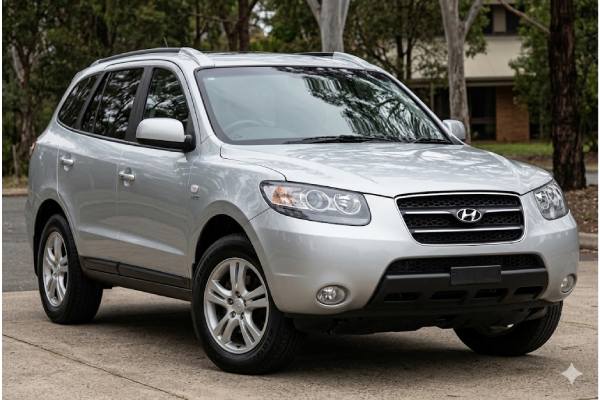
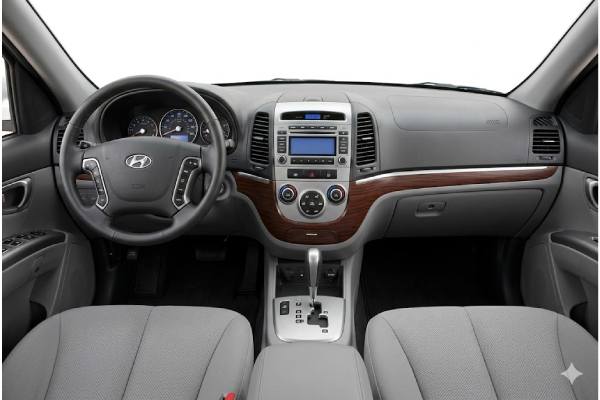
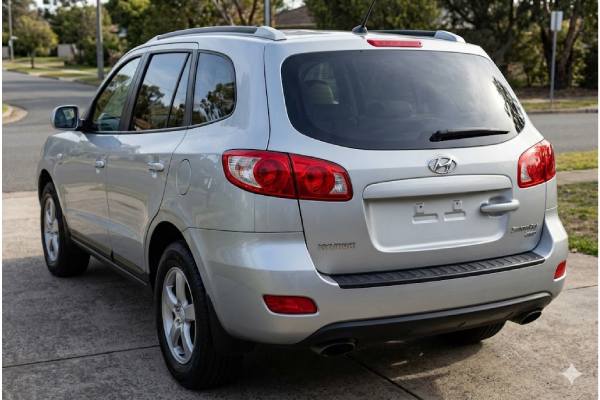
The CM-generation Hyundai Santa Fe with the 2.7-litre V6 sits in an interesting place on the used SUV market. It is not the quickest, most modern, or most fuel-efficient version of the Santa Fe, but it offers a simple naturally aspirated petrol engine, available 4WD traction, a practical cabin, and generally reasonable parts availability. For buyers who want a family-sized SUV without diesel emissions hardware or turbocharger complexity, the 2.7 V6 remains worth a careful look.
The important point is condition. These cars are now old enough that maintenance history, corrosion, timing-belt age, cooling-system health, and drivetrain fluid service matter more than trim badges. A well-kept Santa Fe CM 2.7 V6 can still feel sturdy and useful, but a neglected one can quickly become expensive.
Quick Overview
- Strong advantages include a smooth V6, practical cabin space, simple petrol powertrain, and useful on-demand 4WD traction.
- The 2.7 V6 is less complex than many diesels, with no turbocharger, DPF, or high-pressure common-rail diesel system to manage.
- The main ownership caveat is the timing belt: age matters as much as mileage, and skipped belt service is a serious risk.
- Fuel use is moderate to high for the power output, commonly around 10–13 L/100 km in mixed real-world driving.
- In many markets, the timing belt interval is around 120,000 km / 75,000 miles or 60 months, but the exact requirement must be checked against the VIN and local service schedule.
Table of Contents
- Santa Fe CM Used Overview
- Santa Fe CM 2.7 V6 Specs
- Santa Fe CM Trims and Safety
- Reliability, Issues and Recalls
- Maintenance and Buying Checks
- Driving Feel and Performance
- Santa Fe CM Rival Comparison
Santa Fe CM Used Overview
The Hyundai Santa Fe CM was the second generation of the Santa Fe nameplate and marked a major step away from the softer, more compact first-generation model. In 2.7 V6 4WD form, it is a five-door midsize SUV with a transverse petrol V6, front-biased on-demand 4WD, independent suspension at both ends, and either a 5-speed manual or a 4-speed automatic depending on market and trim. Many regions also offered diesel and larger V6 versions, so the exact 2.7 V6 specification must be separated from other Santa Fe CM variants.
The engine is Hyundai’s 2.7-litre Mu-family G6EA V6 in most listings for this version. It is naturally aspirated, uses multi-point fuel injection, and produces about 186 hp, or 189 PS, at 6,000 rpm in European-style ratings. Torque is roughly 245–248 Nm at 4,000 rpm. That gives the Santa Fe enough power for normal family use, but it is not a performance SUV. The engine’s appeal is smoothness and relative mechanical simplicity rather than outright thrust.
The 4WD system is best understood as all-weather traction assistance, not a heavy-duty off-road system. It normally behaves like a front-wheel-drive SUV and sends torque rearward when slip is detected. Some versions include a driver-selectable lock mode for low-speed slippery surfaces, but there is no low-range transfer case and no front or rear locking axle differential. It is well suited to snow, wet rural roads, gravel tracks, and light trail use, but it should not be treated like a body-on-frame off-roader.
As a used purchase, the Santa Fe CM 2.7 V6 makes the most sense for buyers who value space, comfort, simple petrol servicing, and lower purchase prices over fuel economy. Its main advantages are a roomy cabin, a fairly robust engine when maintained properly, decent towing ability in many non-US markets, and a less fragile feel than some crossover rivals of the same period. The downsides are clear too: fuel use is not light, the 4-speed automatic can feel dated, and deferred maintenance can erase the value advantage quickly.
The best examples are usually those with documented timing-belt service, clean coolant, smooth automatic shifts, quiet suspension, and proof that recall work has been completed. High-mileage cars are not automatically bad, but they need careful inspection for oil leaks, wheel-bearing noise, worn suspension arms, rear coupling or differential noise, and rust around the subframes, brake lines, sills, tailgate area, and rear suspension mounts.
Santa Fe CM 2.7 V6 Specs
Specifications vary by region, emissions certification, seating layout, wheels, transmission, and measuring standard. The figures below represent the common 2006–2009 Santa Fe CM 2.7 V6 4WD specification, with notes where market differences are important.
| Powertrain and efficiency | Santa Fe CM 2.7 V6 4WD |
|---|---|
| Engine code | G6EA / Mu 2.7 V6, market dependent |
| Engine layout | Transverse front-mounted V6 petrol |
| Cylinders / valvetrain | 6 cylinders, DOHC, 4 valves per cylinder, 24 valves total |
| Bore × stroke | 86.7 × 75.0 mm / 3.41 × 2.95 in |
| Displacement | 2.7 L / 2,656 cc |
| Induction | Naturally aspirated |
| Fuel system | Multi-point fuel injection |
| Compression ratio | Commonly listed around 10.1:1 to 10.4:1 by market data |
| Max power | 186 hp / 139 kW / 189 PS at 6,000 rpm |
| Max torque | About 245–248 Nm / 181–183 lb-ft at 4,000 rpm |
| Timing drive | Timing belt |
| Rated efficiency | About 10.4–10.6 L/100 km combined under many non-US test cycles; EPA 4WD automatic rating is 19 mpg US combined |
| Real-world highway at 120 km/h / 75 mph | Often about 10–12 L/100 km, depending on tyres, load, roof bars, wind, and transmission |
| Transmission and driveline | Details |
|---|---|
| Manual transmission | 5-speed manual on some markets |
| Automatic transmission | 4-speed automatic with manual shift mode on many versions |
| Drive type | Front-biased on-demand 4WD / AWD |
| Differential setup | Open front and rear differentials; electronically controlled centre coupling on 4WD models |
| Low-range gearing | Not fitted |
| Locking axle differentials | Not fitted |
| Chassis and dimensions | Typical figures |
|---|---|
| Front suspension | MacPherson struts, coil springs, anti-roll bar |
| Rear suspension | Independent multi-link, coil springs, anti-roll bar |
| Steering | Hydraulic power-assisted rack and pinion; around 3.2 turns lock-to-lock in some specifications |
| Front brakes | Ventilated discs, commonly around 298 mm / 11.7 in |
| Rear brakes | Solid discs, commonly around 302 mm / 11.9 in |
| Popular tyre size | 235/65 R17; 235/60 R18 on some higher trims |
| Ground clearance | Around 203 mm / 8.0 in in many specifications |
| Approach / departure / breakover | Around 25.6° / 22.9° / 18.4° where published |
| Length | About 4,650–4,680 mm / 183.1–184.3 in, market dependent |
| Width | 1,890 mm / 74.4 in |
| Height | About 1,720–1,795 mm / 67.7–70.7 in, depending on roof rails and measurement method |
| Wheelbase | 2,700 mm / 106.3 in |
| Turning circle | Around 10.9 m / 35.8 ft kerb-to-kerb |
| Kerb / curb weight | About 1,725–1,996 kg / 3,803–4,400 lb depending on transmission, seating, and market |
| GVWR | About 2,400–2,550 kg / 5,291–5,622 lb depending on configuration |
| Fuel tank | 75 L / 19.8 US gal / 16.5 UK gal |
| Cargo volume | About 774 L VDA seats up in some data; up to about 1,582–2,274 L seats folded depending on measurement method and seating layout |
| Performance and capability | Typical figure |
|---|---|
| 0–100 km/h / 0–62 mph | About 10.0–10.3 seconds |
| Top speed | About 190 km/h / 118 mph |
| 100–0 km/h braking distance | No single universal official figure; healthy examples on quality tyres are typically in the low-to-mid 40 m range |
| Towing capacity | Often 2,000 kg / 4,409 lb braked and 750 kg / 1,653 lb unbraked in many non-US markets; North American ratings may be lower for the 2.7 |
| Payload | Commonly around 600–700 kg / 1,323–1,543 lb depending on kerb weight and GVWR |
| Fluids and service capacities | Typical specification to verify by VIN |
|---|---|
| Engine oil | API SJ or later in many manuals; 5W-20, 5W-30, 10W-30, or market-specific grade; about 4.5 L / 4.8 US qt with filter |
| Coolant | Ethylene glycol-based long-life coolant, usually 50/50 premix; about 7.0–8.5 L / 7.4–9.0 US qt depending on heater and market |
| Automatic transmission fluid | Hyundai/Kia ATF SP-III type for the 4-speed automatic; total capacity often about 7.8–8.5 L / 8.2–9.0 US qt, less for drain-and-fill |
| Manual gearbox oil | Market-specific gear oil, commonly around 75W-85 or 75W-90; verify GL rating before filling |
| Transfer case and rear differential | Usually gear oil in the 75W-90 range; capacity is small, commonly around 0.5–1.0 L per unit depending on component |
| Brake fluid | DOT 3 or DOT 4, depending on manual and market |
| A/C refrigerant | R-134a; about 600 g / 21.2 oz for single A/C systems and about 850 g / 30.0 oz with rear evaporator in many filling charts |
| A/C compressor oil | PAG oil, often PAG46/FD46XG type; around 150–210 mL / 5.1–7.1 fl oz depending on A/C layout |
| Key torque values | Wheel nuts about 88–107 Nm / 65–79 lb-ft; oil drain plug often around 35–40 Nm / 26–30 lb-ft; verify fasteners in service data |
| Safety and driver assistance | Availability |
|---|---|
| Airbags | Dual front, front side, and curtain airbags on many trims; availability varies by region and early base trim |
| ABS / EBD | Commonly fitted; standard in many markets |
| Stability control / traction control | Standard or trim-dependent depending on region and model year |
| IIHS rating | Good in moderate overlap front, side, and head restraint tests for the tested 2007–2012 CM range as applicable |
| Euro NCAP / old scheme | Period data is generally under the pre-2009 star system rather than current percentage scoring; commonly listed as 4-star adult, 3-star child, and 0-star pedestrian for the 2006-era CM test |
| Headlight rating | Modern IIHS headlight ratings were not part of the original 2006–2009 assessment framework |
| ADAS | AEB, adaptive cruise, lane keeping, blind-spot monitoring, rear cross-traffic alert, and traffic-sign assist were not typical equipment on this generation |
Santa Fe CM Trims and Safety
Trim names depend heavily on market. In North America, the 2.7 V6 was mainly associated with GLS versions, while SE and Limited grades often used the larger 3.3 V6. In the UK, Australia, and other right-hand-drive or European-influenced markets, names such as CDX, CRTD/CDX for diesels, SX, SLX, and Elite may appear, and the petrol V6 could be paired with different seating and equipment packages. This is why the badge on the tailgate is only a starting point; the VIN plate, build sheet, handbook pack, and option codes tell the full story.
The most useful quick identifiers are practical ones. A 2.7 V6 car should have a petrol V6 engine bay layout rather than the 2.2 CRDi diesel, no diesel particulate filter hardware, and a timing-belt-driven front engine cover arrangement. 4WD models may have an AWD or 4WD badge, rear differential hardware, rear driveshafts, a transfer unit, and, on some versions, a lock switch for low-speed traction assistance. Manual cars are less common in some regions, while automatic 4WD versions are easier to find.
Equipment varied widely, but common comfort and convenience items included alloy wheels, air conditioning or climate control, cruise control, roof rails, heated mirrors, power windows, remote locking, trip computer, fog lamps, leather trim on higher versions, heated front seats, upgraded audio, and optional sunroof. Seven-seat versions were available in many regions, but not every 2.7 V6 4WD was a seven-seater. Third-row seats reduce underfloor storage and add weight, so a five-seat model may feel slightly lighter and simpler.
Safety equipment also depends on year and region. The strongest versions of the CM generation came with anti-lock brakes, electronic brake-force distribution, brake assist, stability control, traction control, front airbags, front side airbags, side curtain airbags, active front head restraints, tyre-pressure monitoring in some markets, and ISOFIX/LATCH child-seat provisions. Some early or lower-grade models in certain markets did not have the full equipment set, so do not assume every car has the same airbag and stability-control package.
Crash-test results are generally respectable for the period but must be read in context. The IIHS-rated CM Santa Fe performed well in the original moderate-overlap, side, and head-restraint tests for the applicable 2007–2012 range. However, this generation predates small-overlap testing, modern pedestrian AEB tests, current headlight ratings, and most modern active safety expectations. Euro NCAP-style data for the 2006-era car comes from an older star-based assessment, so it should not be compared directly with a 2020s five-star rating.
The Santa Fe CM also lacks modern ADAS. There is no factory AEB, adaptive cruise control, lane centering, traffic-sign recognition, or 360-degree camera system on the 2006–2009 2.7 V6. Parking sensors or a reversing camera may appear on some trims or aftermarket installations, but they are not equivalent to a modern calibrated driver-assistance suite. After windscreen, airbag, seat, steering, or brake repairs, make sure warning lights go out normally and that no airbag, ABS, or ESC fault codes are stored.
Reliability, Issues and Recalls
The 2.7 V6 Santa Fe CM is generally a straightforward vehicle, but it is now old enough that age-related deterioration is the main reliability story. Engine failures are less common than maintenance failures. The cars that last best usually have frequent oil changes, fresh coolant, documented timing-belt work, serviced transmission and AWD fluids, clean grounds and connectors, and no long-term coolant or oil leaks.
| Issue area | Prevalence | Severity / cost | Symptoms | Likely cause and remedy |
|---|---|---|---|---|
| Timing belt overdue | Common on neglected cars | High | Noisy front cover, unknown history, rough running after belt slip | Replace belt, tensioner, idlers, and usually water pump; do not gamble on age |
| Oil leaks | Occasional to common | Low to medium | Burning smell, oil on undertray, wet valve covers | Valve-cover gaskets, cam/crank seals, oil-pan seepage; reseal correctly |
| Cooling-system ageing | Occasional | Medium to high | Overheating, sweet smell, coolant loss | Radiator, hoses, thermostat, water pump, cap, or neglected coolant; pressure-test before purchase |
| Automatic shift flare or harshness | Occasional | Medium | Delayed engagement, harsh 2–3 shift, dark ATF | Old fluid, solenoid/body wear, mounts, or internal wear; service fluid only if no severe damage |
| AWD coupling or rear driveline noise | Occasional | Medium | Binding, humming, rear clunk, vibration | Old gear oil, worn propshaft support, rear differential wear, coupling faults |
| Wheel bearings | Common with age | Medium | Speed-related hum, change in noise when turning | Replace bearing/hub assembly and check tyre wear |
| Suspension bushings and links | Common | Low to medium | Knocks, wandering, uneven tyre wear | Worn control-arm bushes, anti-roll links, strut mounts, ball joints |
| Brake switch faults | Known recall / campaign area | Low if recall covered | Brake lights fail, ESC light, shifter stuck in Park, cruise issues | Verify recall completion; replace stop-lamp switch if affected |
| Occupant classification faults | Recall / service action area | Medium safety concern | Passenger airbag warning or classification issue | Dealer software recalibration or campaign remedy where applicable |
| Corrosion | Climate dependent | Low to high | Rusted brake lines, subframe rust, seized bolts | Inspect underside, rear suspension mounts, sills, fuel/brake lines, tailgate seams |
The timing belt is the most important single maintenance item. The 2.7 V6 is a belt-driven engine, and an unknown belt should be treated as due unless there is proof of replacement. A smart belt service normally includes the belt, hydraulic or mechanical tensioning components as applicable, idlers, water pump, accessory belts, and fresh coolant. Buyers should be cautious of sellers who say “the belt looks fine” without receipts; visual condition is not enough.
Engine oil leaks are usually manageable but can become messy. Valve-cover gaskets may leak onto hot surfaces, while front crank or cam seals often show up during timing-belt inspection. Oil contamination on the timing belt area is a warning sign because it can shorten belt life. Cooling problems deserve equal attention: old radiators, swollen hoses, weak caps, stuck thermostats, and neglected coolant can turn a simple SUV into an overheating risk.
The automatic transmission is not sophisticated by modern standards, but it should shift smoothly when warm. A slight old-school feel is normal; flare, bang shifts, delayed reverse, or dark burnt ATF is not. The 4WD driveline should be quiet. A low-speed clunk can come from mounts, rear diff bushes, prop-shaft joints, or suspension, while a hum may come from tyres, wheel bearings, or the rear differential.
Service actions and recalls differ by country and VIN. Important headline areas include stop-lamp switch replacement campaigns on various Hyundai models, occupant classification system recalibration on some 2007–2009 Santa Fe vehicles, and ABS module-related fire-risk campaigns on certain early CM vehicles in some markets. The only safe way to confirm completion is an official VIN recall check plus dealer service records.
For a pre-purchase inspection, ask for:
- Timing belt and water pump invoice with date, mileage, and parts listed.
- Proof of brake switch, OCS, ABS, and other recall completion where applicable.
- Transmission, transfer case, and rear differential fluid history.
- Coolant service history and evidence of no overheating.
- Underside inspection photos, especially in snowy or coastal climates.
- A diagnostic scan showing no active ABS, airbag, transmission, or engine fault codes.
Maintenance and Buying Checks
A Santa Fe CM 2.7 V6 should be maintained as an ageing mechanical SUV, not as a disposable cheap vehicle. The purchase price may be low, but it still has a V6 engine, 4WD hardware, independent suspension, and age-sensitive rubber, seals, and electronics.
| Item | Practical interval | Notes |
|---|---|---|
| Engine oil and filter | 10,000–12,000 km / 6,000–7,500 miles or 6–12 months | Use the correct viscosity for climate and market; shorten interval for short trips, towing, heat, or high mileage |
| Engine air filter | 15,000–30,000 km / 10,000–20,000 miles | Replace sooner in dusty regions |
| Cabin air filter | 12 months or 15,000–20,000 km | Often neglected; affects HVAC flow |
| Spark plugs | Around 90,000–100,000 km / 60,000 miles, depending on plug type | Use correct heat range and torque; rear bank access adds labour |
| Timing belt | Often around 120,000 km / 75,000 miles or 60 months | Replace immediately if history is unknown; include tensioners, idlers, and water pump |
| Coolant | 3–5 years, depending on coolant specification | Flush if contaminated or unknown; check radiator and hoses |
| Automatic transmission fluid | 50,000–80,000 km / 30,000–50,000 miles in severe use | Use only the correct ATF type; avoid universal fluid unless approved |
| Manual gearbox oil | 80,000–100,000 km / 50,000–60,000 miles | Verify oil specification before filling |
| Transfer case / rear differential oil | 50,000–80,000 km / 30,000–50,000 miles | Shorten interval for towing, water crossings, or heavy winter use |
| Brake fluid | Every 2 years | Moisture-contaminated fluid corrodes components and lowers boiling point |
| Brake pads / rotors | Inspect every service | Rear brakes may suffer corrosion if the vehicle sits |
| Tyre rotation | 8,000–12,000 km / 5,000–7,500 miles | Important for AWD coupling health and tyre noise control |
| Wheel alignment | Annually or after suspension work | Uneven wear is common with worn bushes |
| Drive belts and hoses | Inspect every service; replace by condition | Replace cracked belts and swollen hoses before trips |
| 12 V battery | Test annually after 4 years | Weak batteries cause misleading electrical faults |
For buyers, the inspection should start underneath. Look at subframes, rear trailing-arm areas, brake pipes, fuel lines, exhaust hangers, the spare wheel well, sill seams, and the lower tailgate. Surface rust is expected on many old SUVs, but heavy flaking around suspension mounts or brake lines can make the car uneconomical.
In the engine bay, check for coolant crust around the radiator, thermostat housing, hose ends, and water pump area. Listen for belt chirp, pulley noise, ticking from cold start, and misfires under load. A smooth idle and clean acceleration are good signs. The oil should not smell heavily of fuel, and the coolant should not show oil contamination.
During the road test, use light throttle, moderate throttle, and a full kickdown if road conditions allow. The transmission should engage Drive and Reverse promptly, shift without slipping, and avoid harsh flares once warm. On a tight slow turn, listen for binding or clunks from the rear driveline. At highway speed, note steering vibration, tyre roar, wheel-bearing hum, and whether the vehicle tracks straight.
The best trim to buy is usually not the most luxurious one; it is the cleanest, best-documented example. A higher-spec car with leather, sunroof, seven seats, 18-inch wheels, and extra electronics may be attractive, but it also has more age-related failure points. A simpler 17-inch-wheel example with complete maintenance records can be the better long-term ownership choice.
Long-term durability is fair to good when the car is maintained correctly. The 2.7 V6 itself is not highly stressed, but it depends on timely belt service, clean oil, and healthy cooling. At this age, budget for catch-up maintenance after purchase unless the seller has already done it with receipts.
Driving Feel and Performance
The Santa Fe CM 2.7 V6 drives like a comfort-focused midsize SUV from the late 2000s. It feels more settled and grown-up than the first-generation Santa Fe, with better cabin space, more stable highway manners, and a more substantial structure. It is not sporty, but it is easy to live with when the suspension and tyres are in good condition.
The V6 is smooth and predictable. It does not deliver the low-rpm surge of the diesel or the stronger top-end pull of the larger 3.3 V6, but it responds cleanly and avoids the lag or vibration associated with some older diesel SUVs. Around town, throttle response is gentle and manageable. On faster roads, it needs revs for confident passing, especially with passengers, luggage, roof bars, or a trailer.
Manual versions feel more direct and can make better use of the engine’s modest torque, but many used examples are automatics. The 4-speed automatic is durable when serviced, but it dates the driving experience. It may hold lower gears on hills, kick down audibly when asked for acceleration, and feel busier than a modern 6-speed or 8-speed automatic. Smooth shifts are normal; hunting, slipping, or banging is not.
Ride quality is one of the Santa Fe’s stronger traits. On 17-inch wheels with quality tyres, it absorbs rough roads well and feels relaxed over broken surfaces. Larger wheels can sharpen impacts and increase tyre noise. Worn rear shocks, tired control-arm bushes, and cheap tyres make a big difference, so a poor-driving example should not automatically be blamed on the design.
Handling is safe rather than sharp. The steering is moderately weighted but not especially communicative. Body roll is present, and quick direction changes remind you that this is a family SUV. Straight-line stability is good when the alignment is correct. Braking feel is adequate, though brake condition varies widely on used cars; old fluid, corroded rear discs, seized sliders, and budget tyres can all make the car feel worse than it should.
Real-world economy is the main compromise. In urban use, expect roughly 13–15 L/100 km, or about 16–18 mpg US / 19–22 mpg UK. Mixed use often lands near 10–13 L/100 km, or about 18–24 mpg US / 22–28 mpg UK. Steady highway driving at 100–110 km/h can be more reasonable, but 120 km/h, hills, winter tyres, and roof bars increase consumption. Cold weather and short trips can push fuel use significantly higher because the V6 takes time to warm fully.
Towing ability is useful in markets where the 2.7 V6 4WD is rated up to 2,000 kg braked, but the engine is not effortless with a heavy trailer. Expect more downshifts, higher fuel consumption, and slower climbs on long grades. Cooling-system condition, transmission fluid health, brake condition, trailer brakes, tyre load rating, and towball download matter more than the headline number. For regular heavy towing, the larger V6 or diesel versions may be better suited.
In snow and rain, the 4WD system adds confidence, especially with proper tyres. It helps the vehicle pull away and maintain traction on slippery roads, but it does not shorten braking distances or overcome worn tyres. The Santa Fe is at its best as a calm all-weather family SUV, not a performance machine or rock-crawling 4×4.
Santa Fe CM Rival Comparison
The Santa Fe CM 2.7 V6 competes with older midsize SUVs and crossovers such as the Toyota RAV4 V6, Honda CR-V, Kia Sorento, Nissan X-Trail, Mitsubishi Outlander, Chevrolet Captiva, Subaru Forester, and larger family SUVs from the same era. Its appeal depends on what the buyer values most.
| Rival | Where the Santa Fe is stronger | Where the rival may be stronger |
|---|---|---|
| Toyota RAV4 V6 | More spacious-feeling cabin in some versions; often cheaper used | RAV4 V6 is much quicker and has strong reliability reputation |
| Honda CR-V | Smoother V6 power and better towing in some markets | CR-V is usually more economical and easier to service |
| Kia Sorento | More car-like ride and family practicality | Older Sorento is more rugged for towing/off-road use in some versions |
| Nissan X-Trail | More refined cabin and smoother engine | X-Trail can be lighter, simpler, and cheaper to run |
| Mitsubishi Outlander | Comfortable ride and available seven-seat layouts | Outlander may feel more agile and economical depending on engine |
| Chevrolet Captiva | Often better perceived build quality and drivetrain smoothness | Captiva may offer diesel availability and lower purchase price |
| Subaru Forester | Larger cabin and stronger towing in many specifications | Forester has better handling and permanent AWD character |
Compared with a Toyota or Honda, the Hyundai often wins on value and equipment for the money. Compared with a Subaru, it feels larger and softer, but less agile. Compared with ladder-frame SUVs, it is more comfortable and easier to drive daily, but less capable off-road. Compared with modern crossovers, it lacks safety technology, infotainment, fuel efficiency, and gearbox refinement, but it is mechanically simpler and often much cheaper to buy.
The strongest argument for this Santa Fe is not that it beats every rival on paper. It does not. The argument is that a clean, documented 2.7 V6 4WD can be a practical, comfortable, relatively simple used SUV with useful traction and manageable repair costs. Its biggest advantages are space, smoothness, mature road manners, and a drivetrain that avoids diesel-specific complications.
The weakest argument is fuel economy. Anyone expecting compact-crossover running costs will be disappointed. The 2.7 V6 also needs serious preventive maintenance, especially the timing belt and fluids. Buying the cheapest example with no service history is rarely a bargain.
A good Santa Fe CM 2.7 V6 4WD is worth considering when it has a clean underside, smooth driveline, documented belt service, working safety systems, good tyres, and no evidence of overheating. A poor one should be avoided even if it looks inexpensive, because the cost of catching up on a neglected V6 4WD SUV can exceed the vehicle’s market value very quickly.
References
- Hyundai Owners manuals | Hyundai Motor UK 2026 (Owner’s Manual)
- Hyundai Santa Fe (CM) 2.7i V6 4WD Specs, Performance, Comparisons 2026 (Technical Specifications)
- Gas Mileage of 2009 Hyundai Santa Fe 2009 (Fuel Economy)
- 2009 Hyundai Santa Fe 2009 (Safety Rating)
- Check for Recalls: Vehicle, Car Seat, Tire, Equipment 2026 (Recall Database)
Disclaimer
This article is for informational purposes only and is not a substitute for professional diagnosis, repair, inspection, or official service information. Specifications, torque values, fluid capacities, service intervals, recall applicability, and procedures can vary by VIN, market, production date, transmission, trim, and equipment. Always verify critical information against the official service documentation for the exact vehicle before carrying out maintenance or repairs.
Please share this article on Facebook, X/Twitter, or other platforms if it helped you compare, maintain, or evaluate the Hyundai Santa Fe CM 2.7 V6 4WD.