
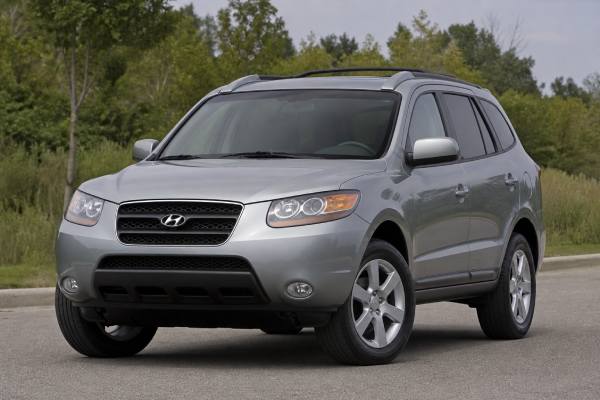
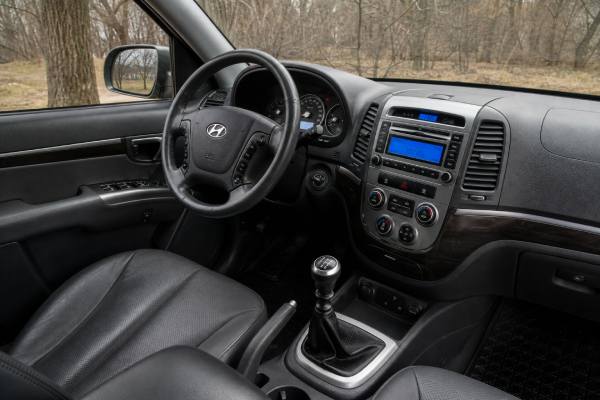
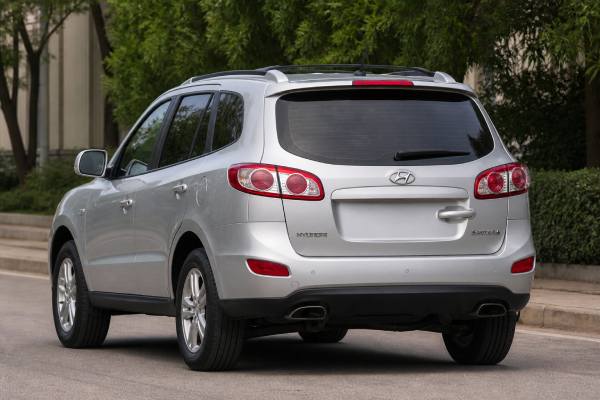
The 2007–2009 Hyundai Santa Fe AWD with the 2.7-liter V6 sits in a practical middle ground: large enough for family use, simple enough to maintain without modern turbocharging or direct injection, and old enough that condition now matters more than brochure equipment. In CM-generation form, this Santa Fe is a unibody crossover rather than a traditional body-on-frame SUV, so its strengths are comfort, winter traction, cargo space, and everyday usability rather than heavy towing or off-road punishment.
The 2.7 V6 version is usually the lower-output engine compared with the 3.3 V6 offered in the same generation, but it has an appealing ownership profile for buyers who value simplicity. Its timing belt, automatic transmission fluid, AWD transfer case oil, rear differential oil, cooling system, suspension wear, and safety recalls deserve close attention before purchase.
Quick Specs and Notes
- Naturally aspirated 2.7-liter V6 with 185 hp, smooth delivery, and less complexity than turbocharged engines.
- AWD adds useful wet-weather and winter traction, including a driver-selectable lock mode for low-speed slippery conditions.
- Standard stability control, ABS, side-curtain airbags, and strong period crash-test results make it reassuring for its age.
- The timing belt is a major ownership item: normal replacement is typically every 75,000 miles or 60 months.
- Severe-use oil service can be as short as 3,000 miles or 3 months; normal use is commonly 7,500 miles or 12 months.
Table of Contents
- Hyundai Santa Fe CM AWD Brief
- Hyundai Santa Fe CM Technical Specs
- Hyundai Santa Fe CM Trims and Safety
- Reliability Issues and Service Actions
- Maintenance and Used Buyer Checks
- Driving Performance and Economy
- Santa Fe CM Against Rivals
Hyundai Santa Fe CM AWD Brief
The CM-generation Hyundai Santa Fe was sold from the late 2000s as Hyundai’s larger family crossover, positioned above the Tucson and aimed at buyers who wanted SUV practicality without the rougher ride and fuel use of a truck-based vehicle. The version covered here is the 2007–2009 Santa Fe AWD with the 2.7-liter V6, rated at 185 hp. In North American terms, this was most closely associated with the GLS trim, although trim names and standard equipment varied by market.
Mechanically, this Santa Fe uses a transverse front-mounted V6, front-biased all-wheel drive, and either a 5-speed manual or a 4-speed automatic depending on year, market, and configuration. In practice, most used AWD 2.7 V6 examples are automatic. The AWD system is an on-demand setup that normally behaves like a front-drive vehicle, then sends torque rearward when slip is detected. A lock mode can hold a 50:50 front-to-rear torque split at low speeds, which is useful on snow, mud, steep gravel driveways, or loose surfaces.
The 2.7 V6 is not the quickest Santa Fe engine of the period. Buyers who regularly tow, climb mountain grades fully loaded, or want stronger highway passing will notice the gap between this engine and the 3.3 V6. But the 2.7 has advantages: no turbocharger, no gasoline direct injection, no complex hybrid hardware, and a relatively conventional service layout. The main tradeoff is the timing belt, which must be replaced on schedule. A neglected belt is not a minor maintenance delay; it can turn a usable SUV into an expensive repair.
As a used vehicle, the Santa Fe CM is best judged by evidence rather than mileage alone. A 130,000-mile example with documented timing belt, coolant, transmission fluid, transfer case oil, rear differential oil, and recall completion can be a better buy than a lower-mileage example with vague history. The common age-related weak points are not unusual for a crossover of this era: suspension bushings, wheel bearings, oil leaks, cooling hoses, brake corrosion, AWD driveline fluid neglect, and electrical issues related to sensors or safety-system recalls.
Its everyday appeal remains clear. The cabin is roomy, visibility is good, the cargo area is useful, and the ride is more relaxed than sporty. With the second row folded, it can carry bulky household loads that smaller compact SUVs struggle with. It is also easier to park and less thirsty than many traditional seven-seat SUVs, though the 2.7 AWD still uses a meaningful amount of fuel by modern standards.
For buyers, the best use case is simple: winter-capable family transport with sensible running costs, provided maintenance records are strong. The weakest use case is buying the cheapest example available and assuming Hyundai simplicity will overcome years of deferred service.
Hyundai Santa Fe CM Technical Specs
The figures below apply primarily to the 2007–2009 Hyundai Santa Fe CM AWD 2.7 V6 in North American-style specification. Exact values can vary by market, trim, transmission, seating layout, emissions equipment, tyres, and production date, so VIN-specific service data remains the final authority.
| Item | Hyundai Santa Fe AWD 2.7 V6 |
|---|---|
| Engine code / family | Hyundai Mu-series V6, commonly identified as G6EA |
| Engine layout | Transverse V6, 6 cylinders, DOHC, 4 valves per cylinder |
| Bore × stroke | 86.7 × 75.0 mm (3.41 × 2.95 in) |
| Displacement | 2.7 L (2,656 cc) |
| Induction | Naturally aspirated |
| Fuel system | Multi-point fuel injection |
| Compression ratio | About 10.1:1, depending on market data source |
| Maximum power | 185 hp (138 kW) @ 6,000 rpm |
| Maximum torque | 248 Nm (183 lb-ft) @ about 4,000 rpm |
| Timing drive | Timing belt |
| Official economy, AWD | About 13.8 city / 10.2 highway / 12.4 combined L/100 km; 17 / 23 / 19 mpg US; 20.4 / 27.6 / 22.8 mpg UK |
| Real-world highway at 120 km/h | Typically about 9.8–11.5 L/100 km when healthy, lightly loaded, and running suitable tyres |
| Item | Typical specification |
|---|---|
| Transmission | 5-speed manual or 4-speed automatic with manual shift mode, depending on market and build |
| Drive type | Electronically controlled on-demand AWD |
| Differentials | Open differentials with electronic traction and stability control support |
| Front suspension | MacPherson strut |
| Rear suspension | Multi-link independent |
| Steering | Hydraulic rack-and-pinion; about 35.8 ft turning circle |
| Brakes | Four-wheel disc brakes; exact rotor diameter varies by market and parts catalog |
| Common tyre size | 235/70 R16 on many GLS models; larger wheels on higher trims and some packages |
| Ground clearance | About 206 mm (8.1 in) |
| Length / width / height | About 4,676 / 1,890 / 1,725–1,796 mm (184.1 / 74.4 / 67.9–70.7 in) |
| Wheelbase | 2,700 mm (106.3 in) |
| Curb weight | About 1,760–1,785 kg (3,880–3,935 lb), depending on transmission and equipment |
| Fuel tank | 75 L (19.8 US gal / 16.5 UK gal) |
| Cargo volume | About 968 L seats up / 2,214 L seats folded; 34.2 / 78.2 ft³ by SAE-style figures |
| Metric | Typical value |
|---|---|
| 0–100 km/h | Roughly 10.5–11.5 seconds, depending on transmission, tyres, load, and test method |
| Top speed | About 180–190 km/h (112–118 mph), market dependent |
| 100–0 km/h braking | Typically around 42–45 m (138–148 ft) when tyres and brakes are in good condition |
| Braked towing | Commonly 907–1,270 kg (2,000–2,800 lb), depending on market, equipment, hitch, and cooling package |
| Unbraked towing | Often around 750 kg (1,650 lb) where local rules permit; verify market documentation |
| Payload | Typically about 600–750 kg (1,320–1,650 lb), depending on GVWR and curb weight |
| System | Specification and capacity |
|---|---|
| Engine oil | API SJ/SL or higher and ILSAC GF-3 or higher; 5W-20 or 5W-30 commonly preferred; about 4.5 L (4.8 US qt) with filter |
| Coolant | Ethylene-glycol coolant suitable for aluminum engines; 50/50 mix typical, 35–60% concentration range; about 8.4 L (8.9 US qt) |
| Automatic transmission fluid | Hyundai/Kia SP-III type fluid for the 4-speed automatic; total fill about 8.5 L (9.0 US qt), service fill lower |
| Transfer case and rear differential | Hypoid gear oil to the specified grade; typical capacities are roughly 0.8–0.9 L each, depending on unit |
| A/C refrigerant | R134a; commonly about 600 g without rear evaporator or 850 g with rear evaporator, label dependent |
| A/C compressor oil | PAG-type oil; commonly about 150–210 mL depending on rear A/C equipment |
| Key torque values | Engine oil drain plug about 39 Nm (29 lb-ft); wheel nuts commonly 90–110 Nm (66–81 lb-ft), depending on wheel and market data |
| Area | Equipment or rating |
|---|---|
| IIHS results | Top Safety Pick for the period; Good moderate-overlap front, Good side on applicable builds, Good head restraints and seats |
| NHTSA-style period results | Strong frontal and side-impact performance for its class, with rollover ratings typical of midsize SUVs of the era |
| Airbags | Dual front airbags, front seat-mounted side airbags, and side-curtain airbags for outboard occupants |
| Chassis safety systems | ABS, Electronic Brake-force Distribution, Brake Assist, Electronic Stability Control, traction control, and tyre-pressure monitoring |
| ADAS | No modern AEB, adaptive cruise, lane centering, blind-spot monitoring, or cyclist detection on this 2007–2009 configuration |
| IIHS headlight rating | Not rated under the later IIHS headlight test program |
The key technical point is that this is an older, mechanically conventional crossover. It does not have today’s active driver-assist package or fuel-saving hybrid hardware, but it also avoids many of the complex systems that can make newer used SUVs expensive outside warranty.
Hyundai Santa Fe CM Trims and Safety
For the 2007–2009 period, the 2.7 V6 was most commonly linked with the GLS grade in North America, while the more powerful 3.3 V6 appeared in upper trims such as SE and Limited. This matters when comparing used listings, because many Santa Fe CM examples advertised as AWD may not share the same engine, transmission, wheel package, towing equipment, or interior specification.
A typical 2.7 GLS AWD can be identified by the smaller V6 engine, simpler interior trim, 16-inch wheel package on many examples, and absence of the higher-output 3.3-liter badging or equipment associated with SE and Limited models. Depending on year and market, GLS equipment could include air conditioning, power windows and locks, cruise control, keyless entry, tilt-and-telescoping steering wheel, CD audio, roof rails, and cloth upholstery. Popular and Premium-style packages may add convenience equipment such as upgraded audio, power driver seat, sunroof, or additional interior features.
The 2009 model year brought useful equipment updates across the Santa Fe range, including improved audio availability and USB/iPod-style connectivity on many configurations. Upper trims received additional convenience items, but not all of those apply to the 2.7 AWD version. When inspecting a specific vehicle, avoid assuming equipment from a Limited or SE brochure applies to a GLS 2.7. The safest approach is to verify the VIN, window sticker, build plate, and actual installed equipment.
Mechanically, the most important trim-related differences are engine, transmission, wheels, towing equipment, and cooling provisions. The 3.3 V6 versions are stronger and often better equipped for heavier use, while the 2.7 V6 is simpler but less powerful. Wheel and tyre packages also matter: 16-inch tyres are usually cheaper, quieter, and better cushioned; larger wheels can sharpen response slightly but may increase replacement cost and ride firmness.
On safety, the Santa Fe CM was strong for its time. Standard Electronic Stability Control was a major advantage in the late 2000s, especially on an AWD family crossover. The vehicle also used ABS, Brake Assist, Electronic Brake-force Distribution, front airbags, front side airbags, side-curtain airbags, active front head restraints, and tyre-pressure monitoring. Child-seat provisions include LATCH/ISOFIX-style anchor points for compatible seating positions, although the exact layout depends on market and seating configuration.
There are two important safety caveats. First, this Santa Fe does not have the modern driver-assistance systems now expected on newer family SUVs. Automatic emergency braking, adaptive cruise control, lane keeping, traffic-sign recognition, and blind-spot systems were not part of this 2.7 AWD package. Second, recall completion matters. Airbag occupant-classification software, clock spring issues, and stop-lamp switch campaigns are not cosmetic details; they directly affect safety-system behavior. Any used Santa Fe should have recall status checked by VIN and confirmed with service records.
After collision repair, suspension work, steering work, or airbag-system service, warning lights should be taken seriously. A lit SRS, ABS, ESC, or TPMS warning lamp means the system may not work as intended. On a vehicle of this age, “it has been on for years” is not a reassuring explanation.
Reliability Issues and Service Actions
The 2.7 V6 Santa Fe CM can be durable, but it is not maintenance-free. Its reliability depends heavily on timing belt history, fluid service, cooling-system condition, and whether safety recalls have been completed. The most expensive failures are usually caused by deferred maintenance rather than inherent design complexity.
| Prevalence | Issue | Typical symptoms | Likely remedy | Cost tier |
|---|---|---|---|---|
| Common | Overdue timing belt | No proof of replacement, belt age beyond interval, chirps or front-cover noise | Replace timing belt, tensioner, idlers, water pump, and related seals as a kit | Medium to high |
| Common | Suspension and steering wear | Clunks, wandering, uneven tyre wear, vague steering | Inspect control-arm bushings, ball joints, links, struts, mounts, and alignment | Low to medium |
| Occasional | Automatic transmission shift quality issues | Harsh shifts, delayed engagement, flare, shudder | Check fluid condition, scan transmission data, service with correct SP-III fluid, repair if internal wear is present | Medium to high |
| Occasional | AWD transfer case or rear differential neglect | Binding, whining, vibration, leaks, driveline clunk | Inspect mounts, prop shaft, couplings, transfer case, rear differential, and replace fluids | Medium |
| Occasional | Oil and coolant leaks | Burning smell, oil on undertray, coolant odor, low fluid levels | Inspect valve covers, front engine seals, hoses, radiator, thermostat housing, and water pump | Low to medium |
| Occasional | Safety-system recalls or warning lights | SRS lamp, airbag light, brake lights not working, ESC/ABS warnings | Verify VIN campaigns, scan modules, complete software updates or component replacement | Low to medium when recall-covered |
| Rare but serious | Severe corrosion | Rust on subframes, brake lines, suspension mounts, body seams, fuel/brake pipe areas | Professional lift inspection; reject heavily corroded vehicles | High |
The timing belt is the biggest engine-specific maintenance concern. The 2.7 V6 uses a belt rather than a chain, and age matters as much as mileage. A belt that is within mileage but far beyond the time interval should still be treated as due. A sensible service includes the belt, tensioner, idler pulleys, water pump, thermostat if accessible, accessory belts, and cam/crank seals if there is any sign of leakage.
Oil leaks are usually manageable if caught early. Valve-cover gaskets, front engine seals, and oil-pan sealing areas should be checked on a lift. A small seep is not unusual on an older vehicle, but heavy oil around the timing cover deserves attention because oil contamination can shorten belt life.
Cooling-system condition is also important. The V6 depends on stable coolant flow and correct antifreeze concentration. Look for dried coolant residue, heater performance problems, overheating history, soft hoses, a noisy water pump, or a radiator that looks swollen, patched, or heavily corroded. Repeated overheating is a reason to walk away unless the cause and repair quality are fully documented.
The automatic transmission is generally serviceable when maintained with the correct fluid, but age, heat, towing, and neglected ATF can produce shift complaints. A test drive should include cold engagement, gentle acceleration, kickdown, hill climbing, and steady cruising. Harsh shifting can come from fluid condition, mounts, sensors, valve-body wear, or internal clutch wear, so diagnosis matters.
AWD components should not be ignored. The rear differential, transfer case, propeller shaft, and coupling hardware age even when the vehicle spends most of its life on pavement. Listen for whining, rumbling, binding during tight turns, or vibration under load. Mismatched tyres can stress AWD systems, so all four tyres should be the same size, similar brand and pattern, and close in tread depth.
Known service actions include occupant-classification software updates, clock spring replacement on affected vehicles, and stop-lamp switch campaigns. Because affected production ranges can depend on VIN and market, the right check is not a guess by model year. Use an official VIN recall lookup and request dealer service history when possible.
A strong pre-purchase inspection should include a full scan of engine, transmission, ABS, ESC, airbag, and body modules. Older vehicles can hide faults after warning lamps have been cleared, so readiness monitors and stored history codes should be reviewed, not just the dashboard.
Maintenance and Used Buyer Checks
Good maintenance is what separates a dependable Santa Fe CM from a cheap SUV that becomes expensive immediately after purchase. The 2.7 V6 is not a difficult engine to understand, but it punishes neglect in predictable ways: old belts, old coolant, dirty ATF, ignored AWD fluids, worn suspension, and corrosion.
| Item | Typical interval | Notes |
|---|---|---|
| Engine oil and filter | 7,500 miles / 12 months normal; 3,000 miles / 3 months severe use | Use the correct API/ILSAC oil grade; short trips, towing, dust, and heat count as severe use |
| Engine air filter | Inspect regularly; replace about every 30,000 miles or sooner in dusty use | A clogged filter hurts economy and throttle response |
| Cabin air filter | About every 15,000–30,000 miles depending on conditions | Replace sooner if airflow is weak or odor develops |
| Coolant | First service around 60,000 miles / 60 months, then about every 30,000 miles / 24 months | Use aluminum-compatible ethylene-glycol coolant and correct concentration |
| Timing belt | 75,000 miles / 60 months normal; shorter severe-use interval may apply | Replace belt, tensioner, idlers, water pump, and inspect seals |
| Spark plugs | Usually around 60,000–100,000 miles depending on plug type and market | Misfires under load often point to plugs, coils, wires, or intake leaks |
| Automatic transmission fluid | Inspect periodically; severe use commonly 60,000 miles or sooner | Use the specified SP-III type fluid; avoid universal fluid unless explicitly approved |
| Transfer case and rear differential oil | Inspect periodically; often around 30,000–60,000 miles in AWD or severe use | Change immediately after water immersion |
| Brake fluid | Every 2–3 years is a sensible age-based interval | Old fluid can corrode hydraulic parts and reduce boiling resistance |
| Tyre rotation and alignment | Rotate about every 5,000–7,500 miles; align when wear or steering symptoms appear | AWD needs closely matched tyres across all four corners |
| 12 V battery | Test annually after 3 years; replace commonly around 4–6 years | Weak voltage can trigger misleading electronic faults |
A buyer should ask for proof, not promises. The most valuable records are timing belt service, coolant changes, ATF service, AWD fluid service, brake work, tyre replacement as a set, recall completion, and any major suspension repairs. If the seller says the timing belt was done but has no invoice, price the vehicle as though it has not been done.
Inspection should begin underneath. Check subframes, suspension arms, brake pipes, fuel lines, exhaust hangers, rocker edges, rear wheel arches, and body seams. Rust is highly climate-dependent, and a Santa Fe from a salted-road region can be much worse than a higher-mileage vehicle from a dry area. Surface rust is manageable; structural corrosion around suspension mounts is not.
During the test drive, start the engine cold. Listen for belt-area noises, ticking, misfires, exhaust leaks, and power-steering groan. The V6 should idle smoothly and pull cleanly. The automatic should engage Drive and Reverse without a long pause or hard clunk. At highway speed, watch for steering vibration, wheel-bearing hum, driveline drone, and brake pulsation.
Electrical checks are worth the time. Test all windows, locks, mirrors, heater speeds, air conditioning, rear defogger, lights, wipers, cruise control, audio system, key fobs, and dashboard warning lamps. Make sure the SRS light illuminates during startup and goes out; a lamp that never turns on may have been tampered with.
The best examples to seek are not necessarily the highest trim. A well-maintained 2.7 GLS AWD with clean fluids, matching tyres, working A/C, completed recalls, and a documented timing belt is often more attractive than a neglected, better-equipped version. Avoid vehicles with overheating history, missing timing belt proof, severe rust, persistent SRS or ABS lights, slipping transmission, mismatched tyres, or evidence of heavy towing without fluid-service records.
Long-term durability is reasonable when the vehicle is maintained like an older mechanical machine rather than a disposable appliance. Budgeting for catch-up service after purchase is wise. Even a good example may need tyres, brakes, struts, fluids, belts, hoses, and a battery simply because of age.
Driving Performance and Economy
On the road, the Santa Fe CM 2.7 AWD feels honest and predictable rather than fast. The V6 is smooth at moderate revs and suits relaxed driving, but it needs rpm when the vehicle is loaded or climbing. Compared with the 3.3 V6, the 2.7 has less reserve power for passing and merging, especially with passengers, cargo, roof-box drag, or winter tyres.
Throttle response is straightforward because there is no turbo lag. The engine’s character is linear: gentle around town, busier when pushed. The 4-speed automatic is the limiting factor by modern standards. It has fewer ratios than later 5-, 6-, or 8-speed units, so it may hold gears longer, downshift more noticeably, and run at higher revs on grades. That is normal to a point, but harsh engagement, slipping, flare between shifts, or delayed Reverse are not normal.
Ride comfort is one of the Santa Fe’s better qualities. The long wheelbase and independent rear suspension help it absorb rough roads better than many older truck-based SUVs. The steering is light enough for parking and stable enough on the highway, though it does not offer much feedback. Body roll is present if driven quickly through bends, but the chassis is predictable and stability control provides a useful safety net.
Braking feel depends heavily on maintenance. A healthy Santa Fe stops with adequate confidence for family use, but old brake fluid, cheap tyres, corroded sliders, tired pads, or warped rotors quickly reduce confidence. On any used example, brake condition should be judged by a proper inspection, not just pedal feel during a short drive.
The AWD system is designed for traction rather than performance handling. In normal driving it behaves mostly like a front-drive crossover, then adds rear-axle support when needed. The lock mode is helpful at low speeds in snow or mud, but it is not a substitute for low-range gearing, locking differentials, or dedicated off-road tyres. Tyre quality makes a major difference: good winter tyres transform this vehicle in cold climates, while worn all-seasons can make AWD feel far less effective than expected.
Fuel economy is acceptable for a 2000s V6 AWD crossover but poor compared with modern hybrid SUVs. In city use, expect roughly 13.5–16.0 L/100 km, or about 15–17 mpg US, depending on traffic, trip length, and climate. Mixed driving commonly lands around 11.5–13.5 L/100 km, or 17–20 mpg US. Steady highway driving at 100–110 km/h can fall near 9.0–10.5 L/100 km, while 120 km/h cruising, hills, winter tyres, and roof accessories can push it closer to 10.0–11.5 L/100 km.
Cold weather increases consumption noticeably. Short trips with warm-up time, thick fluids, heated glass, defroster use, and winter tyres can add 10–25% to fuel use. The effect is more obvious on a naturally aspirated V6 AWD vehicle than on newer hybrids that recover energy and shut the engine off more often.
For towing, the 2.7 AWD should be treated conservatively. It can handle small trailers within the rated limit when properly equipped, but it is not the best Santa Fe CM for frequent towing. Transmission heat, braking margin, tyre load rating, tongue weight, and coolant temperature matter more than peak horsepower. A moderate trailer can increase fuel consumption by 30–60% depending on speed, frontal area, terrain, and wind.
The best driving impression comes from a car on good tyres with fresh suspension, clean fluids, and no warning lights. In that state, it remains a comfortable, secure, and useful crossover. In neglected form, the same model can feel noisy, loose, slow, thirsty, and expensive.
Santa Fe CM Against Rivals
Against late-2000s midsize crossovers, the Santa Fe CM 2.7 AWD competes on value, safety equipment, cabin space, and mechanical simplicity. Its natural rivals include the Toyota RAV4 V6, Honda CR-V, Ford Edge, Chevrolet Equinox, Kia Sorento, Subaru Forester, Nissan Murano, and Mitsubishi Outlander. Each offers a different balance of performance, fuel use, refinement, and ownership risk.
| Rival | Main advantage over Santa Fe | Where Santa Fe can make more sense |
|---|---|---|
| Toyota RAV4 V6 AWD | Much stronger acceleration and strong reliability reputation | Santa Fe feels larger, often costs less, and may offer better value when maintained |
| Honda CR-V AWD | Better fuel economy and simpler four-cylinder ownership | Santa Fe has V6 smoothness, more cargo flexibility, and stronger highway comfort |
| Subaru Forester | Excellent bad-weather traction and compact size | Santa Fe is roomier, quieter, and more relaxed for family highway use |
| Ford Edge AWD | More powerful V6 and broader cabin | Santa Fe can be easier to buy cheaply and has a less bulky feel |
| Nissan Murano AWD | Smoother premium feel and stronger acceleration | Santa Fe avoids Murano CVT concerns and can be simpler to service |
| Kia Sorento | Some versions offer more traditional SUV capability | Santa Fe is more crossover-like, comfortable, and family-friendly in daily driving |
The Santa Fe’s strongest advantage is not that it beats every rival in one metric. It is that it offers a broad, useful package at reasonable used prices. The cabin is spacious, the controls are easy to understand, the engine is conventional, safety equipment was generous for the period, and AWD gives real confidence in poor weather.
Its weaknesses are equally clear. Fuel economy is not modern, the 2.7 V6 is only adequate, the timing belt adds a non-negotiable service cost, and many examples are now old enough to need suspension, brake, seal, and cooling-system work. A Toyota or Honda rival may have stronger resale support, while a Subaru may feel more secure on snow. But those alternatives can also cost more or have their own age-related problems.
The Santa Fe CM 2.7 AWD is worth considering when the price reflects condition and the maintenance history is strong. It is less attractive when bought only because it is cheap. In this age band, the best rival is often not a different model but a better-maintained example. A clean Santa Fe with records can be a practical, durable family vehicle; a neglected one can erase its purchase-price advantage quickly.
References
- AWARD WINNING 2009 SANTA FE ADDS FEATURES 2009 (Manufacturer Publication)
- Gas Mileage of 2009 Hyundai Santa Fe 2026 (Fuel Economy)
- 2007 Hyundai Santa Fe 2007 (Safety Rating)
- Vehicle Detail Search – 2007 HYUNDAI SANTA_FE 2026 (Recall Database)
- HYUNDAI 2009 SANTA FE AUTOMOBILE OWNER’S MANUAL | ManualsLib 2009 (Owner’s Manual)
Disclaimer
This article is for informational purposes only and is not a substitute for professional diagnosis, inspection, or repair. Specifications, torque values, capacities, service intervals, procedures, and equipment can vary by VIN, market, model year, production date, trim, and installed options. Always verify critical information against the official service documentation, under-hood labels, parts catalog, and qualified technician guidance for the specific vehicle.
If this helped, consider sharing it on Facebook, X/Twitter, or another platform so other owners and used-car buyers can find it.