
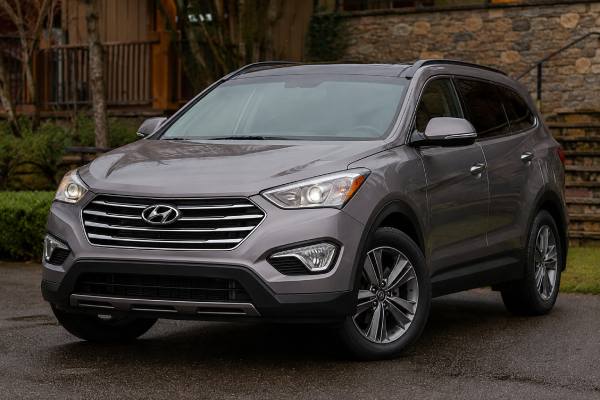
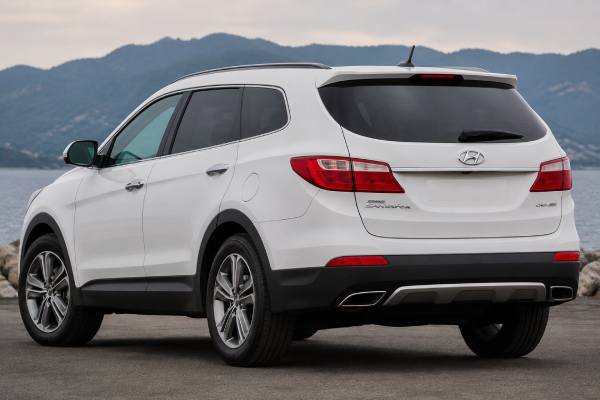
The Hyundai Grand Santa Fe 4WD in NC long-wheelbase form is a large seven-seat diesel SUV built for families who need more space than the regular Santa Fe but still want manageable running costs, strong torque, and all-weather traction. In European-market form, the 2.2 CRDi diesel was the core engine, paired mainly with a six-speed torque-converter automatic and an on-demand 4WD system.
As a used purchase, its appeal is straightforward: it offers generous passenger space, a big boot with the third row folded, respectable towing capacity, and a durable R-series diesel when properly serviced. The main ownership questions are less about outright performance and more about maintenance history, diesel emissions equipment, automatic transmission servicing, corrosion exposure, and whether recall or service actions have been completed.
Quick Overview
- Strong 2.2 CRDi torque, seven-seat practicality, and standard 4WD on most Grand Santa Fe NC diesel versions make it a capable family hauler.
- The long-wheelbase body gives more third-row and luggage space than the regular Santa Fe, with up to about 1,842 L of cargo volume with rear seats folded.
- Common buyer checks include DPF/EGR condition, automatic transmission shift quality, AWD coupling service, rear suspension wear, and corrosion-prone hardware.
- Engine oil and filter service is typically every 10,000–15,000 km or 12 months, with shorter intervals preferred for city use, towing, or short trips.
- Braked towing capacity is commonly listed at 2,000 kg, but cooling, tyres, brakes, and service condition matter more than the headline number.
Table of Contents
- Hyundai Grand Santa Fe NC Guide
- Grand Santa Fe NC Technical Data
- Grand Santa Fe NC Equipment and Safety
- Reliability and Known Issues
- Maintenance and Used Buyer Checks
- Driving Feel and Real Performance
- Rivals and Ownership Verdict
Hyundai Grand Santa Fe NC Guide
The Grand Santa Fe NC is the extended, more spacious version of the third-generation Santa Fe family. Depending on market, it may be referred to as Grand Santa Fe, Santa Fe LWB, or Santa Fe XL. The NC designation is commonly used for the long-wheelbase variant, while the related regular-length Santa Fe is often known by the DM code. For 2013–2015 European-market diesel versions, the key configuration is the 2.2 CRDi four-cylinder turbodiesel, 4WD, and six-speed automatic transmission.
The 2.2 CRDi engine is Hyundai’s D4HB R-series diesel. It uses common-rail direct injection, a variable-geometry turbocharger, intercooling, and a diesel particulate filter. The 197 hp figure is often quoted as 197 PS or approximately 145 kW, with some late-2015 or market-specific listings showing around 200 PS or 147 kW after emissions updates. The practical difference for most drivers is small: the engine’s character is defined more by its mid-range torque than by its peak power number.
The Grand Santa Fe was aimed at buyers who wanted a genuine three-row SUV rather than a compact crossover with occasional rear seats. Its longer wheelbase and rear overhang provide more luggage room and easier third-row packaging than the shorter Santa Fe. It is still not a full-size off-roader, but it is more useful for long family trips, airport runs, school duty, and holiday towing than many smaller seven-seat SUVs.
Its strengths are everyday usability and equipment value. Many examples were sold in high trim grades with leather, heated and ventilated front seats, navigation, parking assistance, xenon headlights, lane departure warning, panoramic roof availability, and a powered tailgate. In markets where it was offered as a single high-spec model, there may be fewer stripped-out cars than with some rivals.
The limitations are also clear. This is a heavy diesel SUV, so fuel economy depends heavily on route type, load, tyre choice, and maintenance condition. Short urban trips are not ideal for the DPF. The automatic gearbox is smooth rather than sporty, and the steering is tuned for easy driving rather than sharp feedback. Buyers looking for serious off-road hardware, a low running-cost city car, or a sporty SUV should look elsewhere.
For used buyers, the best examples are not necessarily the lowest-mileage cars. A regularly serviced car that has done longer journeys, had clean diesel fuel, correct oil, periodic transmission and driveline fluid changes, and documented recall checks is usually a safer bet than a low-mileage example used mostly for short trips.
Grand Santa Fe NC Technical Data
Specifications vary by country, trim, emissions level, and model-year changeover. The figures below reflect the common European-market Hyundai Grand Santa Fe NC 2.2 CRDi 4WD automatic specification from 2013–2015, with notes where late-2015 cars may differ.
| Powertrain item | Hyundai Grand Santa Fe NC 2.2 CRDi 4WD |
|---|---|
| Engine code | D4HB, Hyundai R-series diesel |
| Engine layout & cylinders | Inline-4, 4 cylinders, DOHC, 4 valves per cylinder, 16 valves total |
| Bore × stroke | 85.4 × 96.0 mm (3.36 × 3.78 in) |
| Displacement | 2.2 L (2,199 cc) |
| Induction | Variable-geometry turbocharger with intercooler |
| Fuel system | Common-rail direct injection, diesel |
| Compression ratio | 16.0:1 |
| Maximum power | 145 kW / 197 PS at 3,800 rpm; some late cars listed around 147 kW / 200 PS |
| Maximum torque | 436 Nm (322 lb-ft) around 1,800–2,500 rpm; late listings may show 440 Nm (325 lb-ft) |
| Timing drive | Chain-driven camshaft system |
| Emissions equipment | EGR, oxidation catalyst, DPF; late Euro 6b listings may include additional NOx aftertreatment |
| Rated efficiency | Around 7.6 L/100 km combined (30.9 mpg US / 37.2 mpg UK) on NEDC-cycle figures |
| Real-world highway at 120 km/h | Typically about 8.0–9.5 L/100 km (29–25 mpg US / 35–30 mpg UK), depending on tyres, load, wind, and condition |
| Transmission and driveline | Specification |
|---|---|
| Transmission | 6-speed torque-converter automatic, commonly associated with Hyundai A6LF-series units |
| Drive type | On-demand 4WD/AWD with front-biased normal operation and rear-axle engagement as needed |
| Differential hardware | Open differentials; no low range, no mechanical locking differentials |
| 4WD function | Electronic traction control and lock mode on many versions for low-speed slippery conditions |
| Best use | Snow, wet roads, gravel tracks, towing on firm surfaces, light unsurfaced access roads |
| Not intended for | Rock crawling, deep mud, repeated hard off-road impacts, or heavy-duty low-range work |
| Chassis, dimensions and capacities | Specification |
|---|---|
| Front suspension | MacPherson struts with coil springs |
| Rear suspension | Multi-link with coil springs |
| Steering | Electric rack-and-pinion; commonly listed around 15.0:1 steering ratio |
| Front brakes | Ventilated discs, about 320–321 mm (12.6 in), market dependent |
| Rear brakes | Solid discs, about 302 mm (11.9 in), market dependent |
| Common tyre sizes | 235/60 R18 or 235/55 R19, usually on 7.5J wheels |
| Ground clearance | About 180 mm (7.1 in) |
| Approach / departure / breakover | About 16.7° / 20.2° / 15.8° |
| Length / width / height | 4,915 / 1,885 / 1,695 mm (193.5 / 74.2 / 66.7 in) |
| Wheelbase | 2,800 mm (110.2 in) |
| Turning circle | About 11.2 m (36.7 ft), kerb-to-kerb style figure |
| Kerb weight | Commonly around 1,977 kg (4,359 lb); listings range roughly 1,902–2,042 kg by trim |
| GVWR | About 2,600 kg (5,732 lb) |
| Fuel tank | 71 L (18.8 US gal / 15.6 UK gal) |
| Cargo volume | About 200 L with seven seats in use, 634 L in five-seat mode, up to 1,842 L with rear rows folded; measuring method varies |
| Performance and capability | Specification |
|---|---|
| 0–100 km/h | About 10.3 seconds |
| Top speed | About 200 km/h (124 mph) |
| Braked towing capacity | Commonly 2,000 kg (4,409 lb), with correct equipment and market approval |
| Unbraked towing capacity | About 750 kg (1,653 lb) |
| Payload | Around 620–640 kg (1,367–1,411 lb), depending on kerb-weight listing |
| 100–0 km/h braking | No single official figure; condition, tyre, load, and brake quality are decisive on used examples |
| Fluids and service capacities | Common specification or capacity |
|---|---|
| Engine oil | ACEA C3 low-SAPS diesel oil, commonly 5W-30; some hot-climate schedules list 5W-40 |
| Engine oil capacity | About 6.7 L (7.1 US qt), including filter on many 2.2 CRDi listings |
| Coolant | Ethylene-glycol long-life coolant, normally 50/50 premix unless local documentation states otherwise |
| Coolant capacity | About 9.1 L (9.6 US qt) |
| Automatic transmission fluid | Hyundai/Kia SP-IV type fluid; full dry capacity commonly listed around 7.7 L (8.1 US qt) |
| Transfer case and rear differential | Hypoid gear oil, commonly SAE 75W-90 API GL-5; capacity is small and must be verified by VIN |
| A/C refrigerant | R134a; about 600 g without rear A/C or about 750 g with rear A/C in many DM/NC listings |
| A/C compressor oil | PAG/ISO 46 type, often around 120 mL with rear A/C; always confirm on under-bonnet label |
| Wheel nut torque | 107–127 Nm (79–94 lb-ft) on many Hyundai owner-manual specifications |
| Engine oil drain plug torque | Commonly around 34–44 Nm (25–33 lb-ft); verify for the exact sump and plug type |
| Safety and driver assistance | Availability and rating notes |
|---|---|
| Euro NCAP | Related 2012 Santa Fe DM test achieved 5 stars; the Grand Santa Fe NC shares the platform but may not have a separate published Grand-specific Euro NCAP test |
| Euro NCAP category scores | Commonly reported for the 2012 Santa Fe as 96% adult, 89% child, 71% pedestrian, 86% safety assist |
| IIHS | 2013 US Santa Fe/Santa Fe Sport ratings applied to both two-row and three-row models; Top Safety Pick status, but small-overlap performance was weaker than main tests |
| Headlight rating | IIHS headlight ratings were not part of the 2013 test set in the same way as modern ratings |
| Standard safety hardware | ABS, EBD, brake assist, ESC, traction control, hill-start assist, downhill brake control, multiple airbags |
| ADAS availability | Lane departure warning, parking camera/sensors, xenon/adaptive lighting and other systems vary by trim and market; AEB/ACC were not broadly standard on these years |
Grand Santa Fe NC Equipment and Safety
The Grand Santa Fe NC was usually positioned above the regular Santa Fe, so equipment levels were often generous. In some European markets it was offered in one high trim, while other countries used names such as Premium, Style, Luxury, or similar local grades. Trim names are not always directly comparable between countries, so equipment should be checked from the build sheet, VIN, and the actual car rather than from a badge alone.
Common exterior and functional equipment included 18-inch or 19-inch alloy wheels, roof rails, front and rear fog lamps, LED daytime running lights, LED rear lamps, xenon or adaptive xenon headlights on higher trims, a full-size spare wheel in some markets, and body-colour mirrors with integrated indicators. Metallic paint, panoramic sunroof packages, towbar preparation, and premium exterior finishes were often optional.
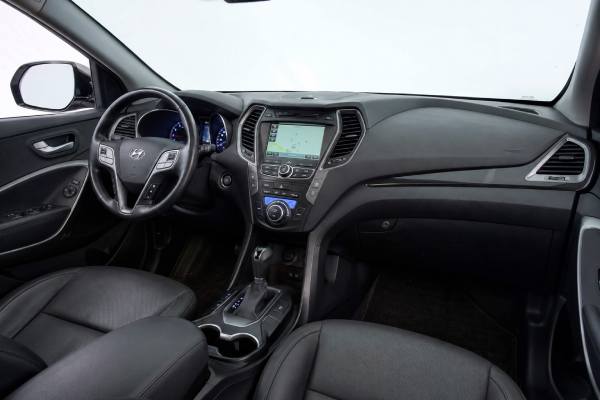
Inside, high-spec cars may have leather upholstery, heated front and rear seats, ventilated front seats, electrically adjustable front seats, driver memory, dual-zone climate control, rear cabin ventilation, an electric parking brake, keyless entry, push-button start, cruise control, navigation, Bluetooth, a reversing camera, parking sensors, an upgraded audio system, powered tailgate, rear-door curtains, and a large trip-computer display. A useful quick identifier is the wheel size: many upper-grade European examples used 235/55 R19 tyres, while some markets and trims used 235/60 R18.
Seating configuration is another point to verify. The Grand Santa Fe was sold with six or seven seats depending on market and trim. A six-seat version usually has second-row captain’s chairs, making third-row access easier but reducing total seating capacity. A seven-seat version uses a second-row bench in a 2+3+2 layout. Families carrying adults in the back should test third-row comfort rather than relying on the seat count alone.
Safety equipment was strong for its period. Multiple airbags were fitted, including front airbags, side airbags, curtain airbags, and in many markets a driver knee airbag. ISOFIX/LATCH child-seat anchorages were provided in the second row, with top-tether provisions depending on market. Stability control, traction control, brake assist, electronic brake-force distribution, downhill brake control, hill-start assist, tyre-pressure monitoring, and emergency stop signal functions were commonly included.
Crash-test interpretation needs care. The shorter Santa Fe DM achieved a strong Euro NCAP result in 2012, and the US IIHS ratings for 2013 Santa Fe models applied to both two-row and three-row variants in several categories. However, the long-wheelbase Grand Santa Fe NC was not always separately tested under each regional body. The safest approach is to treat the ratings as highly relevant platform evidence, not a substitute for checking the exact market, year, and equipment of the vehicle being purchased.
ADAS was limited by modern standards. Lane departure warning was available or standard on some high trims, but it is not the same as today’s active lane centring. Adaptive cruise control and autonomous emergency braking were not universally fitted across 2013–2015 Grand Santa Fe diesels. After windscreen replacement, front-end body repair, suspension work, or steering-angle sensor faults, any camera or radar-based systems fitted to the car should be calibrated according to official service procedures.
Reliability and Known Issues
The 2.2 CRDi Grand Santa Fe has a generally solid mechanical base, but it is not a “service-and-forget” SUV. Age, diesel emissions hardware, heavy body weight, automatic transmission condition, and salty-climate corrosion are the main ownership risks. A car with clear maintenance records is worth paying more for than one with attractive equipment but unknown history.
| Issue area | Prevalence | Severity/cost | Symptoms | Likely remedy |
|---|---|---|---|---|
| DPF loading and failed regenerations | Common on short-trip cars | Medium to high | DPF warning, high idle, fan running after shutdown, limp mode, rising oil level | Diagnostic scan, forced regen only if safe, fix root cause, use correct oil |
| EGR and intake soot | Common with urban use | Medium | Hesitation, smoke, poor economy, fault codes | Clean/replace EGR components, inspect intake and sensors |
| Fuel filter or injector concerns | Occasional | Medium | Hard starting, rough idle, loss of power, fuel-pressure codes | Replace fuel filter, test injectors, check fuel quality and water contamination |
| Turbo/boost leaks | Occasional | Medium | Whistle, underboost codes, black smoke, limp mode | Inspect intercooler hoses, clamps, actuator and boost-control system |
| Timing-chain noise | Rare to occasional at higher mileage | High | Cold rattle, cam/crank correlation codes | Measure chain stretch, inspect guides/tensioner, replace as needed |
| Six-speed automatic shift issues | Occasional | Medium to high | Harsh shifts, delayed engagement, flare, shudder | Check ATF condition, software updates, fluid service, professional diagnosis |
| AWD coupling/transfer case wear | Occasional | Medium | Binding, whining, vibration, rear-drive engagement faults | Change gear oils, inspect coupling, transfer case, rear differential |
| Suspension and wheel bearings | Common with mileage | Low to medium | Knock over bumps, uneven tyre wear, humming | Replace bushes, links, ball joints, bearings; align |
| Electrical convenience faults | Occasional | Low to medium | Camera faults, parking sensor errors, tailgate problems, sunroof noise | Diagnose harness, sensors, switches, drains, calibration |
| Corrosion-related hardware issues | Climate dependent | Medium | Sticking hood latch, rusty brake lines, seized bolts | Inspect underside, repair corrosion, complete recalls, protect vulnerable areas |
The D4HB engine is strongest when it gets clean oil, regular filter changes, correct coolant, and enough sustained driving to complete DPF regenerations. Short journeys are the hardest use case. A diesel that repeatedly starts cold, drives a few kilometres, and shuts down before reaching full temperature may suffer DPF soot loading, oil dilution, EGR deposits, and poor fuel economy. During a test drive, the engine should pull cleanly from low revs, idle smoothly when warm, and show no persistent smoke once fully up to temperature.
The automatic transmission should shift smoothly when cold and hot. A slight diesel SUV “heaviness” is normal, but clunks, delayed Drive or Reverse engagement, repeated flare between gears, or shudder under light throttle point to trouble. Many official schedules describe automatic transmission fluid as long-life under normal service, but used buyers should still value evidence of ATF replacement, especially above 80,000–120,000 km or on cars used for towing.
Driveline checks matter because the 4WD system adds expensive parts. Listen for whining or rumbling from the rear differential, binding during tight parking turns, and vibration under load. Gear oil in the transfer case and rear differential is inexpensive compared with replacing hardware. A neglected AWD system may still drive normally in dry conditions, so checks should include a workshop inspection, diagnostic scan, and road test on varied surfaces where safe.
Suspension wear is expected on a heavy seven-seat SUV. Front drop links, control-arm bushes, rear trailing-arm bushes, rear shock absorbers, top mounts, and wheel bearings are common wear points with age. Uneven tyre wear can indicate alignment issues, worn bushes, or previous impact damage. Premium tyres are strongly recommended because the Grand Santa Fe’s braking, stability control, wet grip, and steering feel are tyre-sensitive.
Recalls and service actions vary by market. Known Santa Fe-related actions in different regions have included hood latch cable issues and ABS/HECU-related fire-risk campaigns on certain Hyundai/Kia vehicles, but applicability depends on VIN, market, build date, and exact model. The correct check is an official Hyundai dealer or national VIN recall database, not a generic model-year assumption. Ask for written confirmation that open recalls and service campaigns have been completed.
Maintenance and Used Buyer Checks
A Grand Santa Fe NC should be maintained like a heavy diesel SUV, not like a small hatchback. The engine, transmission, brakes, tyres, suspension, AWD hardware, and emissions equipment all work hard. A shorter, conservative schedule is usually better than stretching intervals to the maximum, especially for cars used in city traffic, cold weather, mountains, towing, or dusty conditions.
| Service item | Practical interval | Notes |
|---|---|---|
| Engine oil and filter | 10,000–15,000 km or 12 months | Use low-SAPS ACEA C3 oil of the correct viscosity; shorten for short trips or towing |
| Engine air filter | Inspect every service; replace around 20,000–40,000 km | Replace sooner in dusty conditions |
| Cabin filter | 12 months or 15,000–20,000 km | Important for HVAC airflow and demisting |
| Diesel fuel filter | Around 20,000–40,000 km, market dependent | Critical for injector and high-pressure pump protection |
| Coolant | First major change around 80,000 km or several years, then by official schedule | Use correct long-life coolant and mix ratio |
| Brake fluid | Every 2 years or about 40,000 km | Moisture-contaminated brake fluid can damage hydraulic components |
| Brake pads and rotors | Inspect every service | Heavy vehicle weight makes brake condition important |
| Automatic transmission fluid | 60,000–80,000 km in severe use; do not ignore high-mileage fluid | Use correct SP-IV type fluid and procedure |
| Transfer case and rear differential oil | 60,000–80,000 km, or sooner if towing | Small capacities make clean fluid important |
| Drive belt and hoses | Inspect every service; replace on age/cracking | Heat and diesel vibration age rubber parts |
| Timing chain | No routine belt-style replacement | Investigate rattle, timing faults, or guide/tensioner wear |
| Tyre rotation | 8,000–12,000 km | Helps prevent uneven wear on AWD vehicles |
| Alignment check | Annually or after tyre/suspension impact | Especially important with 19-inch tyres |
| 12 V battery | Test annually after year 4 | Weak batteries cause many electrical symptoms |
| A/C system | Inspect yearly | Rear A/C cars have larger charge and more pipework |
| Diagnostic scan | At purchase and before major trips | Include engine, transmission, AWD, ABS, SRS, and ADAS modules |
A good pre-purchase inspection should begin underneath the car. Check brake lines, rear subframe areas, suspension arms, exhaust hangers, fuel lines, underbody seams, jacking points, and the rear differential area. Surface rust is not unusual in salted climates, but flaking structural corrosion, swollen brake pipes, seized adjusters, or heavily rusted mounting points should affect the price or end the purchase.
The engine bay should be dry, clean enough to inspect, and free of obvious coolant staining or oil leaks. Look around the rocker cover, turbo oil lines, intercooler hoses, injector area, coolant expansion tank, and radiator. The oil level should not be overfilled, as a rising level on a diesel can indicate interrupted DPF regenerations and fuel dilution. Coolant should be clean and stable, not oily or rusty.
On the road, test the car from cold. It should start promptly, idle evenly, pull without hesitation, and shift cleanly. During steady cruising, watch for steering vibration, driveline hum, and transmission hunting. Under moderate acceleration, boost should build smoothly without smoke or limp-mode behaviour. On braking, the pedal should be firm and the car should stop straight without steering-wheel shake.
Inside, operate every expensive feature: panoramic roof, powered tailgate, seat heaters and ventilation, navigation, camera, parking sensors, folding seats, rear climate controls, electric parking brake, Bluetooth, and all window switches. Water leaks from roof drains or tailgate seals can become expensive if they reach electrical connectors or modules.
The most desirable examples are usually high-spec cars with documented maintenance, matching quality tyres, clean underside, smooth gearbox, working 4WD, no persistent diesel warning lights, and proof of recall checks. Avoid cars with a hidden service history, repeated DPF faults, transmission harshness, poor body repairs, mixed cheap tyres, or suspiciously fresh underseal covering corrosion.
Driving Feel and Real Performance
The Grand Santa Fe NC drives like a comfortable, heavy, front-biased seven-seat SUV. It is not sharp, but it is composed when maintained well. The longer body gives it good motorway stability, and the diesel torque suits relaxed cruising. Around town, the steering is light, the seating position is high, and visibility is helped by parking sensors and the reversing camera on better-equipped cars.
Ride quality depends heavily on wheel and tyre choice. Cars on 18-inch wheels with 235/60 tyres usually ride more calmly over broken surfaces than 19-inch versions. The 19-inch package looks better and can sharpen initial steering response slightly, but it also increases road noise and impact harshness on poor roads. Worn suspension bushes or cheap tyres can make the car feel far older than it is.
The 2.2 CRDi engine is at its best in the mid-range. It pulls strongly from low rpm, so normal overtaking and hill climbing do not require high revs. Turbo lag is present at very low engine speed, especially from a rolling crawl, but the automatic usually masks it well. In heavy traffic, the powertrain can feel slightly delayed if the transmission hesitates between gears, so shift quality is an important test-drive point.
The six-speed automatic is smooth when healthy. It is not as quick as newer eight-speed units, but its torque-converter design suits towing and low-speed manoeuvring. Kickdown is deliberate rather than aggressive, and the gearbox may hold lower gears on climbs or when loaded. Active ECO modes, where fitted, soften throttle response and can make the car feel slower; many drivers prefer normal mode for predictable response.
Real-world economy is route dependent. In urban driving, expect roughly 9.5–11.5 L/100 km (25–20 mpg US / 30–25 mpg UK), with worse figures in winter or repeated short trips. Mixed driving often sits around 8.5–10.0 L/100 km (28–24 mpg US / 33–28 mpg UK). At 100–110 km/h, a healthy car can be more economical, but at 120 km/h with roof bars, winter tyres, headwind, or a full load, consumption rises quickly.
Braking feel should be progressive, but the vehicle’s weight means brake maintenance is important. Pulsation through the pedal or steering wheel usually points to rotor thickness variation, hub rust, sticking calipers, or poor-quality replacement parts. A loaded Grand Santa Fe descending a mountain road or towing a trailer needs excellent fluid, pads, rotors, tyres, and cooling system condition.
The 4WD system improves traction in rain, snow, and loose surfaces, but it is not a traditional off-road transfer case. It normally behaves as a front-biased system and sends torque rearward when needed. The lock mode can help at low speeds on slippery ground, yet ground clearance, approach angle, road-biased tyres, and lack of low range limit serious off-road use.
Towing is one of the model’s practical strengths. With a braked rating around 2,000 kg, the Grand Santa Fe can tow caravans, small horse trailers, and utility trailers within legal limits when properly equipped. Under load, fuel consumption can increase by 30–60% or more depending on trailer size, speed, wind, and terrain. For regular towing, transmission fluid, cooling-system condition, brake condition, rear suspension, and tyre load rating become essential checks.
Rivals and Ownership Verdict
The Grand Santa Fe NC sits in a useful middle ground. It is larger and more family-focused than many compact seven-seat SUVs, but cheaper and less complex than premium large SUVs of the same era. Its most natural rivals include the Kia Sorento, Mitsubishi Outlander, Volvo XC90, Toyota Highlander in petrol or hybrid markets, Ford S-Max as an MPV alternative, and later used choices such as the Skoda Kodiaq.
Compared with the Kia Sorento, the Hyundai feels closely related in engineering philosophy: practical, diesel-friendly, well equipped, and sensible. The Sorento may be easier to find in some markets and can offer similar running costs. The Grand Santa Fe’s advantage is often its higher equipment level and long-wheelbase cabin space, depending on trim.
Against the first-generation Volvo XC90, the Hyundai feels newer in infotainment, efficiency, and diesel economy, while the Volvo counters with a strong safety image, premium cabin feel in higher trims, and broad parts knowledge. The Volvo can be more expensive to repair at age, and many examples are older or more heavily used. The Hyundai is usually the more rational family buy if condition is equal.
The Mitsubishi Outlander is usually cheaper to run and easier to park, but it does not feel as substantial or as strong when loaded. It is a better fit for buyers who need occasional third-row seats and low costs, while the Grand Santa Fe is better for regular long-distance family use. The Toyota Highlander is dependable and spacious in markets where available, but petrol running costs can be much higher than the Hyundai diesel’s highway economy.
A Ford S-Max or Galaxy is often the better pure people-carrier. They offer easier access, better third-row packaging, and more car-like handling. The Hyundai counters with SUV ground clearance, 4WD traction, towing ability, and a more robust image for rough weather or rural use. Choosing between them depends on whether the buyer needs SUV capability or maximum passenger practicality.
The Grand Santa Fe is worth considering when the service history is strong and the car has been used in a way that suits a diesel. Its biggest advantages are space, equipment, torque, towing capacity, and all-weather confidence. Its weaknesses are age-related diesel emissions issues, potentially expensive automatic/AWD repairs if neglected, limited modern ADAS, and running costs that are higher than smaller crossovers.
A well-kept 2013–2015 Hyundai Grand Santa Fe 4WD 2.2 CRDi can still make a very capable family SUV. The safest purchase is a documented, regularly serviced example with smooth transmission behaviour, clean diesel diagnostics, healthy tyres and brakes, no unresolved recalls, and no hidden corrosion. Buy on condition first, trim second, and mileage third.
References
- PASSENGER CAR PRICELIST HYUNDAI Grand Santa Fe 2014 (Manufacturer Pricelist)
- PERIODIC MAINTENANCE SERVICE FOR SANTA FE 2.2 (DM) 2020 (Maintenance Schedule)
- Euro NCAP | Hyundai SANTA FE 2024 (Safety Rating Database)
- 2013 Hyundai Santa Fe 2013 (Safety Rating)
- Check for Recalls: Vehicle, Car Seat, Tire, Equipment 2026 (Recall Database)
Disclaimer
This information is for general informational purposes only and is not a substitute for professional diagnosis, repair advice, or official Hyundai service documentation. Specifications, torque values, maintenance intervals, procedures, fluids, recalls, and equipment can vary by VIN, market, production date, trim, and previous repairs. Always verify critical data against the official owner’s manual, workshop manual, under-bonnet labels, dealer records, and VIN-specific recall checks before servicing or purchasing a vehicle.
Share this page on Facebook, X/Twitter, or your preferred social platform if it helped with your Grand Santa Fe research.