

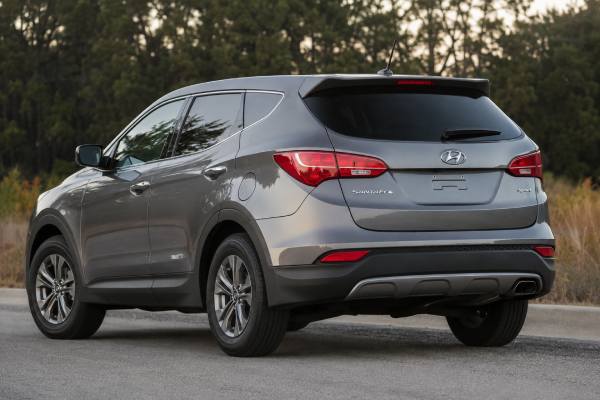

The 2013–2016 Hyundai Santa Fe Sport FWD with the 2.4 GDi engine is the five-seat version of Hyundai’s DM-generation Santa Fe family. It sits between compact crossovers and larger midsize SUVs, offering generous cabin space, a naturally aspirated direct-injected four-cylinder engine, front-wheel drive, and a conventional six-speed automatic transmission.
For used buyers, the appeal is easy to understand: it has more room than many compact SUVs, a simple driveline compared with AWD versions, good standard equipment, and a comfortable road feel. The main caution is the Theta II GDi engine family, which makes service history, oil level discipline, recall completion, and engine-noise checks especially important.
Quick Overview
- Spacious five-seat cabin with strong cargo volume for the class: about 35.4 cu ft seats up and 71.5 cu ft seats folded.
- Standard FWD and a six-speed automatic keep the driveline simpler than AWD models.
- The 2.4 GDi engine delivers 190 hp, but it is better for steady driving than heavy towing or frequent full-load use.
- Check engine-related recalls, bearing-noise history, oil consumption, and ABS/hood-latch recall completion before purchase.
- Typical oil service is every 7,500 miles or 12 months in normal use, shorter under severe driving.
Table of Contents
- Santa Fe Sport FWD Context
- Santa Fe Sport 2.4 Specs
- Santa Fe Sport Trims and Safety
- Reliability Issues and Recalls
- Maintenance and Used Buying
- Driving Performance and Economy
- Comparisons with Key Rivals
Santa Fe Sport FWD Context
The Santa Fe Sport was introduced for the 2013 model year as the shorter, two-row member of the third-generation Santa Fe lineup. In North America, the “Sport” name distinguished it from the longer three-row Santa Fe. The model covered here is the front-wheel-drive 2.4 GDi version, not the turbocharged 2.0T and not the AWD variant.
Its core layout is straightforward: a transverse 2.4-liter Theta II GDi inline-four, a six-speed torque-converter automatic, front-wheel drive, independent suspension, electric power steering, and a unitized crossover body. This made it more of a family crossover than an off-road SUV. Its strengths are cabin space, ease of driving, equipment value, and a smooth ride; its weaknesses are modest low-rpm torque, only average fuel economy by current standards, and some well-known engine-related ownership risks.
The 2.4 GDi engine produces 190 hp at 6,300 rpm and 181 lb-ft of torque at 4,250 rpm. Those numbers were competitive when the vehicle was new, but the engine needs revs to move the Santa Fe Sport briskly. Around town it feels adequate, especially with one or two occupants. With a full cabin, cargo, steep grades, or highway passing demands, the naturally aspirated four-cylinder has to work harder than a V6 or turbocharged rival.
The FWD version is the simplest Santa Fe Sport mechanically. It avoids the rear differential, prop shaft, AWD coupling, and transfer components used on AWD versions. That can lower long-term maintenance complexity and slightly improve fuel economy. The trade-off is traction: in snow, wet hills, gravel driveways, or steep winter conditions, good tyres matter more because the front wheels handle both propulsion and steering.
The 2013 model year is notable because early EPA ratings were higher than later years. The 2013 Santa Fe Sport 2WD 2.4 was rated at 21 mpg city, 29 mpg highway, and 24 mpg combined. By 2016, the FWD 2.4 rating was 20 mpg city, 27 mpg highway, and 23 mpg combined. In real use, many examples fall in the low-to-mid 20s mpg US depending on speed, load, tyres, maintenance, and city traffic.
As a used purchase, this model works best for drivers who want a roomy, comfortable, five-seat crossover and are willing to inspect carefully rather than buy only on price. A good example with complete service history can still be practical. A neglected example with engine noise, oil consumption, unresolved recalls, or poor fluid history can become expensive quickly.
Santa Fe Sport 2.4 Specs
The tables below focus on the North American 2013–2016 Santa Fe Sport FWD 2.4 GDi. Some values vary by trim, wheel package, model year, market, production date, and optional equipment, so VIN-specific documentation remains the final authority.
| Item | Hyundai Santa Fe Sport FWD 2.4 GDi |
|---|---|
| Model years covered | 2013–2016 |
| Generation / code | Third generation Santa Fe Sport, DM / AN production references |
| Engine code | Theta II GDi 2.4, commonly G4KJ family |
| Layout and cylinders | Transverse inline-four, 4 cylinders, DOHC, 4 valves per cylinder, Dual CVVT |
| Bore × stroke | 88.0 × 97.0 mm (3.46 × 3.82 in) |
| Displacement | 2.4 L (2,359 cc) |
| Induction | Naturally aspirated |
| Fuel system | Gasoline direct injection |
| Compression ratio | 11.3:1 |
| Maximum power | 190 hp (142 kW) @ 6,300 rpm |
| Maximum torque | 181 lb-ft (245 Nm) @ 4,250 rpm |
| Timing drive | Timing chain |
| Rated efficiency | 2013 EPA: 9.8 L/100 km combined (24 mpg US / 28.8 mpg UK); 2016 EPA: 10.2 L/100 km combined (23 mpg US / 27.6 mpg UK) |
| Real-world highway at 120 km/h / 75 mph | Typically about 9.0–10.5 L/100 km (22–26 mpg US / 26–31 mpg UK), depending on load, tyres, wind, and terrain |
| Item | Specification |
|---|---|
| Transmission | 6-speed automatic with SHIFTRONIC manual mode; A6MF-family application depending on build |
| Drive type | Front-wheel drive |
| Differential | Open front differential with traction/stability control intervention |
| Front / rear suspension | MacPherson strut front; independent multi-link rear |
| Steering | Motor-driven power steering; selectable steering effort on some trims |
| Brakes | Four-wheel disc brakes; commonly about 320 mm (12.6 in) front and 302 mm (11.9 in) rear, trim dependent |
| Common tyre sizes | 235/65 R17 standard on many 2.4 models; 235/60 R18 on some packages |
| Ground clearance | About 185 mm (7.3 in) |
| Length / width / height | 4,689 mm / 1,880 mm / about 1,679 mm (184.6 in / 74.0 in / 66.1 in) |
| Wheelbase | 2,700 mm (106.3 in) |
| Turning circle | About 10.9 m (35.8 ft), kerb-to-kerb |
| Curb weight | About 1,569–1,640 kg (3,459–3,616 lb), depending on year and equipment |
| GVWR | About 2,300 kg (5,071 lb), equipment dependent |
| Fuel tank | About 66 L (17.4 US gal / 14.5 UK gal) |
| Cargo volume | About 1,002 L (35.4 ft³) seats up; 2,025 L (71.5 ft³) seats folded, SAE-style published volume |
| Item | Typical value or guidance |
|---|---|
| 0–100 km/h / 0–62 mph | Roughly 9.5–10.5 seconds, depending on test conditions and load |
| Top speed | About 190 km/h (118 mph), market dependent |
| 100–0 km/h braking | Typically about 40–43 m (131–141 ft) on good tyres; not an official constant across trims |
| Towing capacity | Up to about 907 kg (2,000 lb) for the 2.4 FWD in common U.S. listings; equipment and market dependent |
| Payload | About 660 kg (1,455 lb), trim dependent |
| Engine oil | API/ILSAC gasoline oil; 5W-20 or 5W-30 commonly specified, with 5W-30 often preferred in many service references; about 4.8 L (5.1 US qt) with filter |
| Coolant | Ethylene-glycol coolant suitable for aluminum engines/radiators, normally 50/50 with distilled water; capacity varies by equipment |
| Automatic transmission fluid | Hyundai genuine ATF SP-IV or approved equivalent; total capacity about 7–8 L (7.4–8.5 US qt), drain-and-fill amount lower |
| Differential / transfer case | Not applicable to FWD model apart from the automatic transaxle final drive sharing transaxle lubrication |
| A/C refrigerant | R-134a on most 2013–2016 North American examples; under-hood label should be followed, commonly around 600 g (21 oz) without rear evaporator |
| A/C compressor oil | PAG-type oil; amount depends on component replacement and exact system, commonly around 120 mL (4.1 fl oz) system reference |
| Key torque specs | Wheel nuts: 107–127 Nm (79–94 lb-ft). Oil drain plug is commonly around 39 Nm (29 lb-ft), but verify by VIN and plug type. |
For safety data, the most directly relevant public test body for the North American Santa Fe Sport is IIHS. The 2013–2016 group earned Good ratings in several major crashworthiness tests, but the driver-side small-overlap result for the pre-facelift structure was Marginal. Later 2017 updates improved the model’s IIHS position, but that improvement does not automatically apply backward to all 2013–2016 examples.
Santa Fe Sport Trims and Safety
The 2.4 GDi FWD was usually positioned as the base or volume version of the Santa Fe Sport. Trim names varied by market and year, but in the U.S. the 2.4 model commonly appeared as the standard Santa Fe Sport, while the 2.0T models carried more performance-oriented equipment and higher option content.
A typical 2.4 FWD example may have cloth seating, 17-inch alloy wheels, air conditioning, power accessories, Bluetooth, steering-wheel controls, cruise control, stability control, traction control, four-wheel disc brakes, and a split-folding second row. Higher packages could add heated front seats, power driver’s seat, dual-zone climate control, a larger infotainment display, navigation, upgraded audio, leather seating, panoramic roof, parking sensors, rear camera availability depending on year, and larger wheels.
Mechanical differences are more important than badges. The 2.4 FWD uses the naturally aspirated engine and the simpler front-drive layout. The 2.0T adds a turbocharged engine and higher tow ratings in many listings. AWD versions add rear driveline hardware and can be preferable in snow-belt use, but they also add service points and more parts to inspect. For a buyer who mostly drives on paved roads in mild climates, the FWD 2.4 is the lower-complexity choice.
Quick identifiers include the absence of a “2.0T” badge, 2.4 engine emissions label under the hood, front-drive VIN/build data, and no rear differential visible under the vehicle. A 2.4 FWD will also usually have smaller wheels than upper 2.0T trims, although wheel swaps are common on used vehicles.
| Area | What to check |
|---|---|
| Base 2.4 FWD | Usually the simplest and most common configuration; best for lower running complexity. |
| Popular packages | May add heated seats, power seat, upgraded audio, rear camera, larger screen, roof, and convenience features. |
| Wheel packages | 17-inch tyres generally ride better and cost less; 18-inch packages can sharpen response but may ride firmer. |
| Infotainment | Check Bluetooth pairing, navigation response, backup camera image, steering-wheel buttons, and speaker output. |
| Year changes | Equipment availability shifted across 2013–2016, and 2016 examples often feel better equipped than early base models. |
Safety equipment was strong for the period. The Santa Fe Sport used seven airbags in many North American trims, including front airbags, front seat-mounted side airbags, side-curtain airbags, and a driver knee airbag. It also included electronic stability control, traction control, anti-lock brakes, brake assist, hill-start assist, tyre-pressure monitoring, and LATCH child-seat anchors.
Advanced driver assistance was limited compared with newer SUVs. Blind-spot monitoring became available on some trims and years, but automatic emergency braking, lane centering, adaptive cruise control, and traffic-sign recognition were not part of the early 2013–2016 2.4 FWD experience in the way buyers now expect. A rearview camera may be present depending on year and package, but it should not be assumed on every base 2013 example.
IIHS rated the 2013 Santa Fe Sport as a Top Safety Pick under the criteria of the time. The key nuance is the small-overlap front result, which was Marginal for 2013–2016 applications. Moderate-overlap front, side, roof strength, and head restraints were rated Good. The side test included a two-wheel-drive Sport test vehicle, which is relevant to the FWD model, although IIHS added weight to represent AWD mass.
Any ADAS-equipped vehicle needs proper calibration after windshield replacement, collision repair, steering-angle work, or sensor-related repairs. For this generation, the more common practical issue is not complex camera calibration but confirming that ABS, ESC, airbag, seat-belt, parking sensor, camera, and blind-spot warning lights complete their normal self-check and stay off during a test drive.
Reliability Issues and Recalls
The Santa Fe Sport FWD 2.4 can be a durable family crossover when maintained well, but it is not a model to buy casually. The main concern is the Theta II GDi engine family. Some vehicles have lived long lives with regular oil changes; others have suffered bearing wear, oil consumption, knocking, or engine replacement. The difference often comes down to production range, recall status, maintenance, oil level, operating conditions, and how quickly symptoms were addressed.
| Issue | Prevalence | Severity | Typical signs | Best response |
|---|---|---|---|---|
| Connecting-rod bearing wear / engine knock | Known concern | High | Knock from lower engine, oil-pressure warnings, metal debris, loss of power | Stop driving, check recall/warranty eligibility, dealer diagnosis, possible engine replacement |
| Oil consumption | Occasional to common at higher mileage | Medium to high | Low dipstick level between services, blue smoke, catalyst stress, ticking | Document consumption test, inspect PCV/leaks, shorten oil intervals, pursue coverage if eligible |
| GDi intake deposits | Occasional | Medium | Rough idle, misfires, hesitation, poor cold running | Scan for misfire data, inspect plugs/coils, consider intake cleaning when confirmed |
| High-pressure fuel system faults | Occasional | Medium | Hard start, stumble, fuel smell, lean/rich codes | Check pressure data, inspect fuel lines and pump area, repair with correct high-pressure procedures |
| Automatic shift harshness | Occasional | Low to medium | Delayed engagement, flare, bump shifts, hunting | Check ATF condition, mounts, software updates, adaptation reset, leaks |
| Suspension and steering wear | Common with age | Low to medium | Clunks, uneven tyre wear, wandering, vibration | Inspect control arms, sway links, struts, bearings, alignment, tyres |
| ABS module fire-related recalls | Recall-dependent | High | Often no warning before recall; ABS light possible | Run VIN through official recall checker and complete remedy before regular use |
| Hood latch cable corrosion | Recall-dependent | Medium to high | Secondary latch may not secure correctly | Confirm recall completion; replace cable/latch parts as required |
The 2013–2014 2.4 GDi Santa Fe Sport was involved in major engine-related service action and recall activity concerning connecting-rod bearing wear. The concern is serious because bearing wear can lead to engine seizure or stall. Some remedies included inspection procedures, engine replacement where needed, and later knock-detection software campaigns across broader Hyundai/Kia Theta II applications. A buyer should not rely on a verbal claim that “the recall was done.” Ask for dealer records, VIN campaign history, and any engine replacement invoice.
A separate fuel-pipe recall affected some vehicles previously repaired under engine recalls. The risk involved damage, misalignment, or improper torque of the high-pressure fuel pipe after engine replacement work. That is why a Santa Fe Sport with a replacement engine is not automatically worry-free; the quality and completeness of the repair matter.
ABS module recalls also matter. Earlier actions involved 2013–2015 Santa Fe Sport vehicles where brake fluid could leak inside the ABS module and cause an electrical short. Later Hyundai recall activity also addressed ABS fuse replacement on certain affected vehicles. Because coverage depends on VIN and production date, the only safe approach is to check the exact vehicle through the official recall database and Hyundai dealer records.
The 2013–2017 Santa Fe and Santa Fe Sport also had a hood-latch recall involving corrosion of the secondary latch cable. In severe cases, if the primary latch were released or not fully latched, the secondary latch might not hold the hood down. It is an inexpensive-looking issue with a potentially serious consequence, so confirmation matters.
For pre-purchase inspection, start the engine cold and listen for lower-end knock, timing-chain rattle, loud ticking beyond normal GDi injector noise, and rough idle. Let it reach operating temperature, then check for smoke, coolant smell, oil leaks, fuel smell, warning lights, and fan operation. During the test drive, include a gentle start, moderate acceleration, highway cruise, full stop, reverse engagement, and a few low-speed turns over bumps. Any engine knock, active oil-pressure warning, misfire, or fuel odor should stop the purchase unless the vehicle is priced as a repair project.
Maintenance and Used Buying
The 2.4 GDi Santa Fe Sport rewards preventive maintenance. The engine uses direct injection, runs relatively high compression, and has known sensitivity to oil quality, oil level, and bearing health. Long oil intervals, low oil level, cheap filters, and ignored noises are the wrong combination for this powertrain.
| Item | Normal interval | Severe-use guidance | Notes |
|---|---|---|---|
| Engine oil and filter | About 7,500 miles / 12 months | About 3,750 miles / 6 months | Check level frequently; use correct API/ILSAC oil and quality filter. |
| Engine air filter | Inspect regularly; replace around 30,000 miles | Replace sooner in dust | A dirty filter hurts economy and throttle response. |
| Cabin air filter | About 15,000 miles / 12 months | More often in dusty or humid climates | Weak airflow and odors usually point here first. |
| Spark plugs | Often around 97,500–105,000 miles | Inspect sooner if misfire or rough idle appears | Use correct heat range and torque; GDi engines dislike worn plugs. |
| Coolant | Long-life schedule; commonly first major service near 120,000 miles / 10 years, then shorter repeats | Shorten if contaminated or repairs are performed | Use coolant compatible with aluminum engine/radiator systems. |
| Automatic transmission fluid | Often listed as no routine replacement under normal use | About 60,000 miles under severe use | Drain-and-fill with ATF SP-IV specification; avoid universal fluid unless clearly approved. |
| Brake fluid | Inspect at service visits | Replace every 2–3 years in humid or mountain use | Use DOT 3 or DOT 4 as specified. |
| Brake pads and rotors | Inspect every 7,500–15,000 miles | More often in city or hill use | Check rear caliper slide pins and parking-brake operation. |
| Tyre rotation and alignment | Rotate every 5,000–7,500 miles | Align if uneven wear or after suspension work | FWD models can wear front tyres quickly. |
| Serpentine belt and hoses | Inspect from about 60,000 miles onward | Replace sooner if cracked, noisy, swollen, or leaking | Age matters as much as mileage. |
| Timing chain | No scheduled replacement | Inspect if rattle, cam/crank correlation codes, or poor running occurs | Replace chain, guides, tensioner, and related parts only when out of spec or symptomatic. |
| 12 V battery | Test yearly after 3 years | Replace around 4–6 years depending on climate | Weak batteries can trigger confusing electrical symptoms. |
For a used buyer, the best example is not always the lowest-mileage one. A 120,000-mile vehicle with documented 5,000-mile oil changes, completed recalls, clean ATF, good tyres, and no engine noise may be safer than an 80,000-mile vehicle with no records and a suspiciously clean engine bay.
Ask for:
- Oil-change records showing correct mileage and time intervals.
- Dealer campaign printout for engine, ABS, fuel-pipe, hood-latch, and theft-related updates where applicable.
- Evidence of spark plug replacement near the correct mileage.
- ATF service history if the vehicle was used in traffic, heat, hills, or towing.
- Receipts for brakes, tyres, battery, coolant, and suspension work.
- Any engine replacement paperwork, including fuel-pipe recall completion.
During inspection, check the oil level before the seller starts the engine. Very low oil is a warning sign even if the engine sounds acceptable at first. Look inside the oil filler for heavy sludge, inspect the coolant reservoir for contamination, and scan the engine computer even if no warning light is on. Pending misfire, catalyst, fuel-trim, cam-correlation, and knock-sensor codes are meaningful.
Recommended years depend on condition more than badge. A well-maintained 2015–2016 can be appealing because equipment levels improved and age is lower, but these years still need VIN checks. A 2013–2014 should be approached more cautiously because of engine and ABS recall exposure, though a fully documented repaired example may still be viable. Avoid vehicles with unexplained engine replacement, active warning lights, fuel smell, knocking, severe oil consumption, water intrusion, salvage history, or missing title/service records.
Long-term durability is fair to good when the engine is healthy and maintained conservatively. The body, cabin, suspension, and transmission generally age in a normal way for a family crossover. The engine is the deciding factor.
Driving Performance and Economy
The Santa Fe Sport 2.4 FWD drives like a comfort-biased family crossover. The seating position is high enough to feel SUV-like, the cabin is wide, and the suspension takes the edge off broken pavement better than many smaller crossovers. It is not sporty in the sharp sense, but it feels stable and secure at normal road speeds.
The steering is light in town and easy during parking. Some trims offer selectable steering effort, but the difference is mostly weight rather than road feel. On the highway, the Santa Fe Sport tracks well when the tyres and alignment are right. If it wanders, tramlines, or pulls, look first at tyres, alignment, front control-arm bushings, and strut condition.
The 2.4 GDi engine is smooth enough at steady speeds but not especially muscular at low rpm. Throttle response is predictable, and the six-speed automatic generally shifts smoothly. Under moderate throttle it tries to keep revs low for economy; under hard throttle it downshifts and lets the engine rev. That is normal behavior, not necessarily a fault. A flare between gears, delayed reverse, repeated harsh 2–3 or 3–4 shifts, or a shudder under load deserves diagnosis.
Noise levels are acceptable for the era. Tyre roar depends heavily on tyre brand and tread wear. Wind noise can increase with roof-rack crossbars, door-seal wear, or panoramic-roof issues on equipped trims. The GDi injectors make a light ticking sound that is normal, but deep metallic knocking from the lower engine is not.
Real-world economy is mixed. A gentle driver in suburban use may see about 9.5–10.5 L/100 km (22–25 mpg US / 26–30 mpg UK). Dense city traffic, short trips, winter fuel, roof boxes, old tyres, and aggressive acceleration can push consumption toward 12–14 L/100 km (17–20 mpg US / 20–24 mpg UK). On open highways at 100–110 km/h, mid-to-high 20s mpg US is possible. At 120 km/h / 75 mph, expect the engine to work harder and economy to settle closer to 22–26 mpg US.
Towing should be modest. The 2.4 FWD can handle a small utility trailer or light recreational load when properly equipped, but it is not the best Santa Fe Sport for repeated towing. Payload also matters: passengers, cargo, tongue weight, and accessories all count. On long grades, the four-cylinder will downshift often, fuel consumption will rise sharply, and brake condition becomes more important.
Tyres make a major difference. The standard 17-inch package gives the most compliant ride and lower replacement cost. Eighteen-inch wheels can look better and feel slightly more responsive, but they can add impact harshness and tyre expense. For FWD winter driving, a quality winter tyre set is more valuable than many buyers expect.
Overall, the 2.4 FWD is best driven with mechanical sympathy: keep the oil full, let the engine warm before hard acceleration, avoid lugging under heavy load, service fluids on time, and do not ignore new noises.
Comparisons with Key Rivals
The Santa Fe Sport 2.4 FWD competes with several popular crossovers from the same period, including the Toyota RAV4, Honda CR-V, Ford Escape, Chevrolet Equinox, Kia Sorento, Nissan Rogue, and Subaru Outback. Its identity is slightly different from some of them: it is roomier and more substantial than many compact SUVs, but it is not as efficient or as light.
| Rival | Santa Fe Sport advantage | Rival advantage |
|---|---|---|
| Toyota RAV4 | Often roomier-feeling cabin and strong value for equipment | Usually stronger reliability reputation and simpler ownership risk profile |
| Honda CR-V | More substantial road feel and generous features for the price | Better fuel economy and strong resale demand |
| Ford Escape | More relaxed cabin and simpler naturally aspirated 2.4 compared with some turbo Escapes | Sharper handling and stronger turbo performance in higher trims |
| Chevrolet Equinox 2.4 | Better cargo flexibility and often nicer interior presentation | Parts availability is broad, but engine condition is also a major buying concern |
| Kia Sorento | Similar platform logic in some years, often comparable value | Sorento may offer different seating and powertrain combinations depending on year |
| Subaru Outback | Higher seating position and more SUV-like cabin feel | Standard AWD and better poor-weather traction |
Compared with the CR-V and RAV4, the Hyundai feels larger and often more upscale for the money, especially in well-optioned trims. The trade-off is fuel economy and engine-risk perception. A buyer who wants the lowest-stress ownership path may prefer the Toyota or Honda. A buyer who prioritizes space, comfort, and purchase price may find the Hyundai more attractive if the specific vehicle passes inspection.
Against the Escape, the Santa Fe Sport is less agile but more relaxed. The Ford’s turbo engines can feel stronger, but they bring their own service questions. The Hyundai’s naturally aspirated 2.4 is simpler in concept, though the Theta II history means it is not automatically safer from repair risk.
The Chevrolet Equinox 2.4 is a close used-market rival because it also offers space and value, and it also has engine-related concerns in some years. Between the two, condition and records matter more than brand loyalty. Avoid neglected examples of either.
The Subaru Outback is the more traction-focused alternative. It is better for rough weather and unpaved access roads, but its standard AWD brings its own tyre-matching and driveline maintenance needs. The Santa Fe Sport FWD makes more sense where snow is rare and simplicity is preferred.
The best reason to choose the Santa Fe Sport 2.4 FWD is value with space. The best reason to walk away is uncertainty around the engine. When the price reflects the risk, the recalls are complete, and the maintenance file is strong, it can still be a sensible used family crossover. When the seller cannot prove care, there are safer places to spend used-SUV money.
References
- Manuals & Warranties | Hyundai Resources | MyHyundai 2026 (Owner’s Manual Resource)
- Gas Mileage of 2016 Hyundai Santa Fe 2026 (Fuel Economy)
- Gas Mileage of 2013 Hyundai Santa Fe 2026 (Fuel Economy)
- 2013 Hyundai Santa Fe Sport 2026 (Safety Rating)
- Part 573 Safety Recall Report 23V-651 2023 (Recall Database)
Disclaimer
This article is for informational purposes only and is not a substitute for professional diagnosis, repair, or inspection. Specifications, torque values, service intervals, capacities, procedures, recalls, and equipment can vary by VIN, market, production date, trim, and installed options. Always verify critical information against official Hyundai service documentation, the owner’s manual, the under-hood labels, and a qualified technician’s inspection.
If this helped, please consider sharing it on Facebook, X/Twitter, or another platform to support our work.