
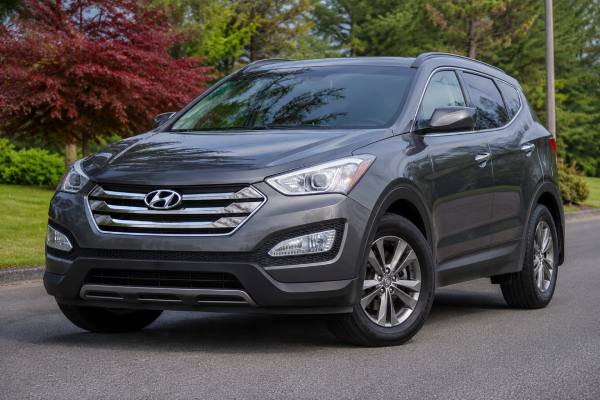

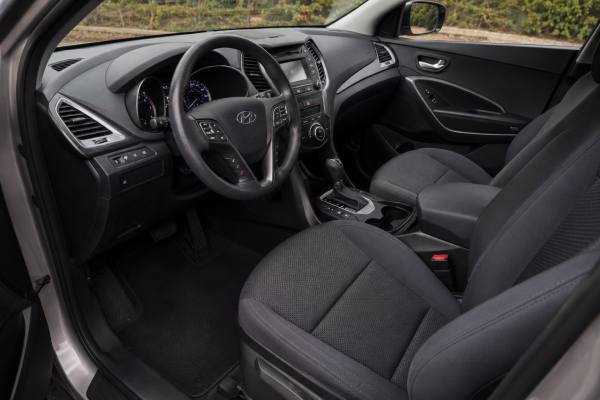
The 2013–2016 Hyundai Santa Fe Sport 2.0T FWD is the short-wheelbase, five-seat version of Hyundai’s third-generation Santa Fe family. In North American form, it paired a strong turbocharged 2.0-liter direct-injection gasoline engine with a conventional 6-speed automatic transmission and front-wheel drive, giving it more passing power than many four-cylinder family crossovers of the same period.
For used buyers, the appeal is clear: roomy cabin, large cargo area, high equipment levels, good crash-test performance, and a powertrain that feels stronger than the base 2.4-liter model. The main caution is also clear: this Theta II turbo engine family has known service-action and recall history, so maintenance records and VIN-specific campaign completion matter more than mileage alone.
Quick Specs and Notes
- Strong 264 hp turbo engine gives the Santa Fe Sport 2.0T confident highway passing and useful towing capability.
- The five-seat DM body offers practical cargo space, a comfortable ride, and easy everyday visibility.
- Higher trims can include leather, panoramic roof, navigation, premium audio, rear camera, heated rear seats, and blind-spot monitoring on later cars.
- Engine recall history, oil consumption, bearing noise, and fuel-system campaign completion should be checked before purchase.
- Use a shortened oil interval for hard use: about 5,000 miles or 6 months is a sensible ceiling, and 3,000–3,750 miles is prudent for severe turbo service.
Table of Contents
- Santa Fe Sport DM Used Context
- Santa Fe Sport DM Technical Specs
- Santa Fe Sport DM Trims and Safety
- Reliability, Issues and Service Actions
- Maintenance Schedule and Buying Checks
- Driving, Performance and Economy
- Rivals and Used Market Fit
Santa Fe Sport DM Used Context
The Santa Fe Sport 2.0T FWD covered here is the two-row, five-passenger Santa Fe Sport sold in the 2013–2016 model years before the 2017 facelift. It is not the longer three-row Santa Fe with the 3.3-liter V6, and it is not the later 2017–2018 lower-output 2.0T version used in some markets. The relevant vehicle is the DM-generation short-wheelbase crossover with the 2.0-liter turbocharged gasoline direct-injection engine, front-wheel drive, and a 6-speed automatic transmission.
In the used market, the 2.0T sits above the 2.4 GDI model. The difference is not subtle. The turbo engine produces 264 hp and 269 lb-ft of torque, so the Santa Fe Sport feels much more relaxed when merging, climbing grades, or carrying passengers and luggage. It also commonly came with richer equipment, especially in 2.0T and 2.0T Ultimate-style configurations depending on model year.
Its body size is a practical middle ground. At about 184.6 inches long with a 106.3-inch wheelbase, it is easier to park than many three-row SUVs but still has generous rear-seat and cargo room. The rear bench folds in a useful 40/20/40 split, making it flexible for family duty, pets, sports gear, or occasional bulky loads.
The major trade-off is ownership risk. A Santa Fe Sport 2.0T with complete service history, completed recalls, clean oil-change records, and no early signs of engine bearing noise can be a strong value. A neglected example can become expensive quickly. The turbocharged, direct-injected Theta II engine needs clean oil, proper viscosity, good cooling-system health, and prompt attention to abnormal noise or oil loss.
The best candidates are usually late-2015 or 2016 cars with clear maintenance documentation and dealer records showing open campaigns have been completed. Earlier 2013–2014 vehicles are not automatically poor choices, but they deserve a stricter inspection because many of the most important engine-related campaigns centered on that period. Mileage matters, but condition, records, and VIN history matter more.
Santa Fe Sport DM Technical Specs
The figures below focus on the North American Santa Fe Sport 2.0T FWD. Some numbers vary by market, production date, wheel package, trim, tow equipment, and test method, so VIN-specific service data should always be used for repair work.
| Item | Santa Fe Sport 2.0T FWD data |
|---|---|
| Engine code | Theta II 2.0 T-GDi family, commonly identified as G4KH-family in parts data; verify by VIN |
| Layout | Transverse inline-4, aluminum block/head, DOHC, 4 valves per cylinder, Dual CVVT |
| Bore × stroke | 86.0 × 86.0 mm (3.39 × 3.39 in) |
| Displacement | 2.0 L (1,998 cc) |
| Induction | Twin-scroll turbocharger with intercooling |
| Fuel system | Gasoline direct injection |
| Compression ratio | About 9.5:1 |
| Max power | 264 hp (197 kW) @ 6,000 rpm |
| Max torque | 365 Nm (269 lb-ft) @ 1,750 rpm |
| Timing drive | Timing chain |
| Rated efficiency | 2013: 11.8 / 8.7 / 10.2 L/100 km city/highway/combined (20 / 27 / 23 mpg US; 24 / 32 / 28 mpg UK). 2016 EPA listing: 12.4 / 9.0 / 10.7 L/100 km (19 / 26 / 22 mpg US; 23 / 31 / 26 mpg UK) |
| Real highway at 120 km/h | Commonly about 9.5–11.0 L/100 km (21–25 mpg US; 26–30 mpg UK), depending on tires, load, wind, grade, and turbo use |
| Item | Data |
|---|---|
| Transmission | 6-speed automatic with SHIFTRONIC manual mode; A6LF2-family application commonly associated with 2.0T models |
| Drive type | Front-wheel drive |
| Differential | Open front differential with brake-based traction and stability control |
| Front / rear suspension | MacPherson strut front; independent multi-link rear |
| Steering | Motor-driven power steering; about 15.03:1 ratio; about 2.95 turns lock-to-lock |
| Brakes | Four-wheel disc brakes; front ventilated, rear solid; front rotors commonly around 320 mm (12.6 in), rear around 302 mm (11.9 in), verify by VIN |
| Popular tire size | 235/55 R19 on many 2.0T models; some trims/markets use 235/65 R17 or other packages |
| Ground clearance | About 185 mm (7.3 in) |
| Length / width / height | 4,689 mm / 1,880 mm / 1,679–1,689 mm (184.6 in / 74.0 in / 66.1–66.5 in) |
| Wheelbase | 2,700 mm (106.3 in) |
| Turning circle | About 10.9 m (35.8 ft) curb-to-curb |
| Curb weight | About 1,619 kg (3,569 lb) for 2.0T FWD, depending on equipment |
| GVWR | Approximately 2,270–2,300 kg (5,000–5,070 lb), depending on certification label |
| Fuel tank | 65.9 L (17.4 US gal / 14.5 UK gal) |
| Cargo volume | About 1,002 L (35.4 ft³) seats up / 2,025 L (71.5 ft³) seats folded, SAE-style manufacturer listing |
| Item | Data |
|---|---|
| 0–100 km/h / 0–62 mph | Typically about 7.5–8.3 seconds depending on trim, fuel, tires, and test method |
| Top speed | Not usually emphasized in US factory data; generally around 190–200 km/h (118–124 mph) in comparable DM 2.0T data |
| 100–0 km/h braking | Commonly around 39–42 m (128–138 ft) in independent testing, highly tire-dependent |
| Towing capacity | Up to 1,588 kg (3,500 lb) braked with correct equipment; about 750 kg (1,650 lb) unbraked where permitted, verify local rules and owner’s manual |
| Payload | Door-label payload commonly around 450–550 kg (990–1,210 lb), depending on trim and options |
| Engine oil | ACEA A5/API-compatible gasoline oil; 5W-30 commonly preferred, 5W-40 allowed in many manuals; about 4.8 L (5.1 US qt) with filter |
| Coolant | Ethylene-glycol coolant for aluminum engines, mixed with distilled water; system capacity roughly 7.5–9.7 L (7.9–10.2 US qt), verify by year |
| ATF | Hyundai/Kia ATF SP-IV specification; total capacity roughly 7.1–7.8 L (7.5–8.2 US qt), service drain amount lower |
| A/C refrigerant | R-134a on most 2013–2016 North American vehicles; charge often around 600 g (21.2 oz) without rear evaporator, confirm under-hood label |
| A/C compressor oil | PAG-type oil, commonly FD46XG/PAG46 family; quantity varies by compressor and service operation |
| Key torque specs | Oil drain plug about 39 Nm (29 lb-ft); wheel lug nuts commonly about 108–127 Nm (80–94 lb-ft), verify service data |
| Crash ratings | IIHS: Good in moderate overlap, side, roof strength, and head restraints; Marginal in driver-side small overlap for 2013–2016 rating application. NHTSA: commonly listed with 5-star overall rating for these model years |
| ADAS | Basic stability and braking aids standard; blind-spot monitoring optional/trim-dependent on later examples; AEB/ACC/lane centering were not typical equipment for 2013–2016 US Santa Fe Sport 2.0T |
Santa Fe Sport DM Trims and Safety
For 2013–2016, the Santa Fe Sport lineup was built around the standard 2.4-liter model and the more powerful 2.0T. The 2.0T was the performance and equipment step-up, usually easy to identify by its badging, twin-tip exhaust details, 19-inch alloy wheels on many examples, proximity key with push-button start, and higher-grade interior trim. Exact packaging changed by year, but the 2.0T was rarely a stripped-down vehicle.
Typical equipment on the Santa Fe Sport platform included air conditioning, Bluetooth, USB/aux inputs, cruise control, 40/20/40 folding rear seats, stability control, traction control, hill-start assist, downhill brake control, tire-pressure monitoring, and seven airbags including a driver knee airbag. The 2.0T added the turbocharged engine and often brought popular convenience equipment as standard or through packages.
Common option and trim features included:
- Leather seating surfaces, heated front seats, and heated rear seats.
- Dual-zone automatic climate control with cabin air filtration.
- Power front seats and power liftgate on higher trims.
- 4.3-inch display audio or 8-inch navigation screen, depending on year and package.
- Rearview camera, premium audio, HD Radio, and Blue Link telematics.
- Panoramic sunroof, heated steering wheel, rear side-window sunshades, and upgraded interior trim.
- Blind-spot detection on many later higher-trim examples, especially 2015–2016 depending on market.
The safety structure was strong for its time, but it should be judged by the test standards of the period. IIHS results were good in several major categories, including moderate-overlap front, side, roof strength, and head restraint evaluations. The weak point was the small-overlap driver-side test, where the 2013–2016 application was rated Marginal. That does not erase the vehicle’s broader safety strengths, but it is an important distinction when comparing it with newer SUVs designed around tougher small-overlap testing.
NHTSA 5-Star Safety Ratings were favorable for the Santa Fe Sport, with the model commonly listed at five stars overall. Rollover resistance was naturally not sedan-like because of the crossover body height, so tire condition, correct tire pressure, and suspension health matter.
Child-seat practicality is good. The rear bench is wide, the door openings are usable, and LATCH/ISOFIX provisions are fitted, though bulky rear-facing seats may still require front-seat adjustment. As with any older family SUV, inspect seat belts for slow retraction, previous collision repairs, moisture damage, and proper airbag warning-light operation.
ADAS expectations should remain realistic. This generation is not a modern semi-assisted-driving SUV. Stability control, ABS, brake assist, electronic brake-force distribution, hill-start assist, and available blind-spot monitoring are the core safety aids. If a car has camera, radar, or blind-spot features, confirm they work after windshield, bumper, mirror, or body repairs, because sensor alignment and calibration can be affected by collision work.
Reliability, Issues and Service Actions
The Santa Fe Sport 2.0T’s reliability picture is mixed rather than simply good or bad. The body, interior hardware, suspension layout, and conventional automatic transmission are generally straightforward, but the turbocharged Theta II GDI engine requires serious due diligence. The main buying question is whether a specific vehicle has been maintained correctly, inspected under applicable campaigns, and kept free from early engine distress.
| Issue | Prevalence | Severity | Symptoms and remedy |
|---|---|---|---|
| Connecting-rod bearing wear / engine knock | Known concern, especially campaign-affected vehicles | High | Metallic knock, oil-pressure symptoms, warning lamp, DTC P1326, limp mode, or stall risk. Confirm recall and knock-sensor campaign status; repair may involve inspection, software update, or engine replacement depending on VIN and test result. |
| Oil consumption | Occasional to common with age | Medium to high | Low oil level between services, blue smoke, fouled plugs, catalytic stress. Perform an oil-consumption test, check PCV function, and inspect for leaks before condemning the engine. |
| GDI carbon buildup | Occasional | Medium | Rough idle, cold misfire, hesitation, reduced economy. Intake-valve cleaning may be needed on higher-mileage cars, especially short-trip vehicles. |
| Turbo and boost-control wear | Occasional | Medium to high | Whine, smoke, low boost, overboost/underboost codes, oil seepage. Check intake plumbing, intercooler hoses, wastegate operation, and oil-feed condition. |
| Automatic transmission shift flare or harshness | Occasional | Medium | Delayed engagement, rough 2–3 or 3–4 shifts, shudder. Confirm fluid condition, software updates, mounts, and adaptation values before replacing major parts. |
| Suspension, wheel bearings, and steering wear | Common with age | Low to medium | Knocks over bumps, humming, uneven tire wear, steering wander. Inspect control-arm bushings, struts, rear links, alignment, and wheel bearings. |
| Electrical and infotainment faults | Occasional | Low to medium | Camera glitches, Bluetooth problems, sensor warnings, weak battery behavior. Check software, grounds, battery health, and water intrusion before parts replacement. |
The most important service actions relate to engine inspection, knock-sensor logic, high-pressure fuel pipe inspection after engine replacement, and fire-risk recalls on some vehicles. Campaign 162 covered certain 2013–2014 Santa Fe Sport models with 2.0T and 2.4 GDI engines, requiring inspection for connecting-rod bearing wear and possible engine replacement. Later service actions and warranty extensions addressed engine long-block coverage for some vehicles and diagnostic logic for knock detection.
The high-pressure fuel pipe campaign is also important because some vehicles that received engine replacement needed inspection of the fuel pipe installation and torque. A fuel smell, visible seepage, or poor post-repair documentation should not be ignored.
For 2013 Santa Fe Sport vehicles, also check ABS-related fire-risk recall status. Some Hyundai and Kia recalls advised owners to park outside until repaired because an electrical short in the ABS module could increase fire risk. The correct remedy and affected population depend on VIN, so the only safe approach is a current VIN check and dealer confirmation.
Pre-purchase checks should include:
- Run the VIN through official recall systems and ask a Hyundai dealer for campaign completion history.
- Start the engine cold and listen for knocking, chain rattle beyond a brief start-up sound, or turbo whine.
- Check the oil level before the test drive and again after, looking for neglect, fuel dilution, sludge, or overfill.
- Scan for stored and pending codes, especially P1326, misfire codes, boost codes, oxygen-sensor codes, and transmission adaptation faults.
- Inspect the fuel rail and high-pressure line area for evidence of previous work or leakage.
- Road-test long enough for full temperature, including gentle acceleration, kickdown, steady cruise, and stop-and-go shifts.
A well-documented example can last well, but this is not a vehicle to buy casually from photos alone.
Maintenance Schedule and Buying Checks
Hyundai’s factory schedule varies by year, market, climate, and normal versus severe use. For a used turbocharged GDI Santa Fe Sport, a conservative schedule is wise because fuel dilution, heat, short trips, and turbo operation punish oil faster than gentle highway use.
| Service item | Practical interval | Notes |
|---|---|---|
| Engine oil and filter | 5,000 miles / 8,000 km or 6 months; 3,000–3,750 miles for severe use | Use correct ACEA/API-rated 5W-30 or approved 5W-40; keep receipts. Never run low on oil. |
| Engine air filter | 15,000–30,000 miles / 24,000–48,000 km | Inspect sooner in dust; a restricted filter affects turbo response and economy. |
| Cabin air filter | 12 months or 12,000–15,000 miles | Replace sooner for odor, weak airflow, or pollen-heavy use. |
| Spark plugs | 45,000–60,000 miles / 72,000–96,000 km | Turbo GDI engines are sensitive to worn plugs; use correct heat range and gap. |
| Coolant | First major change around 60,000 miles / 96,000 km, then every 30,000–50,000 miles depending on coolant | Use coolant compatible with aluminum Hyundai engines; inspect hoses, thermostat, radiator, and water pump. |
| Automatic transmission fluid | 50,000–60,000 miles / 80,000–96,000 km for used/severe service | Use Hyundai/Kia SP-IV specification. “Lifetime” fluid claims should not stop preventive service on older cars. |
| Brake fluid | Every 2–3 years | Use DOT 3 or DOT 4 as specified. Moisture causes corrosion and poor pedal feel. |
| Brake pads and rotors | Inspect every service | Check rear caliper slide pins, parking brake operation, rotor rust, and uneven wear. |
| Serpentine belt, hoses, mounts | Inspect every 15,000 miles; replace when cracked, oil-soaked, swollen, or noisy | Turbo heat accelerates rubber aging. |
| Timing chain system | No fixed replacement interval; inspect by symptoms | Watch for start-up rattle, cam/crank correlation faults, guide wear, tensioner problems, and oil-pressure issues. |
| 12 V battery | Test yearly after 3 years; typical replacement 4–6 years | A weak battery can trigger strange electronic faults and poor starting behavior. |
| Tires and alignment | Rotate every 5,000–7,500 miles; align when wear or pull appears | 19-inch tires improve response but can add ride harshness and cost. |
A buyer’s inspection should focus on expensive items first. Look underneath for oil leaks at the timing cover, valve cover, turbo oil lines, oil pan, and rear main area. Inspect the coolant reservoir and radiator neck for residue or low level. Check that the cooling fan cycles normally and that the A/C works at idle and highway speed.
On the road, a good 2.0T should build boost smoothly, shift without flare, track straight, and brake without steering shake. A brief puff of condensation on cold start is normal; blue smoke, fuel smell, or a rough idle is not. The engine should not sound like a diesel once warm. Any seller who says “they all knock” should be treated with caution.
Recommended years and trims depend on the individual car, but later 2015–2016 examples often offer better equipment and less early-production risk. A 2013–2014 can still be worthwhile if it has documented recall work and strong maintenance records. Avoid cars with missing oil history, unresolved recalls, active P1326 history without documented remedy, flood evidence, severe accident repairs, or unexplained engine replacement with no dealer paperwork.
Long-term durability is best when the owner treats the Santa Fe Sport 2.0T like a turbocharged engine rather than a basic appliance: frequent oil service, warm-up before heavy throttle, cooling-system attention, clean air filtration, and quick response to warning lights.
Driving, Performance and Economy
The Santa Fe Sport 2.0T FWD feels stronger than its size suggests. The 2.0-liter turbo does not have the low-speed smoothness of a naturally aspirated V6, but it delivers a broad, useful shove once boost arrives. In normal driving, the engine is quiet enough and the automatic transmission keeps revs low. When asked to pass, the 6-speed will kick down decisively, and the torque makes highway merging easy.
Turbo lag is present but not severe. From a stop, there is a short pause before full torque arrives, especially with the air conditioning on or with a full load. Once moving, the engine pulls well from low and mid rpm. Active ECO mode softens throttle response and shift behavior; it can help calm city driving but makes the vehicle feel less alert.
Ride quality is one of the Santa Fe Sport’s strengths. The chassis is tuned more for comfort than sharpness, and the independent rear suspension helps it stay composed over uneven pavement. The 19-inch tire package gives the 2.0T a more planted look and slightly crisper response, but it can transmit more impact harshness than smaller wheels. On worn roads, tire choice makes a big difference to cabin noise.
Handling is safe and predictable rather than sporty. The front-drive version is lighter than AWD models and turns in reasonably well, but hard throttle while cornering can bring some torque steer or inside-wheel spin. Stability control is well judged for family use. Steering effort changes through selectable modes on many cars, though feedback remains filtered.
Brake feel is generally firm enough, and stopping performance is acceptable when the pads, rotors, tires, and brake fluid are fresh. Pulsation under braking usually points to rotor thickness variation, hub rust, or pad deposits rather than a basic design flaw.
Real-world fuel economy depends heavily on driving style. The 2.0T can return reasonable highway numbers when driven gently, but city use, cold weather, roof racks, and frequent boost use quickly raise consumption.
| Driving condition | Typical result |
|---|---|
| Urban short trips | 12.5–15.5 L/100 km (15–19 mpg US; 18–23 mpg UK) |
| Mixed commuting | 10.5–12.5 L/100 km (19–22 mpg US; 23–27 mpg UK) |
| Highway 100 km/h / 62 mph | 8.5–9.8 L/100 km (24–28 mpg US; 29–33 mpg UK) |
| Highway 120 km/h / 75 mph | 9.5–11.0 L/100 km (21–25 mpg US; 26–30 mpg UK) |
| Cold winter city use | Often 10–20 percent worse due to warm-up, winter fuel, HVAC load, and tires |
Towing is possible, but this is not a heavy-duty tow vehicle. With a moderate trailer and proper brakes, the 2.0T has enough torque for relaxed cruising. Heat management, brake condition, tire pressures, and transmission fluid condition matter on grades. Expect a major economy penalty under tow, often 25–40 percent depending on trailer shape and speed.
For daily use, the Santa Fe Sport 2.0T FWD works best as a comfortable, quick family crossover, not as an off-road SUV or a performance vehicle. Its real advantage is effortless midrange power combined with a useful cabin.
Rivals and Used Market Fit
The Santa Fe Sport 2.0T FWD competed with a broad group of two-row crossovers and midsize family SUVs. Its closest used-market rivals include the Ford Edge EcoBoost, Kia Sorento 2.0T or V6, Toyota RAV4, Honda CR-V, Subaru Forester, Nissan Murano, Chevrolet Equinox, and Mazda CX-5.
Compared with the Toyota RAV4 and Honda CR-V of the same period, the Hyundai feels more powerful and often more upscale inside, especially in 2.0T trim. The Toyota and Honda usually win for simplicity, resale value, and long-term reputation, but neither delivers the same turbocharged punch in these model years.
Against the Ford Edge EcoBoost, the Santa Fe Sport is a bit more maneuverable and generally easier to package as a five-seat family crossover. The Edge can feel wider and more substantial, but the Hyundai has a strong equipment-per-dollar case. Both need careful turbo and maintenance inspection.
The Mazda CX-5 is the driver’s choice in this class. It has sharper steering and a more responsive chassis, but earlier naturally aspirated versions are not as quick as the Santa Fe Sport 2.0T. Buyers who prioritize handling may prefer the Mazda; buyers who want power, space, and comfort may prefer the Hyundai.
The Subaru Forester offers standard AWD and better poor-weather traction, but its cabin and highway refinement from this era may feel less substantial. The Hyundai FWD is less suitable for snowbelt buyers who need AWD traction, although good tires narrow the gap in many normal conditions.
The Kia Sorento is the most closely related alternative. Depending on year and configuration, it may offer similar engines, more seating flexibility, or a different feature mix. The same engine-history caution applies to related Hyundai/Kia GDI powertrains, so the best choice is usually the better-maintained individual vehicle.
The Santa Fe Sport 2.0T’s advantages are clear:
- Strong acceleration for the class.
- Comfortable ride and quiet highway manners.
- Practical five-seat cabin with large cargo capacity.
- High feature content for the used price.
- Conventional automatic transmission rather than a CVT or dual-clutch unit.
Its disadvantages are just as important:
- Engine campaign history must be taken seriously.
- Real-world fuel economy is only average when the turbo is used often.
- Front-wheel-drive traction can be limited in snow or wet uphill starts.
- Some safety and ADAS features now feel dated compared with newer SUVs.
- A neglected example can cost more to repair than the purchase price suggests.
The best verdict is conditional. A clean, well-maintained 2013–2016 Santa Fe Sport 2.0T FWD can be a satisfying used crossover with strong performance and good practicality. It is most attractive when priced below comparable Toyota or Honda models and backed by strong service documentation. It is least attractive when sold with missing records, unresolved recalls, warning lights, engine noise, or “fresh oil” that hides a consumption problem. Buy the history, not just the badge or horsepower number.
References
- All-New Santa Fe Lineup Reinvents the family CUV Landscape with Progressive Design, Efficient Powertrains and Upscale Amenities 2012 (Manufacturer Publication)
- Gas Mileage of 2013 Hyundai Santa Fe 2013 (Fuel Economy)
- Gas Mileage of 2016 Hyundai Santa Fe 2016 (Fuel Economy)
- 2013 Hyundai Santa Fe Sport 2013 (Safety Rating)
- Check for Recalls: Vehicle, Car Seat, Tire, Equipment | NHTSA 2026 (Recall Database)
Disclaimer
This article is for informational purposes only and is not a substitute for professional diagnosis, inspection, repair, or official service documentation. Specifications, torque values, maintenance intervals, recall applicability, fluids, procedures, and equipment can vary by VIN, market, production date, trim, and previous repairs. Always verify critical information against the official owner’s manual, service manual, emissions label, under-hood labels, and dealer VIN records before buying parts or performing work.
If this information helped, please consider sharing it on Facebook, X/Twitter, or another platform to support our work.