

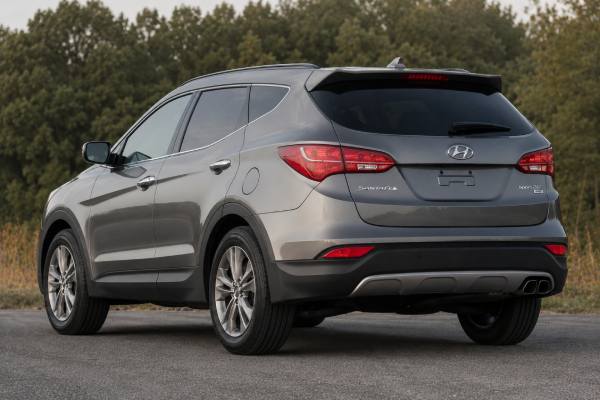
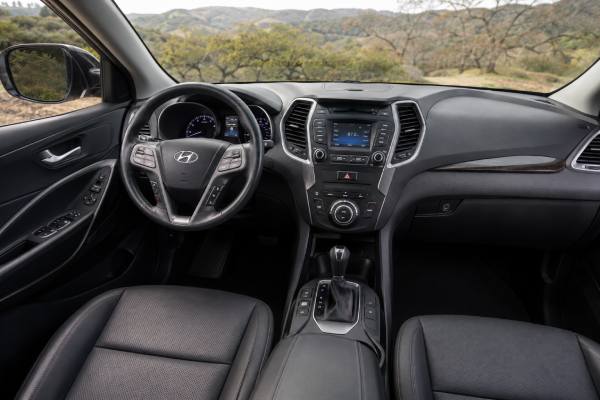
The 2013–2016 Hyundai Santa Fe FWD with the 3.3 GDi V6 is the long-wheelbase, three-row version of Hyundai’s third-generation Santa Fe family. In North America it was sold simply as the Santa Fe, while some markets used Santa Fe XL, Grand Santa Fe, or NC-related naming to distinguish it from the shorter Santa Fe Sport.
Its main appeal is straightforward: a naturally aspirated 290 hp V6, a conventional six-speed automatic, useful three-row packaging, and a strong feature-per-dollar mix. It is not the most fuel-efficient midsize SUV of its period, and a careful used-vehicle inspection matters, but a well-maintained front-wheel-drive example can still make sense for buyers who want space and smooth power without the complexity of turbocharging or all-wheel drive.
What to Know
- Strong 3.3 GDi V6 performance, with confident highway passing and a 5,000 lb towing rating when properly equipped.
- Practical three-row cabin, with 6-seat captain’s-chair or 7-seat bench layouts depending on trim.
- Good safety fundamentals for the era, including seven airbags, stability control, and strong IIHS results in most crash categories.
- Watch for incomplete recalls, oil leaks, GDI carbon buildup, aging suspension parts, and harsh shifts from neglected ATF.
- Typical normal-use oil service is every 7,500 miles or 12 months; severe use shortens this to about 3,750 miles or 6 months.
Table of Contents
- Hyundai Santa Fe NC Model Profile
- Hyundai Santa Fe NC V6 Specs
- Hyundai Santa Fe NC Equipment and Safety
- Reliability Issues and Recalls
- Maintenance and Buying Checks
- Driving Feel and Real Economy
- Santa Fe NC Versus Rivals
Hyundai Santa Fe NC Model Profile
The 2013–2016 Santa Fe FWD 3.3 GDi V6 sits in a slightly unusual place in Hyundai’s lineup history. It arrived alongside the shorter Santa Fe Sport, but the two vehicles served different jobs. The Sport was a two-row crossover with four-cylinder engines, while this long-wheelbase Santa Fe was the family-oriented three-row model. That distinction matters when checking parts, recalls, specifications, and used listings, because “Santa Fe” and “Santa Fe Sport” are often mixed together in ads.
The covered vehicle is the front-wheel-drive, gasoline V6 model. It uses Hyundai’s Lambda II 3.3-liter direct-injected V6, a naturally aspirated engine with dual overhead camshafts and variable valve timing. Output is 290 hp at 6,400 rpm and 252 lb-ft at 5,200 rpm. The torque peak is fairly high, so it feels smooth rather than diesel-like at low rpm, but it pulls strongly once the transmission downshifts.
The transmission is Hyundai’s in-house six-speed SHIFTRONIC automatic. It is a conventional torque-converter unit, not a CVT or dual-clutch gearbox. For long-term ownership, that is a meaningful advantage. The six-speed automatic is generally durable when kept clean and cool, and it suits the V6’s relaxed character. Front-wheel drive also reduces mechanical complexity compared with AWD versions by eliminating the rear differential, transfer case, prop shaft, and rear coupling service concerns.
Size-wise, the NC long-wheelbase Santa Fe is a midsize crossover rather than a full-size SUV. It offers three rows, but the third row is best suited to children, smaller adults, or occasional use. The second row is the sweet spot, especially in Limited models with captain’s chairs. Cargo space behind the third row is modest, but folding the third row opens up useful luggage room.
The biggest advantages are value, power, comfort, and equipment. A used Santa Fe V6 often costs less than an equivalent Toyota Highlander or Honda Pilot, yet it offers a strong engine, available leather, panoramic roof, navigation, rear climate controls, and blind-spot monitoring on many examples. The trade-offs are weaker resale value, higher fuel consumption than smaller turbocharged or hybrid rivals, and the need to verify recalls and maintenance carefully.
For used buyers, the best examples are usually later 2015–2016 vehicles with complete service records, no accident history, and documented recall completion. Earlier 2013–2014 examples can still be good, but age, deferred maintenance, and early-build repairs matter more than trim level.
Hyundai Santa Fe NC V6 Specs
The figures below describe the 2013–2016 Hyundai Santa Fe NC long-wheelbase FWD with the 3.3 GDi V6 in typical North American specification. Some values vary by model year, trim, wheel package, roof rails, tow package, and market documentation.
| Item | Specification |
|---|---|
| Engine code/family | Lambda II 3.3 GDi, commonly G6DH family |
| Layout | 60-degree V6, 6 cylinders, DOHC, 4 valves per cylinder |
| Bore × stroke | 92.0 × 83.8 mm (3.62 × 3.30 in) |
| Displacement | 3.3 L, 3,342 cc (203.9 cu in) |
| Induction | Naturally aspirated |
| Fuel system | Gasoline direct injection |
| Compression ratio | 11.5:1 |
| Maximum power | 290 hp (216 kW) @ 6,400 rpm |
| Maximum torque | 342 Nm (252 lb-ft) @ 5,200 rpm |
| Timing drive | Timing chain |
| EPA efficiency, FWD | 18 city / 25 highway / 21 combined mpg US; about 13.1 / 9.4 / 11.2 L/100 km |
| Real highway at 120 km/h | About 10.5–12.5 L/100 km (19–22 mpg US), depending on tyres, load, wind, and terrain |
| Item | Specification |
|---|---|
| Transmission | 6-speed SHIFTRONIC torque-converter automatic, Hyundai A6LF-series family |
| Drive type | Front-wheel drive |
| Differential | Open front differential integrated with the transaxle |
| Item | Specification |
|---|---|
| Front suspension | MacPherson strut |
| Rear suspension | Multi-link independent |
| Steering | Motor-driven electric power steering; selectable steering effort on many trims |
| Brakes | Ventilated front discs about 320 mm (12.6 in); rear discs about 302 mm (11.9 in) |
| Popular tyre sizes | 235/60R18 or 235/55R19 |
| Ground clearance | About 185 mm (7.3 in) |
| Length / width / height | 4,905 / 1,885 / 1,690–1,700 mm (193.1 / 74.2 / 66.5–66.9 in) |
| Wheelbase | 2,800 mm (110.2 in) |
| Turning circle | About 11.2 m (36.9 ft), kerb-to-kerb |
| Curb weight | About 1,770–1,790 kg (3,904–3,946 lb), depending on trim |
| GVWR | About 2,500 kg (5,512 lb) |
| Fuel tank | 71 L (18.8 US gal / 15.6 UK gal) |
| Cargo volume, SAE | 383 L (13.5 ft³) behind third row; 1,159 L (40.9 ft³) behind second row; 2,265 L (80.0 ft³) maximum |
| Item | Typical figure |
|---|---|
| 0–100 km/h | About 7.4–7.8 seconds for FWD, depending on test method and load |
| 0–60 mph | About 7.1 seconds in independent testing |
| Top speed | About 200–210 km/h (124–130 mph) where published; not always advertised in North American material |
| Braking, 100–0 km/h | About 39–41 m; roughly 128–135 ft from 62 mph, tyre and surface dependent |
| Towing capacity | Up to 2,268 kg (5,000 lb) braked when properly equipped; unbraked limits vary by market |
| Payload | About 716 kg (1,579 lb), depending on trim and equipment |
| Item | Specification / capacity |
|---|---|
| Engine oil | SAE 5W-30 preferred; API SM / ILSAC GF-4 or better; 5.7 L (6.0 US qt) with filter |
| Coolant | Ethylene-glycol coolant for aluminum engines, mixed with distilled water; about 9.1 L (9.6 US qt) |
| Automatic transmission fluid | Hyundai/Kia SP-IV ATF or approved equivalent; about 7.8 L (8.2 US qt) total fill |
| Brake fluid | FMVSS116 DOT 3 or DOT 4; about 0.7–0.8 L (0.74–0.85 US qt) |
| A/C refrigerant | R-134a; about 600 ± 25 g front A/C, 800 ± 25 g front plus rear A/C |
| A/C compressor oil | PAG FD46XG; about 120 ± 10 g front A/C, 210 ± 10 g front plus rear A/C |
| Wheel lug nut torque | 88–107 Nm (65–79 lb-ft) |
| Engine oil drain plug torque | About 39 Nm (29 lb-ft), with a new sealing washer |
| Item | Rating or availability |
|---|---|
| NHTSA | Typically 5-star overall rating for the model group; 5-star frontal and side, 4-star rollover on many listings |
| IIHS | Good in moderate-overlap front, side, roof strength, and head restraints; Marginal in driver-side small overlap for 2013–2016 ratings |
| IIHS headlight rating | No separate IIHS headlight rating for this 2013–2016 group |
| Airbags | Seven airbags, including front, side, curtain, and driver knee airbag |
| ADAS | Blind-spot monitoring available on many trims; AEB, adaptive cruise, and lane keeping were not core features on this pre-facelift group |
Hyundai Santa Fe NC Equipment and Safety
The 2013–2016 Santa Fe NC FWD was generally offered in two main North American trims. For 2013–2015, the usual names were GLS and Limited. For 2016, the entry three-row trim was commonly called SE, with Limited continuing above it. Market names vary, but the basic trim split is easy to identify: the lower trim is usually a 7-passenger model with a second-row bench, while the Limited is commonly a 6-passenger model with second-row captain’s chairs.
The GLS/SE trim is the practical choice. It gives the same 3.3-liter V6 and six-speed automatic as the Limited, so the mechanical experience is similar. Typical equipment includes 18-inch alloy wheels, rear climate controls, Bluetooth, cruise control, power accessories, roof rails, and a useful level of safety equipment. Many examples also have option packages that add navigation, a larger touchscreen, heated seats, leather or upgraded upholstery, and a power liftgate.
The Limited is the more comfortable and easier-to-identify version. Look for 19-inch wheels, leather seating, captain’s chairs, upgraded audio, panoramic sunroof, power front seats, keyless entry with push-button start, and more exterior brightwork. The Limited’s cabin usually feels more premium, but the 19-inch tyre package can ride more firmly and costs more to replace than 18-inch rubber.
Functional differences are limited. FWD models use the same basic V6 and automatic regardless of trim, and the key mechanical distinction is not GLS versus Limited but FWD versus AWD. The AWD version adds rear driveline hardware and different maintenance needs. The FWD version is lighter, simpler, and usually a little more efficient, but it depends more heavily on good tyres for wet-weather and winter traction.
Safety equipment was strong for the class at launch. Standard systems include anti-lock braking, brake assist, electronic brake-force distribution, traction control, electronic stability control, Vehicle Stability Management, hill-start assist, and a full airbag package including a driver’s knee airbag. LATCH child-seat anchors are provided in the second row, with tether provisions depending on seating layout.
Blind-spot monitoring is the main driver-assistance feature to look for. It was notable equipment for this generation, but it should not be confused with newer semi-active systems. These vehicles generally do not have modern automatic emergency braking, cyclist detection, adaptive cruise control, lane centering, or traffic-sign recognition. When repairing a rear bumper, quarter panel, or side body area on a blind-spot-equipped car, sensor positioning and calibration should be treated seriously; poor repairs can cause false alerts or missed detections.
Year-to-year changes were mostly equipment related. Later cars tend to have better option packaging and may be easier to find with desirable convenience features. The 2016 model year also benefits from being the final pre-facelift year in this group, making it attractive for buyers who want the most mature version before later styling and equipment revisions arrived.
Reliability Issues and Recalls
The 3.3 GDi Santa Fe is generally more appealing from a durability standpoint than Hyundai’s troubled Theta four-cylinder models of the same era, but it is not maintenance-free. Its long-term health depends heavily on oil quality, cooling-system condition, transmission fluid condition, and whether recall work has been completed.
| Issue | Prevalence | Severity | Typical signs | Recommended action |
|---|---|---|---|---|
| GDI intake carbon buildup | Occasional | Medium | Rough idle, hesitation, misfires, reduced response | Diagnose misfires first; walnut-shell clean intake valves when confirmed |
| Valve-cover, timing-cover, or oil-pan seepage | Occasional | Low to medium | Burning-oil smell, damp engine surfaces, oil on splash shield | Repair gaskets/sealant leaks before they contaminate belts, mounts, or wiring |
| Ignition coils and spark plugs | Occasional with age | Low to medium | Check-engine light, misfire under load, rough cold start | Use correct iridium plugs and verify coil output, plug wells, and injector balance |
| Six-speed automatic harsh shifts | Occasional | Medium | Shift flare, delayed engagement, bump on downshift | Check fluid condition, scan TCU data, perform updates/adaptations, service ATF if appropriate |
| Suspension wear | Common with mileage | Low to medium | Clunks, wandering, tyre cupping, uneven braking feel | Inspect struts, rear shocks, sway links, control-arm bushings, ball joints, and alignment |
| ABS module recall exposure | VIN-dependent | High | Open recall, ABS warning, electrical smell, fire-risk advisory | Check the VIN through official recall lookup and complete the dealer remedy |
The Lambda II V6 uses a timing chain, so there is no scheduled timing-belt replacement. That does not mean the system should be ignored forever. Rattle on cold start, cam/crank correlation faults, persistent misfires, or metallic debris in the oil are reasons for deeper inspection of chain tensioners, guides, cam phasers, and oil-pressure control. Clean oil is the best preventive measure.
Direct injection gives the engine good power and compression, but it also means fuel does not wash over the intake valves. High-mileage engines used for short trips can develop carbon deposits. Mild deposits may cause little more than a rough idle; heavier buildup can trigger misfire codes. A proper diagnosis should separate carbon buildup from plugs, coils, injectors, vacuum leaks, and PCV faults.
The six-speed automatic is usually smoother and less risky than many CVTs of the era, but fluid condition matters. Hyundai often described the ATF as low-service under normal use, yet city driving, heat, towing, hills, and age justify a more conservative service approach. Burnt-smelling fluid, delayed Drive engagement, or repeated shift flare deserves attention before buying.
Recalls are a major used-buying checkpoint. Important Hyundai campaigns affecting this generation include the secondary hood latch recall on certain 2013–2017 Santa Fe and Santa Fe Sport vehicles, and ABS-related fire-risk recalls that are VIN- and year-dependent. Some ABS recalls affect certain 2013–2015 Santa Fe vehicles, while a separate 2016–2018 Santa Fe recall addressed ABS module electrical short risk. The practical rule is simple: never rely only on the model year. Check the VIN through an official recall tool and ask for dealer proof that every open campaign has been completed.
Software and calibration updates are also worth checking. ECU and TCU updates may address drivability, shift quality, diagnostic logic, or emissions readiness. Infotainment and navigation systems can be outdated, and some Blue Link cellular functions from this era may no longer work as originally sold. Blind-spot monitoring faults after bodywork should be treated as calibration or sensor-position problems until proven otherwise.
Rust is market-dependent. In salt-belt regions, inspect the rear subframe area, brake and fuel lines, suspension mounting points, tailgate seams, lower door edges, hood latch area, and fasteners around the underbody shields. Surface rust is expected on older SUVs; swollen seams, weakened mounting points, or heavily corroded brake lines are more serious.
Maintenance and Buying Checks
A Santa Fe NC V6 rewards ordinary preventive maintenance. The engine, transmission, and chassis are not exotic, but the vehicle is now old enough that “lifetime” assumptions should be replaced with condition-based servicing.
| Item | Normal interval | Severe-use or practical used-car advice |
|---|---|---|
| Engine oil and filter | 7,500 miles or 12 months | 3,750 miles or 6 months for short trips, heat, dust, towing, heavy traffic, or cold starts |
| Tyre rotation | Every 7,500 miles | Rotate sooner if uneven wear appears; align after suspension work |
| Cabin air filter | About 15,000 miles or yearly | Replace sooner in dusty or humid climates |
| Engine air filter | Inspect regularly; often replaced around 30,000 miles | Replace sooner in dust or construction-road use |
| Spark plugs | About 105,000 miles or 120 months | Replace earlier if misfires, hard starts, or poor fuel economy appear |
| Coolant | First service around 120,000 miles or 60 months; then about every 30,000 miles or 24 months | Test strength and pH on older vehicles; replace after cooling-system repairs |
| Automatic transmission fluid | No routine normal-service replacement in some schedules | Drain and fill around 60,000 miles under severe use; strongly consider service on any used example with unknown history |
| Brake fluid | Inspect periodically | Replace every 2–3 years if moisture is high or service history is unknown |
| Brake pads and rotors | Inspect at oil services | Check rear caliper slide pins and parking-brake operation in rust-prone regions |
| Serpentine belt and hoses | Inspect regularly | Replace if cracked, glazed, swollen, oil-soaked, or noisy |
| Timing chain | No scheduled replacement | Inspect if noisy, if timing-correlation faults appear, or if oil-change history is poor |
| 12 V battery | Test annually after year 3 | Replace commonly around 4–6 years, depending on climate and usage |
Before buying, start with the paperwork. A good Santa Fe should have regular oil changes, coolant history, brake-fluid or brake-service records, tyre receipts, and proof of recall completion. A vehicle with fewer miles but no records can be riskier than a higher-mileage one with careful service.
The inspection should include a cold start. Listen for timing-chain rattle, excessive lifter noise, exhaust leaks, and uneven idle. During the road test, check for clean 1–2 and 2–3 shifts, smooth kickdown, no shudder on light throttle, and no delayed engagement when shifting from Park to Drive or Reverse. A scan tool should be used even if the dashboard has no warning lights; stored misfire, transmission, ABS, or body-control codes can reveal issues that a seller has not mentioned.
Under the hood, look for coolant residue, oil seepage around the valve covers and timing cover, cracked intake ducting, weak engine mounts, and signs of poor previous repairs. Underneath, check subframes, suspension arms, brake lines, exhaust hangers, and the lower radiator support. On cars with a panoramic roof, inspect drains and headliner edges for water marks.
For trim selection, a clean 2015–2016 SE or Limited is often the easiest recommendation. The SE gives the same core mechanical package with fewer luxury features to fail. The Limited is nicer for family use, especially with captain’s chairs, but inspect the roof, power liftgate, seat motors, navigation, audio, blind-spot system, and 19-inch tyres carefully. Avoid examples with overheating history, unexplained misfires, heavy oil leaks, missing recall proof, or harsh transmission behavior that the seller dismisses as normal.
Long-term durability is best described as good when maintained, average when neglected. The V6 itself is capable of high mileage, but age-related repairs are now part of ownership. Budget for suspension refreshes, brakes, tyres, fluids, ignition parts, and occasional electronic repairs rather than expecting a low-cost SUV to stay low-cost without investment.
Driving Feel and Real Economy
The Santa Fe NC FWD V6 drives like a comfort-oriented family crossover. It is not sporty in the way a Mazda CX-9 tries to be, but it feels secure, quiet, and easy to place. The steering is light at parking speeds and becomes heavier in selectable modes, although the difference is more about effort than true road feel. Straight-line stability is good, and the long wheelbase helps the vehicle feel settled on highways.
Ride quality depends heavily on wheels and tyres. Models on 18-inch wheels generally have the better balance of comfort, tyre cost, and pothole tolerance. Limited models with 19-inch wheels look sharper and may feel a little more responsive, but they can transmit more impact harshness over broken pavement. Rear suspension wear can make the vehicle feel floaty or clunky, so a tired example may not represent how the chassis felt when healthy.
The 3.3 GDi V6 is the highlight. Around town, it is smooth and quiet, but because peak torque arrives high in the rev range, the transmission often downshifts for quick acceleration. On ramps and two-lane passing are handled with confidence. Independent testing has put FWD acceleration to 60 mph at roughly 7.1 seconds, which remains respectable for a naturally aspirated three-row crossover.
The six-speed automatic is usually unobtrusive. It prefers higher gears for economy, so a firm throttle input is needed for decisive passing. When maintained, shifts are smooth and predictable. When fluid is old or adaptive values are off, the same transmission can feel lazy, abrupt, or inconsistent. That is why a long road test matters more than a short drive around a dealer lot.
Fuel economy is the main compromise. Official FWD ratings are about 18 mpg city, 25 mpg highway, and 21 mpg combined, equal to roughly 13.1, 9.4, and 11.2 L/100 km. In real use, many drivers should expect about 13.5–16.5 L/100 km in city driving, 9.5–11.5 L/100 km on steady highways, and 11.5–13.5 L/100 km mixed. At 120 km/h, the boxy body, roof rails, passengers, and tyre choice can push consumption toward the upper end of the range. Cold weather, winter fuel, short trips, and remote starts can add another 10–20 percent.
Front-wheel drive is adequate for most paved-road use, but it has limits. The V6 can overwhelm mediocre front tyres on wet roads if the driver is aggressive, and snowy hills demand proper winter tyres. The stability control is generally effective, but it cannot create traction where the front tyres have none. Buyers in heavy snow regions should compare the simplicity of FWD against the confidence of AWD and its extra maintenance costs.
Towing is possible but should be approached realistically. The 5,000 lb rating is strong for the class, yet a loaded three-row cabin plus trailer tongue weight can approach payload limits quickly. For regular towing, use proper trailer brakes, check cooling-system condition, keep transmission fluid fresh, and avoid assuming the rating applies equally well in mountains, heat, or high-speed interstate travel. Fuel consumption can rise sharply under tow, often by 30–60 percent depending on trailer shape and weight.
Braking feel is stable in ordinary driving, but repeated high-speed stops with a full load can produce odor and fade if pads, rotors, or fluid are tired. Fresh brake fluid, quality pads, properly lubricated caliper hardware, and good tyres make a noticeable difference.
Santa Fe NC Versus Rivals
The Santa Fe NC’s strongest rivals are the Toyota Highlander V6, Honda Pilot, Kia Sorento V6, Nissan Pathfinder, Ford Edge, and Mazda CX-9. Each has a different personality, so the Hyundai’s appeal depends on priorities.
| Rival | Santa Fe advantage | Rival advantage |
|---|---|---|
| Toyota Highlander V6 | Often cheaper with similar power and generous equipment | Stronger resale value and a broader reliability reputation |
| Honda Pilot | Smoother styling, strong V6 output, better feature value | More practical boxy cabin and usually better third-row usability |
| Kia Sorento V6 | Long-wheelbase Santa Fe has a more family-focused three-row package | Sorento may feel tidier to park and can be cheaper |
| Nissan Pathfinder | Conventional automatic feels more reassuring than Nissan’s CVT of the era | Pathfinder can offer a roomier cabin and competitive fuel economy |
| Ford Edge | Three-row seating and strong standard V6 output | Edge has a more spacious two-row layout and broad parts availability |
| Mazda CX-9 | Better value and newer-feeling electronics on many examples | Mazda has sharper steering and a more engaging chassis |
Against the Highlander, the Santa Fe’s biggest advantage is price. A similarly equipped Highlander often commands more money, and Toyota’s resale strength can make older examples expensive relative to condition. The Hyundai counters with more horsepower on paper, a pleasant cabin, and strong equipment. The Highlander remains the safer choice for buyers who value resale and a conservative reliability record above purchase price.
Against the Pilot, the Santa Fe feels less van-like and more polished inside, but the Honda is usually the better people mover. Families who use the third row daily may prefer the Pilot’s packaging. Buyers who use the third row occasionally may prefer the Hyundai’s smoother feel and lower used-market cost.
The Pathfinder is a more complicated comparison. It offers comfort and good packaging, but Nissan’s CVT reputation makes some used buyers cautious. The Hyundai’s six-speed automatic is a clear advantage for anyone who dislikes CVT behavior or wants a more conventional ownership path.
The Mazda CX-9 is the driver’s choice, especially for steering and road feel. The Santa Fe is calmer, more comfort-biased, and usually less expensive to buy. If driving enjoyment matters most, the Mazda deserves a look. If smooth V6 power, family equipment, and value are the priority, the Hyundai is easier to justify.
Overall, the 2013–2016 Santa Fe FWD 3.3 GDi V6 is worth considering when condition is strong and the price reflects its age. Its advantages are real: strong power, useful three-row flexibility, good safety equipment for the era, and a conventional automatic transmission. Its weaknesses are also clear: fuel economy, age-related maintenance, recall diligence, and a third row that is better occasional than full-time. Buy the best-maintained example, not simply the highest trim or lowest odometer reading.
References
- TWO ALL-NEW 2013 HYUNDAI SANTA FE MODELS MAKE WORLD DEBUTS AT 2012 NEW YORK INTERNATIONAL AUTO SHOW 2012 (Manufacturer Publication)
- NC CAN eng 8.QXP 2017 (Owner’s Manual)
- 2016 Hyundai Santa Fe 2016 (Safety Rating)
- Vehicle Detail Search – 2016 HYUNDAI SANTA FE 3.3L 2016 (Recall Database)
- Manuals & Warranties | Hyundai Resources 2026 (Owner’s Manual Resource)
Disclaimer
This article is for informational purposes only and is not a substitute for professional diagnosis, repair, or inspection. Specifications, torque values, service intervals, procedures, fluids, and safety equipment can vary by VIN, market, model year, trim, and installed options. Always verify details against the official owner’s manual, service information, certification labels, and dealer records for the specific vehicle.
If you found this useful, please consider sharing it on Facebook, X/Twitter, or another platform to help support our work.