
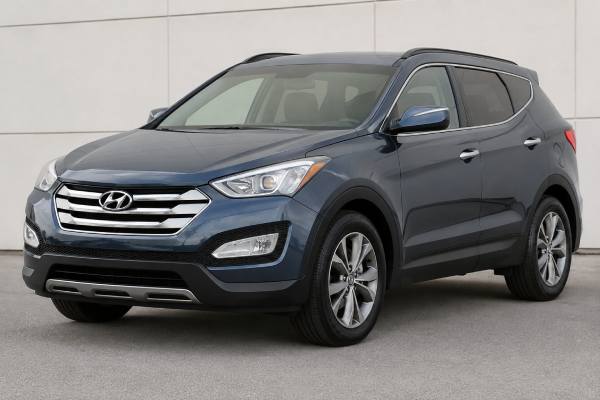
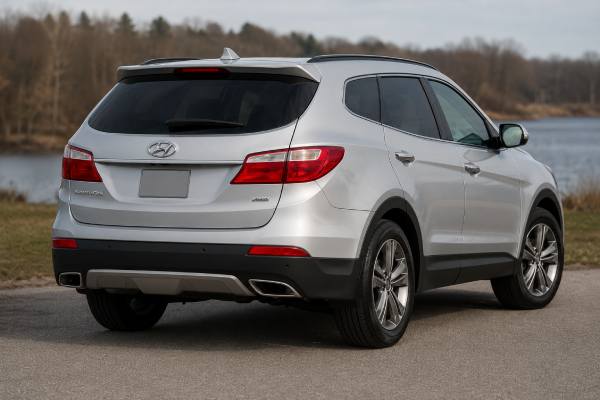
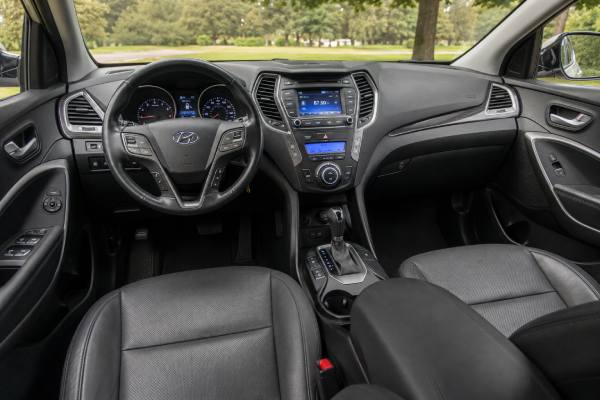
The 2013–2016 Hyundai Santa Fe AWD with the 3.3 GDi V6 is the longer three-row member of the third-generation Santa Fe family, known in some markets as the Santa Fe XL or Grand Santa Fe. It sits above the shorter Santa Fe Sport and was aimed at families who wanted V6 power, optional seven-seat practicality, and all-weather traction without moving into a full-size SUV.
Its strengths are clear: a smooth naturally aspirated V6, a conventional 6-speed automatic, generous cabin space, and useful towing ability when properly equipped. The main buying questions today are less about headline power and more about service history, recall completion, AWD condition, suspension wear, and whether the vehicle has been maintained well enough to avoid expensive age-related repairs.
Quick Specs and Notes
- The 3.3 GDi V6 makes 290 hp and 252 lb-ft, giving the long-wheelbase Santa Fe confident highway and loaded-family performance.
- AWD models add useful winter and wet-road traction, with a driver-selectable lock mode for low-speed slippery conditions.
- The cabin offers genuine three-row flexibility, with up to about 2,265 L of cargo volume behind the front seats.
- Common ownership checks include ABS-module recall completion, hood-latch recall completion, GDI intake deposits, AWD fluid service, and suspension wear.
- A practical used-car service rhythm is engine oil every 7,500 miles or 12 months in normal use, and closer to 3,750–5,000 miles under severe city, winter, towing, or short-trip use.
Table of Contents
- Santa Fe NC AWD Profile
- Santa Fe NC Technical Specs
- Santa Fe NC Trims and Safety
- Reliability Issues and Service Actions
- Maintenance and Used Buyer Guide
- Driving Performance and Road Use
- How Santa Fe NC Compares
Santa Fe NC AWD Profile
The Hyundai Santa Fe AWD covered here is the long-wheelbase NC version with the 3.3-litre Lambda II GDi V6, built for model years 2013 through 2016 in this pre-facelift form. In North America, the vehicle was generally sold simply as the Hyundai Santa Fe, while the shorter two-row model carried the Santa Fe Sport name. In Canada and some later markets, the long model became more commonly known as Santa Fe XL; globally, similar versions may be called Grand Santa Fe.
That naming matters because the 3.3 GDi V6 is tied to the larger body, not the shorter four-cylinder Santa Fe Sport in the U.S. lineup. This is a 5-door unibody SUV with three rows, front-transverse engine placement, a 6-speed automatic transmission, and an on-demand AWD system. Most examples seat seven, while higher trims may use second-row captain’s chairs for six-seat configuration.
The 3.3 GDi engine is naturally aspirated, so there is no turbocharger, intercooler, or boost-control system to maintain. Instead, it relies on direct injection, dual continuously variable valve timing, and displacement to deliver its power. With 290 hp at 6,400 rpm and 252 lb-ft at 5,200 rpm, it is not a low-revving truck engine, but it is smooth, quiet, and willing to rev. That character suits highway merging, mountain driving, and full-passenger loads better than the four-cylinder Sport models.
The AWD system is best understood as a traction aid rather than a heavy-duty off-road system. It normally behaves like a front-biased crossover, sending torque rearward when slip or demand is detected. A lock function can help at low speed on snow, mud, gravel, or steep slippery driveways, but there is no low-range transfer case and no mechanical locking differential. Ground clearance is reasonable for winter roads and light tracks, not rock crawling.
For used buyers, the appeal is practical. The Santa Fe NC offers a more manageable footprint than many full-size three-row SUVs, yet it provides better third-row and cargo usefulness than many compact crossovers. Fuel economy is only average by modern standards, especially in city driving, but the powertrain is familiar, parts availability is good, and the cabin still feels functional if the vehicle has been cared for.
The best examples are not necessarily the lowest-mileage ones. A well-documented Santa Fe with regular oil changes, replaced spark plugs, serviced AWD fluids, completed recalls, and clean underbody condition is usually a safer choice than a neglected low-mileage car that has spent years on short trips with old fluids and original suspension parts.
Santa Fe NC Technical Specs
Specifications vary slightly by market, trim, wheel package, and measurement standard. The figures below focus on the North American-style 2013–2016 long-wheelbase Santa Fe/Santa Fe XL AWD with the 3.3 GDi V6.
| Item | Hyundai Santa Fe AWD 3.3 GDi V6 |
|---|---|
| Engine code | G6DH, Lambda II GDi V6 |
| Engine layout | Front transverse V6, 6 cylinders, DOHC, 4 valves per cylinder |
| Bore × stroke | 92.0 × 83.8 mm (3.62 × 3.30 in) |
| Displacement | 3.3 L (3,342 cc) |
| Induction | Naturally aspirated |
| Fuel system | Gasoline direct injection |
| Compression ratio | 11.5:1 |
| Maximum power | 290 hp (216 kW) @ 6,400 rpm |
| Maximum torque | 342 Nm (252 lb-ft) @ 5,200 rpm |
| Timing drive | Timing chain |
| Rated efficiency | About 13.1 / 9.8 / 11.8 L/100 km city/highway/combined for typical AWD versions; 18 / 24 / 20 mpg US; 21.6 / 28.8 / 24.0 mpg UK |
| Real-world highway at 120 km/h | Typically about 10.0–11.5 L/100 km (20–24 mpg US / 24–29 mpg UK), depending on tyres, roof load, terrain, wind, and temperature |
| Item | Specification |
|---|---|
| Transmission | 6-speed automatic with SHIFTRONIC manual mode; A6LF-family unit |
| Drive type | On-demand AWD, front-biased in normal driving |
| Differentials | Open differentials with electronic traction control; no locking axle differential |
| Front suspension | MacPherson strut independent suspension |
| Rear suspension | Independent multi-link suspension |
| Steering | Motor-driven power steering; driver selectable modes on many trims |
| Brakes | Four-wheel discs with ABS, stability control, brake assist, and electronic brake-force distribution |
| Common tyre sizes | 235/60 R18 or 235/55 R19, depending on trim |
| Ground clearance | About 186 mm (7.3 in) |
| Length / width / height | About 4,905 / 1,885 / 1,689–1,700 mm (193.1 / 74.2 / 66.5–66.9 in) |
| Wheelbase | 2,799–2,800 mm (110.2 in) |
| Turning circle | About 11.0 m (36–37 ft) kerb-to-kerb |
| Curb weight | About 1,960–2,030 kg (4,320–4,475 lb), depending on trim and equipment |
| GVWR | About 2,550 kg (5,622 lb) for AWD automatic versions |
| Fuel tank | 71 L (18.8 US gal / 15.6 UK gal) |
| Cargo volume | About 383 L (13.5 ft³) behind third row, 1,158 L (40.9 ft³) behind second row, 2,265 L (80.0 ft³) behind front seats; SAE-style North American measurement |
| Metric | Typical figure |
|---|---|
| 0–100 km/h (0–62 mph) | About 7.8–8.5 seconds, depending on trim, load, and test conditions |
| Top speed | Approximately 190–200 km/h (118–124 mph), market dependent |
| 100–0 km/h braking | Typically around 38–41 m (125–135 ft from 60 mph in independent-style testing), tyre dependent |
| Towing capacity | Up to 2,268 kg (5,000 lb) braked when properly equipped; unbraked ratings vary by market, commonly around 750 kg (1,653 lb) where published |
| Payload | Roughly 500–590 kg (1,100–1,300 lb), depending on trim, occupants, accessories, and GVWR label |
| System | Specification and capacity |
|---|---|
| Engine oil | SAE 5W-30 commonly preferred; API SM/ILSAC GF-4 or later, ACEA A5 or suitable updated equivalent; 5.7 L (6.0 US qt) with filter |
| Coolant | Ethylene-glycol coolant for aluminum engines/radiators, mixed with distilled water; about 9.1 L (9.6 US qt) |
| Automatic transmission fluid | Hyundai/Kia ATF SP-IV; total capacity about 7.8 L (8.24 US qt), drain-and-fill amount lower |
| Rear differential oil | API GL-5 SAE 75W-90 hypoid gear oil; about 0.53 L (0.56 US qt) |
| Transfer case oil | API GL-5 SAE 75W-90 hypoid gear oil; about 0.68 L (0.72 US qt) |
| Brake fluid | DOT 3 or DOT 4; about 0.7–0.8 L (0.74–0.85 US qt) |
| A/C refrigerant | R-134a on most 2013–2016 examples; about 600 ± 25 g front A/C or 800 ± 25 g front + rear A/C |
| A/C compressor oil | PAG FD46XG type; about 120 ± 10 g front A/C or 210 ± 10 g front + rear A/C |
| Wheel lug nuts | 107–127 Nm (79–94 lb-ft) |
| Engine oil drain plug | About 39 Nm (29 lb-ft), using a new washer |
| Area | Result or equipment |
|---|---|
| IIHS crashworthiness | Good in moderate overlap, side, roof strength, and head restraints; Marginal in driver-side small overlap for 2013–2016 rating period |
| IIHS front crash prevention | Not available on the 2016 rating page for this generation |
| IIHS LATCH ease of use | Acceptable for 2015–2016 listed rating |
| Euro NCAP-related DM Santa Fe result | European Santa Fe generation achieved 5 stars in 2012, with strong adult and child occupant scores; equipment and body details may differ by market |
| ADAS availability | Blind-spot detection and rear cross-traffic alert were available on higher trims; AEB, adaptive cruise, lane centering, and cyclist detection were not typical features for this 2013–2016 version |
Santa Fe NC Trims and Safety
Trim names depend heavily on market. In the United States, the long-wheelbase V6 Santa Fe was commonly offered as GLS, Limited, SE, and Ultimate-type configurations across the 2013–2016 period. In Canada, Santa Fe XL naming was common, with Premium, Luxury, Limited, and similar grades. The mechanical package remained broadly consistent: 3.3 GDi V6, 6-speed automatic, FWD or AWD depending on configuration, and two- or three-row seating depending on the exact version.
The most basic way to identify the long-wheelbase V6 model is by its body length, three-row interior, and 3.3 V6 badging or VIN/engine information. It is longer than the Santa Fe Sport and has a more family-hauler layout. AWD examples may also have an AWD badge, a centre-console AWD lock button, and underbody rear driveline hardware. Do not rely only on badges, because used vehicles may have had badges removed or replaced.
Equipment differences are more important than the trim badge itself. Lower trims usually have cloth seating, 18-inch wheels, conventional audio, manual or power front seats depending on package, and a rearview camera on many examples. Higher trims may add leather, heated second-row seats, ventilated front seats, power liftgate, panoramic sunroof, navigation, larger screen, upgraded audio, 19-inch wheels, second-row captain’s chairs, proximity key, and blind-spot monitoring.
Mechanically, wheel and tyre packages are the most common functional difference. The 18-inch setup with 235/60 R18 tyres usually gives a slightly more compliant ride and better pothole tolerance. The 19-inch setup with 235/55 R19 tyres looks sharper and may improve steering response slightly, but replacement tyres cost more and rough-road impact harshness can increase. Towing capability also depends on correct equipment, hitch installation, wiring condition, load distribution, and brake requirements.
Safety equipment for the period is solid but not modern by current standards. Standard systems typically include front airbags, front seat-mounted side airbags, side curtain airbags for outboard rows, a driver knee airbag on many North American examples, ABS, electronic stability control, traction control, brake assist, hill-start assist, downhill brake control, tyre-pressure monitoring, and LATCH/ISOFIX child-seat provisions depending on market.
Crash-test performance has one important nuance. The Santa Fe scored well in several established IIHS tests, but the driver-side small-overlap result for 2013–2016 was Marginal. That does not make the vehicle unsafe, but it does show that the generation was designed before small-overlap protection became as strong across the industry as it is today. Buyers comparing it with newer SUVs should keep that in mind.
ADAS is limited compared with current vehicles. Blind-spot detection and rear cross-traffic alert are useful features where fitted, but automatic emergency braking, adaptive cruise control, lane centering, traffic-sign recognition, and advanced pedestrian or cyclist detection were not normal equipment for this pre-facelift version. After windscreen replacement, collision repair, or suspension work, any fitted camera, radar, steering-angle, or blind-spot sensor functions should be checked and calibrated as required by Hyundai procedures.
Reliability Issues and Service Actions
The 3.3 GDi V6 Santa Fe is generally less associated with the well-known Hyundai/Kia four-cylinder Theta engine bearing recalls than the Santa Fe Sport 2.4 and 2.0T models. That is a meaningful advantage, but it does not make the V6 maintenance-free. Age, oil quality, cooling-system condition, AWD fluid neglect, and prior recall completion matter more than the badge on the liftgate.
Common to occasional engine issues include GDI-related intake valve deposits, ignition coil or spark-plug misfires, oil seepage from valve covers or timing-cover areas, and minor coolant leaks from hoses, thermostat housings, water pumps, or radiator end tanks. Symptoms include rough idle, cold-start stumble, flashing check-engine light under load, oil smell after parking, coolant crust around fittings, or slow coolant loss. Remedies range from spark plugs and coils to intake cleaning, gasket replacement, cooling-system pressure testing, or component replacement.
Timing chains are designed for long service life, not routine replacement at a fixed mileage. Still, a high-mileage or poorly serviced engine can develop chain rattle, worn guides, weak tensioners, or timing-correlation fault codes. A brief noise at start-up should not be ignored if it becomes regular, grows louder, or appears with drivability faults. The right response is diagnosis, not automatic parts replacement.
The 6-speed automatic is usually smooth when maintained, but used examples can show delayed engagement, harsh 2–3 or 3–4 shifts, torque-converter shudder, or adaptive shift confusion. Some issues improve after correct SP-IV fluid service and software/adaptive relearn procedures; others point to valve-body, solenoid, internal wear, or mount problems. Avoid any vehicle that bangs into gear, slips under throttle, overheats when towing, or has dark burnt-smelling ATF.
AWD-specific checks are important. The rear differential, transfer case, driveshaft, coupler, and rear wheel bearings should be inspected for leaks, rumble, vibration, binding on tight turns, or delayed rear-axle engagement. Fluid replacement is cheap compared with driveline repairs. In snowy or salty regions, look closely at subframes, brake lines, suspension arms, rear fasteners, exhaust hangers, and the hood latch area.
Relevant recalls and service actions vary by VIN. The major items to verify include the ABS module fire-risk recall affecting certain Santa Fe years, the secondary hood-latch cable corrosion recall for 2013–2017 Santa Fe/Santa Fe Sport vehicles, and certain seat-belt buckle harness recalls on some 2016–2017 models. Some vehicles may also have market-specific or accessory-related actions. The only reliable answer is an official VIN check plus dealer service records showing completion.
Pre-purchase checks should include:
- Full service history, with oil-change intervals and fluid specifications visible on invoices.
- Official recall completion printout from a Hyundai dealer or government recall database.
- Cold start after sitting overnight, listening for chain rattle, misfires, exhaust leaks, or belt noise.
- Transmission shift test from cold and hot, including light throttle, kickdown, reverse engagement, and highway lock-up.
- AWD inspection on a lift for leaks, rear coupler function, driveshaft play, and rear differential noise.
- Suspension and steering check for clunks, worn front lower control arms, rear bushings, wheel bearings, and alignment wear.
- Underbody corrosion inspection, especially in salt-belt climates.
The most attractive used examples feel tight, shift cleanly, run quietly, hold temperature, show no warning lights, and have proof of recall and fluid service. A cheap example with neglected fluids, mismatched tyres, unresolved recalls, and multiple dashboard lights can become expensive quickly.
Maintenance and Used Buyer Guide
For long-term ownership, the Santa Fe 3.3 GDi responds best to conservative maintenance. Hyundai’s normal-use intervals are acceptable for easy highway driving, but many used examples live in severe-service conditions: short trips, freezing starts, hot summers, stop-and-go traffic, dusty roads, long idling, heavy passenger loads, and towing. In those conditions, shorter fluid intervals are sensible.
| Item | Recommended practical interval |
|---|---|
| Engine oil and filter | Every 7,500 miles / 12,000 km or 12 months in normal use; every 3,750–5,000 miles / 6,000–8,000 km in severe use |
| Engine air filter | Inspect every 15,000 miles / 24,000 km; replace around 30,000 miles / 48,000 km or sooner in dust |
| Cabin air filter | Every 12–24 months, sooner if airflow drops or odour develops |
| Spark plugs | About 97,500 miles / 156,000 km for iridium plugs, or sooner with misfires or fuel-economy loss |
| Coolant | First major replacement often around 10 years / 120,000 miles; then about every 2 years / 30,000 miles, subject to local manual |
| Automatic transmission fluid | Inspect regularly; replace around 60,000 miles / 96,000 km under severe use or when buying used with unknown history |
| Rear differential and transfer case oil | Every 60,000 miles / 96,000 km in severe use; sooner after water exposure, towing, or fluid leakage |
| Brake fluid | Every 2–3 years, or when moisture content is high |
| Brake pads, rotors, and parking brake | Inspect at every tyre rotation; clean and lubricate hardware in corrosion-prone climates |
| Tyre rotation and pressure | Every 7,500 miles / 12,000 km; keep all four tyres matched in size, wear, and type on AWD models |
| Wheel alignment | Check annually, after impacts, or when tyre wear is uneven |
| Serpentine belt and hoses | Inspect yearly after 60,000 miles / 96,000 km; replace if cracked, swollen, noisy, or oil-contaminated |
| Timing chain system | No routine belt-style replacement; inspect if rattling, fault codes, poor maintenance history, or timing-correlation symptoms appear |
| 12 V battery | Test annually after year 3; replacement commonly needed around 4–6 years |
When buying, start with the paperwork. A Santa Fe with repeated quick-lube receipts showing the right oil and consistent mileage is better than one with vague “dealer maintained” claims but no proof. Look for spark plug replacement near the expected interval, coolant service by age, and AWD driveline fluid service. If the seller says the transmission is sealed for life, treat that as a reason to inspect more carefully, not as reassurance.
A good inspection should include a lift check. Look for oil around the front timing cover and valve covers, coolant staining, torn CV boots, rear differential seepage, transfer case wetness, loose exhaust shields, rust at suspension mounting points, and brake-line corrosion. Uneven tyre wear may point to alignment problems or worn suspension bushings. Mismatched tyres on AWD models are a red flag because rolling-diameter differences can stress the AWD system.
Recommended versions are usually well-equipped AWD models with 18-inch wheels, complete service records, and no unresolved warning lights. Higher trims are pleasant, but panoramic roofs, power liftgates, navigation units, and larger wheels add inspection points and repair cost. A high-trim vehicle is worthwhile only when all electrical equipment works properly.
The long-term durability outlook is good for a maintained example. The body and interior usually age well, the V6 has adequate power without turbo complexity, and the transmission is conventional. The weak point is not a single guaranteed failure; it is cumulative neglect. Old fluids, ignored recalls, cheap tyres, deferred suspension work, and corrosion can turn an otherwise sensible family SUV into a poor buy.
Driving Performance and Road Use
The Santa Fe NC 3.3 AWD drives like a comfortable family crossover rather than a sporty SUV. The V6 is the highlight. It is smooth at low load, quiet at highway speed, and strong enough to move the three-row body without feeling strained. Peak torque arrives fairly high in the rev range, but the engine’s displacement gives it enough flexibility for normal city driving. When loaded with passengers or climbing grades, it performs better than the four-cylinder versions of the era.
Throttle response is measured rather than sharp. The 6-speed automatic generally shifts smoothly and keeps engine speed low in relaxed driving. Under hard acceleration, it will downshift decisively and let the V6 rev, which is where the engine does its best work. Some drivers may notice gear hunting on rolling hills or when towing, especially with cruise control active. Manual mode can help hold a gear on descents or long grades.
Ride quality depends heavily on wheel size and tyre condition. On 18-inch tyres, the Santa Fe usually feels settled, absorbent, and family-friendly. On 19-inch wheels, sharp bumps and expansion joints are more noticeable, though the vehicle still remains comfortable for its class. Cabin noise is moderate: wind and road noise are controlled well enough for long trips, but coarse pavement and worn tyres can make the cabin louder with age.
Handling is predictable rather than agile. The steering is light, and selectable steering modes change effort more than true feedback. Body roll is present in fast corners, but the chassis feels stable when driven normally. Braking performance is adequate for family use, though any buyer should pay attention to pedal feel, rotor condition, caliper slide lubrication, and brake-fluid age. A soft pedal, vibration, or pulling under braking needs diagnosis before purchase.
Real-world fuel economy is the trade-off. In city use, expect roughly 13–15 L/100 km (16–18 mpg US / 19–22 mpg UK), sometimes worse in cold weather or short trips. On open highways at 100–110 km/h, 9–10.5 L/100 km (22–26 mpg US / 26–31 mpg UK) is realistic. At 120 km/h, with AWD, passengers, roof rails, winter tyres, or hills, 10–11.5 L/100 km is more typical. Mixed use commonly lands near 11.5–13 L/100 km.
The AWD system improves confidence in rain and snow, especially with good tyres. It is not a substitute for winter tyres, and it will not overcome poor braking grip on ice. The lock mode is useful at low speed, but the system returns to normal behaviour as speed rises. For towing, the Santa Fe is capable within its rating, but it should be set up correctly with the right hitch, wiring, trailer brakes where required, and conservative loading. Expect a substantial fuel-economy penalty when towing, often 25–40 percent depending on trailer shape, speed, and terrain.
How Santa Fe NC Compares
Against rivals from the same period, the Santa Fe NC 3.3 AWD sits in a useful middle ground. It is smaller and easier to park than many full-size SUVs, but roomier and stronger than compact crossovers. Its closest natural competitors include the Toyota Highlander V6 AWD, Honda Pilot AWD, Kia Sorento V6 AWD, Ford Explorer V6 AWD, Nissan Pathfinder V6 AWD, and Mazda CX-9 AWD.
The Toyota Highlander has a stronger reputation for long-term resale value and conservative durability. It is usually more expensive used, and comparable examples may have higher mileage for the same price. The Santa Fe counters with stronger feature value, a pleasant V6, and often a lower purchase price.
The Honda Pilot offers boxier packaging, excellent interior utility, and a strong ownership reputation. Its driving feel is more utilitarian, and older examples can also have age-related transmission, suspension, and timing-belt maintenance considerations depending on year. The Santa Fe feels more modern inside than some Pilot years, but the Pilot is often better for maximum third-row practicality.
The Kia Sorento V6 AWD is mechanically related in broad Hyundai/Kia terms and can be a strong alternative. Depending on year, it may be smaller or differently packaged. Used pricing, condition, and service history often matter more than the badge. A well-maintained Sorento is preferable to a neglected Santa Fe, and vice versa.
The Ford Explorer offers more space and a heavier feel, but it can be more expensive to repair and less efficient. The Nissan Pathfinder of this era has a roomy cabin and strong V6, but its CVT reputation makes careful inspection essential. The Mazda CX-9 is more enjoyable to drive, but older examples can be thirstier and may have their own corrosion and suspension concerns.
The Santa Fe’s main advantages are value, V6 smoothness, manageable size, good equipment levels, and useful towing capacity. Its drawbacks are average fuel economy, limited modern ADAS, small-overlap crash-test weakness compared with newer SUVs, and the need to verify recalls and AWD service carefully.
For a used buyer, the verdict is straightforward: the 2013–2016 Hyundai Santa Fe AWD 3.3 GDi V6 is worth considering when the example is clean, documented, and priced below equivalent Toyota or Honda alternatives. It is not the best choice for maximum fuel economy or the latest safety technology, but it remains a practical, comfortable, and capable three-row SUV when maintained properly.
References
- Gas Mileage of 2016 Hyundai Santa Fe 2016 (Fuel Economy)
- Vehicle Detail Search – 2016 HYUNDAI SANTA FE 3.3L | NHTSA 2016 (Recall Database)
- 2016 Hyundai Santa Fe 2016 (Safety Rating)
- Specifications & Consumer information 2016 (Owner’s Manual)
- Check for Recalls: Vehicle, Car Seat, Tire, Equipment 2026 (Recall Database)
Disclaimer
This article is for informational purposes only and is not a substitute for professional diagnosis, repair, or inspection. Specifications, torque values, service intervals, capacities, recall applicability, and procedures can vary by VIN, market, trim, equipment, production date, and later service updates. Always verify critical information against the official owner’s manual, factory service documentation, under-hood labels, dealer records, and an official VIN recall check before buying, repairing, towing, or servicing the vehicle.
If this article was useful, please consider sharing it on Facebook, X/Twitter, or another platform to support our work.