


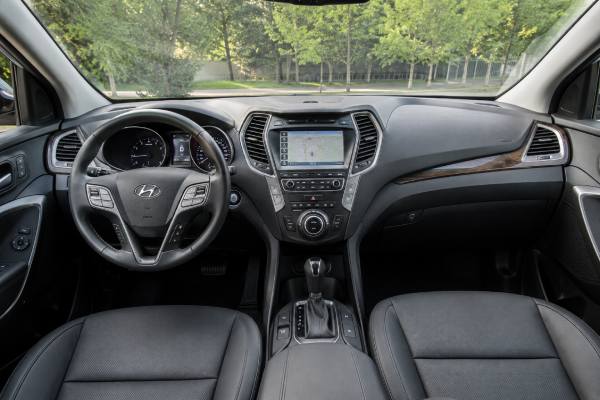
The facelifted Hyundai Santa Fe DM with the 2.2 CRDi diesel and 4WD is a practical seven-seat SUV that sits in the useful middle ground between family crossover comfort and genuine long-distance capability. In European and UK specification, it pairs a 2,199 cc R-series diesel engine with either a 6-speed manual or 6-speed automatic gearbox, standard 4WD, strong towing capacity, and a cabin that feels more premium than many older used-family SUVs.
Its appeal is not only the 200 hp output. The bigger advantage is torque: 440 Nm available low in the rev range, which gives the Santa Fe relaxed motorway performance, good hill-climbing ability, and enough reserve for towing or full-passenger loads. The main buying questions are condition, service history, diesel emissions health, underbody corrosion, and whether the car has had the right driveline fluids and recall checks.
Owner Snapshot
- Strong 440 Nm diesel torque makes the Santa Fe DM 2.2 CRDi well suited to motorway driving, hills, and towing.
- Standard 4WD, generous cabin space, and up to 2,500 kg braked towing on manual versions give it useful family-SUV versatility.
- The main ownership caveats are DPF/EGR issues from short-trip use, neglected AWD fluids, suspension wear, and corrosion in salted climates.
- Engine oil service intervals are commonly 15,000–30,000 km or 12–24 months depending on market and duty cycle; severe use should be closer to 15,000 km or annually.
- Diesel fuel filters and brake fluid deserve regular attention, typically around 30,000 km for the fuel filter and 2 years for brake fluid in many service schedules.
Table of Contents
- Santa Fe DM Facelift Guide
- Santa Fe DM 2.2 CRDi Specs
- Santa Fe DM Trims and Safety
- Reliability Issues and Service Actions
- Maintenance and Used Buying
- Driving Performance and Economy
- Rivals and Value Comparison
Santa Fe DM Facelift Guide
The 2016–2018 Hyundai Santa Fe DM facelift is the updated third-generation Santa Fe, not the later TM model that followed. In most European markets, the exact version covered here is the five-door SUV body with Hyundai’s 2.2 CRDi R-series four-cylinder diesel, 4WD, and either a 6-speed manual or 6-speed automatic transmission. UK-market cars were commonly sold in Premium and Premium SE grades, with 5-seat and 7-seat configurations depending on trim and market.
The facelift brought a sharper front end, revised lighting, upgraded equipment, and broader availability of driver-assistance features. Mechanically, it remained a conventional transverse-engine SUV: diesel engine at the front, front-biased 4WD with an electronically controlled rear-axle coupling, independent suspension, and disc brakes all round. It is not a heavy-duty off-roader with low range or locking differentials, but it is far more useful in poor weather, gravel tracks, winter roads, and towing conditions than a basic front-wheel-drive crossover.
The 2.2 CRDi engine is the main reason many used buyers focus on this version. It is a 16-valve DOHC turbo diesel with common-rail direct injection, a timing chain, a diesel particulate filter on most European-market cars, and enough low-speed torque to move the Santa Fe without working the engine hard. The 200 PS rating translates to about 197 bhp or 147 kW, while torque is quoted at 440 Nm. That makes it stronger than many 2.0-litre diesel rivals of the same period.
As a used car, the Santa Fe DM is strongest when judged as a practical long-distance family SUV. It has comfortable front seats, a roomy second row, a usable third row for children or shorter adults, and a large cargo area when the rear seats are folded. The driving position is high, visibility is good, and the controls are simple compared with newer touchscreen-heavy SUVs.
The trade-off is that it is a fairly large, heavy diesel SUV. City fuel use rises quickly in traffic, tyres and brakes are not small-car cheap, and neglected diesel emissions systems can become expensive. Buyers should also remember that equipment, service intervals, fluids, and safety systems vary by VIN and market. A UK Premium SE automatic, for example, can have features such as blind-spot detection, smart parking assist, panoramic roof, rear cross-traffic alert, and higher-grade audio, while lower or region-specific grades may be simpler.
For the right owner, the best version is usually a well-serviced automatic or manual with evidence of regular oil changes, diesel fuel filter replacement, brake fluid changes, AWD fluid servicing, clean underbody condition, and completed recall work. A Santa Fe that has mainly done motorway mileage is usually a better bet than a low-mileage diesel used only for short urban trips.
Santa Fe DM 2.2 CRDi Specs
Specifications below describe the facelift-era European/UK 2.2 CRDi 4WD model. Figures can vary by market, seat count, trim, wheel package, transmission, emissions calibration, and homologation method.
| Item | Hyundai Santa Fe DM 2.2 CRDi 4WD |
|---|---|
| Engine code | D4HB R-series diesel |
| Layout | Inline-4, DOHC, 4 valves per cylinder |
| Bore × stroke | 85.4 × 96.0 mm (3.36 × 3.78 in) |
| Displacement | 2.2 L (2,199 cc) |
| Induction | Turbocharged diesel with intercooler |
| Fuel system | Common-rail direct injection |
| Compression ratio | 16.0:1 |
| Maximum power | 200 PS / 197 hp (147 kW) @ 3,800 rpm |
| Maximum torque | 440 Nm (325 lb-ft) @ 1,750–2,750 rpm |
| Timing drive | Chain |
| Official combined economy | Manual: 6.0 L/100 km (39.2 mpg US / 47.1 mpg UK); automatic: 6.6 L/100 km (35.6 mpg US / 42.8 mpg UK) |
| Real-world highway at 120 km/h | Typically about 7.2–8.5 L/100 km (27.7–32.7 mpg US / 33.2–39.2 mpg UK), depending on tyres, load, weather, and roof accessories |
| Item | Specification |
|---|---|
| Manual transmission | 6-speed manual, market dependent |
| Automatic transmission | 6-speed torque-converter automatic, commonly A6LF-series |
| Drive type | 4WD, front-biased on-demand system |
| Differentials | Open front and rear differentials with brake-based traction control; no mechanical lockers |
| Item | Figure |
|---|---|
| Front suspension | MacPherson strut |
| Rear suspension | Multi-link independent |
| Steering | Rack and pinion power steering; 2.95 turns lock-to-lock |
| Brakes | Front vented discs about 321 mm (12.6 in); rear solid discs about 302 mm (11.9 in), VIN dependent |
| Popular tyres | 235/60 R18 or 235/55 R19 |
| Ground clearance | 180 mm (7.1 in) |
| Approach / departure / breakover | 16.5° / 21.2° / 16.6° |
| Length / width / height | 4,700 / 1,880 / 1,675 mm (185.0 / 74.0 / 65.9 in) |
| Wheelbase | 2,700 mm (106.3 in) |
| Turning circle | 10.9 m (35.8 ft), kerb-to-kerb |
| Kerb weight | About 1,806–2,003 kg (3,982–4,416 lb), depending on seats, trim, and transmission |
| GVWR | 2,600 kg (5,732 lb) |
| Fuel tank | 64 L (16.9 US gal / 14.1 UK gal) |
| Cargo volume | 5-seat: 585 / 1,680 L SAE; 7-seat: 516 / 1,615 L SAE, seats up / seats down |
| Item | Manual | Automatic |
|---|---|---|
| 0–100 km/h | About 9.0 s | About 9.6 s |
| Top speed | 203 km/h (126 mph) | 203 km/h (126 mph) |
| 100–0 km/h braking | Typically about 40–43 m (131–141 ft), tyre and load dependent | Typically about 40–43 m (131–141 ft), tyre and load dependent |
| Braked towing | 2,500 kg (5,512 lb) | 2,000 kg (4,409 lb) |
| Unbraked towing | 750 kg (1,653 lb) | 750 kg (1,653 lb) |
| Payload | About 623–794 kg (1,373–1,750 lb) | About 597–768 kg (1,316–1,693 lb) |
| System | Specification and capacity |
|---|---|
| Engine oil | Low-SAPS diesel oil, commonly 5W-30 ACEA C3; service fill about 6.3–6.7 L (6.7–7.1 US qt) |
| Coolant | Ethylene-glycol long-life coolant, typically 50:50 mix; capacity about 9.1–9.3 L (9.6–9.8 US qt) |
| Automatic transmission | Hyundai/Kia SP-IV ATF; total capacity about 7.7 L (8.1 US qt), drain quantity lower |
| Manual transmission | 75W manual gear oil to Hyundai specification; about 1.8–1.9 L (1.9–2.0 US qt) |
| Transfer case and rear differential | Hypoid gear oil to correct Hyundai specification; capacity varies by unit, verify by VIN before filling |
| Brake fluid | DOT 3 or DOT 4 as specified on cap/manual; renew by time as well as condition |
| A/C refrigerant | Usually R-134a on many DM cars, but confirm under-bonnet label; charge commonly around 650 g (22.9 oz) |
| A/C compressor oil | PAG oil type and charge must match compressor label; commonly around 120 mL (4.1 fl oz) |
| Key torque values | Wheel nuts commonly 88–107 Nm (65–79 lb-ft); oil drain plug commonly about 35–45 Nm (26–33 lb-ft); verify all repair torques by VIN |
| Item | Availability or rating |
|---|---|
| Euro NCAP | DM generation achieved 5 stars in 2012 testing; adult 96%, child 89%, pedestrian 71%, safety assist 86% |
| IIHS | No directly comparable IIHS rating for the European 2.2 CRDi 4WD DM diesel; US results do not map perfectly to this variant |
| Headlight rating | No exact IIHS headlight rating for this European diesel version |
| ADAS | Blind-spot detection, rear cross-traffic alert, lane departure warning, smart cruise, and autonomous emergency braking were trim and market dependent |
Santa Fe DM Trims and Safety
In the UK, the facelift Santa Fe 2.2 CRDi 4WD was most often seen in Premium and Premium SE form, with some special or regional editions depending on year. Premium already gave the car a high equipment level: leather trim, heated seats, 18-inch wheels, rear parking assistance, dual-zone climate control, navigation on many cars, roof rails, LED daytime running lamps, and a practical fold-flat rear-seat layout.
Premium SE moved the Santa Fe closer to a near-luxury family SUV. Typical identifiers include 19-inch wheels, panoramic glass roof, ventilated front seats, upgraded audio, larger infotainment display, blind-spot detection, rear cross-traffic alert, smart parking assist, electric tailgate on some cars, and higher-grade interior trim. Later special editions could add advanced smart cruise control, autonomous emergency braking, around-view monitor, and appearance details. Because equipment varied across markets, the safest buying method is to check the build sheet, VIN, and actual dashboard buttons rather than relying on trim badges alone.
Mechanically, the important differences are not as broad as the feature differences. The same 2.2 CRDi engine output was generally used, but towing capacity differs by transmission: the manual is typically rated higher for braked towing than the automatic. Wheel size also matters. The 18-inch tyre package usually gives a more compliant ride and lower replacement cost, while 19-inch wheels sharpen the look but can make the ride busier and make pothole damage more likely.
Safety equipment is strong for the period. The Santa Fe DM body structure performed well in Euro NCAP testing, and the model was known for a solid passive-safety package: front, side, and curtain airbags, stability control, anti-lock braking, brake assist, traction control, hill-start assist, downhill brake control, tyre-pressure monitoring, seatbelt reminders, and ISOFIX/LATCH-style child-seat anchors depending on market. Seven-airbag setups were commonly listed in UK material, including a driver’s knee airbag.
The main limitation is that advanced driver assistance was not universal. Many cars have blind-spot detection and rear cross-traffic alert, while AEB and adaptive cruise are more dependent on later trim, option package, and region. Lane support in this period is often lane departure warning rather than the more active lane-centering systems found in newer SUVs. After windscreen replacement, front camera service, radar removal, suspension work, or body repair, driver-assistance sensors may require calibration. A car with warning lights disabled, mismatched windscreen glass, or poor radar alignment should be treated cautiously.
For family use, check all child-seat mounting positions, third-row seatbelts, rear curtain-airbag trim, seat-folding cables, and rear air-conditioning vents where fitted. A high-spec seven-seat Santa Fe is very useful, but its safety and convenience features are only valuable if they work correctly.
Reliability Issues and Service Actions
The 2.2 CRDi Santa Fe DM has a generally durable reputation when serviced correctly, but it is not immune to age-related diesel and SUV issues. The strongest examples tend to have steady motorway use, documented oil changes, clean coolant, fresh filters, and proof that the 4WD system has not been ignored. The weakest are low-mileage urban cars that rarely complete DPF regeneration, or high-mileage tow vehicles with no transmission and differential fluid history.
Common or higher-priority checks include:
- DPF and EGR issues: Frequent short trips can prevent complete diesel particulate filter regeneration. Symptoms include rising oil level, frequent cooling fan operation after shutdown, warning lights, limp mode, poor economy, or failed emissions tests. The remedy is diagnosis first, not immediate parts replacement: check soot load, differential pressure sensor values, EGR operation, boost leaks, thermostat performance, injector correction, and software status.
- Boost and intake leaks: Split intercooler hoses, loose clamps, or leaking intake pipes can cause hissing, black smoke, reduced power, and overboost or underboost codes. Repairs are usually moderate cost if caught early.
- Fuel filter and injector sensitivity: Dirty diesel, delayed fuel-filter changes, or water contamination can cause hard starting, hesitation, rail-pressure faults, or injector correction issues. A regular diesel fuel-filter interval is cheap protection.
- Timing chain noise: The D4HB uses a timing chain, not a scheduled timing belt. Chains can last a long time, but cold-start rattle, correlation faults, metal debris, or tensioner/guide wear should not be ignored.
- Automatic transmission shift quality: The 6-speed automatic is usually smooth, but old ATF can contribute to harsh engagement, delayed shifts, or torque-converter shudder. A fluid service can help if no mechanical damage has occurred.
- AWD coupling and rear driveline: Binding on tight turns, rear-end clunks, vibration, or warning lights can point to coupling, prop-shaft, differential, mount, or tyre-size mismatch problems. Four matched tyres are important.
- Suspension wear: Drop links, rear suspension bushes, wheel bearings, top mounts, and self-leveling rear dampers on some seven-seat versions can wear with age, towing, and rough roads.
- Brake and parking brake faults: Rear calipers, electronic parking brake mechanisms, corroded discs, and seized slide pins are common used-SUV items, especially after winter use.
- Corrosion: Inspect subframes, rear suspension arms, brake pipes, fuel lines, towbar mounts, exhaust hangers, door bottoms, tailgate seams, and panoramic-roof drainage areas.
Software and calibration updates can matter. Engine ECU updates may address drivability, emissions-system logic, sensor interpretation, or warning-light behavior. Transmission updates can improve shift timing. Infotainment updates may fix Bluetooth, navigation, and rear-camera issues. ADAS-equipped cars may need calibration after glass, bumper, steering, or suspension work.
Recall and service-action coverage depends heavily on market and VIN. Some global Santa Fe-related campaigns have involved hood latch corrosion, ABS module electrical issues, seatbelt or airbag components, and region-specific safety items. These should not be assumed from the model year alone. Use an official VIN check through Hyundai or the relevant national recall database, then confirm completion with dealer records. On a used purchase, “no warning lights” is not enough; ask for written recall status and any dealer campaign invoices.
A sensible pre-purchase inspection should include diagnostic scan of all modules, DPF soot and regeneration data, cold start, hot restart, transmission behavior, 4WD engagement, tyre matching, coolant pressure check, underbody corrosion inspection, and a road test over bumps and at motorway speed.
Maintenance and Used Buying
Maintenance is where good Santa Fe DM ownership becomes predictable. The 2.2 CRDi is not unusually fragile, but it does need clean oil, clean diesel filtration, correct low-ash lubricant for the DPF, healthy cooling, and attention to driveline fluids. Treat any “sealed for life” language with caution on an older tow-capable SUV; long-term durability improves when ATF, transfer case oil, and rear differential oil are changed before symptoms appear.
| Item | Typical interval | Notes |
|---|---|---|
| Engine oil and filter | 15,000–30,000 km or 12–24 months | Use the shorter interval for city use, towing, cold climates, or frequent DPF regenerations |
| Engine air filter | 20,000–40,000 km | Inspect sooner in dusty areas |
| Cabin air filter | 15,000–30,000 km or annually | Important for demisting and HVAC airflow |
| Diesel fuel filter | About 30,000 km in many schedules | Replace sooner if fuel quality is uncertain or water contamination is suspected |
| Coolant | Often 80,000–120,000 km or 5–6 years | Use correct long-life coolant and mix ratio |
| Brake fluid | Every 2 years | Moisture content matters on heavy SUVs and tow vehicles |
| Automatic transmission fluid | 60,000–90,000 km for severe use | Use Hyundai/Kia SP-IV specification fluid |
| Manual gearbox oil | Inspect around 60,000 km; replace if contaminated or used hard | Use correct manual transaxle fluid |
| Transfer case and rear differential | 60,000–90,000 km under heavy use | Important for towing, winter roads, and high-mileage cars |
| Serpentine belt and hoses | Inspect annually; replace around 90,000–120,000 km if aged | Look for cracking, glazing, coolant staining, and swelling |
| Timing chain | No fixed replacement interval | Inspect for rattle, stretch, guide wear, tensioner faults, or timing correlation codes |
| Tyre rotation and alignment | 10,000–15,000 km | Keep all four tyres matched to protect AWD hardware |
| 12 V battery | Test annually after 4 years | Weak batteries cause misleading electronic faults |
When buying, start with paperwork. A stamped book is helpful, but invoices are better because they show the actual oil grade, fuel filter, coolant, ATF, brake fluid, and driveline work performed. Reject vague claims such as “full service history” if there is no evidence of diesel and AWD-specific maintenance.
On inspection, look underneath before you fall in love with the interior. Surface rust is normal in many climates, but deep corrosion around suspension mounts, brake pipes, subframes, and towbar points changes the value of the car. Check the rear differential and transfer case for leaks, and inspect the prop shaft, CV boots, and exhaust flex sections.
During the road test, the engine should start cleanly from cold, idle smoothly, pull strongly from low revs, and show no excessive smoke once warm. The automatic should engage Drive and Reverse without a heavy thump and shift without flare. The manual clutch should not slip under full torque in a high gear. Listen for wheel-bearing hum, suspension knocks, steering rack noises, and rear-end clunks.
The best used examples are not necessarily the lowest-mileage ones. A higher-mileage Santa Fe with motorway use, clean oil, good tyres, completed recalls, and driveline services can be a better purchase than a lightly used diesel with repeated short-trip DPF trouble. Premium SE models are attractive, but check expensive features such as panoramic roof, electric tailgate, ventilated seats, cameras, blind-spot monitoring, and parking sensors before paying a premium.
Long-term durability is good when maintained, but budget realistically. A used Santa Fe DM may need tyres, brakes, suspension links, battery, fluids, and possibly DPF/EGR work soon after purchase. Set aside a reconditioning fund and avoid cars with warning lights, mismatched tyres, unexplained coolant loss, or unclear recall status.
Driving Performance and Economy
The Santa Fe DM 2.2 CRDi drives like a large, comfort-focused diesel SUV. It is not sporty, but it feels strong and settled. The best part of the powertrain is its mid-range torque. With 440 Nm available from low rpm, the car does not need to be revved hard, and it handles motorway gradients, overtaking, and full-family loads with less effort than many smaller diesel crossovers.
Throttle response is smooth rather than sharp. There is some diesel lag if the engine is below the boost range, but once moving the Santa Fe pulls confidently. The manual version feels more direct and gives the highest braked towing rating, while the automatic suits the vehicle’s relaxed character better in daily use. The 6-speed automatic is not as quick as modern 8-speed or dual-clutch units, but it is usually smooth, predictable, and well matched to the engine’s torque. It may hunt slightly on rolling hills if heavily loaded, especially when towing.
Ride quality depends strongly on wheel size. Cars on 18-inch wheels and 235/60 tyres are more compliant and quieter over broken roads. Premium SE cars with 19-inch wheels look sharper but can feel firmer over potholes and expansion joints. Body control is acceptable for the size and age of the SUV, though quick direction changes reveal its weight. Steering is light and easy in town, with enough stability at motorway speeds but limited feedback when cornering hard.
Noise levels are generally good for a diesel SUV of this era. The engine is audible when cold and under hard acceleration, but it settles at cruising speed. Wind noise can increase around roof rails, panoramic-roof seals, or worn door seals. Tyres also make a noticeable difference; budget tyres can make the cabin feel much older than it is.
Real-world economy is highly use dependent. A warm engine on steady A-road or motorway use can return strong figures for a seven-seat 4WD SUV. Short trips, cold weather, stop-start traffic, roof boxes, towing, or repeated DPF regeneration can move fuel use sharply upward.
Typical owner-observed ranges are:
- City and short-trip use: about 8.5–10.5 L/100 km (22–28 mpg US / 27–33 mpg UK)
- Mixed use: about 7.0–8.5 L/100 km (28–34 mpg US / 33–40 mpg UK)
- Steady highway use: about 6.5–8.0 L/100 km (29–36 mpg US / 35–43 mpg UK)
- 120 km/h motorway cruising: often about 7.2–8.5 L/100 km (28–33 mpg US / 33–39 mpg UK)
The 4WD system is best understood as an all-weather traction system, not a rock-crawling setup. It normally behaves like a front-biased SUV and sends torque rearward when slip is detected. The lock button can help at low speeds on snow, mud, gravel, or a slippery launch surface, but there is no low range and ground clearance is modest. Tyres matter more than the badge: winter or all-season tyres transform the car in cold climates.
For towing, the Santa Fe’s strengths are torque, wheelbase, weight, and stability. The manual’s higher braked tow rating is useful on paper, while the automatic is easier in traffic and on manoeuvres. When towing, expect fuel use to rise substantially. A moderate caravan or trailer can add 20–50% to consumption depending on frontal area, speed, wind, and terrain. Watch coolant temperature, transmission behavior, tyre pressures, and brake condition before long trips.
Rivals and Value Comparison
The Santa Fe DM 2.2 CRDi 4WD competes most naturally with the Kia Sorento, Nissan X-Trail, Mitsubishi Outlander, Skoda Kodiaq, Toyota Land Cruiser-derived alternatives in some markets, and older seven-seat SUVs such as the Volvo XC90 and Honda CR-V where seating and towing needs overlap. Its strongest rival is the Kia Sorento of the same period, which shares much of the same mechanical DNA but has different styling, equipment mixes, and market pricing.
Against the Sorento, the Hyundai feels similar in powertrain character and practicality. The Kia often has a slightly more upright, square-edged cargo area feel, while the Hyundai can appear a little more polished inside in high trim. Buying condition matters far more than badge choice.
Against the Nissan X-Trail, the Santa Fe feels stronger and more substantial, especially with seven occupants or a trailer. The X-Trail may be cheaper to run in lighter-duty use, but it does not match the Hyundai’s diesel torque and towing confidence in comparable form.
Against the Mitsubishi Outlander, the Santa Fe feels more refined and more powerful in diesel 4WD form. The Outlander’s advantage is often price and simplicity, while plug-in hybrid versions appeal to drivers with short commutes. For long-distance diesel use and towing, the Santa Fe is usually the more satisfying choice.
Against the Skoda Kodiaq, the Hyundai is older in design but often stronger in diesel towing feel. The Kodiaq has a more modern cabin layout, sharper infotainment, and more efficient later engines, while the Santa Fe counters with robust equipment levels and a relaxed, substantial driving feel.
The Santa Fe’s main advantage as a used buy is value. It often offers leather, heated seats, seven-seat versatility, 4WD, strong diesel torque, and serious towing ability for less money than premium-badge SUVs. The disadvantage is that high-spec features, diesel emissions components, and AWD hardware can be expensive if neglected.
The best buying decision is to prioritize evidence over specification. A clean Premium model with excellent records can be better than a poorly maintained Premium SE loaded with expensive features. Choose 18-inch wheels if comfort and tyre cost matter. Choose the automatic if daily ease matters more than maximum braked tow rating. Choose the manual if you tow near the rated limit and prefer simpler long-term driveline behavior.
A well-kept Santa Fe DM 2.2 CRDi 4WD remains a compelling used family SUV because it combines space, torque, equipment, and practicality without becoming overly complex. It is at its best as a long-distance, all-weather, family-and-towing vehicle. It is less ideal for low-mileage urban use, where the diesel emissions system may never work in its preferred operating pattern.
References
- Hyundai Motor Company 2016 (Manufacturer Brochure)
- Santa Fe 2017 (UK Brochure)
- Euro NCAP | Hyundai SANTA FE 2018 (Safety Rating)
- Vehicle Detail Search – 2016 HYUNDAI SANTA FE SUV AWD | NHTSA 2026 (Recall Database)
- PMSS – Update Nov 2024- Website .xlsx 2024 (Maintenance Schedule)
Disclaimer
This article is for informational purposes only and is not a substitute for professional diagnosis, service, repair, or safety inspection. Specifications, torque values, service intervals, fluid capacities, procedures, recalls, and equipment vary by VIN, market, model year, trim, and installed options. Always verify against official Hyundai service documentation, the vehicle’s under-bonnet labels, dealer records, and the relevant recall database before carrying out maintenance or repairs.
If this information was useful, please consider sharing it on Facebook, X/Twitter, or your preferred social platform to support our work.