

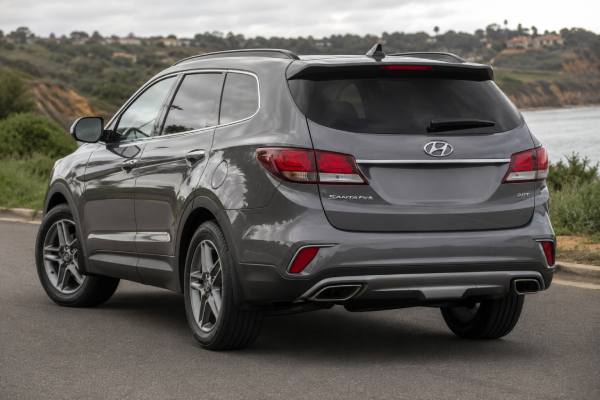

The 2017–2018 Hyundai Santa Fe FWD with the 3.3-litre GDi V6 sits in a specific part of the Santa Fe family: it is the facelifted, long-wheelbase, three-row NC model sold in North America, not the shorter Santa Fe Sport. Its appeal is straightforward. It offers a naturally aspirated V6, a conventional six-speed automatic, usable seven-seat packaging, and strong equipment value in a family SUV that is now mainly evaluated as a used purchase.
For buyers, the key questions are less about novelty and more about condition, service history, recall completion, fuel costs, and whether the V6’s performance advantage is worth the higher consumption compared with four-cylinder rivals. In good condition, this Santa Fe is comfortable, quiet, and practical. Poor maintenance, unresolved recalls, or neglected fluid service can change the ownership picture quickly.
Quick Specs and Notes
- The 3.3 GDi V6 makes 290 hp and gives the three-row Santa Fe confident highway passing and towing ability.
- FWD models are simpler than AWD versions, with fewer driveline fluids and no transfer case or rear differential service.
- The main ownership caveats are recall verification, oil-level monitoring, direct-injection carbon buildup, and cooling-system condition.
- Normal-use oil service is typically every 12,000 km / 7,500 miles or 12 months; severe use shortens this to 6,000 km / 3,750 miles or 6 months.
- Braked towing capacity is up to 2,268 kg / 5,000 lb when properly equipped.
Table of Contents
- Hyundai Santa Fe NC Family Role
- Hyundai Santa Fe NC Technical Specs
- Hyundai Santa Fe NC Trims and Safety
- Reliability and Known Service Actions
- Maintenance Schedule and Buying Checks
- Driving Feel and Real-World Economy
- Santa Fe NC Against Rivals
Hyundai Santa Fe NC Family Role
The NC Santa Fe covered here is the longer, three-row version of Hyundai’s third-generation Santa Fe line. In the U.S. market for 2017 and 2018, it was simply called Santa Fe, while the shorter two-row version was sold as Santa Fe Sport. In Canada, the same long-wheelbase model was commonly known as Santa Fe XL. That naming difference matters because specifications, crash-test notes, recalls, and used listings can mix the two body styles.
This version uses Hyundai’s Lambda II 3.3-litre GDi V6, a naturally aspirated direct-injection engine paired with a six-speed automatic transmission. Front-wheel drive is the simpler configuration: no rear differential, no transfer case, lower curb weight than AWD, and slightly better fuel economy in most trims. It is still a large crossover, however, so running costs remain closer to a V6 family SUV than a compact crossover.
The facelift brought updated front and rear styling, interior equipment improvements, and important structural changes for crash performance. The model was offered as a practical family vehicle rather than a sporty SUV. Its strengths are clear: smooth power delivery, a calm highway ride, good second-row space, available six- or seven-seat layouts depending on trim, and generous standard equipment for the money.
The third row is best understood as occasional seating. It works for children or short adult trips, but it does not turn the Santa Fe into a full-size SUV. Cargo space behind the third row is limited, although folding the third row creates a useful luggage area. With both rear rows folded, the Santa Fe becomes a very practical load carrier for household, travel, and outdoor use.
The main advantage of the 3.3 GDi FWD model is its balance of simplicity and performance. It avoids turbocharger complexity and AWD driveline service while retaining enough output for merging, mountain roads, and moderate towing. The trade-off is fuel consumption. Buyers moving from a four-cylinder crossover should expect noticeably higher fuel use in city driving, especially in cold weather or short-trip operation.
As a used vehicle, condition matters more than trim badge. A clean SE with complete maintenance records can be a better buy than a neglected Limited Ultimate. The ideal example has documented oil changes, completed recalls, good tires, smooth shifting, no coolant or oil leaks, no warning lights, and a service history that shows attention to brakes, suspension, battery condition, and cabin electronics.
Hyundai Santa Fe NC Technical Specs
The following figures apply to the 2017–2018 facelifted NC three-row Santa Fe with front-wheel drive and the 3.3-litre GDi V6. Some values vary by trim, market, tyre package, production date, and equipment. Always verify VIN-specific data before ordering parts or performing service.
| Item | Hyundai Santa Fe FWD 3.3 GDi V6 |
|---|---|
| Engine code | G6DH, Lambda II 3.3 GDi V6 |
| Engine layout | 60-degree V6, 6 cylinders, DOHC, 4 valves per cylinder |
| Bore × stroke | 92.0 × 83.8 mm / 3.62 × 3.30 in |
| Displacement | 3.3 L / 3,342 cc |
| Induction | Naturally aspirated |
| Fuel system | Gasoline direct injection |
| Compression ratio | 11.5:1 |
| Maximum power | 290 hp / 216 kW at 6,400 rpm |
| Maximum torque | 342 Nm / 252 lb-ft at 5,200 rpm |
| Timing drive | Timing chain |
| Rated fuel economy | SE FWD: 13.1 / 9.4 / 11.2 L/100 km city/highway/combined; 18 / 25 / 21 mpg US; 21.6 / 30.0 / 25.2 mpg UK |
| Upper-trim FWD fuel economy | About 13.8 / 10.2 / 11.8 L/100 km; 17 / 23 / 20 mpg US; 20.4 / 27.6 / 24.0 mpg UK |
| Real-world highway at 120 km/h / 75 mph | Typically about 10.5–12.0 L/100 km / 20–22 mpg US / 24–27 mpg UK, depending on tyres, load, wind, terrain, and temperature |
| Item | Specification |
|---|---|
| Transmission | Six-speed electronic automatic with SHIFTRONIC manual mode; A6LF-family automatic |
| Drive type | Front-wheel drive |
| Differential | Open front differential with electronic traction and stability control |
| Front suspension | MacPherson strut with gas dampers and stabilizer bar |
| Rear suspension | Multi-link with gas dampers and stabilizer bar |
| Steering | Motor-driven power steering; 15.01:1 ratio; 2.95 turns lock-to-lock |
| Brakes | Front ventilated discs 320 × 28 mm / 12.6 × 1.1 in; rear solid discs 302 × 10 mm / 11.9 × 0.4 in |
| Common tyres | SE: 235/60 R18 on 18 × 7.5J wheels; upper trims: 235/55 R19 on 19 × 7.5J wheels |
| Ground clearance | Approximately 185 mm / 7.3 in, market and tyre dependent |
| Length / width / height | 4,905 / 1,885 / 1,689 mm; 193.1 / 74.2 / 66.5 in, excluding mirrors and without roof-rack height allowance |
| Wheelbase | 2,799 mm / 110.2 in |
| Turning circle | 11.25 m / 36.9 ft curb-to-curb |
| Curb weight, FWD | About 1,822–1,835 kg / 4,017–4,045 lb depending on trim |
| GVWR, FWD | 2,500 kg / 5,512 lb |
| Estimated payload | About 665–678 kg / 1,467–1,495 lb before options and accessories |
| Fuel tank | 71 L / 18.8 US gal / 15.6 UK gal |
| Cargo volume, SAE | Behind third row: 382 L / 13.5 ft³; behind second row: 1,158 L / 40.9 ft³; behind front row: 2,265 L / 80.0 ft³ |
| Item | Specification or guidance |
|---|---|
| 0–100 km/h / 0–62 mph | Typically in the high-7 to low-8 second range depending on trim, load, tyre condition, and test method |
| Top speed | Approximately 200–210 km/h / 124–130 mph where conditions and market calibration allow |
| Braking distance | Healthy examples are typically around the low-40 m range from 100–0 km/h; independent 70–0 mph testing has been around 178 ft on an AWD test vehicle |
| Towing capacity | 2,268 kg / 5,000 lb braked; 907 kg / 2,000 lb unbraked |
| Engine oil | SAE 5W-30 commonly recommended; API SM / ILSAC GF-4 or later, market dependent; drain-and-refill about 5.7 L / 6.0 US qt, with some U.S. spec material listing 6.3 qt, so verify by dipstick and service data |
| Coolant | Ethylene-glycol coolant for aluminum engines, mixed with distilled water; full system about 9.1 L / 9.6 US qt |
| Automatic transmission fluid | Hyundai/Kia ATF SP-IV equivalent; total capacity about 7.8 L / 8.24 US qt |
| Brake fluid | DOT 3 or DOT 4; about 0.7–0.8 L / 0.74–0.85 US qt |
| A/C refrigerant and oil | R-134a; about 600 ± 25 g front A/C or 800 ± 25 g front plus rear A/C; PAG FD46XG compressor oil about 120 ± 10 g or 210 ± 10 g depending on system |
| Wheel lug torque | Typically 88–107 Nm / 65–79 lb-ft; verify the owner’s manual and wheel type |
| Safety ratings | IIHS Top Safety Pick+ when equipped with optional front crash prevention and qualifying headlights; NHTSA overall rating commonly listed as 5 stars for 2018 Santa Fe |
| ADAS availability | Blind-spot monitoring, rear cross-traffic alert, lane-departure warning, adaptive cruise control, and forward collision warning/AEB vary by trim and package |
Hyundai Santa Fe NC Trims and Safety
For 2017–2018 U.S. models, the three-row Santa Fe lineup was relatively simple. The main trims were SE, SE Ultimate, and Limited Ultimate. All used the 3.3 GDi V6 and six-speed automatic. Front-wheel drive was standard, while AWD was available, but this article focuses on the FWD version.
The SE is the practical baseline. It generally has seven-passenger seating with a second-row bench, 18-inch wheels, the V6 powertrain, rearview camera, basic infotainment, roof rails, and core safety hardware. SE Ultimate adds higher equipment content, usually including larger wheels, more convenience features, upgraded infotainment, and more driver-assistance availability. Limited Ultimate is the luxury-oriented trim, commonly identified by six-passenger seating with second-row captain’s chairs, 19-inch wheels, higher-grade interior trim, panoramic sunroof availability, premium audio, and a fuller driver-assistance package.
Mechanical differences are modest. The engine, transmission, basic suspension layout, brake sizes, and towing rating remain broadly consistent. Wheel and tyre packages make the biggest everyday difference. The 18-inch SE tyre usually gives a slightly calmer ride and lower replacement cost. The 19-inch package looks better and can sharpen response slightly, but it brings more tyre expense and a firmer edge over broken pavement.
Useful identifiers include:
- Santa Fe rather than Santa Fe Sport badging on U.S. 2017–2018 three-row models.
- NC body code references in service literature for the long-wheelbase model.
- KM8S VIN pattern often seen on the three-row Santa Fe, although VIN decoding should always be done with official data.
- Second-row captain’s chairs as a common Limited Ultimate clue.
- 19-inch wheels, panoramic roof, premium audio, and larger infotainment screen as signs of upper equipment packages.
Safety performance is a strong point, but the details matter. IIHS rated the 2018 three-row Santa Fe well overall, including Good results in major crashworthiness categories, with an Acceptable rating for the passenger-side small-overlap test. The Top Safety Pick+ award depended on optional front crash prevention and specific headlights. That means not every used example should be assumed to have the same crash-avoidance equipment or headlight rating.
The facelifted body structure is especially important. IIHS notes structural and restraint improvements beginning with 2017 models built after March 2016. For a 2017 vehicle, checking the build date on the driver-door certification label is worthwhile. Most 2018 examples fall after the structural update, but a careful buyer should still verify the exact vehicle.
The safety equipment list includes multiple airbags, stability control, traction control, ABS, electronic brake-force distribution, brake assist, tyre-pressure monitoring, LATCH child-seat anchors, and rearview camera. Available driver-assistance systems can include blind-spot detection, lane-change assist, rear cross-traffic alert, lane-departure warning, smart cruise control, forward collision warning, and automatic emergency braking. Availability depends heavily on trim and package.
Any collision repair near the front radar, windshield camera area, bumper, steering angle sensor, or suspension alignment can affect ADAS calibration. On a used Santa Fe with driver-assistance features, ask for records after bumper, windshield, grille, or suspension work. A warning light is not the only sign of a poor calibration; uneven lane-support behavior, false alerts, or inoperative adaptive cruise can also point to sensor or alignment issues.
Reliability and Known Service Actions
The 3.3 GDi Santa Fe can be durable, but it is not a vehicle to buy casually without inspection. The engine is powerful and generally smooth, yet it uses direct injection, has a timing chain system, and is now old enough for age-related leaks, sensors, mounts, cooling hoses, and electrical issues to matter. The best examples are those maintained on time with high-quality oil and verified recall completion.
| System | Prevalence | Severity | Symptoms | Likely remedy |
|---|---|---|---|---|
| ABS module recall exposure | VIN-dependent | High | Recall open, ABS/MIL warning, burning smell, or no symptom | VIN recall check and dealer remedy completion |
| 2017 crankshaft recall group | Rare, production-date specific | High | Engine noise, bearing wear, possible stalling risk | Dealer inspection and engine replacement if required |
| Oil consumption or low oil level | Occasional | Medium to high | Low dipstick reading, ticking, bearing noise, oil light during cornering | Consumption test, leak repair, shorter oil intervals, engine diagnosis |
| Direct-injection intake deposits | Occasional with mileage | Medium | Rough cold idle, misfires, reduced response | Diagnosis, intake cleaning where needed, quality fuel, correct oil service |
| Cooling system aging | Common with age | Medium | Coolant smell, seepage, crusting, rising temperature, weak heater output | Pressure test, hose/radiator/cap replacement, correct coolant fill and bleed |
| Six-speed automatic shift quality | Occasional | Medium | Harsh 2–3 shift, flare, delayed engagement, hunting on grades | Software check, fluid service if severe-use history, mount and sensor inspection |
| Suspension and steering wear | Common with mileage | Low to medium | Clunks, wandering, uneven tyre wear, vibration | Control-arm bushings, ball joints, links, alignment, tyres |
| Body and underbody corrosion | Climate-dependent | Medium | Rust at subframes, brake lines, exhaust, suspension hardware, tailgate seams | Inspection, rust repair, replacement hardware, avoid badly corroded examples |
The most important service-action topic is the ABS module fire-risk recall. Certain 2016–2018 Santa Fe NC vehicles without Smart Cruise Control were included in Recall 218, NHTSA 22V-056. The issue involved ABS modules that could malfunction internally and cause an electrical short, increasing fire risk while parked or driving. The remedy involved replacing the ABS multi-fuse with a revised part, and owners were advised to park outside until repaired. A used buyer should not rely on a seller’s verbal claim; ask for a printed dealer record or check the VIN through official recall tools.
A separate 2017 recall affected a smaller group of Santa Fe vehicles equipped with 3.3-litre engines. The crankshaft assemblies may have had surface irregularities that could cause premature bearing wear. The affected production window was narrow, but the severity is high because bearing wear can lead to engine damage or stalling. For any 2017 example, confirm whether Recall Campaign 168 applies and whether it was completed.
Beyond recalls, listen carefully during cold start. A brief high idle is normal, but persistent knocking, deep lower-end noise, heavy ticking after oil pressure builds, or chain rattle that continues should be treated seriously. Check the dipstick before startup and again after the test drive. A V6 that is consistently run low on oil is a poor bet, even if it drives well during a short inspection.
The timing chain does not have a fixed belt-style replacement interval. It should be inspected when symptoms appear: extended start rattle, cam/crank correlation faults, chain-related diagnostic codes, rough running, or abnormal timing data. Chain, guide, and tensioner work is not routine maintenance, but it becomes expensive when needed.
The automatic transmission is usually smooth when healthy. A mild downshift can be normal, but flare, repeated hunting, delayed reverse engagement, or harsh engagement from Park to Drive deserve further diagnosis. Hyundai often describes the fluid as not requiring normal-use service, but severe-use operation can justify ATF replacement. For high-mileage used examples, evidence of careful fluid service is a positive sign if correct SP-IV fluid was used.
Maintenance Schedule and Buying Checks
Maintenance is the difference between a good Santa Fe and an expensive one. The 3.3 GDi V6 is not unusually difficult to service, but it rewards regular oil changes, clean intake air, healthy cooling, and attention to small leaks before they become major repairs.
| Interval | Service items |
|---|---|
| Every fuel stop or monthly | Check engine oil level, coolant reservoir level, washer fluid, tyre pressure, exterior lights, and visible leaks |
| 12,000 km / 7,500 miles or 12 months | Replace engine oil and filter under normal use; rotate tyres; inspect battery, air cleaner, cooling hoses, and brake pedal free play |
| 6,000 km / 3,750 miles or 6 months | Use this shorter oil interval for severe service: short trips, towing, heavy traffic, dusty roads, extreme cold, mountain driving, or frequent stop-and-go use |
| 24,000 km / 15,000 miles | Inspect brakes, driveshaft boots, steering and suspension joints, exhaust, A/C refrigerant condition, and rear brake pads; replace cabin filter as needed |
| 48,000 km / 30,000 miles | Replace engine air filter and cabin filter; inspect brake fluid, fuel filter condition, fuel lines, parking brake, suspension fasteners, and steering components |
| 96,000 km / 60,000 miles or 72 months | Begin drive-belt inspections; replace if cracked, glazed, noisy, or tension is reduced; consider ATF service for severe-use vehicles |
| 160,000 km / 100,000 miles or 10 years | Replace spark plugs; inspect ignition coils, plug wells, valve-cover seepage, and intake condition |
| Coolant interval | Market schedules vary; many owner schedules call for first coolant replacement at 192,000 km / 120,000 miles or 60 months, then every 48,000 km / 30,000 miles or 24 months; verify locally |
| Timing chain | No routine belt interval; inspect for rattle, stretch, guide or tensioner wear, oil-pressure issues, and timing-correlation faults |
| 12 V battery | Test annually after year three; replacement is commonly needed around 4–6 years depending on climate and use |
Essential fluid choices include SAE 5W-30 engine oil meeting the required API/ILSAC specification, Hyundai/Kia SP-IV automatic-transmission fluid, DOT 3 or DOT 4 brake fluid, and ethylene-glycol coolant suitable for aluminum engines. The FWD model does not require rear differential or transfer-case oil service, which is one of its practical ownership advantages over AWD.
Before buying, inspect the vehicle in daylight and start it from cold. A good pre-purchase inspection should include:
- Full VIN recall check and dealer campaign history.
- Oil-level check before startup and evidence of regular oil changes.
- Cold-start noise assessment, including timing-chain and lower-end bearing sounds.
- Scan for stored and pending diagnostic codes, not just dashboard warning lights.
- Cooling-system pressure test and inspection for radiator, hose, thermostat, and water-pump seepage.
- Transmission test from Park to Reverse and Drive, plus gentle and hard acceleration shifts.
- Brake inspection for rotor rust, pulsing, seized slide pins, and parking-brake operation.
- Suspension check for front lower control-arm bushings, ball joints, strut mounts, rear links, and wheel bearings.
- Underbody rust inspection, especially in salt-belt vehicles.
- Tyre date codes, tread depth, uneven wear, and wheel damage.
- Interior electronics check: camera, parking sensors, infotainment, HVAC blend doors, heated seats, power tailgate, sunroof drains, and all ADAS functions if fitted.
The best trims to seek depend on priorities. SE FWD is attractive for lower tyre cost, simpler equipment, and seven-seat practicality. Limited Ultimate is better for buyers who want captain’s chairs, premium features, and driver-assistance technology, but more equipment means more items to inspect. Avoid any trim with unresolved recalls, unclear oil history, overheating evidence, water intrusion, heavy corrosion, or driveline symptoms.
Long-term durability is generally favorable when maintenance is consistent. The V6 is unstressed in normal family use, the automatic is conventional, and the FWD layout avoids AWD service points. The main financial risk is not routine maintenance; it is buying an example with hidden engine, recall, cooling, or corrosion problems.
Driving Feel and Real-World Economy
The Santa Fe NC 3.3 FWD drives like a comfortable family crossover with more engine than most rivals of its era. The V6 is the highlight. It is smooth at low rpm, quiet when cruising, and strong enough that the transmission does not need to work constantly on rolling terrain. Peak torque arrives high in the rev range, but the displacement gives enough response for normal traffic without feeling strained.
Throttle response is progressive rather than sharp. The six-speed automatic favors smoothness, and in relaxed driving it shifts cleanly. Kickdown response is acceptable, though not modern eight-speed quick. On hills or during loaded highway passing, it may hold lower gears longer and let the V6 rev, which is normal for this engine. Active Eco mode softens throttle response and can reduce unnecessary downshifts, but it also makes the vehicle feel less eager.
Ride quality depends strongly on the wheel package. The 18-inch setup is the more forgiving choice for rough roads and long-distance family use. The 19-inch tyres on upper trims add visual presence and a slightly more immediate steering feel, but impacts are more noticeable and replacement costs are higher. Cabin noise is generally well controlled, with wind and tyre noise more obvious than engine noise at highway speed.
Handling is stable rather than athletic. The Santa Fe tracks well on the highway and feels secure in sweepers, but it is a tall, front-heavy three-row crossover. Push hard and the front tyres run wide before anything dramatic happens. Steering is light and easy in town, but feedback is limited. Braking feel is predictable when the system is in good condition, though old fluid, rusty rotors, cheap tyres, or worn suspension can quickly make the vehicle feel less composed.
Fuel economy is the main compromise. In mixed real-world driving, many FWD 3.3 owners should expect about 10.5–12.5 L/100 km, equal to roughly 19–22 mpg US or 23–27 mpg UK. Dense city driving can rise to 13–15 L/100 km, or about 16–18 mpg US. Highway cruising at 100–110 km/h can be reasonably efficient for a V6 crossover, but 120 km/h, roof boxes, winter tyres, headwinds, and heavy loads all increase consumption.
Cold weather has a real effect. Short trips in winter can increase fuel use by 10–25 percent because the V6 takes time to warm fully, the transmission stays in richer warm-up strategy longer, and tyres and fluids create more drag. A weak thermostat, dragging brake caliper, underinflated tyres, or old spark plugs can make economy worse.
For towing, the 5,000 lb braked rating is useful, but it should not be treated as permission to ignore payload, tongue weight, tyres, brake condition, or cooling health. The FWD layout can tow moderate loads, but traction on wet ramps, gravel, or steep driveways is not as strong as AWD. With a trailer, expect a large fuel penalty, often 25–40 percent depending on frontal area and speed. A transmission cooler, correct hitch setup, brake controller where appropriate, and conservative speed make a meaningful difference.
The Santa Fe is at its best as a calm road-trip vehicle. It has enough engine for full-family travel, enough comfort for long distances, and enough cargo flexibility for real use. It is less satisfying for buyers who want sharp handling, low fuel costs, or a genuinely spacious adult third row.
Santa Fe NC Against Rivals
The Santa Fe NC competes most directly with V6 versions of the Kia Sorento, Toyota Highlander, Honda Pilot, Nissan Pathfinder, Ford Explorer, and Dodge Durango. It is smaller and more manageable than some of those, but roomier and more powerful than many two-row crossovers. Its used-market appeal comes from value, V6 performance, equipment, and relatively simple FWD mechanicals.
Against the Kia Sorento V6, the Hyundai feels closely related because the two share broad powertrain and platform thinking. The Kia may offer different seating and trim combinations depending on year, but the Hyundai’s three-row Santa Fe packaging is straightforward and family-focused. Buying between them should come down to condition, service records, and price more than badge.
Against the Toyota Highlander, the Santa Fe usually offers a lower used price and strong equipment value. The Highlander has a stronger reputation for long-term durability and resale value, but well-kept examples often cost more. The Hyundai gives a buyer more power and features per dollar, while the Toyota is often the safer conservative choice for low-drama ownership.
Against the Honda Pilot, the Santa Fe feels smaller and easier to place, but the Pilot has a more adult-friendly third row and broader cargo usefulness. The Hyundai’s V6 is smooth and strong, yet the Honda is better for families that regularly use all rows. The Santa Fe is better for buyers who need occasional third-row seating rather than minivan-like space.
Against the Nissan Pathfinder of the same era, the Hyundai’s conventional six-speed automatic is a point in its favor for buyers who dislike CVT behavior. The Pathfinder can be comfortable and roomy, but transmission feel and service history deserve careful attention. The Santa Fe’s powertrain character is more traditional.
Against the Ford Explorer and Dodge Durango, the Santa Fe is generally easier to park and more fuel-efficient than larger, heavier SUVs, but it cannot match their maximum passenger and cargo space. The Durango, in particular, feels more truck-like and offers higher-output engine options. The Hyundai is the lighter-duty, more urban-friendly choice.
The best reason to choose the 2017–2018 Santa Fe FWD 3.3 is value with real V6 performance. The best reason to pass is if fuel economy, third-row adult space, or brand-long resale strength is the main priority. A clean, recalled, well-serviced FWD Santa Fe can be a sensible used family SUV. A neglected one should be avoided, no matter how attractive the asking price looks.
References
- 2018 HYUNDAI SANTA FE SPECIFICATIONS 2018 (Manufacturer Specifications)
- Maintenance 2018 (Owner’s Manual)
- 2018 Hyundai Santa Fe 2018 (Safety Rating)
- Part 573 Safety Recall Report 22V-056 2022 (Recall Database)
- Part 573 Safety Recall Report 17V-578 2017 (Recall Database)
Disclaimer
This article is for informational purposes only and is not a substitute for professional diagnosis, repair, or inspection. Specifications, torque values, service intervals, capacities, recalls, and procedures can vary by VIN, market, production date, trim, and installed equipment. Always verify details against the official owner’s manual, service information, recall database, and dealer records for the exact vehicle.
If this helped you evaluate the Hyundai Santa Fe NC, please consider sharing it on Facebook, X/Twitter, or another platform to support our work.