

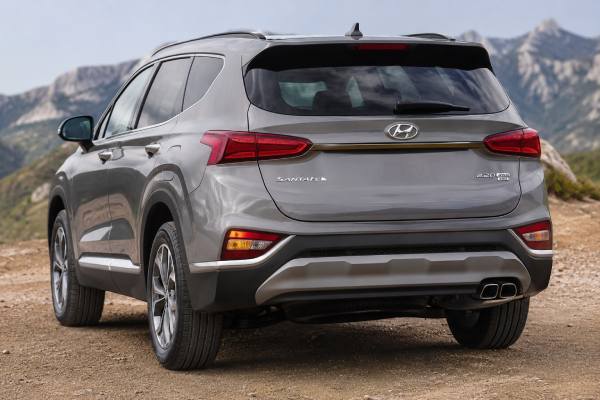

The fourth-generation Hyundai Santa Fe TM with the 2.2 CRDi diesel is a large, practical family SUV aimed at long-distance comfort, towing ability, and low-rev torque rather than sporty driving. In front-wheel-drive form, it is lighter and usually more economical than the AWD version, while keeping the same 2.2-litre diesel output and spacious cabin.
For used buyers, the important details are the exact market specification, transmission, emissions equipment, trim level, and service record. The 2018–2020 Santa Fe TM was sold with different equipment packages across Europe, the UK, Australia, and other regions, so a VIN-specific check matters. Still, the core formula is consistent: a roomy seven-seat-capable SUV, a strong diesel engine, and a comfort-focused chassis.
Owner Snapshot
- Strong 440 Nm diesel torque makes the Santa Fe TM relaxed on highways, with confident overtaking and towing manners.
- FWD versions avoid the extra weight and rear driveline maintenance of AWD models, improving efficiency and simplicity.
- The cabin is one of the model’s strengths, with generous second-row space, useful cargo volume, and available seven-seat layouts.
- Short-trip use can stress the DPF, EGR, SCR/AdBlue, and battery systems; check for warning lights, incomplete regenerations, and poor service history.
- For European diesel models, normal engine oil service is typically every 30,000 km or 24 months, but severe use calls for about 15,000 km or 12 months.
Table of Contents
- Santa Fe TM Diesel Profile
- Santa Fe TM Technical Data
- Santa Fe TM Trims and Safety
- Reliability and Service Actions
- Maintenance and Used Buying
- Driving Character and Efficiency
- How Santa Fe Compares
Santa Fe TM Diesel Profile
The Hyundai Santa Fe TM arrived as the fourth generation of Hyundai’s mid-size-to-large SUV line. In 2018–2020 pre-facelift diesel form, the 2.2 CRDi FWD version used Hyundai’s R-series/R II four-cylinder turbo-diesel engine, paired with either a manual or automatic transmission depending on market, model year, and trim. In the UK and much of Europe, the 8-speed automatic 2WD became the main configuration for higher-volume late-pre-facelift examples, while some earlier or lower-trim cars were also available with a manual gearbox.
This Santa Fe is best understood as a family and touring SUV. It is not as rugged as a body-on-frame off-roader, and FWD models do not have the all-weather traction of Hyundai’s HTRAC AWD system. The advantage is lower mechanical complexity, slightly better fuel economy, and less weight over the rear axle. For drivers who mainly use paved roads, motorways, school runs, commuting, and holiday travel, the FWD diesel is often the most sensible version.
The engine’s main appeal is torque. With about 200 PS and 440 Nm, the 2.2 CRDi does not need high revs to move the Santa Fe convincingly. It feels strongest from roughly 1,750 rpm, where the turbocharger is working well and the transmission can hold higher gears without constant kickdown. This suits long-distance cruising, moderate towing, and fully loaded family use.
The TM generation also moved the Santa Fe forward in interior quality and safety technology. Depending on trim, it could include leather upholstery, heated and ventilated front seats, heated rear seats, a larger infotainment screen, premium audio, surround-view cameras, adaptive cruise control, blind-spot assistance, rear cross-traffic alert, lane support, and automatic emergency braking. Base trims are still practical, but the best used examples are usually mid- or high-spec cars with full safety equipment and LED headlights.
The main accuracy point is that the badge alone is not enough. A 2018–2020 Santa Fe TM 2.2 CRDi may be 5-seat or 7-seat, manual or automatic, FWD or AWD, Euro 6d-Temp or a region-specific emissions configuration, and equipped with different wheel sizes and driver-assistance systems. A buyer should always confirm the VIN, build plate, service book, emissions label, and local homologation data before relying on a single published specification.
Santa Fe TM Technical Data
The figures below focus on the 2018–2020 Santa Fe TM FWD 2.2 CRDi 200 PS diesel, with notes where market, seating, trim, or transmission changes the result. Values are representative of European and UK-type specifications.
| Category | Specification |
|---|---|
| Model | Hyundai Santa Fe TM FWD |
| Body style | 5-door SUV, 5 or 7 seats depending market/trim |
| Model years covered | 2018–2020 pre-facelift diesel |
| Engine code/family | R II / D4HB 2.2 CRDi |
| Layout | Front transverse inline-4 diesel |
| Valvetrain | DOHC, 4 valves per cylinder, 16 valves total |
| Bore × stroke | 85.4 × 96.0 mm (3.36 × 3.78 in) |
| Displacement | 2.2 L / 2,199 cc |
| Induction | Turbocharged, intercooled |
| Fuel system | Common-rail direct injection |
| Emissions equipment | DPF; SCR/AdBlue on Euro 6d-Temp diesel versions |
| Compression ratio | 16.0:1 |
| Max power | 200 PS / 147 kW at 3,800 rpm |
| Max torque | 440 Nm / 325 lb-ft at 1,750–2,750 rpm |
| Timing drive | Chain |
| Drive type | Front-wheel drive |
| Differential | Open front differential |
| Transmission | 6-speed manual or 8-speed torque-converter automatic, market-dependent |
| Rated economy | About 6.0–6.9 L/100 km combined depending test cycle, trim, tyres, and transmission |
| Real highway at 120 km/h | Commonly about 7.0–8.0 L/100 km when lightly loaded |
| Dimensions and Chassis | Specification |
|---|---|
| Front suspension | MacPherson strut |
| Rear suspension | Independent multi-link |
| Steering | Rack-mounted motor-driven power steering |
| Steering ratio / lock-to-lock | Approx. 13.8:1 / about 2.5–2.6 turns |
| Front brakes | Ventilated discs, about 320 mm (12.6 in) |
| Rear brakes | Solid discs, about 305 mm (12.0 in) |
| Common tyre sizes | 235/65 R17, 235/60 R18, 235/55 R19 |
| Length | 4,770 mm (187.8 in) |
| Width excluding mirrors | 1,890 mm (74.4 in) |
| Height | About 1,680–1,705 mm (66.1–67.1 in), equipment-dependent |
| Wheelbase | 2,765 mm (108.9 in) |
| Ground clearance | About 185 mm (7.3 in) |
| Turning circle | About 11.4 m (37.4 ft) |
| Kerb weight | About 1,825–1,955 kg (4,023–4,310 lb), depending trim/transmission |
| GVWR | About 2,529–2,534 kg (5,575–5,587 lb) for UK-type 2WD diesel versions |
| Payload | About 579–704 kg (1,277–1,552 lb), depending version |
| Fuel tank | 71 L (18.8 US gal / 15.6 UK gal) |
| Cargo volume, 7-seat VDA | About 547 L seats up / 1,625 L maximum |
| Cargo volume, 5-seat VDA | About 625 L seats up / 1,695 L maximum |
| Performance and Capability | Specification |
|---|---|
| 0–100 km/h | About 9.3–9.5 seconds, transmission-dependent |
| Top speed | About 205 km/h (127 mph) |
| 100–0 km/h braking | Typically around 38–40 m (125–131 ft), tyre and test dependent |
| Braked towing | 2,000 kg with automatic; up to 2,500 kg on some manual 2WD specifications |
| Unbraked towing | 750 kg |
| Noseweight | About 100 kg where specified |
| Roof load | About 100 kg where specified |
| Fluids and Service Capacities | Specification |
|---|---|
| Engine oil | ACEA C3 or C2 low-SAPS oil for DPF-equipped diesels; common viscosities include 0W-30, 5W-30, 0W-40, or 5W-40 depending climate and market |
| Engine oil capacity | About 6.5 L (6.87 US qt) drain and refill |
| Coolant | Ethylene-glycol coolant suitable for aluminum radiators, mixed with deionized or soft water |
| Coolant capacity | About 8.8–9.0 L (9.3–9.5 US qt) |
| Automatic transmission fluid | Hyundai/Kia ATF SP-IV type where specified |
| ATF capacity | About 7.1 L (7.50 US qt), service method dependent |
| Manual transmission fluid | API GL-4 SAE 70W type |
| Manual gearbox capacity | About 1.8–1.9 L (1.9–2.0 US qt) |
| Brake fluid | DOT 3 or DOT 4 |
| Brake fluid capacity | About 0.44–0.48 L (0.46–0.50 US qt) |
| A/C refrigerant, Europe | R1234yf, about 625 g front A/C or 800 g front + rear A/C |
| A/C compressor oil | PAG, about 120 g front A/C or 210 g front + rear A/C |
| Urea/AdBlue tank | About 18 L (19 US qt) on SCR-equipped diesels |
| Key torque values | Wheel nuts commonly about 107–127 Nm (79–94 lb-ft); drain plugs and chassis fasteners should be verified by VIN-specific service data |
| Safety and Assistance | Rating or Equipment |
|---|---|
| Euro NCAP | 5 stars, 2018 test |
| Euro NCAP adult occupant | 94% |
| Euro NCAP child occupant | 88% |
| Euro NCAP vulnerable road users | 67% |
| Euro NCAP safety assist | 76% |
| IIHS, US 2019–2020 Santa Fe | Top Safety Pick+ with specific headlights; US test vehicles differ from European diesel models |
| IIHS headlights | LED projector versions rated Good; halogen projector versions rated Marginal |
| Driver assistance | AEB, pedestrian detection, lane support, blind-spot warning, rear cross-traffic warning, adaptive cruise, surround-view camera, and parking aids vary by trim and market |
Santa Fe TM Trims and Safety
Trim names vary by country, but the general pattern is consistent. In the UK, SE, Premium, and Premium SE grades were common. Other European markets used names such as Style, Trend, Comfort, Executive, Premium, or equivalent local grades. The base mechanical package stayed similar, but wheels, lighting, upholstery, infotainment, seat equipment, and ADAS availability changed significantly.
SE-type models usually have smaller alloy wheels, cloth trim, dual-zone climate control, roof rails, key safety systems, and seven seats in some markets. Premium-type models commonly add leather-faced trim, larger wheels, navigation, heated seats, more parking assistance, and additional convenience features. Premium SE or top trims are the ones to seek if you want ventilated front seats, heated rear seats, panoramic roof, premium audio, 360-degree camera, powered tailgate, and the best lighting package.
The most useful used-car identifiers are straightforward. Wheel size helps identify trim level: 17-inch wheels are usually lower trim, 18-inch wheels mid trim, and 19-inch wheels upper trim. LED headlight signatures, leather seat facings, ventilated-seat buttons, powered tailgate controls, larger infotainment displays, and camera-view buttons are also quick cabin clues. The VIN and build sheet remain the only reliable way to confirm factory options.
From a safety standpoint, the Santa Fe TM was strong for its period. Euro NCAP awarded the 2018 Santa Fe a five-star rating, with particularly high adult and child occupant scores. It also performed well in IIHS testing in the US, though IIHS data must be treated as related rather than identical for European diesel FWD cars. The structure is broadly relevant, but engine, trim, lighting, and market equipment are not always the same.
Airbag coverage typically includes front, side, and curtain airbags, while ISOFIX/LATCH child-seat anchors are provided for the second-row outer seats in most markets. Stability control, anti-lock braking, hill-start assist, downhill brake control, trailer stability assist, tyre-pressure monitoring, and emergency stop signalling were widely fitted.
ADAS availability is where trim choice matters most. Forward Collision-Avoidance Assist with pedestrian detection, lane-keeping support, blind-spot warning, rear cross-traffic alert, adaptive cruise control, and surround-view monitoring were not always standard on every trim in every market. After windscreen replacement, front-end repair, suspension alignment, bumper removal, or camera/radar work, calibration may be required. A car with warning lights disabled, poorly repaired bumper brackets, mismatched windscreens, or non-functioning lane/radar systems should be treated cautiously.
Reliability and Service Actions
The 2.2 CRDi Santa Fe TM has a generally solid reputation when serviced properly and used for the kind of driving a modern diesel prefers. The engine is well suited to long runs, towing, and motorway use. Problems are more likely when the car has spent years on short urban trips, missed oil services, low-quality fuel, or repeated interrupted DPF regeneration cycles.
Common or occasional issues can be grouped by system:
| Issue area | Prevalence | Severity | Symptoms | Likely cause and remedy |
|---|---|---|---|---|
| DPF loading | Occasional to common in short-trip cars | Medium to high | DPF warning, limp mode, frequent fan operation, rising oil level | Incomplete regeneration; diagnose soot/ash load, repair sensors or leaks, perform proper regeneration only when safe |
| EGR/intake deposits | Occasional | Medium | Hesitation, rough running, smoke, fault codes | Soot and oil vapor deposits; clean or replace affected EGR/intake parts after diagnosis |
| SCR/AdBlue faults | Occasional on Euro 6d diesels | Medium to high | AdBlue warning, no-start countdown, NOx sensor codes | Low fluid quality, sensor faults, heater/pump/module issues; use correct urea fluid and scan before replacing parts |
| Battery and electronics | Common with age | Low to medium | Random warnings, stop-start faults, weak cranking | Aging 12 V battery or poor voltage; test battery and charging system before deeper diagnosis |
| Automatic shift quality | Occasional | Medium | Harsh engagement, flare, hunting, delayed shifts | Old ATF, adaptation issue, software need, mount wear; check for updates and fluid condition |
| Suspension and tyres | Common wear item | Low to medium | Knocks, uneven tyre wear, steering vibration | Bushings, ball joints, alignment, worn tyres; inspect front and rear suspension carefully |
| Brake corrosion | Common with low use or winter salt | Low to medium | Pulsation, scraping, poor rear brake appearance | Corroded discs or sticky calipers; inspect rear brakes and parking brake mechanism |
| Cooling or oil leaks | Occasional | Medium | Coolant smell, wet undertray, oil mist | Hose, seal, cooler, or gasket seepage; pressure-test and repair early |
| Timing chain noise | Rare if maintained | High | Rattle at start-up, timing correlation faults | Chain, guide, or tensioner wear; verify with diagnostic data before replacement |
The timing system is chain-driven, so there is no scheduled timing belt replacement. That does not mean it should be ignored. A rattling start-up, cam/crank correlation fault, poor oil history, or metal debris in the oil should trigger proper diagnosis. Clean oil and correct low-SAPS specification are important because the turbocharger, chain tensioner, emissions equipment, and hydraulic components all depend on oil quality.
Service actions and recalls are market-specific. Some 2019–2023 Santa Fe TM vehicles in North America were included in a trailer tow hitch harness recall where water ingress could cause an electrical short in the accessory harness module. Some European markets also had VIN-specific campaigns involving systems such as fuel tank mounting, eCall data, or other production issues. These do not automatically apply to every 2.2 CRDi FWD car, so the correct step is to check the VIN through Hyundai, the local national recall database, and dealer service records.
For pre-purchase inspection, ask for proof of oil services, brake fluid changes, coolant service, fuel filter replacement, AdBlue/SCR repairs, software updates, and any completed recall campaigns. A healthy car should cold-start cleanly, idle evenly, pull strongly from low revs, shift smoothly, maintain coolant temperature, show no DPF or SCR warnings, and have no dampness around the engine, gearbox, radiator, fuel lines, or underbody.
Maintenance and Used Buying
For European diesel models, Hyundai’s normal schedule commonly lists oil and filter replacement at 30,000 km or 24 months. That interval assumes proper fuel, suitable use, and normal operating conditions. For city driving, repeated short trips, towing, dusty roads, mountain use, heavy traffic, commercial use, or low annual mileage, a shorter 15,000 km or 12-month interval is far safer.
| Item | Practical interval |
|---|---|
| Engine oil and filter | 30,000 km / 24 months normal; 15,000 km / 12 months severe use |
| Engine oil level check | Every 500 km or before long trips |
| Air cleaner filter | Inspect at service; replace about every 60,000 km normal or sooner in dust |
| Cabin filter | Replace about every 30,000 km / 24 months or sooner in polluted/dusty areas |
| Fuel filter cartridge | Inspect/replace according to fuel quality; commonly 60,000 km in normal European schedule |
| Drive belts | First inspect about 90,000 km / 72 months, then every 30,000 km / 24 months |
| Coolant | First replace about 210,000 km / 10 years, then every 30,000 km / 24 months |
| Brake fluid | Replace every 30,000 km / 24 months |
| Brake pads, discs, hoses | Inspect every service |
| Automatic transmission fluid | Officially often “no check/no service” in normal use; replace about 90,000–100,000 km in severe use or for long-term ownership |
| Manual transmission fluid | Inspect periodically; replace after water exposure or severe use |
| Tyre rotation and alignment | Rotate about every 10,000–15,000 km; align if wear is uneven |
| 12 V battery | Test annually after 4 years; many last 4–6 years |
| AdBlue/SCR system | Keep filled with fresh ISO 22241 fluid; diagnose warnings promptly |
| Timing chain | No routine replacement; inspect if noisy or diagnostic faults appear |
A good used Santa Fe TM should have matching tyres of the correct load and speed rating, a clean MOT/inspection history, no evidence of accident repair around the radar/camera areas, no water damage in the boot or under carpets, and no warning lights at start-up. Pay attention to the rear brakes, suspension links, wheel bearings, tailgate operation, panoramic roof drains where fitted, and third-row seat mechanisms.
During a test drive, start the engine from cold and listen for chain rattle, injector knock, belt squeal, or turbo whistle. The automatic should engage Drive and Reverse without a heavy thump. Under load, the engine should pull smoothly without surging. After the drive, check for coolant smell, oil leaks, diesel leaks, and active cooling fans that keep running unusually long.
The most desirable versions are usually mid- or high-trim cars with LED headlights, full ADAS, documented Hyundai service history, and evidence of longer-distance use. A lower-trim FWD car can still be a sensible buy if it is mechanically clean, but missing safety equipment and halogen headlights reduce appeal. Avoid cars with repeated DPF/SCR warning history, incomplete recall records, suspicious mileage gaps, cheap mismatched tyres, or unexplained battery/electrical faults.
Long-term durability is promising if the car is maintained more conservatively than the longest official intervals. The engine, gearbox, and chassis can handle high mileage, but modern diesel emissions repairs can be expensive. The safest ownership strategy is simple: correct oil, clean fuel, regular long runs, early diagnosis of warning lights, and documented servicing.
Driving Character and Efficiency
On the road, the Santa Fe TM FWD 2.2 CRDi feels calm, stable, and mature. The steering is light enough for town use but steady at motorway speed. It is not a sharp-handling SUV, and the front-drive layout can run wide if pushed hard on wet roads, but body control is tidy for a large family vehicle. The suspension is tuned more for comfort than aggression, especially on 17- or 18-inch wheels.
The 19-inch wheel package improves visual stance but can make the ride firmer over broken surfaces. Tyre choice matters. A high-quality touring tyre reduces cabin noise, improves wet braking, and helps the Santa Fe feel more secure. Cheap or mismatched tyres can make the front axle feel vague and increase wheelspin under hard acceleration.
The diesel engine suits the car well. It has a useful low-rpm band and does not need to be revved hard. Turbo lag is present at very low revs, especially from a rolling crawl, but once the engine is above roughly 1,700 rpm it delivers confident pull. The automatic transmission generally suits the engine better than a manual for family use because it keeps the engine in its torque band and makes towing or traffic easier. A healthy gearbox should shift smoothly; repeated harshness or flaring should not be dismissed as normal.
Noise control is good for a diesel SUV of this period. There is some cold-start diesel sound outside the vehicle, but once warm, the engine settles down. At motorway speed, wind and tyre noise become more noticeable than the engine, particularly on coarse surfaces or larger wheels.
Real-world fuel economy depends heavily on journey type. In town, expect roughly 8.0–10.0 L/100 km (24–29 mpg US / 28–35 mpg UK), especially in cold weather. Mixed driving often lands around 6.8–8.0 L/100 km (29–35 mpg US / 35–42 mpg UK). On steady highways at 100–120 km/h, a lightly loaded FWD diesel can often manage about 6.5–8.0 L/100 km (29–36 mpg US / 35–43 mpg UK), depending on tyres, wind, temperature, and roof load.
Towing is one of the diesel Santa Fe’s advantages. The strong torque, long wheelbase, and good braking hardware make it more relaxed than many smaller SUVs. The automatic 2WD version is commonly rated around 2,000 kg braked, while some manual 2WD versions are rated higher. When towing, expect noticeably higher consumption, often 20–40% more with a moderate trailer and more with a caravan, hills, headwinds, or high speeds. Regular ATF, brake, tyre, and cooling-system checks become more important if the car tows frequently.
How Santa Fe Compares
The 2018–2020 Hyundai Santa Fe TM 2.2 CRDi competes most naturally with the Kia Sorento, Skoda Kodiaq, Peugeot 5008, Nissan X-Trail, Mitsubishi Outlander, and some larger used SUVs from Toyota, Ford, and Volkswagen. Its strengths are space, diesel torque, comfort, equipment, and warranty coverage when newer. Its weaknesses are size in tight streets, diesel emissions complexity, and the fact that FWD versions lack the traction advantage of AWD rivals.
| Rival | Santa Fe advantage | Rival advantage |
|---|---|---|
| Kia Sorento diesel | Similar engineering, but Santa Fe often feels slightly more modern inside in TM form | Sorento may offer broader seven-seat practicality and strong value |
| Skoda Kodiaq | Santa Fe has strong diesel torque and generous standard equipment | Kodiaq feels lighter, sharper, and often more efficient |
| Peugeot 5008 | Santa Fe is stronger for towing and long-distance diesel work | 5008 is lighter, more efficient, and has a more flexible cabin layout |
| Nissan X-Trail | Santa Fe feels more substantial and refined | X-Trail can be cheaper to buy and easier to park |
| Mitsubishi Outlander | Santa Fe diesel is better for motorway torque and towing | Outlander PHEV can suit short electric commuting better |
| Volkswagen Tiguan Allspace | Santa Fe offers more relaxed diesel strength and equipment value | Tiguan Allspace has a more precise driving feel and strong resale |
For buyers who need seven seats, regular towing, and long-distance diesel economy, the Santa Fe TM remains a convincing used SUV. It is more refined than many older diesel rivals and less complicated than later hybrid or plug-in hybrid versions in some respects. For mostly urban use, however, it is not the ideal choice. A petrol hybrid, smaller SUV, or non-diesel alternative may be cheaper to maintain if most trips are short.
The best reason to choose this Santa Fe is balance. It offers enough power, enough space, enough comfort, and enough safety technology without feeling overly complicated in FWD form. The best reason to walk away is a poor service record or evidence that the emissions system has been neglected. A well-maintained example can be a dependable family SUV; a neglected one can quickly become expensive.
References
- Hyundai Santa Fe press kit – December 2019 2019 (Technical Specifications)
- OWNER’S MANUAL 2019 (Owner’s Manual)
- Euro NCAP | Hyundai SANTA FE 2018 (Safety Rating)
- 2019 Hyundai Santa Fe 2019 (Safety Rating)
- Home | Hyundai Recalls & Service Campaigns 2026 (Recall Database)
Disclaimer
This article is for informational purposes only and is not a substitute for professional diagnosis, repair, or official service guidance. Specifications, torque values, service intervals, fluids, procedures, emissions equipment, recalls, and safety systems can vary by VIN, market, trim, production date, and installed equipment. Always verify important details against the official owner’s manual, service documentation, Hyundai dealer systems, and local regulatory databases before buying, servicing, towing, or repairing the vehicle.
If you found this useful, please consider sharing it on Facebook, X/Twitter, or another platform to help support our work.