


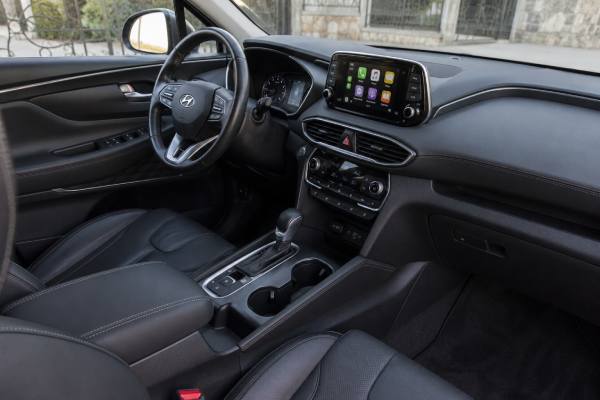
The 2018–2020 Hyundai Santa Fe TM with the 2.2 CRDi diesel and 4WD is a practical seven-seat SUV aimed at families, long-distance drivers, and buyers who want strong towing ability without moving into a larger body-on-frame vehicle. In European and UK form, this version pairs Hyundai’s 2.2-litre R-series diesel with either a 6-speed manual or, more commonly, an 8-speed torque-converter automatic and HTRAC all-wheel drive.
Its appeal is straightforward: generous cabin space, useful diesel torque, a strong safety package for the period, and a calm motorway character. The important checks are equally clear: diesel emissions equipment, service history, AWD fluid maintenance, tyres, brakes, and software or recall completion should all be verified before purchase.
Quick Overview
- Strong 440 Nm diesel torque gives the Santa Fe confident motorway performance and useful towing ability.
- Seven seats, 547 L VDA luggage capacity with the third row folded, and a quiet cabin make it a strong family SUV.
- Euro NCAP awarded the 2018 Santa Fe five stars, with high adult and child occupant protection scores.
- Diesel ownership depends heavily on correct oil, DPF-friendly use, AdBlue system health, and timely fuel-filter changes.
- A sensible service rhythm is engine oil every 15,000 km or 12 months, with shorter intervals for heavy urban use, towing, or repeated short trips.
Table of Contents
- Santa Fe TM Diesel Context
- Santa Fe TM Technical Data
- Santa Fe TM Trims and Safety
- Reliability Issues and Service Actions
- Maintenance and Used Buying
- Driving Performance and Efficiency
- Comparison With Key Rivals
Santa Fe TM Diesel Context
The TM-generation Hyundai Santa Fe arrived as a more mature SUV than the model it replaced. It moved the Santa Fe further into large family-SUV territory, with a longer body, a more refined interior, stronger driver-assistance availability, and a more settled long-distance feel. In many European markets, the early TM Santa Fe was sold primarily with the 2.2 CRDi diesel, making this version especially relevant on the used market.
The engine is Hyundai’s 2.2-litre R-series four-cylinder diesel, commonly identified by the D4HB family code. In this application it was rated at 200 PS, or 147 kW, with 440 Nm of torque. Some sources list the output as 197 hp because metric horsepower and mechanical horsepower are not identical. In real use, the important figure is the torque: 440 Nm arrives low in the rev range and suits the Santa Fe’s weight better than a smaller petrol engine would.
The 4WD version uses Hyundai’s HTRAC system. It is not a low-range off-road system and should not be confused with a ladder-frame 4×4, but it gives the Santa Fe better traction on wet roads, snow, gravel lanes, steep driveways, and campsites. For most owners, its value is not serious rock-crawling ability; it is confidence when the vehicle is loaded with passengers, luggage, winter tyres, or a trailer.
The automatic version is the easiest one to recommend for most buyers. The 8-speed torque-converter transmission suits the diesel engine well, keeps revs low on the motorway, and gives smoother low-speed manoeuvring than many dual-clutch systems. The manual 4WD version is rarer in some markets and can tow more on paper, but the automatic is more relaxed in family use.
This Santa Fe is also a seven-seat SUV in UK specification, with the third row best suited to children or shorter adult trips. With the third row folded, the boot is usefully large and square. With all seats in use, luggage space is much tighter, so families using seven seats regularly should check whether roof-box or trailer options are part of the ownership plan.
The best reason to choose this specific version is long-distance versatility. It is at its strongest when used for motorway commuting, family travel, towing moderate loads, and mixed driving that lets the diesel aftertreatment system reach full operating temperature. It is less ideal for drivers who mainly make short urban trips, because repeated cold starts and low-speed journeys are hard on the diesel particulate filter, EGR system, battery, and oil condition.
Santa Fe TM Technical Data
The figures below focus on the European/UK-market Santa Fe TM 2.2 CRDi 4WD from 2018–2020. Specifications can vary by country, trim, wheel size, seating layout, model year, and transmission, so VIN-specific confirmation is always needed before ordering parts, choosing fluids, or planning repairs.
| Item | Hyundai Santa Fe TM 2.2 CRDi 4WD |
|---|---|
| Engine code / family | R-series 2.2 CRDi, commonly D4HB |
| Layout and valvetrain | Inline-4 diesel, DOHC, 4 valves per cylinder |
| Bore × stroke | 85.4 × 96.0 mm / 3.36 × 3.78 in |
| Displacement | 2.2 L / 2,199 cc |
| Induction | Turbocharged, intercooled |
| Fuel system | Common-rail direct diesel injection |
| Compression ratio | 16.0:1 |
| Maximum power | 200 PS / 147.1 kW at 3,800 rpm |
| Maximum torque | 440 Nm / 324.5 lb-ft at 1,750–2,750 rpm |
| Timing drive | Chain-driven camshafts; inspect for noise, stretch, guide wear, and correlation faults |
| Rated efficiency, 4WD auto | About 7.1–7.3 L/100 km / 33–32 mpg US / 40–39 mpg UK, depending on wheel and trim |
| Real-world highway at 120 km/h / 75 mph | Typically about 7.2–8.5 L/100 km / 33–28 mpg US / 39–33 mpg UK, depending on tyres, load, temperature, and terrain |
| Fuel tank | 71 L / 18.8 US gal / 15.6 UK gal |
| AdBlue / DEF tank | 23 L / 6.1 US gal / 5.1 UK gal where SCR-equipped |
| Item | Specification |
|---|---|
| Transmission | 8-speed torque-converter automatic, commonly A8LF2; 6-speed manual offered in some markets |
| Drive type | HTRAC 4WD / AWD with electronically controlled coupling |
| Differentials | Open front and rear differentials with brake-based traction control; no low range or locking axle differential |
| Front suspension | MacPherson strut |
| Rear suspension | Multi-link |
| Steering | Rack-mounted motor-driven power steering; 2.53 turns lock-to-lock |
| Brakes | Front 320 mm ventilated discs; rear 305 mm solid discs |
| Popular tyre sizes | 235/60 R18 on 18 in wheels; 235/55 R19 on 19 in wheels |
| Ground clearance | 185 mm / 7.3 in |
| Approach / breakover / departure | 18.5° / 15.7° / 21.2° |
| Length / width / height | 4,770 / 1,890 / 1,703 mm — 187.8 / 74.4 / 67.0 in |
| Wheelbase | 2,765 mm / 108.9 in |
| Turning circle | 11.4 m / 37.4 ft |
| Kerb weight, 4WD auto | About 1,895–2,020 kg / 4,178–4,453 lb |
| GVWR, 4WD auto | 2,594 kg / 5,719 lb |
| Cargo volume | 547 L / 19.3 ft³ seats up in five-seat use; 1,625 L / 57.4 ft³ seats down, VDA method |
| Metric | 4WD automatic figure |
|---|---|
| 0–100 km/h / 0–62 mph | About 9.4 seconds |
| Top speed | 204 km/h / 127 mph |
| 100–0 km/h braking distance | Not consistently published; expect tyre- and surface-dependent results in the mid-40 m range for a loaded SUV |
| Braked towing capacity | 2,000 kg / 4,409 lb for 4WD automatic; some manual versions rated to 2,500 kg / 5,512 lb |
| Unbraked towing capacity | 750 kg / 1,653 lb |
| Payload, 4WD auto | About 574–699 kg / 1,265–1,541 lb, depending on trim and equipment |
| Maximum roof load | 100 kg / 220 lb |
| Trailer noseweight | 100 kg / 220 lb |
| System | Specification and capacity guidance |
|---|---|
| Engine oil | Low-SAPS diesel oil suitable for DPF-equipped engines, commonly ACEA C2/C3 0W-30 or 5W-30 depending on market and climate; approximately 6.3–6.5 L / 6.7–6.9 US qt with filter |
| Coolant | Hyundai long-life ethylene-glycol coolant at the specified mix ratio, usually 50:50 with deionised water where concentrate is used; about 8.8–8.9 L / 9.3–9.4 US qt |
| Automatic transmission fluid | Hyundai/Kia SP-IV-RR or VIN-specified equivalent for A8LF2; total fill commonly around 7.1 L / 7.5 US qt, with drain-and-fill quantity lower |
| Transfer case and rear differential | Use Hyundai-specified hypoid gear oil; capacity varies by housing and drain method, so measure and fill to the service-level plug |
| Brake fluid | DOT 4; replace on time because moisture raises corrosion and boiling-risk concerns |
| A/C refrigerant | R-1234yf on most TM-market vehicles; charge amount must be taken from the under-bonnet label, with many manuals listing about 625 ± 25 g / 22.05 ± 0.88 oz |
| A/C compressor oil | PAG oil; verify label and compressor specification before service, commonly around 120 ± 10 mL / 4.23 ± 0.35 fl oz on related TM applications |
| Wheel nuts | 107–127 Nm / 79–94 lb-ft; tighten in a star pattern and recheck after wheel removal |
| Area | 2018–2020 Santa Fe TM notes |
|---|---|
| Euro NCAP | Five stars; adult occupant 94%, child occupant 88%, vulnerable road users 67%, safety assist 76% |
| IIHS | North American ratings apply to US-market petrol versions and trim-specific headlights, not directly to the European diesel 4WD specification |
| Airbags | Front, front-side, and curtain airbags; front passenger airbag deactivation switch |
| Child-seat points | ISOFIX/i-Size points on second-row outer seats; front passenger ISOFIX availability depends on market specification |
| ADAS | AEB with pedestrian recognition, lane keeping assist, driver attention warning, adaptive cruise on automatic models, blind-spot monitoring, rear cross-traffic alert, and surround camera depending on trim |
Santa Fe TM Trims and Safety
In the UK, the early Santa Fe TM diesel range was commonly structured around SE, Premium, and Premium SE grades. Other markets used different trim names, but the pattern was similar: lower grades had the core seven-seat layout and safety equipment, mid grades added comfort and infotainment upgrades, and top grades brought larger wheels, more convenience systems, and additional driver-assistance hardware.
SE models are the simplest to identify by their 17-inch wheels, cloth upholstery, halogen projector headlights, 7-inch touchscreen display audio, and more basic audio system. They still came well equipped by family-SUV standards, with seven seats, dual-zone climate control, rear camera, parking sensors, roof rails, trailer wiring preparation in some markets, AEB, lane support, stability control, downhill brake control, and tyre-pressure monitoring.
Premium models are often the sweet spot. They normally add 18-inch wheels, leather seat facings, heated front and outer rear seats, LED headlights, power-folding mirrors, smart key, wireless phone charging, navigation, KRELL premium audio, and more complete blind-spot and rear cross-traffic systems depending on transmission. On the 2.2 CRDi 4WD automatic, Premium gives a good mix of ride comfort, equipment, and tyre cost.
Premium SE versions are easy to spot by 19-inch wheels, panoramic sunroof, ventilated front seats, driver memory function, head-up display, surround-view monitor, and higher-grade rear cross-traffic braking functions in markets where fitted. The 19-inch wheels sharpen the look but add tyre cost and can make the ride slightly busier over broken surfaces. For buyers who care more about comfort than appearance, the 18-inch package is often preferable.
Mechanically, the key distinction is not usually trim but drivetrain and transmission. The 4WD automatic is rated lower for braked towing than some manual versions, but it is easier to drive smoothly and puts less strain on the driver in traffic or when reversing a trailer. The AWD system does not add locking differentials, low-range gearing, or dedicated off-road hardware. Its main value is traction management.
Safety specification is one of the Santa Fe’s strengths. Euro NCAP tested the 2018 model and awarded five stars, with particularly strong adult and child occupant scores. The safety result reflects both the body structure and the standard driver-assistance systems fitted to the tested European specification. As always, a crash rating applies to the tested configuration and assessment year, so equipment differences matter.
For family use, check that all seat belts retract smoothly, the third-row belt reminders operate, child-locks function properly, and the ISOFIX covers and anchors are undamaged. Vehicles that have had windscreen replacement, front bumper work, suspension alignment, or crash repair should have ADAS camera and radar calibration verified. A small error in radar alignment can affect adaptive cruise, AEB sensitivity, or warning accuracy.
Quick identifiers when inspecting a used vehicle:
- 17-inch wheels and cloth trim usually indicate SE.
- 18-inch wheels, navigation, KRELL audio, leather seat facings, and heated rear outer seats usually indicate Premium.
- 19-inch wheels, panoramic roof, ventilated seats, HUD, and surround-view monitor usually indicate Premium SE.
- HTRAC or 4WD badging, rear differential hardware, and a rear prop shaft confirm the AWD model.
- The automatic selector, adaptive cruise with stop-and-go, and electric parking brake point to the 8-speed automatic version.
Reliability Issues and Service Actions
The Santa Fe TM 2.2 CRDi is generally a solid long-distance SUV when serviced correctly, but it is not a maintenance-free diesel. Its reliability depends on clean oil, correct low-ash lubricant, good fuel filtration, healthy cooling, periodic AWD fluid attention, and driving patterns that allow the DPF and SCR systems to work properly.
The most common ownership problems are not dramatic engine failures. They are usually diesel-system and age-related issues: DPF warnings after repeated short trips, EGR fouling, AdBlue faults, weak batteries, sticking brake hardware, worn tyres from poor alignment, and suspension wear on heavy cars used over bad roads. These are manageable, but they become expensive when ignored.
| Issue | Prevalence | Severity | Symptoms | Likely remedy |
|---|---|---|---|---|
| DPF loading from short trips | Common in urban use | Medium to high | DPF warning, high idle, fan running, reduced economy | Forced regeneration only after diagnosis; fix failed sensors, thermostat, EGR, or injector faults first |
| EGR and intake deposits | Occasional to common | Medium | Hesitation, rough running, fault codes, smoke | Clean or replace EGR parts; inspect intake and update software where applicable |
| AdBlue / SCR faults | Occasional | Medium to high | No-start countdown, warning lamp, poor DEF consumption readings | Scan for NOx sensor, injector, heater, pump, or tank faults; use fresh DEF only |
| 8-speed automatic shift harshness | Occasional | Medium | Delayed engagement, flare, harsh 2–3 or 3–4 shift, vibration under light load | Check software, mounts, fluid condition, adaptation values, and torque-converter operation |
| AWD coupling or rear driveline wear | Occasional | Medium | Binding, rumble, vibration, rear-end noise, warning lamps | Inspect tyres for matching size/tread depth, service fluids, check coupling and rear differential |
| Front suspension and wheel bearings | Occasional | Low to medium | Knocking, humming, uneven tyre wear | Inspect control-arm bushes, drop links, ball joints, bearings, and alignment |
| Rear brake corrosion | Common in wet climates | Low to medium | Scored discs, parking-brake noise, pulsing pedal | Clean and lubricate hardware, replace discs/pads if corroded or below spec |
The timing chain is not a scheduled belt replacement item, but that does not mean it can be ignored. Listen for cold-start rattles, check for cam/crank correlation faults, and watch for poor oil-change history. Chain stretch, guide wear, or tensioner issues are more likely when oil has been neglected or the engine has been run low on oil.
Oil consumption is not normally the defining concern of this engine, but any used diesel should be checked for leaks around the turbo oil feed and return, crankcase ventilation, sump, oil cooler, and timing cover area. Blue smoke, heavy crankcase pressure, or repeated top-ups between services deserve investigation before purchase.
Cooling-system problems are usually age and maintenance related. Check the radiator, hoses, thermostat behaviour, coolant colour, expansion tank, and heater performance. A diesel that runs too cool may struggle with regeneration; one that runs too hot can damage the turbo, head gasket, and emissions hardware.
Software updates matter. Engine ECU updates can address drivability, emissions diagnostics, regeneration strategy, and sensor logic. Transmission control updates can improve shift quality. Infotainment updates can improve navigation, phone integration, and camera behaviour. ADAS calibration may be required after bumper, windscreen, radar, camera, or alignment work.
Recalls and service campaigns vary by market and VIN. The correct process is simple: check the VIN with an official Hyundai recall tool, ask a Hyundai dealer for campaign history, and compare that with invoices. Do not rely only on verbal assurances from a seller. A completed recall should have a dealer record, not just an old letter in the glovebox.
Pre-purchase checks should include:
- Full service history with oil grade, filters, brake fluid, coolant, transmission/AWD fluid evidence, and diesel fuel-filter replacement.
- Diagnostic scan of engine, transmission, AWD, ABS, airbag, ADAS, and infotainment modules.
- Cold start from overnight, followed by warm idle, boost response, and a motorway-speed test.
- DPF soot load, ash estimate, recent regeneration history, exhaust-pressure sensor data, and temperature-sensor readings.
- AdBlue warning status, tank level plausibility, and NOx-related fault history.
- Tyre brand, tread depth, and matching rolling circumference on all four corners.
- Inspection underneath for leaks, corrosion, damaged undertrays, rear differential seepage, and towbar wiring condition.
Maintenance and Used Buying
A Santa Fe 2.2 CRDi 4WD rewards routine maintenance. It is a heavy diesel SUV with a turbocharger, DPF, SCR/AdBlue system, automatic gearbox, transfer hardware, rear differential, large brakes, and multiple electronic safety systems. Skipping basic servicing can turn a good-value used SUV into an expensive one.
| Item | Suggested interval | Notes |
|---|---|---|
| Engine oil and filter | 15,000 km / 12 months; shorter for severe use | Use correct low-SAPS diesel oil for DPF protection; reduce interval for short trips or towing |
| Engine air filter | Inspect annually; replace about 30,000 km or sooner in dusty use | A blocked filter hurts economy and turbo response |
| Cabin air filter | 12 months | Replace sooner in dusty or high-pollen areas |
| Diesel fuel filter | About 30,000 km / 24 months, or per market schedule | Important for injector and high-pressure pump life |
| Coolant | Follow official long-life interval; inspect annually | Use correct Hyundai-compatible coolant and mix ratio |
| Brake fluid | Every 24 months | Moisture reduces boiling point and can corrode ABS components |
| Automatic transmission fluid | Inspect regularly; consider 60,000–90,000 km service in heavy use | Especially sensible for towing, hills, urban heat, or high mileage |
| Transfer case and rear differential oil | Inspect for leaks; consider 60,000–90,000 km service | Use VIN-correct oil; matching tyres protect the AWD system |
| Timing chain system | No routine belt interval; inspect by symptoms and diagnostic data | Listen for rattle; check tensioner, guides, stretch, and correlation codes |
| Auxiliary belt, pulleys, hoses | Inspect annually; replace when cracked, noisy, or worn | Check belt tensioner and coolant hoses at the same time |
| Tyre rotation and alignment | Rotate about every 10,000–12,000 km; align if wear appears | Use matched tyres on 4WD versions |
| 12 V battery | Test annually after year three | Weak batteries cause misleading electronic faults |
For used buyers, the best cars are not always the lowest-mileage cars. A diesel Santa Fe that has spent its life doing warm motorway miles with annual servicing may be healthier than a lower-mileage vehicle used only for school runs. Diesel aftertreatment systems need heat, time, and stable operating conditions.
The inspection should start before the test drive. Look underneath for oil leaks, coolant residue, damaged undertrays, rear differential dampness, and corrosion around suspension mounting points, subframes, brake lines, exhaust brackets, and body seams. The Santa Fe is not known as a rust-prone body-on-frame vehicle, but any SUV used in salted winter climates deserves a proper underside check.
On start-up, the engine should settle quickly without heavy chain rattle, excessive smoke, or hunting idle. A brief diesel clatter when cold is normal; persistent metallic rattling, strong exhaust smell, or clouds of smoke are not. During the drive, acceleration should be smooth from low rpm, and the automatic gearbox should engage Drive and Reverse cleanly without a heavy thump.
Check all electronic equipment. Heated and ventilated seats, panoramic roof, power tailgate, cameras, parking sensors, blind-spot warning, adaptive cruise, lane assistance, infotainment, USB ports, wireless charging, third-row ventilation, and rear climate outlets can all be costly or inconvenient to repair. On Premium SE cars, the equipment level is attractive, but there is simply more to test.
Recommended versions depend on priorities. For comfort and lower tyre cost, a Premium 4WD automatic on 18-inch wheels is a strong choice. For maximum equipment, a Premium SE is appealing, but check the sunroof, 19-inch tyres, camera system, and suspension condition carefully. For towing near the upper limit, compare the exact VIN towing plate and market rating, because manual and automatic versions can differ.
A good long-term example should feel quiet, straight, smooth, and unstrained. Walk away from cars with missing service records, active emissions warnings, mismatched tyres, unresolved ADAS faults, harsh gearbox engagement, obvious towbar wiring bodges, or sellers who claim that warning lights are “just sensors” without diagnostic proof.
Driving Performance and Efficiency
The Santa Fe 2.2 CRDi 4WD is not a sporty SUV, and it is better for that honesty. Its strengths are stability, diesel torque, cabin comfort, and low-effort progress. It feels happiest at open-road speeds, where the engine sits in its torque band and the 8-speed automatic keeps revs low.
In town, the diesel has enough low-end pull to move the Santa Fe without drama, although there can be a brief pause before the turbo is fully awake. The automatic smooths out most of that behaviour and is preferable for stop-start driving. The steering is light enough for parking but not especially communicative. The turning circle is reasonable for a large SUV, though narrow streets and tight multi-storey car parks still remind you of the vehicle’s width.
At motorway speeds, the Santa Fe is composed. Straight-line stability is good, crosswind resistance is respectable, and road noise is well controlled on 18-inch tyres. The 19-inch setup looks sharper but can add impact harshness and tyre roar, especially on coarse surfaces. Wind noise is present around the mirrors and roof rails at higher speeds, but the overall refinement is competitive for the class and period.
The diesel’s best feature is mid-range torque. From about 1,750 rpm, the engine pulls confidently, which makes overtaking and climbing hills feel easier than the headline 0–100 km/h time suggests. With passengers and luggage on board, it still feels strong enough for normal family use. The engine becomes louder when worked hard, but there is little reason to chase the upper rev range because the useful performance sits in the middle.
The 8-speed automatic generally shifts smoothly and chooses higher gears early for economy. In rolling traffic it can occasionally hesitate before deciding whether to hold a gear or downshift, but this is not unusual for a torque-rich diesel with economy-focused calibration. Sport mode sharpens the response but does not transform the car. Comfort or normal modes suit the Santa Fe better.
Real-world efficiency depends heavily on use. In urban driving with a cold engine, expect roughly 8.5–10.5 L/100 km, or about 28–22 mpg US / 33–27 mpg UK. In mixed use, many owners should see around 7.0–8.5 L/100 km, or 34–28 mpg US / 40–33 mpg UK. On a steady motorway run at 100–120 km/h, figures in the 6.8–8.5 L/100 km range are realistic, depending on load, tyres, weather, roof bars, and terrain.
Cold weather hurts economy. Winter tyres, thicker fluids, electrical loads, heated screens, cabin heating, and longer warm-up times can add 10–20% to fuel use. Short winter trips are especially poor for economy and aftertreatment health. If the vehicle is used mostly in town, plan regular longer drives that allow full warm-up and DPF regeneration.
The AWD system is reassuring rather than playful. In normal driving, it behaves like a front-biased system and sends torque rearward when needed. In rain, snow, gravel, and hill starts, it makes the Santa Fe feel secure. The limiting factor is usually tyres, not the HTRAC hardware. A Santa Fe on quality winter tyres will outperform one on worn all-season tyres regardless of drivetrain.
For towing, the diesel torque is useful, but the Santa Fe still needs respect. Keep within the VIN-specific towing limit, observe noseweight, use correct tyre pressures, and watch transmission temperature in steep or hot conditions. Towing a medium caravan or loaded trailer can raise fuel consumption by 30–60% depending on frontal area, speed, terrain, and wind.
Comparison With Key Rivals
The Santa Fe TM 2.2 CRDi 4WD sits among large family SUVs such as the Kia Sorento, Skoda Kodiaq, Peugeot 5008, Mazda CX-5/CX-8 in some markets, Volkswagen Tiguan Allspace, Nissan X-Trail, and Land Rover Discovery Sport. Its position is clear: more practical and relaxed than many five-seat SUVs, usually better value than premium-badged rivals, and less rugged than traditional off-roaders.
Compared with the Kia Sorento of the same broad period, the Santa Fe feels closely related in mechanical philosophy. Both offer strong diesel torque, seven-seat practicality, and good equipment. The Kia may appeal to buyers who prefer its styling, warranty terms, or trim structure, while the Hyundai often feels slightly more polished inside depending on market specification. Condition and history matter more than badge differences here.
Against the Skoda Kodiaq, the Santa Fe has a more SUV-like seating position and strong diesel character, while the Kodiaq often feels more car-like, efficient, and neatly packaged. The Skoda’s third row is also occasional-use territory, but its cargo flexibility is excellent. The Santa Fe counters with a long warranty reputation, strong standard safety kit, and a comfortable motorway ride.
The Peugeot 5008 is lighter, more efficient, and clever inside, with three individual second-row seats in many versions. It is not a true towing or AWD rival in the same way, because many versions are front-wheel drive only. Buyers who need seven seats but not 4WD may prefer the Peugeot. Buyers who want traction, diesel towing ability, and a more substantial feel will likely prefer the Santa Fe.
The Land Rover Discovery Sport offers more prestige and stronger off-road branding, but it can be more expensive to maintain and riskier as a used purchase if service history is weak. The Hyundai is less glamorous, but it is often the calmer ownership proposition. For families who value predictable costs, that matters.
Compared with smaller SUVs, the Santa Fe’s main trade-off is running cost. Tyres, brakes, fuel, insurance, and fluids cost more than they would on a compact crossover. The benefit is space, comfort, towing ability, and long-distance ease. Buyers should not choose it just because they like the shape; they should choose it because they need the capacity.
The strongest Santa Fe alternative may be another Santa Fe with better history. A well-serviced Premium 4WD automatic with matching tyres, clean diagnostics, and evidence of fluid maintenance is a better buy than a higher-trim car with warning lights, missing invoices, and cheap tyres. This model is at its best when bought carefully and maintained proactively.
References
- Hyundai Santa Fe press kit – December 2019 2019 (Technical Data)
- Hyundai SANTA FE 2018 (Safety Rating)
- Hyundai Owners Manuals | Hyundai Motor UK 2026 (Owner’s Manual Portal)
- OWNER’S MANUAL 2019 (Owner’s Manual)
- Hyundai Recalls & Service Campaigns: Home 2026 (Recall Database)
Disclaimer
This article is for informational purposes only and is not a substitute for professional diagnosis, repair, or inspection. Specifications, torque values, fluid capacities, service intervals, software updates, recalls, and procedures can vary by VIN, market, model year, trim, and equipment. Always verify details against official Hyundai service documentation, the vehicle identification plate, and a qualified technician before carrying out maintenance or repairs.
Please share this article on Facebook, X/Twitter, or other platforms if it helped with your research or ownership planning.