
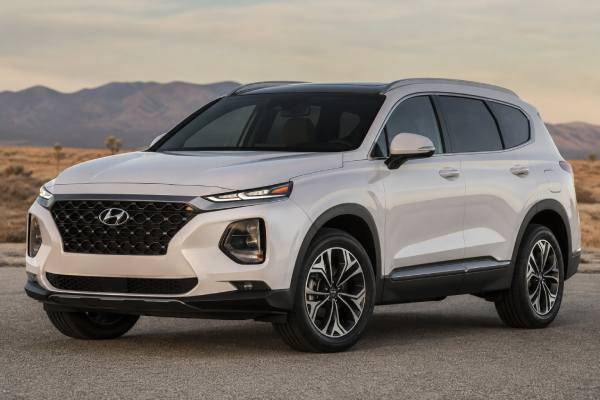
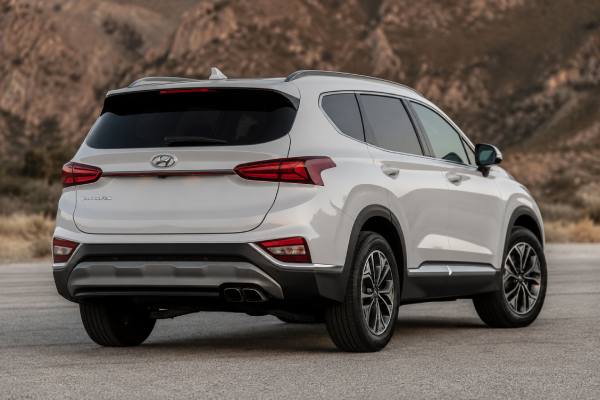
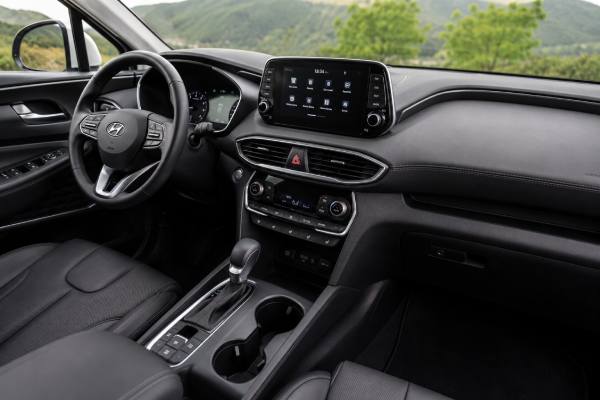
The 2019–2020 Hyundai Santa Fe HTRAC AWD with the 2.0 T-GDi engine is the stronger turbocharged version of the fourth-generation TM Santa Fe. In North America it replaced the older Santa Fe Sport nameplate and positioned itself as a five-seat midsize crossover with more power than the base 2.4 GDI, available all-wheel drive, broad safety equipment, and a practical cabin rather than a third row.
For used buyers, the appeal is straightforward: a roomy body, good towing capacity for the class when properly equipped, a smooth eight-speed automatic, and a strong list of driver-assistance systems. The main caution is that this is a turbocharged direct-injection engine paired with an active AWD system, so service history matters more than on a simpler naturally aspirated front-wheel-drive model.
At a Glance
- The 2.0 T-GDi delivers 235 hp and 260 lb-ft, giving the Santa Fe noticeably stronger passing power than the base 2.4 GDI.
- HTRAC AWD adds useful wet-weather and light-snow traction, with an AWD Lock mode for low-speed slippery conditions.
- Cabin space is a major strength, with about 35.9 cu ft of cargo room behind the second row and 71.3 cu ft with the rear seats folded.
- The key ownership caveat is to verify oil-change history, AWD fluid service, recall completion, and any tow-harness repairs before purchase.
- For the 2.0 T-GDi, normal-use oil and filter service is typically every 6,000 miles or 12 months; severe use calls for shorter intervals.
Table of Contents
- Santa Fe TM 2.0T AWD Profile
- Santa Fe TM Specs and Data
- Santa Fe TM Trims and Safety
- Reliability, Issues and Service Actions
- Maintenance and Used Buying Advice
- Driving Feel and Real-World Performance
- How the Santa Fe Compares
Santa Fe TM 2.0T AWD Profile
The TM-generation Santa Fe covered here is the five-passenger version sold for the 2019 and 2020 model years with Hyundai’s HTRAC all-wheel-drive system and the 2.0-liter turbocharged gasoline direct-injection four-cylinder. In the U.S. market, this powertrain was offered mainly on upper trims, such as Limited 2.0T and Ultimate 2.0T for 2019, and the 2.0T version of SEL or Limited depending on model year and equipment packaging. It should not be confused with the longer Santa Fe XL, which used the previous-generation three-row body.
The engine is Hyundai’s Theta II 2.0 T-GDi, an aluminum-block, aluminum-head, DOHC, 16-valve inline-four with a twin-scroll turbocharger. Output is 235 hp at 6,000 rpm and 260 lb-ft from 1,450 to 3,500 rpm. That broad torque band is the main reason to choose this version over the 2.4 GDI. It does not make the Santa Fe feel sporty in a hot-hatch sense, but it gives the vehicle better low- and mid-speed response when merging, climbing grades, or carrying passengers.
Power goes through an eight-speed automatic transmission with SHIFTRONIC manual shift control. HTRAC AWD is an on-demand system that can vary torque distribution under normal driving and includes an AWD Lock function for low-speed traction. It is not a rock-crawling four-wheel-drive system with a low range or locking differentials, but it is well suited to rain, snow, gravel roads, and steep driveways.
The Santa Fe’s strongest everyday qualities are space, visibility, safety equipment, and value. It has a wide, easy-loading cargo area, a comfortable second row, and a fairly quiet cabin. Compared with many compact SUVs, it feels more substantial; compared with larger three-row SUVs, it is easier to park and usually less expensive to run.
Its compromises are also clear. Fuel economy is only average because the turbo engine and AWD add weight and load. The transmission is smooth most of the time but can feel busy if the driver asks for quick throttle changes. Buyers should also treat the 2.0 T-GDi as a maintenance-sensitive engine: clean oil, correct viscosity, genuine filters, and prompt attention to leaks, misfires, or oil consumption are important.
Santa Fe TM Specs and Data
The following specifications focus on the 2019–2020 Santa Fe TM HTRAC AWD with the 2.0 T-GDi engine. Exact equipment varies by market and trim, especially tire size, headlights, driver-assistance content, and tow equipment.
| Item | Hyundai Santa Fe TM HTRAC AWD 2.0 T-GDi |
|---|---|
| Engine code / family | Theta II 2.0 T-GDi, turbo GDI |
| Layout | Inline-4, aluminum block and head, DOHC, 4 valves per cylinder |
| Bore × stroke | 86 × 86 mm (3.39 × 3.39 in) |
| Displacement | 2.0 L (1,998 cc) |
| Induction | Twin-scroll turbocharger |
| Fuel system | Gasoline direct injection |
| Compression ratio | 10.0:1 |
| Maximum power | 235 hp (175 kW) at 6,000 rpm |
| Maximum torque | 353 Nm (260 lb-ft) at 1,450–3,500 rpm |
| Timing drive | Timing chain |
| Recommended fuel | Regular unleaded, minimum 87 AKI in U.S. use |
| Official fuel economy | 2019 AWD: about 19/24/21 mpg US city/highway/combined; 2020 AWD: about 20/26/22 mpg US depending on trim and certification |
| Metric equivalent | 2019 combined about 11.2 L/100 km; 2020 combined about 10.7 L/100 km |
| Real-world highway at 120 km/h | Commonly about 9.5–11.5 L/100 km (20–25 mpg US), depending on tires, load, terrain, wind, and temperature |
| Item | Specification |
|---|---|
| Transmission | 8-speed automatic; A8LF1 for 2.0T applications |
| Drive type | HTRAC active on-demand AWD |
| Differentials | Open front/rear differentials with electronically controlled AWD coupling; no low range or mechanical lockers |
| Front suspension | MacPherson strut with coil springs and stabilizer bar |
| Rear suspension | Independent multi-link with separated springs and dampers |
| Steering | Column-mounted motor-driven power steering, rack and pinion; 13.8:1 ratio; 2.6 turns lock-to-lock |
| Brakes | Front ventilated discs 320 mm (12.6 in); rear solid discs 305 mm (12.0 in) |
| Common tire size | 235/55R19 on many 2.0T trims; 235/60R18 on some trims and markets |
| Ground clearance | 185 mm (7.3 in) |
| Length / width / height | 4,770 / 1,890 / 1,679 mm (187.8 / 74.4 / 66.1 in); about 1,704 mm (67.1 in) with roof rails |
| Wheelbase | 2,766 mm (108.9 in) |
| Turning circle | 11.4 m (37.5 ft), kerb-to-kerb |
| Curb weight | About 1,843–1,853 kg (4,063–4,085 lb) for 2.0T AWD, depending on trim |
| GVWR | About 2,250 kg (4,960 lb) |
| Fuel tank | 71.2 L (18.8 US gal / 15.7 UK gal) |
| Cargo volume | SAE: 1,017 L (35.9 cu ft) behind second row; 2,019 L (71.3 cu ft) behind front seats |
| Item | Figure or note |
|---|---|
| 0–100 km/h / 0–62 mph | About 8.0–8.3 seconds in favorable independent testing conditions |
| 0–60 mph | About 7.8 seconds in independent testing of an Ultimate 2.0T HTRAC AWD |
| Top speed | Not emphasized in U.S. factory literature; governed speed varies by market and tire rating |
| Braking distance | Independent 60–0 mph testing around 116 ft (35.4 m); 100–0 km/h results vary with tire and surface |
| Towing capacity | 1,588 kg (3,500 lb) braked when properly equipped; 748 kg (1,650 lb) unbraked |
| Payload | Varies by trim and tire placard; typical passenger/cargo capacity is roughly 390–480 kg (860–1,058 lb) |
| System | Specification and capacity guidance |
|---|---|
| Engine oil | Use oil meeting the owner-manual API/ILSAC requirement; 5W-30 is commonly preferred for the 2.0T. Capacity is about 4.8 L (5.1 US qt) with filter. |
| Coolant | Ethylene-glycol, phosphate-based coolant suitable for aluminum engines; use distilled/deionized water and keep mixture within the specified concentration range. Capacity is about 7.5 L (7.9 US qt), but verify by VIN. |
| Automatic transmission fluid | Hyundai/Kia ATF SP-IV type for A8LF1 applications; refill amount depends on drain method and level-setting temperature, so service by procedure rather than guesswork. |
| Transfer case and rear differential | Hypoid gear oil API GL-5 SAE 75W-90 is commonly specified for Hyundai AWD units; capacities are small and must be checked at the fill plug. |
| Brake fluid | DOT 3 or DOT 4 hydraulic brake fluid from a sealed container. |
| A/C refrigerant and oil | Charge type and amount vary by market label; verify from the under-hood A/C label before service. |
| Selected torque values | Engine oil drain plug about 39 Nm (29 lb-ft); wheel lug nuts commonly about 108–127 Nm (80–94 lb-ft). Confirm by official service data. |
| Item | Rating or equipment note |
|---|---|
| IIHS | 2019–2020 Santa Fe earned Top Safety Pick+ status when equipped with specific headlights; IIHS rated front crash prevention vehicle-to-vehicle and pedestrian performance as Superior. |
| IIHS headlights | Rating depends on headlight type and trim; check the exact lamp package on a used vehicle. |
| Euro NCAP | TM Santa Fe rated 5 stars in 2018 testing: Adult Occupant 94%, Child Occupant 88%, Vulnerable Road Users 67%, Safety Assist 76%. The tested European diesel variant differs from the U.S. 2.0T, but the rating is relevant to the TM body structure. |
| ADAS availability | Forward Collision-Avoidance Assist, Lane Keeping Assist, Blind-Spot Collision-Avoidance Assist, Rear Cross-Traffic Collision-Avoidance Assist, Safe Exit Assist, Smart Cruise Control, and driver attention features vary by trim and year. |
Santa Fe TM Trims and Safety
In the U.S. market, the 2.0T engine was tied to the better-equipped Santa Fe trims rather than the entry SE. For 2019, the main 2.0T versions were Limited 2.0T and Ultimate 2.0T, with front-wheel drive or HTRAC AWD depending on configuration. For 2020, Hyundai reshuffled trim naming and packaging, but the pattern remained similar: the turbo engine lived above the base specification and was usually paired with higher comfort and technology content.
Quick identifiers include the 2.0T badge or window sticker, 19-inch wheel package on many examples, dual-zone climate control, power liftgate on higher trims, leather or premium seating depending on version, and more complete driver-assistance content. HTRAC AWD cars can be identified by AWD badging, an AWD Lock control in the cabin, and the rear driveline hardware under the vehicle.
Functional differences are more important than cosmetic ones. The 2.0T received the stronger A8LF1 eight-speed automatic and a higher braked tow rating than the 2.4 GDI. Properly equipped 2.0T models were rated up to 3,500 lb with trailer brakes, and the towing package information notes pre-wiring and a heavy-duty transmission oil cooler for the 2.0T tow setup. Buyers who plan to tow should verify the vehicle has the correct equipment and should not assume every Santa Fe with a hitch has the same wiring or recall status.
Safety equipment was a major selling point. The TM Santa Fe introduced a broad SmartSense package for the period, and many systems that were optional or unavailable on older crossovers became common here. Forward Collision-Avoidance Assist with pedestrian detection, lane keeping, blind-spot monitoring or avoidance, rear cross-traffic assist, adaptive cruise on higher trims, and Safe Exit Assist were all part of the model’s safety identity.
Crash-test interpretation needs care. IIHS results apply to the U.S. Santa Fe body and highlight strong crash performance and front crash prevention, but the Top Safety Pick+ award depends on specific headlights. A used vehicle with lower-rated headlamps may not match the best published result. Euro NCAP’s 2018 rating is useful for understanding the TM platform’s European assessment, but the tested vehicle was not the U.S. 2.0T gasoline model.
After windshield replacement, front-end repairs, suspension work, wheel alignment, or bumper work, driver-assistance systems may need inspection or calibration. This matters on used examples because a vehicle can drive normally while its camera or radar alignment is no longer ideal. Ask for collision repair invoices and calibration documentation if the car has had glass, bumper, grille, or front structural repairs.
Child-seat provisions are good for a five-seat family crossover. The Santa Fe has LATCH/ISOFIX hardware for the rear outboard positions and a tether point for the center position. The rear seat is wide enough for many family setups, although three-across child-seat fit still depends heavily on seat model and base width.
Reliability, Issues and Service Actions
The 2019–2020 Santa Fe 2.0T is best judged as a generally comfortable and well-equipped crossover with a powertrain that rewards attentive maintenance. It is not an unusually fragile vehicle, but the turbo GDI engine, eight-speed automatic, and AWD hardware make neglect more expensive than on a simpler front-drive four-cylinder SUV.
Common or higher-priority checks include:
- Oil level loss or oil consumption: Symptoms include low dipstick level between services, blue smoke after idle, oil smell, or catalyst-related faults. The root cause can range from normal consumption under hard use to PCV issues, turbo seal wear, ring deposits, or internal engine wear. Remedy starts with an oil-consumption test, PCV inspection, leak check, and documented service history.
- Direct-injection intake deposits: GDI engines can develop carbon on intake valves because fuel does not wash the back of the valves. Symptoms may include rough cold idle, hesitation, misfire codes, or reduced response. Cleaning is usually done by walnut-shell blasting or a professional induction-cleaning procedure when symptoms justify it.
- Turbo and charge-air issues: Whistling, low boost, oil in charge pipes, underboost codes, or limp mode can point to hose leaks, wastegate control faults, boost sensors, or turbocharger wear. Good oil quality and warm-up/cool-down habits help long-term turbo health.
- Eight-speed automatic behavior: Occasional shift hesitation or hunting can occur, especially in mixed throttle driving. Harsh shifts, flare, shudder, or delayed engagement should not be dismissed. Diagnosis may include fluid condition checks, software updates, adaptation reset, and inspection for internal wear.
- AWD coupling and rear driveline noise: Binding in tight turns, clunks, whining, or vibration can point to tire circumference mismatch, old gear oil, rear differential wear, prop-shaft issues, or coupling problems. Matching tire brands, sizes, and tread depth are important on AWD models.
- Suspension and steering wear: Listen for front strut noise, control-arm bushing wear, sway-bar links, rear shock noise, wheel-bearing hum, and steering rack or column noises. These are usually medium-cost repairs rather than reasons to reject an otherwise clean car.
- Brake and parking-brake issues: Rusty rear rotors, uneven pad wear, electronic parking brake faults, and brake-fluid neglect are worth checking, especially in wet or salted climates.
Known service actions and recalls should be verified by VIN, not by model year alone. One notable campaign affecting many 2019–2023 Santa Fe vehicles concerns the trailer tow hitch harness. Moisture intrusion into the tow-harness module can create a short circuit and fire risk. The remedy path has included inspection, harness or fuse replacement, and related repair procedures depending on parts and campaign revision. This is especially important if the vehicle has a factory or dealer-installed tow hitch.
Software updates can also matter. ECU and TCU updates may address shift quality, drivability, warning lights, or sensor logic. Infotainment and navigation updates can improve stability, phone compatibility, and map behavior. ADAS-related calibrations are usually not casual updates; they require the correct service equipment and procedures after repairs.
A pre-purchase inspection should request:
- Complete oil-change records, preferably at or before the 6,000-mile interval for the 2.0T.
- Recall completion printout from a Hyundai dealer or official VIN lookup.
- Evidence of spark plug replacement if mileage is near or above 42,000 miles.
- AWD transfer case and rear differential fluid history if mileage is high, towing was common, or the vehicle lived in snow states.
- Cold start, hot idle, full-throttle acceleration, and highway cruise road test.
- Scan for stored, pending, and history codes, not just current warning lights.
- Undercar inspection for oil leaks, coolant seepage, exhaust damage, rust, and collision repairs.
Severity is usually low to medium for wear items and sensors, medium for AWD or suspension repairs, and high for neglected engine, turbo, or transmission problems. The cleanest examples are the ones with boring service records: regular oil changes, matching tires, no unresolved warning lights, and dealer proof that campaigns were completed.
Maintenance and Used Buying Advice
The 2.0 T-GDi Santa Fe should be maintained more like a turbocharged vehicle than a basic commuter crossover. Short trips, cold starts, towing, high heat, dusty roads, and frequent stop-and-go driving all push the vehicle toward severe-service intervals.
| Item | Recommended interval or practice |
|---|---|
| Engine oil and filter | Normal use: about every 6,000 miles or 12 months for the 2.0 T-GDi. Severe use: about every 3,000 miles or 6 months. Check level between services. |
| Tire rotation | About every 6,000 miles on the 2.0T; keep AWD tires matched in brand, size, and tread depth. |
| Cabin air filter | Replace yearly, or sooner in dusty or high-pollen areas. |
| Engine air filter | Inspect at oil services; replace around 18,000 miles under normal-use guidance for 2.0T, sooner in dusty conditions. |
| Spark plugs | Replace around 42,000 miles on the 2.0 T-GDi. Use the correct heat range and gap; misfires are hard on turbo engines and catalysts. |
| Coolant | First replacement around 120,000 miles or 10 years; then about every 30,000 miles or 24 months. Inspect hoses, radiator, cap, and water-pump area at each major service. |
| Brake fluid | Inspect regularly and replace about every 2–3 years in real-world ownership, especially in humid climates. |
| Automatic transmission fluid | Normal-use literature may not require routine service, but many long-term owners service earlier under severe use, towing, heat, or high mileage. Use correct ATF and level-setting procedure. |
| Transfer case and rear differential | Inspect for leaks and fluid condition; consider service around 30,000–60,000 miles under severe use, towing, or snow-belt operation. |
| Drive belt and hoses | First detailed inspection around 60,000 miles or 72 months, then regularly. Replace if cracked, glazed, swollen, noisy, or contaminated. |
| Timing chain | No routine belt-style replacement interval. Inspect for rattle, correlation codes, guide wear, tensioner issues, or stretched-chain symptoms; repair only when symptoms or measurements justify it. |
| 12 V battery | Load-test yearly after three years. Many batteries need replacement around 4–6 years depending on climate and use. |
| Alignment | Check after tire impacts, uneven wear, suspension work, or annually if tire life matters. |
The best used examples are not always the lowest-mileage ones. A 70,000-mile Santa Fe with oil records, matching tires, fresh plugs, completed recalls, and clean scan data is usually a safer bet than a lower-mileage vehicle with missing history and mismatched tires.
During inspection, look closely at the lower engine cover, turbo oil feed and drain areas, valve-cover perimeter, timing cover, radiator seams, coolant reservoir, and transmission case. On AWD vehicles, inspect the transfer case, rear differential, prop shaft, CV joints, and rear coupling area. A small seep can be manageable; fresh wet oil, burnt fluid smell, or underbody cleaning that hides leaks is more concerning.
Road testing should include a cold start, slow parking-lot turns, light-throttle upshifts, firm acceleration, steady highway cruise, and a stop-and-go section. The engine should build boost smoothly without surging. The transmission should engage Drive and Reverse promptly, and shifts should be consistent once warm. Clunks on throttle tip-in can come from mounts, driveline lash, or AWD components.
Trim choice depends on priorities. A well-kept Limited or Ultimate 2.0T HTRAC AWD is attractive because it combines the turbo engine with the better equipment. However, expensive features such as panoramic roof, premium audio, ventilated seats, power liftgate, adaptive cruise, and advanced lighting should all be tested. A simpler trim with fewer luxury features may cost less to repair, but the 2.0T was often packaged with richer equipment.
Long-term durability outlook is fair to good when maintained correctly. The engine is not as low-stress as a naturally aspirated large-displacement V6, but it offers useful torque and acceptable efficiency. The biggest ownership mistake is treating it like a low-maintenance appliance. Use the right fluids, shorten intervals for severe use, keep the tires matched, and resolve warning lights early.
Driving Feel and Real-World Performance
The Santa Fe 2.0T HTRAC AWD feels more relaxed than aggressive. Its turbo torque arrives early, so normal urban driving requires less throttle than the 2.4 GDI. Pulling into traffic, climbing a hill with passengers, or passing from 50–70 mph feels more confident. The engine is not especially characterful, and it can sound coarse when pushed hard, but it fits the Santa Fe’s practical role well.
The eight-speed automatic is generally smooth in gentle use. It favors early upshifts for economy, then downshifts when boost is needed. In Normal mode, throttle response is measured. Sport mode sharpens response and holds lower gears longer, which helps on winding roads or when merging. The tradeoff is more engine noise and fuel use. In hilly traffic, some drivers may notice gear hunting as the transmission tries to balance turbo response with economy.
Ride comfort is one of the stronger qualities. The body feels substantial, the cabin is well isolated for the class, and the suspension absorbs broken pavement better than many smaller crossovers. Nineteen-inch wheels look good and sharpen response slightly, but they can add impact harshness and tire cost compared with 18-inch wheels.
Handling is safe and predictable rather than playful. Steering effort is light at parking speeds and stable on the highway, but road feel is limited. Body roll is noticeable if pushed, especially with passengers or cargo, yet the chassis remains composed. The Santa Fe is at its best driven smoothly, using the turbo torque rather than trying to force sharp responses from a tall crossover.
Braking feel is confidence-inspiring for normal use. Independent testing showed a 2.0T AWD example stopping from 60 mph in the mid-110-foot range, which is respectable for the segment. Real-world braking depends heavily on tire condition, brake pad quality, rotor condition, and load. Used examples with cheap tires or rusty rear rotors will not match published test numbers.
Real-world fuel economy varies widely. In city use, expect roughly 11.8–13.8 L/100 km (17–20 mpg US / 20–24 mpg UK), especially with short trips. Mixed driving often lands around 10.7–12.4 L/100 km (19–22 mpg US / 23–26 mpg UK). Highway driving at 100–120 km/h can range from about 8.7–11.2 L/100 km (21–27 mpg US / 25–32 mpg UK), but roof boxes, winter tires, strong headwinds, and cold weather can move the number sharply downward.
HTRAC AWD improves confidence in rain and snow, but tires still determine most of the grip. The AWD Lock function is useful at low speeds on slippery surfaces, such as snow-packed driveways or loose gravel, but it is not designed for high-speed use or serious off-roading. Ground clearance of 185 mm helps on rough tracks and snow ruts, though approach and departure angles are still crossover-like.
When towing, the 2.0T’s torque helps, but the Santa Fe should be treated as a moderate-duty tow vehicle. Use trailer brakes near the upper rating, keep tongue weight around the recommended range, monitor transmission behavior on grades, and expect fuel consumption to rise substantially. A 20–40% fuel penalty is realistic with a moderate trailer, and more is possible with tall, boxy loads.
How the Santa Fe Compares
Against the Toyota RAV4 and Honda CR-V, the Santa Fe feels larger, quieter, and more substantial. It has more midsize-crossover presence and a wider cabin, but the Toyota and Honda often deliver better fuel economy and stronger resale reputations. The Santa Fe 2.0T makes more torque than the naturally aspirated versions of those rivals, yet its running costs can be higher because of turbo, AWD, and tire expenses.
Against the Ford Edge 2.0 EcoBoost AWD, the Hyundai offers strong value and safety equipment, while the Edge has a broader, more planted road feel and in some configurations a stronger performance image. The Hyundai’s cabin packaging is efficient, and its safety technology was very competitive for the model years, but the Ford can feel more substantial at highway speed.
Against the Nissan Murano V6 AWD, the Santa Fe is more practical and tech-forward, while the Murano is smoother and more relaxed thanks to its naturally aspirated V6. The Murano’s CVT feel is not for everyone, but its engine refinement is a point in its favor. The Santa Fe counters with better cargo shape, a more modern driver-assistance package, and stronger low-rpm turbo torque.
Against the Kia Sorento of the same era, the comparison is close because the vehicles share corporate engineering logic but differ in packaging. The Sorento could be found with a third row in some trims, making it better for occasional extra passengers. The Santa Fe is the cleaner choice if five-seat comfort, cargo usability, and a quieter two-row layout matter more than maximum seating count.
Against newer 2021-and-later Santa Fe models with the 2.5T, the 2019–2020 2.0T feels less powerful and less modern. The later 2.5T brings stronger output and a different transmission strategy, but early versions of newer powertrains also have their own inspection concerns. A clean 2019–2020 2.0T can still be the better used buy if it costs significantly less and has a stronger service history.
The best reason to choose this Santa Fe is balance. It gives useful power, strong safety credentials, a comfortable cabin, practical cargo space, and decent towing capacity without moving into a larger three-row SUV. The best reason to avoid it is if maximum fuel economy, the simplest possible powertrain, or sportier handling matters more than space and equipment.
For most used buyers, the ideal example is a well-documented 2.0T HTRAC AWD with completed recalls, matching quality tires, clean scan results, smooth transmission behavior, and no evidence of neglected oil service. With those boxes checked, it remains a sensible and well-rounded midsize crossover.
References
- 2019 Santa Fe Specifications 2018 (Manufacturer Specifications)
- 2020 Santa Fe Product Guide 2020 (Manufacturer Specifications)
- 2019 Hyundai Santa Fe 2019 (Safety Rating)
- Euro NCAP | Hyundai SANTA FE 2018 (Safety Rating)
- Part 573 Safety Recall Report 23V-181 2023 (Recall Database)
Disclaimer
This article is for informational purposes only and is not a substitute for professional diagnosis, repair, or official service information. Specifications, torque values, service intervals, fluids, procedures, campaigns, and equipment can vary by VIN, market, trim, production date, and installed options. Always verify critical data against the official owner’s manual, service manual, under-hood labels, dealer records, and manufacturer VIN checks before buying, servicing, towing, or repairing the vehicle.
If you found this useful, consider sharing it on Facebook, X/Twitter, or another platform to help support our work.