

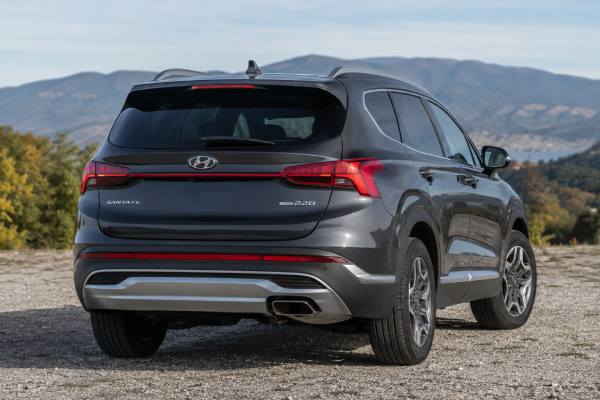

The facelifted Hyundai Santa Fe TM Hybrid brought a useful middle ground to the fourth-generation Santa Fe range: better fuel economy than the 2.5-liter gasoline models, standard HTRAC all-wheel drive in North America, a conventional 6-speed automatic instead of a dual-clutch transmission, and a roomy two-row cabin with premium-leaning equipment on upper trims. It is not a plug-in hybrid, so there is no external charging or EV-only commuting range to manage. Instead, the 1.6-liter turbocharged gasoline engine and electric motor work together automatically, giving the Santa Fe Hybrid a smooth, practical character for family use, winter driving, and long-distance travel.
This version is especially relevant as a used purchase because 2021–2023 examples now sit in the overlap between remaining warranty coverage, rising hybrid-SUV demand, and the usual questions about recalls, battery condition, maintenance history, and real-world fuel economy. The key is understanding which specifications are market-specific, which service items matter most, and how the hybrid AWD system differs from both the regular gasoline Santa Fe and smaller hybrid crossovers.
Quick Specs and Notes
- Standard HTRAC AWD, 226 hp system output, and a smooth 6-speed automatic make it easier to live with than many high-output turbo trims.
- The hybrid powertrain usually returns about 32–34 mpg combined in EPA-style use, with city driving its strongest efficiency setting.
- Upper trims add major comfort and safety equipment, but 19-inch wheels can reduce ride comfort and fuel economy slightly.
- Check recall completion carefully, especially seat belt pretensioner, trailer tow-harness, and rearview-camera actions where applicable.
- Plan engine oil and filter service about every 8,000 miles or 12 months in normal use, shorter for severe short-trip, cold, dusty, or towing use.
Table of Contents
- Santa Fe HTRAC AWD Profile
- Santa Fe Hybrid Technical Specs
- Santa Fe HEV Trims and Safety
- Reliability Issues and Recalls
- Maintenance and Used-Buyer Checks
- Driving Performance and Economy
- Rival Comparison and Value
Santa Fe HTRAC AWD Profile
The 2021–2023 Hyundai Santa Fe Hybrid HTRAC belongs to the facelifted TM-generation Santa Fe, the updated version of Hyundai’s midsize crossover introduced with revised styling, a new interior layout, expanded safety technology, and electrified powertrain options. In North America, the conventional hybrid was sold as a five-seat SUV with standard all-wheel drive. In several other markets, closely related TM Hybrid models were available with different seating layouts, trim names, emissions calibration, equipment levels, and power figures expressed in metric horsepower.
The powertrain is the key distinction. It pairs Hyundai’s Smartstream 1.6-liter turbocharged direct-injection gasoline engine with a transmission-mounted permanent-magnet electric motor and a compact lithium-ion polymer battery. Unlike many hybrid SUVs that use an e-CVT, the Santa Fe Hybrid uses a regular 6-speed automatic transmission. This gives it a more familiar stepped-shift feel while still allowing electric assist, regenerative braking, engine stop-start operation, and short low-speed electric movement when conditions allow.
HTRAC AWD is also important. This is not a rear e-axle setup like some Toyota and Lexus hybrids. The Santa Fe Hybrid uses a mechanical all-wheel-drive layout with an active on-demand system that can send torque rearward through the driveline when traction, acceleration, steering angle, or drive mode call for it. In daily driving, the system is mostly transparent. In rain, snow, gravel, or on steep driveways, it gives the Santa Fe Hybrid a more planted feel than front-drive-only hybrid crossovers.
The Santa Fe Hybrid’s role in the lineup was comfort-biased rather than sporty. It delivered stronger low-speed response than the base 2.5-liter non-turbo Santa Fe, better fuel economy than the 2.5T gasoline model, and less power than the Santa Fe Plug-in Hybrid. The standard hybrid also avoided the extra charging hardware and larger battery of the PHEV, which kept ownership simpler for drivers who wanted hybrid efficiency without needing a home charger.
For used buyers, the strongest advantages are easy drivability, good cabin space, a long warranty structure in many markets, and a powertrain that is not shared with the 8-speed dual-clutch 2.5T versions. The main caveats are that fuel economy depends heavily on speed and wheel size, some recall campaigns are VIN-specific, and hybrid-related diagnosis should be handled with proper high-voltage training rather than general trial-and-error repair.
Santa Fe Hybrid Technical Specs
The tables below focus on the 2021–2023 Santa Fe TM facelift Hybrid with HTRAC AWD and 1.6 T-GDi HEV power. Some figures vary by market, trim, wheel package, homologation method, and model year. North American models are commonly rated at 226 hp combined, while European literature often quotes 230 PS, which is effectively the same output expressed under a different convention.
| Item | Hyundai Santa Fe Hybrid HTRAC AWD TM |
|---|---|
| Platform / generation | TM facelift, 5-door midsize SUV, 2021–2023 model years |
| Powertrain code | Smartstream G1.6 T-GDi HEV; engine family commonly identified as G4FT/G1.6T hybrid family depending on market documentation |
| Engine layout and cylinders | Transverse inline-4, aluminum block/head, DOHC, 4 valves per cylinder, 16 valves total |
| Bore x stroke | 75.6 x 89.0 mm / 2.98 x 3.50 in |
| Displacement | 1.6 L / 1,598 cc |
| Induction | Single turbocharger |
| Fuel system | Turbo gasoline direct injection, regular unleaded in most markets; octane requirement varies by region |
| Compression ratio | 10.5:1 |
| Timing drive | Timing chain; inspect for noise, correlation faults, or tensioner/guide wear rather than replacing by a fixed mileage interval |
| Gasoline engine output | About 178 hp / 132 kW at 5,500 rpm; 265 Nm / 195 lb-ft from about 1,500–4,500 rpm |
| Electric motor | Permanent-magnet synchronous motor, single transmission-mounted motor on front transaxle, about 44.2 kW |
| Hybrid battery | Lithium-ion polymer, about 1.49 kWh, roughly 270 V system voltage |
| Combined output | 226 hp / 169 kW in North America; 230 PS / 169 kW in several European references |
| Combined torque | About 350 Nm / 258 lb-ft in many global specifications; some market literature lists different combined-torque methodology |
| Rated efficiency | EPA-style ratings: about 33/30/32 mpg city/highway/combined on most trims, 36/31/34 mpg on Blue trim; approximately 7.1–7.8 L/100 km depending cycle and trim |
| Real-world highway at 120 km/h / 75 mph | Typically about 8.0–9.5 L/100 km / 25–29 mpg US / 30–35 mpg UK depending tyres, temperature, wind, roof load, and terrain |
| Item | Specification |
|---|---|
| Transmission | Hybrid-calibrated 6-speed automatic with manual shift mode; internal code is VIN/market dependent and not always published in owner literature |
| Drive type | HTRAC active on-demand AWD with mechanical rear driveline |
| Differentials | Open front and rear differentials with brake and stability-control-based torque management; no locking differential |
| Front suspension | MacPherson strut |
| Rear suspension | Multi-link independent |
| Steering | Motor-driven power steering; about 2.5–2.6 turns lock-to-lock depending market; fixed steering ratio not consistently published |
| Brakes | Four-wheel disc brakes; many global specs list 325 mm / 12.8 in ventilated front and rear discs |
| Common wheel / tyre sizes | 235/65 R17 on efficiency-focused trims; 235/55 R19 on many upper trims; market-specific 18- and 20-inch packages may appear |
| Ground clearance | About 208 mm / 8.2 in in North American references; some markets list lower homologated values |
| Approach / departure / breakover | Not central to this road-biased SUV; values vary by bumper and market specification |
| Length / width / height | 4,785 mm / 1,900 mm / about 1,710 mm; 188.4 in / 74.8 in / 67.3 in |
| Wheelbase | 2,765 mm / 108.9 in |
| Turning circle | About 11.4 m / 37.4 ft kerb-to-kerb |
| Kerb / curb weight | About 1,842–1,980 kg / 4,061–4,365 lb depending market and trim; North American Limited examples are commonly around 4,200 lb |
| GVWR / GVM | About 2,530–2,630 kg / 5,580–5,800 lb depending homologation |
| Fuel tank | 67 L / 17.7 US gal / 14.7 UK gal |
| Cargo volume | About 571 L / 20.2 ft³ seats up and 1,649 L / 58.2 ft³ seats down by VDA in some markets; North American SAE-style values are higher at roughly 36.4 / 72.1 ft³ |
| Item | Specification or Guidance |
|---|---|
| 0–100 km/h / 0–62 mph | About 9.1 seconds for AWD in European-market technical data |
| Top speed | 187 km/h / 116 mph |
| 100–0 km/h braking distance | Not normally published by Hyundai; independent tests typically depend heavily on tyre package, load, and surface |
| Towing capacity | North America commonly 907 kg / 2,000 lb braked; European/UK figures may list up to 1,650 kg / 3,638 lb braked and 750 kg / 1,653 lb unbraked |
| Payload | Often about 600–700 kg / 1,320–1,540 lb before market-specific seating and trim changes; use the door placard for the exact vehicle |
| Euro NCAP | 5-star result for the relevant Santa Fe family, with ratings shown for adult occupant, child occupant, vulnerable road users, and safety assist depending test year and variant |
| IIHS | 2021 Santa Fe earned Top Safety Pick with specific headlights; 2022 models built after the applicable production change achieved Top Safety Pick+ status |
| Headlight rating | Good on projector LED upper trims; lower reflector LED headlamps in some 2021–2022 trims were rated Marginal or Poor by IIHS depending build date |
| ADAS suite | Forward collision avoidance, lane keeping/following, blind-spot systems, rear cross-traffic systems, smart cruise, driver attention alerts, and available Highway Driving Assist depending trim and market |
| Item | Typical Specification | Important Note |
|---|---|---|
| Engine oil | Full synthetic 0W-20, API SP / ILSAC GF-6 type; about 4.8 L / 5.1 US qt with filter | Confirm by VIN and under-hood label; some regions list alternate viscosities by climate |
| Coolant | Hyundai long-life ethylene-glycol coolant for aluminum engines, normally 50/50 with deionized water | Hybrid engine, inverter, and battery cooling loops vary by market; total capacity is VIN-specific |
| Automatic transmission fluid | Hyundai/Kia-approved ATF for 6-speed automatic applications, often SP-IV family fluid | Service fill is typically lower than dry capacity; use scan-tool temperature procedure when specified |
| Transfer case / rear differential | Hypoid gear oil, commonly API GL-5 75W-85 or equivalent Hyundai-approved gear oil | Small capacities, often around 0.5–0.7 L each; exact fill level should be checked by service procedure |
| A/C refrigerant | R-1234yf on most 2021–2023 markets | Charge weight is printed on the vehicle label; do not estimate charge by pressure alone |
| A/C compressor oil | Hybrid-compatible electric-compressor oil such as POE/Hyundai-specified equivalent | Using the wrong PAG oil can damage high-voltage A/C components |
| Wheel lug nuts | Typically 108–127 Nm / 80–94 lb-ft | Recheck after wheel removal, especially with alloy wheels |
| Engine oil drain plug | About 39 Nm / 29 lb-ft | Replace washer/gasket where specified and verify thread condition |
Santa Fe HEV Trims and Safety
In the United States, the 2021–2023 Santa Fe Hybrid was generally organized around three trims: Blue, SEL Premium, and Limited. All used the 1.6 T-GDi hybrid system, 6-speed automatic transmission, and HTRAC AWD. The mechanical differences were minor compared with the equipment differences, but wheel size, tyre package, curb weight, and driver-assistance content could affect the way the vehicle felt on the road.
Blue is the efficiency-focused trim. It is usually the best choice for buyers who value fuel economy, lower tyre replacement cost, and simpler equipment. The 17-inch wheel package helps ride quality and economy, and it is the trim most associated with the higher EPA combined rating. It still includes the basic hybrid powertrain, AWD, touchscreen infotainment, heated front seats in many configurations, and Hyundai SmartSense safety equipment.
SEL Premium is the middle sweet spot for many buyers. It typically adds larger wheels, upgraded infotainment with navigation, a better audio system, leather or leather-like trim depending market, panoramic roof availability, additional convenience features, and more premium interior presentation. It may lose a little fuel economy compared with Blue because of weight and tyres, but it feels more like a near-luxury family SUV.
Limited is the equipment-rich version. It can include a larger digital instrument cluster, ventilated front seats, surround-view camera, blind-view monitor, upgraded driver-assistance functions, premium audio, power passenger seat, heated rear seats, and additional parking aids. For a used buyer, Limited is attractive if the electronics all work correctly and the price gap is reasonable. The inspection should include every camera view, parking sensor, seat function, digital display, and driver-assistance warning lamp.
Quick identifiers include the Hybrid or HTRAC badging, the 1.6T HEV engine bay layout, the high-voltage warning labels, the underfloor hybrid battery packaging, and the VIN/build sticker. Blue models are usually easier to spot by smaller wheels and simpler interior equipment. Limited models are easier to identify by digital displays, premium seating features, surround-view camera hardware, and additional driver-assistance displays.
Safety ratings are strong overall, but the details matter. Euro NCAP ratings apply across relevant Santa Fe variants in the tested family, but body style, drivetrain, test protocol, and model-year validity should be checked for the exact vehicle. IIHS results show why headlamps matter: upper-trim projector LEDs performed far better than some lower-trim reflector LEDs. A Santa Fe Hybrid can have excellent crash structure and active-safety systems, yet still differ in nighttime safety performance by headlight type and build date.
The safety equipment set is broad for the class. Depending on trim and market, the Santa Fe Hybrid may include forward collision-avoidance assist with car, pedestrian, cyclist, and junction-turning detection; lane keeping assist; lane following assist; smart cruise control; blind-spot collision-avoidance assist; rear cross-traffic collision-avoidance assist; safe-exit assist; driver attention warning; rear occupant alert; parking collision-avoidance assist; and Highway Driving Assist.
Child-seat provisions are good in the two-row North American layout, with lower anchors for the second-row outboard seats and top tether anchors. Three-row markets have different ISOFIX/LATCH and tether layouts, so imported or non-US vehicles should be checked directly. After windshield replacement, front-end repair, suspension alignment, bumper removal, or camera/radar replacement, ADAS calibration is not optional guesswork. A misaligned camera or radar sensor can create false alerts, late intervention, or unavailable safety functions.
Reliability Issues and Recalls
The Santa Fe Hybrid’s reliability picture is generally encouraging, but it is still a modern turbocharged hybrid with high-voltage hardware, direct injection, AWD components, and software-managed driver-assistance systems. The best examples are serviced on time, have completed recall campaigns, show no unresolved warning lights, and have not been modified with questionable tow wiring, non-approved fluids, or aftermarket electronics.
| Area | Prevalence | Cost Tier | Symptoms | Likely Remedy |
|---|---|---|---|---|
| Recall completion | Common check, VIN-specific | Low if done free by dealer | Open campaign on VIN report, dealer record gap | Official Hyundai dealer campaign completion |
| 12 V battery weakness | Occasional after 3–5 years | Low to medium | No-start, warning messages, random electronic faults | Battery test, replacement, charging-system check |
| Brake rotor corrosion | Common in wet/salted climates | Low to medium | Scraping noise, pulsing, rust lip, reduced smoothness | Service brakes, use friction braking periodically, replace worn rotors/pads |
| GDI intake deposits | Occasional with high mileage/short trips | Medium | Rough idle, hesitation, misfires, reduced response | Diagnosis first, then intake cleaning if confirmed |
| Cooling-system leaks or low coolant | Occasional | Medium | Coolant smell, low reservoir, overheating warning | Pressure test, hose/pump/radiator inspection, correct coolant refill |
| HTRAC driveline wear | Rare to occasional, higher with towing/salt | Medium to high | Whine, binding, vibration, fluid seepage | Fluid service, mount/shaft inspection, differential or coupling repair if needed |
| Hybrid battery or power electronics fault | Rare under normal use | High outside warranty | Hybrid warning, reduced power, no READY state | Dealer-level scan, high-voltage diagnostic, warranty check |
Several recalls and service actions are especially important to verify by VIN. Safety Recall 238, associated with NHTSA recall 22V-816 in the U.S., involved certain Santa Fe Hybrid and Santa Fe Plug-in Hybrid vehicles with front seat belt pretensioners that could deploy abnormally. The remedy involved installing anti-separation protection caps or related dealer action.
Safety Recall 244, associated with NHTSA recall 23V-181, involved certain Santa Fe, Santa Fe Hybrid, Santa Fe Plug-in Hybrid, and related vehicles equipped with a Genuine Hyundai accessory trailer tow hitch harness. Moisture and debris could create a short in the tow-hitch harness module, raising fire risk. Buyers should confirm whether the vehicle had the accessory harness and whether the final remedy was completed, not just an interim inspection.
A later rearview-camera recall affected certain 2021–2022 Santa Fe and Santa Fe Hybrid vehicles where camera circuit-board solder issues could lead to loss of the rear camera image. Because rearview-camera operation is both a safety and compliance issue, it should be checked in reverse during inspection and verified against dealer records.
Software updates matter on these vehicles. Hybrid control, transmission control, battery-management, infotainment, camera, and ADAS updates may not feel dramatic, but they can address warning messages, shift behavior, driveability, phone connectivity, navigation errors, and sensor calibration logic. A good pre-purchase inspection should include a full system scan, not only a generic OBD-II check.
The engine itself is not known for the same failure pattern as older Hyundai/Kia naturally aspirated engines that dominated many public discussions. Still, it is a small turbo engine moving a heavy SUV, so maintenance quality matters. Watch for oil neglect, repeated short-trip use, poor-quality fuel, turbo noise, coolant loss, and misfire history. The timing chain should not be replaced on mileage alone, but chain noise on cold start, cam/crank correlation codes, or tensioner problems should be investigated promptly.
Hybrid battery degradation is usually gradual rather than sudden. The small 1.49 kWh battery cycles frequently, but the system manages its state of charge tightly. A used inspection should look for hybrid warning lamps, abnormal fan noise, signs of water intrusion, past collision repair near high-voltage cabling, and a battery state-of-health report when available. The DC–DC converter and 12 V system should also be checked because many “hybrid problems” begin with a weak low-voltage battery.
Maintenance and Used-Buyer Checks
The Santa Fe Hybrid rewards conservative maintenance. It is not unusually difficult to service, but it has enough hybrid-specific hardware that general fluid guesses and universal scan tools are not enough. The safest approach is to follow the official maintenance schedule for the VIN, then shorten intervals if the vehicle sees repeated short trips, very cold starts, hot climates, mountain driving, dusty roads, roof loads, towing, or heavy urban stop-start use.
| Interval | Service Items | Why It Matters |
|---|---|---|
| Every 8,000 miles / 13,000 km or 12 months | Engine oil and filter, tyre rotation, brake inspection, fluid level check, exterior lights, wipers, hybrid cooling inlets | The turbo engine starts and stops often; clean oil and correct tyre wear are central to long-term economy |
| Every 5,000 miles / 8,000 km or 6 months in severe use | Shortened oil service, tyre rotation, brake and underbody checks | Short trips, towing, dust, cold weather, and city use age oil faster than steady highway driving |
| Every 15,000–16,000 miles / 24,000–26,000 km | Cabin air filter, engine air filter inspection, brake fluid moisture test, steering and suspension inspection | Cabin filters affect HVAC load; brake fluid condition matters even with regenerative braking |
| Every 30,000 miles / 48,000 km | Engine air filter replacement in dirty conditions, fuel-system inspection, driveline leak check, alignment check | Air restriction, alignment error, and driveline leaks can reduce economy and tyre life |
| About 42,000–60,000 miles / 67,000–96,000 km | Spark plugs depending market schedule and operating conditions | Turbo GDI engines are sensitive to plug condition under boost |
| 60,000 miles / 96,000 km severe use | Automatic transmission fluid, transfer case and rear differential fluid, AWD coupler inspection | Towing, snow, hills, and heat justify earlier driveline fluid service |
| First coolant service often around 120,000 miles / 10 years, then shorter follow-up intervals | Engine and hybrid cooling circuits as specified by VIN | Correct coolant protects the aluminum engine, inverter, and hybrid components |
| Every 2 years | Brake fluid moisture test or replacement by condition/market schedule; brake hardware cleaning in salted climates | Regeneration means friction brakes may corrode before they wear out |
| Every 3–5 years | 12 V battery test and likely replacement window | A weak 12 V battery can cause confusing hybrid and electronic faults |
For a used purchase, start with documentation. A complete history should show oil changes at sensible intervals, recall completion, tyre replacements in matching sets, brake service, software updates, and any dealer diagnosis for warning lights. A hybrid battery state-of-health report is valuable, especially on higher-mileage or ex-rideshare vehicles, but it is only one part of the picture. A clean scan with all readiness and hybrid modules checked is more useful than a simple dashboard check.
During the physical inspection, look underneath before driving. Check for oil seepage around the engine, turbo plumbing, transmission case, transfer case, rear differential, axle seals, and coolant hoses. Inspect the underbody panels, rear subframe, suspension arms, brake lines, and fasteners for corrosion if the vehicle lived in a salt-belt area. Look at the tow-hitch wiring if fitted; any non-factory harness work deserves caution.
On the road, the hybrid transition should be smooth. Light throttle may allow low-speed electric movement, but the gasoline engine should start without harsh vibration. The 6-speed automatic should shift cleanly, without flare, harsh engagement, or repeated hunting under moderate load. During a steady cruise, listen for bearing hum, tyre roar, rear differential whine, or driveshaft vibration. Under braking, feel for pedal pulsation or rough rotor surfaces after the regenerative-to-friction blend.
The best trims to seek depend on priorities. Blue is attractive for economy and lower running costs. SEL Premium often gives the best balance of comfort and price. Limited is the right choice for buyers who want the strongest technology and cabin equipment, but every camera, sensor, seat motor, display, and driver-assistance feature should be tested. Avoid examples with missing records, unresolved recalls, mismatched tyres, unknown tow wiring, collision repair near high-voltage components, persistent warning lights, or evidence of flood damage.
Long-term durability should be good when maintenance is disciplined. The powertrain is not simple in the old-fashioned sense, but it uses proven hybrid architecture, a conventional automatic, and manageable battery capacity. The main ownership risk is not routine servicing; it is deferred diagnosis after warning lights, poor collision repair, incorrect fluids, and buying a vehicle without confirming VIN-specific campaigns.
Driving Performance and Economy
The Santa Fe Hybrid is tuned for calm progress rather than sharp response. Around town, it feels more responsive than the horsepower number suggests because the electric motor helps at low speed and fills in torque while the turbo engine builds boost. Step-off is smooth, and the 6-speed automatic gives a familiar sense of gear changes instead of the constant-rev feel some drivers dislike in e-CVT hybrids.
The transition between electric assist and gasoline power is usually well controlled. In light urban driving, the engine may shut off at stops and restart with little fuss. Under stronger acceleration, the 1.6-liter turbo becomes more audible, but the hybrid system reduces the strained feeling that a small turbo engine might otherwise have in a vehicle of this weight. It is not quick in a performance-SUV sense, but the roughly nine-second 0–100 km/h time is adequate for family use, merging, and passing with planning.
The transmission is one of the Santa Fe Hybrid’s underrated advantages. It does not have the abrupt low-speed behavior sometimes associated with dual-clutch transmissions, and it avoids the droning sensation of some hybrid CVTs. In normal mode, it shifts early and keeps the powertrain quiet. Sport mode holds lower gears longer and sharpens throttle response, but it does not transform the SUV into something athletic. Eco mode is best for smooth commuting and fuel economy.
Ride quality depends heavily on wheel size. Models on 17-inch tyres are usually more compliant and quieter over broken pavement. Nineteen-inch wheels look more upscale and can sharpen steering response slightly, but they add tyre cost and can make sharp impacts more noticeable. The suspension is comfort-oriented, with good straight-line stability and predictable cornering. Push harder, and the Santa Fe reminds you it is a tall, heavy family SUV, but it stays composed rather than sloppy.
Steering is light and easy in parking situations, with enough weight on the highway to feel stable. Feedback is limited, but that matches the vehicle’s purpose. Braking feel is generally good for a hybrid, though drivers may notice the blend between regenerative and friction braking at very low speeds or when the battery is full and cannot accept much regeneration. In wet or salted climates, using the friction brakes firmly from time to time helps keep the rotors cleaner.
Real-world fuel economy is strongest in city and suburban driving. The Santa Fe Hybrid often performs well in traffic because it can recapture braking energy and reduce engine idling. Mixed driving commonly lands near the official combined estimates if the vehicle is maintained, tyres are correctly inflated, and speeds are moderate. Highway efficiency is less impressive at 70–75 mph because the Santa Fe is relatively large, AWD adds drag and weight, and the turbo engine must do more steady work.
Cold weather can reduce economy noticeably. Winter fuel, cabin heat demand, cold oil, snow tyres, and shorter engine-off periods may cut fuel economy by 10–25 percent. Roof boxes, bike racks, aggressive all-terrain-style tyres, and towing can reduce it further. When towing a modest trailer, expect a significant fuel penalty and plan around cooling, braking distance, tongue weight, and tyre pressures rather than relying on the maximum rating alone.
Traction is a strength. HTRAC does not make the Santa Fe a serious off-roader, but it gives confidence on wet roads, snow-covered streets, gravel tracks, and steep launches. Snow, mud, or terrain modes in equipped markets adjust throttle, transmission, and traction-control behavior. Tyres still matter more than the badge: a Santa Fe Hybrid on good winter tyres will outperform one on worn all-seasons despite identical AWD hardware.
Rival Comparison and Value
The Santa Fe Hybrid sits between compact hybrid crossovers and larger three-row family SUVs. That position gives it a useful mix of space, comfort, standard AWD in North America, and strong equipment value, but it is not the absolute fuel-economy leader.
Against the Toyota Venza, the Santa Fe Hybrid feels larger, more conventional, and more useful for cargo and towing. The Venza is smoother and more efficient, with Toyota’s well-established hybrid system and e-AWD layout, but it is more of a premium-leaning two-row crossover than a practical midsize family hauler. Buyers who want maximum mpg and Toyota hybrid reputation may lean Venza; buyers who want more room and mechanical AWD feel may prefer the Santa Fe.
Against the Toyota RAV4 Hybrid, the Santa Fe offers a quieter, more upscale cabin and more midsize-SUV presence. The RAV4 Hybrid is usually more efficient, easier to park, and backed by a very strong reliability record. The Hyundai counters with comfort, features, warranty appeal, and a more substantial interior feel. For buyers choosing used, the price difference often decides the argument.
Against the Honda CR-V Hybrid, the Santa Fe is roomier in overall feel and more powerful on paper, while the CR-V counters with excellent packaging, easy controls, and strong real-world efficiency. Later CR-V Hybrids are very polished, but comparable-year pricing can be high. The Santa Fe Hybrid may offer more equipment per dollar, especially in SEL Premium or Limited trim.
The Kia Sorento Hybrid is the closest relative in spirit. It shares broad Hyundai-Kia hybrid technology, but it has a different cabin layout and, in some markets, a small third row. Early U.S. Sorento Hybrids were often front-wheel drive, while the Santa Fe Hybrid’s standard HTRAC AWD gave Hyundai a traction advantage for many buyers. The Sorento makes sense when occasional third-row use is important; the Santa Fe is better as a comfortable two-row SUV.
Compared with the gasoline Santa Fe 2.5T, the Hybrid is less powerful but often easier to recommend used. It is more efficient, smoother in low-speed driving, and avoids the wet dual-clutch transmission used by many 2.5T models. The 2.5T is the choice for stronger acceleration; the Hybrid is the choice for lower fuel use and more relaxed daily ownership.
The Santa Fe Hybrid’s best value case is clear: it suits drivers who want a roomy, comfortable, well-equipped SUV with standard AWD and meaningful fuel savings, but who do not want to plug in or sacrifice cabin practicality. It is less ideal for drivers who spend nearly all their time at high highway speeds, need serious towing capacity, want a third row in the North American market, or prioritize the lowest possible long-term repair risk over features and comfort.
A properly serviced, recall-complete 2021–2023 Santa Fe Hybrid can be a very sensible used buy. The strongest examples are not necessarily the cheapest; they are the ones with clean service records, matching tyres, no unresolved warnings, good brake condition, documented campaign completion, and a trim level that fits the buyer’s actual needs.
References
- 2021 Santa Fe Specifications 2021 (Specifications)
- New SANTA FE – pricing spec and tech 2021 (Specifications)
- Euro NCAP | Hyundai SANTA FE 2024 (Safety Rating)
- 2021 Hyundai Santa Fe 2021 (Safety Rating)
- Vehicle Detail Search – 2022 HYUNDAI SANTA FE HYBRID SUV AWD | NHTSA 2026 (Recall Database)
Disclaimer
This article is for informational purposes only and is not a substitute for professional diagnosis, repair, inspection, or official service documentation. Specifications, torque values, fluid capacities, maintenance intervals, recall applicability, and procedures can vary by VIN, market, model year, trim, and equipment. Always verify service work against the official Hyundai owner’s manual, workshop information, under-hood labels, dealer records, and VIN-specific recall checks.
If this helped you compare or maintain a Santa Fe Hybrid, please share it on Facebook, X/Twitter, or with another owner who may find it useful.