
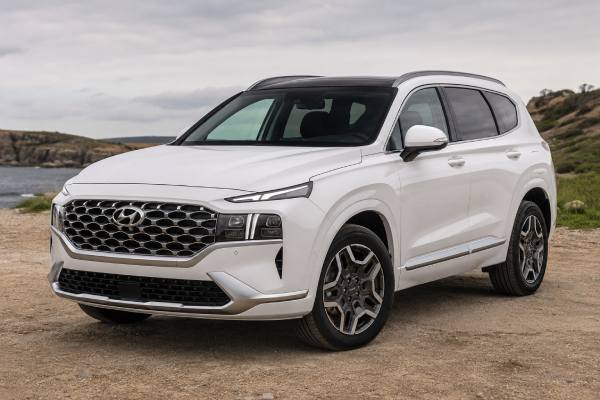

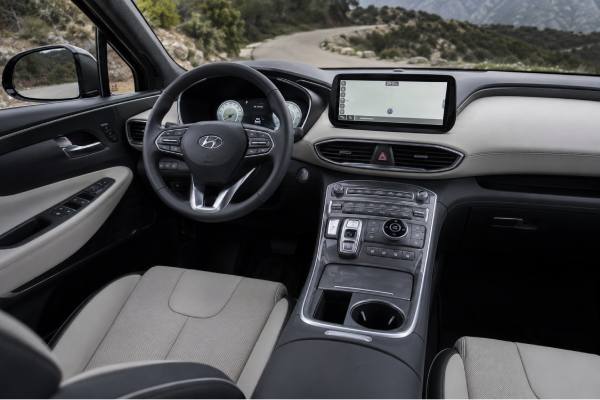
The facelift Hyundai Santa Fe TM Plug-in Hybrid is the most complex version of the fourth-generation Santa Fe sold in many European and selected global markets from 2021 to 2023. It combines the 1.6-litre Smartstream turbo petrol engine with a transmission-mounted electric motor, a 13.8 kWh high-voltage battery, a 6-speed automatic transmission, and standard 4WD.
Its appeal is straightforward: seven-seat SUV practicality, smooth electric driving for local trips, and long-distance flexibility without relying only on charging. The main trade-off is that the PHEV system adds weight, complexity, and a smaller 47-litre fuel tank compared with non-plug-in Santa Fe versions. It is a strong used-family-SUV candidate when the charging system, service history, recalls, tyres, brakes, and hybrid components check out properly.
Quick Overview
- Strong combined output of 265 PS with smooth low-speed EV running and standard 4WD traction.
- Practical 7-seat cabin, 571 L VDA luggage space with seats up, and useful family equipment even in lower trims.
- Best economy comes from regular charging; with a depleted battery, expect it to behave more like a heavy petrol-hybrid SUV.
- Check recall completion, hybrid coolant history, brake condition, charging behaviour, and 12 V battery health before buying.
- A conservative oil-service rhythm is every 8,000–16,000 km or 6–12 months, depending on market schedule and use.
Table of Contents
- Santa Fe TM PHEV Model Brief
- Santa Fe PHEV Technical Specs
- Santa Fe PHEV Trims and Safety
- Reliability Issues and Recalls
- Maintenance and Used Buying
- Driving Range and Performance
- Santa Fe PHEV Rival Comparison
Santa Fe TM PHEV Model Brief
The 2021–2023 Santa Fe Plug-in Hybrid belongs to the facelifted TM generation, but the update went deeper than new lights and interior screens. Hyundai moved the Santa Fe onto a newer platform architecture for the facelift, which helped package electrified powertrains and improve cabin space. In PHEV form, the Santa Fe is a large, three-row family SUV with standard 4WD, a 6-speed automatic transmission, and a plug-in battery large enough for useful everyday electric driving.
The powertrain pairs a 1.6 T-GDi direct-injection turbocharged petrol engine with a permanent-magnet synchronous motor mounted within the hybrid transmission layout. Total system output is 265 PS, commonly rounded to 265 hp in market listings, with 350 Nm of combined torque. The system is not a rear-motor electric AWD layout. Instead, the engine and electric motor drive through the transmission, with a mechanical AWD system sending torque rearward when required.
In daily use, the main advantage is flexibility. Short school runs, commuting, town errands, and low-speed driving can often be done mostly on electricity when the battery is charged. Longer motorway journeys do not require charging stops, but the fuel consumption rises once the traction battery reaches its normal hybrid reserve. Buyers who can charge at home will get the best from it; buyers who cannot charge regularly may be better served by the regular Santa Fe Hybrid or a diesel in markets where diesel remained available.
The PHEV was commonly sold as a well-equipped 7-seater in markets such as the UK, with Premium and Ultimate grades. It kept the same broad body dimensions as the rest of the facelift range, but the battery and PHEV hardware affected weight, fuel-tank size, towing capacity, and boot packaging. It is not a lightweight SUV: kerb weight is about 2.0 to 2.1 tonnes depending on equipment.
For used buyers, the important distinction is between official efficiency and real-world ownership. The low WLTP fuel figure is a weighted plug-in-hybrid test result, not what the car will always use on a long trip. A charged battery, moderate speeds, and regular local use can produce excellent fuel use. A depleted battery, cold weather, roof boxes, heavy loads, and motorway cruising make it behave like a large petrol SUV with hybrid assistance.
The ownership case is strongest when the car has complete dealer or specialist service history, proof of recall completion, no charging faults, even tyre wear, healthy brake discs, and no warning lights from the hybrid, AWD, ADAS, or emissions systems.
Santa Fe PHEV Technical Specs
The figures below describe the 2021–2023 facelift Santa Fe TM 1.6 T-GDi Plug-in Hybrid 4WD, with UK and European-market data used as the baseline where available. Some values vary by country, homologation package, seating layout, roof equipment, tyres, and model year.
| Item | Santa Fe TM 1.6 T-GDi PHEV 4WD |
|---|---|
| Vehicle code / generation | Santa Fe TM facelift, 2021–2023 PHEV |
| Engine | Smartstream 1.6 T-GDi petrol, inline-4, DOHC, 16 valves |
| Engine code | Smartstream G1.6 T-GDi hybrid family; confirm exact stamped code by VIN |
| Displacement | 1.6 L, 1,598 cc |
| Bore × stroke | 75.6 × 89.0 mm (2.98 × 3.50 in) |
| Induction and fuel system | Turbocharged, direct petrol injection |
| Compression ratio | 10.5:1 |
| ICE output | 180 PS / 132.2 kW at 5,500 rpm; 265 Nm (195.5 lb-ft) at 1,500–4,500 rpm |
| Electric motor | Permanent-magnet synchronous motor, single transmission-mounted unit |
| Motor output | 90.96 PS / 66.9 kW; 304 Nm (224 lb-ft) |
| Battery | 13.8 kWh lithium-ion polymer, 360 V system |
| Combined output | 265 PS / 194.9 kW; 350 Nm (258 lb-ft) |
| Timing drive | Timing chain; inspect for noise, stretch faults, and cam/crank correlation codes |
| Official weighted economy | About 1.63 L/100 km, 173.7 mpg UK, 144.6 mpg US, WLTP weighted |
| Official EV range | Up to 36 miles / 69 km in favourable WLTP city-cycle conditions; lower in mixed use |
| Real-world highway at 120 km/h | Often around 7–9 L/100 km once charge-sustaining, depending on load, weather, tyres, and terrain |
| Item | Specification |
|---|---|
| Transmission | 6-speed automatic hybrid transaxle with transmission-mounted electric device |
| Drive type | 4WD / AWD, mechanical rear drive engagement; open differentials with brake-based control |
| Front / rear suspension | MacPherson strut front, multi-link rear |
| Steering | Motor-driven power steering, 2.62 turns lock-to-lock |
| Turning circle | 11.4 m (37.4 ft) |
| Brakes | 325 mm (12.8 in) ventilated discs front and rear |
| Common tyre size | 235/55 R19 on 7.5J × 19 wheels |
| Ground clearance | About 176–177 mm (6.9–7.0 in), market dependent |
| Length / width / height | 4,785 / 1,900 / 1,710 mm (188.4 / 74.8 / 67.3 in) |
| Wheelbase | 2,765 mm (108.9 in) |
| Kerb weight | 2,005–2,112 kg (4,420–4,656 lb) |
| GVWR | 2,690 kg (5,930 lb) in UK PHEV data; some markets list slightly different figures |
| Payload | 578–685 kg (1,274–1,510 lb), equipment dependent |
| Fuel tank | 47 L (12.4 US gal / 10.3 UK gal) |
| Cargo volume | 571 L / 1,649 L VDA seats up / seats down (20.2 / 58.2 ft³) |
| Towing capacity | 1,350 kg braked / 750 kg unbraked (2,976 / 1,653 lb) |
| 0–100 km/h | 8.8 seconds to 0–62 mph / 0–100 km/h equivalent range |
| Top speed | 187 km/h (116 mph) |
| 100–0 km/h braking | Not officially published; tyre condition and brake corrosion matter more for used examples |
| System | Specification / capacity |
|---|---|
| Engine oil | SAE 0W-20, API SN PLUS/SP or ILSAC GF-6; 4.8 L (5.1 US qt) drain and refill |
| Engine coolant | Phosphate-based ethylene-glycol coolant for aluminium radiator; 7.31 L (7.72 US qt) |
| PHEV inverter coolant | 6.67 L (7.04 US qt); refill/service procedure should be handled by a Hyundai dealer or qualified hybrid specialist |
| Automatic transmission fluid | ATF SP4M-1 specification; about 6.0 L (6.3 US qt) |
| Rear differential oil | API GL-5 SAE 75W/85; 0.53–0.63 L (0.56–0.67 US qt) |
| Transfer case oil | API GL-5 SAE 75W/85; 0.53–0.63 L (0.56–0.67 US qt) |
| Brake fluid | SAE J1704 DOT-4 LV / FMVSS 116 DOT-4 / ISO 4925 Class 6 |
| A/C refrigerant | R1234yf; PHEV 650 g front system or 875 g front + rear system |
| A/C compressor oil | POE lubricant; 150 g front system or 230 g front + rear system |
| Wheel-lug torque | 107–127 Nm (79–94 lb-ft) |
The key point behind the numbers is that the PHEV is the heaviest and most sophisticated Santa Fe TM variant. Its braking, tyre, cooling, charging, and software condition matter just as much as its engine service record.
Santa Fe PHEV Trims and Safety
In the UK launch specification, the PHEV was offered mainly in Premium and Ultimate grades, both with 7 seats, 19-inch wheels, full LED lighting, leather seat facings, heated front and rear outer seats, smart adaptive cruise control with stop-and-go, self-levelling rear suspension, a 10.25-inch navigation system, Krell premium audio, trailer wiring, and a spare wheel. That already made the base PHEV well equipped by class standards.
Ultimate added more luxury and assistance features. Typical identifiers include the 12.3-inch digital instrument cluster, head-up display, panoramic sunroof, ventilated front seats, driver memory function, surround-view monitor, Blind Spot View Monitor, Highway Drive Assist, Parking Collision-Avoidance Assist in reverse, Rear Cross-Traffic Alert, rear door blinds, and Remote Smart Parking Assist. A Luxury Pack was also available in some markets, adding Nappa leather upholstery, suede headliner, and upgraded interior trim.
Mechanical differences between Premium and Ultimate are limited. Both use the same 1.6 T-GDi PHEV drivetrain, the same 6-speed automatic, standard 4WD, and the same published tow rating. The differences are mainly visibility, comfort, display technology, parking assistance, and interior finish rather than power, gearbox, suspension design, or braking hardware.
Safety equipment is broad for the period. The Santa Fe PHEV typically includes front, side, and curtain airbags, anti-lock braking, electronic stability control, hill-start assist, downhill brake control, trailer stability assist, tyre-pressure monitoring, rear occupant alert, front passenger airbag deactivation, ISOFIX points for the front passenger seat and second-row outer seats, plus seatbelt reminders for front, rear, and third-row positions.
The driver-assistance suite includes Forward Collision-Avoidance Assist for cars, pedestrians, and cyclists, with junction-turning support in UK launch data. Lane Keeping Assist, Intelligent Speed Limit Warning, Driver Attention Alert, Blind-Spot Collision-Avoidance Assist, adaptive cruise, and eCall are widely fitted. Ultimate-level cars add more camera and parking-support technology. After windscreen replacement, bumper repairs, suspension work, or alignment changes, the camera and radar systems may need calibration. This is especially important on cars showing lane-support warnings, adaptive-cruise faults, or inconsistent AEB behaviour.
The Santa Fe TM received a 5-star Euro NCAP result under the 2018 test protocol, with 94% adult occupant protection, 88% child occupant protection, 67% vulnerable road-user protection, and 76% safety assist. That rating was for the TM generation before the PHEV arrived, but it remains a useful reference for the structure and baseline safety concept. In the U.S., IIHS ratings for the 2019–2023 Santa Fe show strong crashworthiness, with Good ratings in major crashworthiness categories, although headlight results vary by trim and year. The 2022 model earned Top Safety Pick+ status for vehicles built after July 2021.
When checking a used example, do not rely only on the trim badge. Confirm the equipment from the VIN build sheet, infotainment menus, physical buttons, and camera hardware. A car advertised as “Ultimate” should have the surround-view camera, Blind Spot View Monitor display, full digital cluster, HUD, and panoramic roof unless local market naming differs.
Reliability Issues and Recalls
The Santa Fe PHEV has not developed the same broad reputation for major engine or transmission failure as some older Hyundai petrol models, but it is still a high-voltage, turbocharged, AWD SUV with many systems to maintain. The best examples are usually low-mileage family cars with regular dealer servicing and home charging. The riskiest examples are those with missing service records, unresolved recalls, repeated warning lights, long periods of disuse, or neglected brakes and tyres.
Common to occasional ownership issues include:
- Low 12 V battery state: symptoms include no-start behaviour, warning messages, failed remote functions, or odd infotainment faults. Short trips and long parking periods make this worse. Test the 12 V battery, not just the high-voltage battery.
- Brake-disc corrosion: PHEVs use regenerative braking, so friction brakes may see light use. Symptoms are pulsing, scraping, poor rear-disc condition, or uneven pad deposits. Regular brake inspection and occasional firm braking help.
- Charging interruptions: check the Type 2 port, charge locking, cable communication, and charging timer settings. A car should charge cleanly from a known-good wallbox without repeated disconnects.
- Cooling-system sensitivity: the engine and inverter coolant systems must use the correct coolant and bleeding procedures. Low inverter coolant warnings or repeated top-ups need proper diagnosis.
- Tyre wear and alignment: the heavy front-biased hybrid drivetrain and 4WD system are sensitive to mismatched tyres. Uneven wear can indicate alignment, suspension, or AWD coupling stress.
- Infotainment and ADAS glitches: software updates may improve Bluetooth, navigation, cluster warnings, driver-assistance behaviour, and hybrid control logic.
The 1.6 T-GDi uses direct injection and turbocharging. That means oil quality, correct viscosity, warm-up behaviour, and intake cleanliness matter. Carbon build-up is less dramatic than on some older direct-injection engines, but short-trip driving, low-quality fuel, and extended oil intervals are not helpful. Listen for cold-start chain rattle, rough idle, misfire, turbo noises, coolant loss, and fuel-smell issues. A timing chain does not have a routine belt-style replacement interval, but chain stretch, guide wear, tensioner issues, or cam/crank correlation fault codes should be repaired promptly.
The 6-speed automatic hybrid transmission is generally smoother and less controversial than Hyundai’s wet dual-clutch transmissions used in some non-hybrid models. During a test drive, watch for flare between gears, harsh engagement from cold, shudder under light acceleration, delayed reverse, or driveline clunks when moving from EV to hybrid operation. Because the electric motor is integrated into the driveline, any diagnosis should consider hybrid control software, mounts, ATF condition, and AWD components, not just the gearbox itself.
Known U.S. recall themes for related 2022–2023 Santa Fe Plug-in Hybrid vehicles include a 2022 fuel-tank recall on certain PHEV examples, a front seat-belt pretensioner recall affecting some Hyundai and Genesis vehicles including Santa Fe PHEV, a trailer tow-hitch harness fire-risk recall affecting certain Santa Fe, Santa Fe Hybrid, Santa Fe Plug-in, and Santa Cruz vehicles with the genuine accessory harness, and a rearview-camera recall affecting certain 2022 Santa Fe Plug-in Hybrid vehicles. Recall applicability is VIN-specific and market-specific; European cars may have different campaigns, field service actions, or software updates.
Before purchase, ask for:
- A complete service printout, not just stamped pages.
- Proof that all VIN-specific recalls and service campaigns are closed.
- Evidence of oil, brake fluid, coolant, ATF, AWD oil, and filter services where due.
- A diagnostic scan of engine, hybrid, battery management, brake, AWD, ADAS, and infotainment modules.
- A high-voltage battery state-of-health check where the dealer tool supports it.
- Confirmation that both keys, charging cables, charge-port locking, and fuel-door release work correctly.
A clean diagnostic report and full recall history are more valuable than cosmetic extras on this model.
Maintenance and Used Buying
Maintenance should follow the official VIN schedule for the market, but a PHEV that does many short trips still deserves conservative servicing. The petrol engine may run in repeated heat cycles, the brake discs may corrode from low friction use, and the 12 V battery can suffer from long idle periods. A careful owner treats it as both a turbo petrol SUV and an electrified vehicle.
| Item | Typical interval or guidance |
|---|---|
| Engine oil and filter | Every 8,000–16,000 km or 6–12 months depending on market and use; use 0W-20 full synthetic meeting the specified API/ILSAC standard |
| Engine air filter | Inspect regularly; commonly replace around 32,000 km or sooner in dusty use |
| Cabin air filter | Usually every 16,000 km or 12 months; sooner in dusty or urban conditions |
| Brake inspection | Inspect pads, discs, calipers, and parking brake at least every 8,000–16,000 km; check for corrosion from regenerative braking |
| Brake fluid | Replace about every 48,000 km or 36 months in many schedules; use DOT-4 LV specification |
| Spark plugs | Replace around 80,000 km, or earlier if misfire or poor running occurs |
| Engine coolant | First replacement around 200,000 km or 10 years in some schedules, then every 40,000 km or 24 months; verify by market |
| PHEV inverter coolant | Often listed at 56,000 km or 36 months for PHEV; correct fluid and procedure are essential |
| HSG / hybrid starter-generator belt | Inspect frequently; some schedules list replacement every 48,000 km or 24 months |
| Automatic transmission fluid | Some schedules list replacement around 96,000 km; earlier service may be sensible for towing or severe use |
| Rear differential and transfer case oil | Inspect for leaks and service by use pattern; consider replacement around 60,000–100,000 km for long-term ownership |
| Tyre rotation and alignment | Rotate about every 8,000–12,000 km; align if wear is uneven or steering is off-centre |
| 12 V battery | Test annually after year three; replacement is common around 4–6 years depending on use |
| High-voltage battery | No routine replacement; check state of health, cooling, warning history, and charge acceptance during inspection |
For used inspection, begin outside the car. Look for mismatched tyres, inner-edge wear, damaged 19-inch wheels, corroded rear discs, towbar wiring, accident repairs around radar sensors, poor panel gaps, and underbody corrosion. The Santa Fe is not a serious off-roader, but winter roads, salt, muddy lanes, and tow use can still affect suspension bolts, brake lines, subframes, and exhaust hardware.
Inside, check every powered seat, the third-row fold mechanism, rear climate outlets if fitted, panoramic roof movement and drains, the digital cluster, HUD, surround cameras, parking sensors, heated and ventilated seats, wireless charging, USB ports, and all driver-assistance warnings. A weak 12 V battery can make small electrical faults look worse than they are, but do not dismiss repeated warnings without a module scan.
During the test drive, start with a cold car. The engine should cut in smoothly, idle cleanly, and switch between EV and hybrid operation without a thump. The gearbox should shift calmly, reverse should engage without delay, and the AWD system should not clunk or bind in tight turns. On a safe road, test moderate braking from speed; vibration often points to disc corrosion or pad deposits.
Preferred examples are one-owner or well-documented cars with regular charging, dealer campaign records, clean diagnostics, matching premium tyres, and no tow-hitch recall uncertainty. Ultimate trim is attractive for cameras and comfort, but a well-kept Premium can be the better buy if it has fewer faults and a clearer history.
Driving Range and Performance
The Santa Fe PHEV is not sporty, but it is stronger than its size suggests at normal road speeds. The electric motor gives immediate step-off torque, and the turbo petrol engine fills in smoothly once the vehicle asks for more power. The official 0–62 mph time of 8.8 seconds is quick enough for a large three-row SUV, especially one tuned more for family comfort than driver excitement.
The best part of the powertrain is low-speed refinement. Around town, the car can move quietly on electricity, creep smoothly in traffic, and avoid the droning feel that some hybrid SUVs produce under acceleration. The 6-speed automatic also helps it feel more conventional than e-CVT hybrids. When the battery has charge, the Santa Fe can feel relaxed and responsive because the motor supports the engine before the turbo needs to work hard.
At higher speeds, the weight becomes more obvious. It is stable and secure on the motorway, but it is not sharp. Steering is light-to-medium in effort, accurate enough for a family SUV, and filtered rather than communicative. Body control is tidy for the class, although fast direction changes remind you of the battery, 4WD hardware, and seven-seat body. Ride quality on 19-inch wheels is generally comfortable, but poor road surfaces can produce some firmness at low speed.
Noise levels are good in urban and moderate-speed driving. The engine becomes more noticeable under heavy acceleration or when climbing with a depleted battery, but it is usually less intrusive than a small turbo engine in a non-hybrid SUV because the electric motor shares the work. Tyre and wind noise are more apparent at motorway speeds than powertrain noise.
Real-world efficiency depends heavily on charging. With daily charging and short trips, fuel use can be very low because many miles are electric. In mixed EV use, 45–60 km of practical electric range is realistic in mild weather, with less in winter, on motorways, or with frequent cabin heating. Cold weather can reduce usable EV range noticeably because battery temperature, heater demand, wet roads, and winter tyres all work against efficiency.
Once the battery reaches its hybrid reserve, charge-sustaining fuel economy is closer to a large petrol-hybrid SUV. In mixed driving, many owners should expect roughly 6.5–8.5 L/100 km depending on route. At 120 km/h motorway cruising, 7–9 L/100 km is a realistic planning range. Towing, roof boxes, full passenger loads, winter conditions, and hilly terrain can push it higher.
Charging is AC only. There is no DC fast charging. With the onboard charger in the roughly 3.3–3.6 kW class, a full charge from a home wallbox typically takes around 3.5 to 4 hours, while a domestic plug cable takes much longer. A 10–80% charging window is not usually the way PHEV owners think about this car; the practical habit is to plug in at home or work and leave with a full battery.
Traction is a strength. The 4WD system improves wet-road confidence, snowy starts, gravel pullaways, and towing stability. It is not a low-range off-road system, but the AWD lock and terrain modes can help in slippery low-speed situations. Tyres matter more than badges: a Santa Fe PHEV on worn all-season tyres will not outperform a two-wheel-drive vehicle on proper winter tyres in severe snow.
For towing, the 1,350 kg braked rating is useful but lower than some diesel or non-PHEV rivals. The drivetrain has enough torque for moderate trailers, yet sustained hill climbs, battery state, engine temperature, and braking margin deserve respect. Expect a large fuel-consumption penalty when towing, and inspect tow-hitch wiring carefully because of recall history in some markets.
Santa Fe PHEV Rival Comparison
The closest rival is the Kia Sorento Plug-in Hybrid, which shares a related platform and similar 1.6 T-GDi PHEV concept. The Kia often has an edge in boxy cargo packaging and, depending on market, a slightly different trim and warranty proposition. The Hyundai counters with its own cabin design, equipment balance, and a softer, more understated character. Mechanically, the two are close enough that condition, service history, price, and dealer support should matter more than badge preference.
Against the Toyota RAV4 Plug-in Hybrid, the Santa Fe is larger and more family oriented, especially with three rows. The Toyota is quicker and very efficient, with a strong reputation for hybrid durability, but it does not offer the same seven-seat practicality. Buyers who need maximum plug-in performance and simpler long-term hybrid confidence may prefer the Toyota. Buyers who need more seats, more cabin space, and a calmer large-SUV feel may prefer the Hyundai.
The Mitsubishi Outlander PHEV is another logical comparison. It has a long PHEV history, useful EV operation, and seven-seat availability in some versions, but model generation and market specification make a big difference. Older Outlanders feel less refined inside than the facelift Santa Fe, while newer ones are more competitive but often priced differently.
Compared with diesel SUVs such as the Skoda Kodiaq diesel, Peugeot 5008 diesel, or older Santa Fe diesel, the Hyundai PHEV is smoother in town and cleaner for short journeys when charged. Diesel remains better for frequent long-distance towing or motorway use where charging is rare. The PHEV is the better fit for mixed family use with home charging; diesel is still the simpler tool for high annual mileage and heavy towing.
The Santa Fe PHEV’s main advantages are space, comfort, standard 4WD, smooth EV running, generous equipment, and good safety credentials. Its disadvantages are weight, complexity, modest towing for its size, limited fuel tank capacity, and reliance on charging to deliver the best economy.
As a used purchase, it makes the most sense for a driver who can charge several times a week, needs three-row flexibility, values comfort over sharp handling, and is prepared to maintain the hybrid, brake, cooling, AWD, and software systems properly. It is not the cheapest large SUV to run if treated like a normal petrol car, but in the right usage pattern it can be a refined and capable family plug-in hybrid.
References
- New SANTA FE – pricing spec and tech 2021 (Manufacturer Specifications)
- Hyundai Owners manuals | Hyundai Motor UK 2026 (Owner’s Manual)
- Euro NCAP | Hyundai SANTA FE 2018 (Safety Rating)
- 2022 Hyundai Santa Fe 2022 (Safety Rating)
- Recall: Hyundai, Kia Park Outside for Fire Risk | NHTSA 2023 (Recall Database)
Disclaimer
This article is for informational purposes only and is not a substitute for professional diagnosis, repair, or official service instructions. Specifications, torque values, maintenance intervals, fluids, software updates, recalls, and procedures can vary by VIN, market, equipment, and production date. Always verify critical information against the official service documentation for the exact vehicle.
If this information helped, please consider sharing it on Facebook, X/Twitter, or another platform to support our work.