
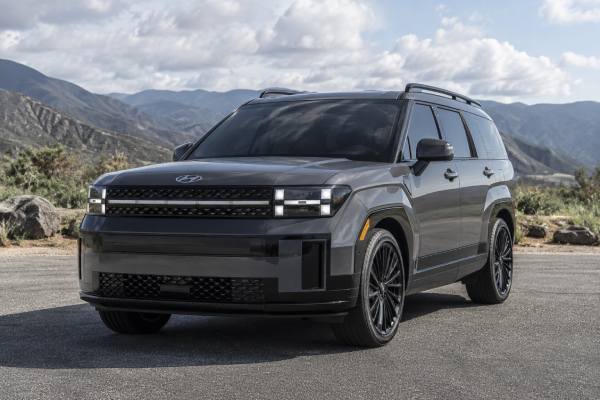


The fifth-generation Hyundai Santa Fe takes a clear step away from the rounded family-SUV shape of earlier models. In MX5 form, it is longer, boxier, more upright, and aimed at buyers who want genuine seven-seat practicality without moving into a full-size SUV. The 1.6 T-GDi HEV FWD version is the front-wheel-drive self-charging hybrid, pairing a turbocharged petrol engine with a compact high-voltage battery, electric motor assistance, and a 6-speed automatic transmission.
For 2024–2025, this version sits in an interesting middle ground. It is not as quick or as mechanically simple as a conventional petrol SUV, and it does not have the plug-in model’s external charging ability. Its strengths are packaging, refinement, low-speed electric assistance, and more manageable running costs than a similarly sized non-hybrid petrol SUV. The main caveat is that the MX5 Santa Fe is still a large, heavy vehicle, so real-world fuel economy depends heavily on speed, climate, tyre size, and how often the hybrid system can recover energy.
Quick Overview
- Strong seven-seat practicality, a flat-sided cargo area, and very good second-row space make it more useful than many mid-size SUVs.
- The 1.6 T-GDi hybrid system delivers smooth low-speed response and avoids the 8-speed dual-clutch transmission used by some non-hybrid Santa Fe versions.
- Official FWD hybrid performance is modest rather than sporty, with 0–100 km/h in about 9.6 seconds and a 180 km/h top speed.
- Early ownership checks should focus on recalls, software updates, wiring-harness service actions, tyre wear, brake condition, and hybrid-system health.
- Typical petrol/hybrid service planning is every 10,000 miles or 12 months in many UK/EU schedules, while some North American schedules use about 7,500–8,000 miles.
Table of Contents
- Santa Fe MX5 FWD Hybrid Profile
- Santa Fe MX5 Hybrid Technical Data
- Santa Fe MX5 Trims and Safety
- Reliability Issues and Service Actions
- Maintenance and Used Buyer Checks
- Driving Feel and Real Economy
- Rival Comparison and Verdict
Santa Fe MX5 FWD Hybrid Profile
The 2024–2025 Santa Fe MX5 FWD 1.6 T-GDi HEV is the front-drive hybrid version of Hyundai’s fifth-generation Santa Fe. In most European and UK contexts, it is a five-door SUV offered with five-, six-, or seven-seat layouts depending on market and trim, though the UK launch specification emphasized seven seats as standard with an optional six-seat configuration on selected grades.
The powertrain is a full hybrid rather than a mild hybrid. That means the vehicle can move at low speeds on electric power alone for short periods, but it is not plugged in and does not provide a meaningful EV-only range. The compact high-voltage battery is used to support launch, low-speed driving, energy recovery during braking, and engine-off coasting when conditions allow.
The petrol engine is Hyundai’s Smartstream 1.6-litre turbocharged direct-injection four-cylinder. In this application, the engine itself is rated at 160 PS, while the combined hybrid system output is 215 PS, or 158 kW. Some markets describe this as 215 hp for simplicity, but the European rating is best understood as 215 PS. The electric motor is integrated into the hybrid transaxle, driving the front wheels through a 6-speed automatic transmission.
This is an important distinction because some non-hybrid Santa Fe models use a different engine and transmission combination. The FWD HEV does not use Hyundai’s 8-speed wet dual-clutch gearbox. That is good news for buyers who prioritize smoothness and long-term simplicity over the sharper shift feel of a DCT. The hybrid’s 6-speed automatic is better suited to relaxed family driving, especially in urban traffic.
The MX5 body is much more upright than the previous Santa Fe. The square rear end, wide tailgate opening, and long wheelbase help cargo access and cabin space. The trade-off is aerodynamic drag at motorway speeds. Around town, the hybrid system can work efficiently because the battery frequently recovers braking energy. At 120 km/h or 75 mph, the engine is doing more of the work, and the Santa Fe’s size becomes more obvious in fuel use.
For buyers, the most practical appeal is not outright performance. It is the combination of seating flexibility, strong safety equipment, predictable hybrid drivability, and a cabin that feels designed for long-distance family use. The main question is whether the added size and weight are necessary. If all three rows and the large boot are used regularly, the FWD hybrid is one of the more sensible Santa Fe variants. If the third row is rarely needed, a smaller hybrid SUV may be cheaper to buy, easier to park, and more efficient.
Santa Fe MX5 Hybrid Technical Data
The following data focuses on the 2024–2025 Santa Fe MX5 1.6 T-GDi HEV FWD. Figures vary by market, seating layout, wheel size, and trim. Where official public data does not consistently publish a value, the table marks it as market/VIN dependent rather than forcing a false number.
| Item | Hyundai Santa Fe FWD 1.6 T-GDi HEV |
|---|---|
| Vehicle code | MX5, fifth-generation Santa Fe |
| Engine family/code | Smartstream G1.6 T-GDi HEV; commonly listed as G4FT family in several markets |
| Engine layout | Transverse inline-4 petrol, DOHC, 4 valves per cylinder, 16 valves total |
| Bore x stroke | 75.6 x 89.0 mm (2.98 x 3.50 in) |
| Displacement | 1.6 L, 1,598 cc |
| Induction and fuel system | Turbocharged, direct injection T-GDi |
| Compression ratio | 10.5:1 |
| Engine output | 160 PS (117.6 kW) at 5,500 rpm |
| Engine torque | 265 Nm (195 lb-ft) from about 1,500–3,500 rpm |
| Hybrid system output | 215 PS (158 kW; about 212 hp) |
| Hybrid system torque | 367 Nm (271 lb-ft), depending on market reporting method |
| Timing drive | Timing chain |
| Electric motor | Permanent magnet synchronous motor, single front transaxle-mounted motor |
| Motor output | 48 kW and 264 Nm |
| Hybrid battery | 1.49 kWh lithium-ion battery, 270 V system |
| Official combined efficiency | About 6.9 L/100 km WLTP FWD (34.1 mpg US / 40.9 mpg UK) |
| Real-world highway at 120 km/h | Typically around 8.0–9.0 L/100 km (26–29 mpg US / 31–35 mpg UK), depending on tyres, weather, load, and terrain |
| Item | Specification |
|---|---|
| Transmission | 6-speed automatic, A6MF2H-type hybrid automatic in many markets |
| Gear ratios | 1st 4.639, 2nd 2.826, 3rd 1.841, 4th 1.386, 5th 1.000, 6th 0.772, reverse 3.385 |
| Final drive | 3.510 FWD |
| Drive type | Front-wheel drive with open front differential and stability-control-based traction management |
| Suspension | MacPherson strut front, multi-link rear |
| Steering | Rack-mounted motor-driven power steering; 2.53 turns lock-to-lock |
| Turning circle | 11.6 m kerb-to-kerb (38.1 ft) |
| Brakes | Ventilated discs front and rear, 325 mm (12.8 in) diameter |
| Common tyre sizes | 235/60 R18 or 255/45 R20; UK launch trims commonly used 255/45 R20 |
| Ground clearance | 177 mm (7.0 in) |
| Length / width / height | 4,830 / 1,900 / 1,720–1,770 mm (190.2 / 74.8 / 67.7–69.7 in), height depending on roof equipment |
| Wheelbase | 2,815 mm (110.8 in) |
| Curb weight | About 1,845–1,975 kg (4,068–4,354 lb) for lighter FWD five-seat versions; about 1,900–2,030 kg (4,189–4,475 lb) for FWD seven-seat versions |
| GVWR | About 2,580–2,640 kg (5,688–5,820 lb), depending on seating layout |
| Fuel tank | 67 L (17.7 US gal / 14.7 UK gal) |
| Cargo volume | VDA: 628 L (22.2 ft³) seats up and 1,949 L (68.8 ft³) seats down for 6/7-seat HEV; five-seat versions up to 711 L and 2,032 L |
| Acceleration | 0–100 km/h in 9.6 seconds; 0–62 mph equivalent in 9.6 seconds |
| Top speed | 180 km/h (112 mph) |
| Braking distance | Not consistently published in official public specifications; tyre-dependent independent results should be checked by test vehicle |
| Towing capacity | 1,110 kg braked (2,447 lb); 750 kg unbraked (1,653 lb) |
| Payload | About 605–740 kg (1,334–1,631 lb), depending on seating and trim |
| Item | Typical requirement for the 1.6 T-GDi HEV |
|---|---|
| Engine oil | SAE 0W-20 full synthetic meeting the required Hyundai/API specification; about 4.8 L (5.1 US qt) with filter in many service references |
| Coolant | Hyundai-approved long-life ethylene-glycol coolant; hybrid cooling-loop capacity and bleeding procedure are VIN dependent |
| Transmission fluid | Hyundai/Kia low-viscosity ATF for the hybrid 6-speed automatic; exact SP-IV/SP4-M/SP4-M1 requirement must be matched by VIN |
| Differential / transfer case | Not applicable to the FWD model as a separate rear differential or transfer case is not fitted |
| Brake fluid | DOT 4 or Hyundai-approved equivalent |
| A/C refrigerant | R-1234yf in most 2024–2025 markets; charge mass must be taken from the under-bonnet label |
| A/C compressor oil | Hybrid-compatible electric-compressor oil; do not substitute conventional PAG oil unless specified by Hyundai |
| Critical torque values | Wheel nuts commonly 107–127 Nm (79–94 lb-ft); oil drain plug commonly about 39 Nm (29 lb-ft); verify by VIN and fastener type |
| Area | 2024–2025 Santa Fe MX5 HEV notes |
|---|---|
| Euro NCAP | 2024 rating: standard equipment rating listed separately from safety-pack rating; adult 84%, child 88%, vulnerable road users 70%, safety assist 69% |
| IIHS | 2024 U.S. Santa Fe rated Top Safety Pick; headlight rating Acceptable for all trims listed by IIHS |
| ADAS | AEB, lane support, speed assistance, driver monitoring, blind-spot systems, rear cross-traffic assistance, and adaptive cruise availability vary by market and trim |
Santa Fe MX5 Trims and Safety
Trim names vary by region. In the UK launch range, the main grades were Premium, Ultimate, and Calligraphy. Other markets use names such as Preferred, Luxury, Limited, Calligraphy, or region-specific equipment packs. The important point for the FWD HEV is that mechanical differences are usually limited. Most trims use the same 1.6 T-GDi hybrid system, the same 6-speed automatic transmission, the same basic suspension layout, and the same front-wheel-drive driveline.
The visible differences are more often in wheels, seating layout, lighting features, upholstery, display and audio equipment, camera systems, roof equipment, and driver-assistance content. Larger wheels, especially 20-inch packages with 255/45 tyres, sharpen initial steering response slightly but can add tyre cost and reduce ride compliance. Eighteen-inch tyres, where offered, are usually the better comfort and efficiency choice.
Typical trim and equipment differences include:
- Entry and mid trims: LED lighting, dual-screen dashboard layout, heated front seats in many markets, key ADAS features, seven-seat layout where standard, and smaller wheel packages in some regions.
- Higher trims: upgraded upholstery, ventilated seats, surround-view camera, blind-spot camera display, head-up display in some markets, premium audio, dual wireless phone charging, digital key functions, panoramic roof, and captain’s-chair second row where available.
- Calligraphy-style trims: more distinctive exterior trim, higher-grade interior materials, enhanced seating equipment, and the broadest convenience package.
Quick identifiers are useful when inspecting a used example. A FWD HEV should not carry an HTRAC or AWD badge, and underbody inspection should not show a rear differential or prop shaft. Hybrid versions have HEV badging or hybrid labeling depending on region, plus the hybrid-specific instrument cluster displays. A plug-in hybrid will have an external charge port and larger battery-related equipment, so it should not be confused with the self-charging HEV.
Safety equipment is generally strong, but exact content is market-sensitive. Front, side, curtain, and center-side airbag coverage is fitted on many versions, along with electronic stability control, anti-lock braking, hill-start assist, trailer stability logic where towing is supported, seatbelt reminders, and ISOFIX/LATCH child-seat anchors. The third row is useful for occasional adult use and children, but child-seat planning should be checked carefully because anchor positions and tether access differ by market and seat configuration.
Driver-assistance calibration matters. Radar, camera, and parking sensors should be recalibrated or checked after windscreen replacement, front bumper repair, suspension alignment work, collision repair, or sensor replacement. A Santa Fe with all the right hardware can still behave poorly if the camera aim, radar alignment, tyre sizes, or steering-angle calibration are incorrect.
For 2024–2025, the FWD HEV is generally a carryover configuration after launch. Some later 2026-market changes in output and towing capacity do not automatically apply to 2024–2025 vehicles, so buyers should avoid assuming that newer brochure figures can be retroactively applied.
Reliability Issues and Service Actions
The MX5 Santa Fe is still relatively new, so long-term reliability evidence is not as mature as it is for older Santa Fe generations. A careful reliability assessment should separate three things: the established 1.6 T-GDi hybrid powertrain family, the new MX5 body and electronics, and market-specific recalls or service campaigns.
The hybrid powertrain has a few practical advantages. It uses a 6-speed automatic rather than the 8-speed dual-clutch transmission found in some non-hybrid Santa Fe versions. It also spreads low-speed load between the petrol engine and electric motor, which can reduce stress in stop-start traffic. The trade-off is complexity: there are high-voltage components, an inverter, a DC–DC converter, power electronics cooling needs, and more software-dependent operation than in a non-hybrid petrol vehicle.
| Area | Prevalence | Severity / cost tier | Symptoms and checks |
|---|---|---|---|
| Software and ADAS calibration | Occasional | Low to medium | False warnings, infotainment glitches, poor lane-centering behavior, camera/radar faults; check for OTA and dealer updates |
| Recall-related wiring issues | Market-specific | Medium to high if ignored | Airbag warning lights, rearview-camera failure, warning messages; verify VIN completion with Hyundai or official recall database |
| 12 V battery weakness | Occasional | Low to medium | No-start condition, multiple warning lights, accessory glitches; load-test battery before diagnosing expensive modules |
| Brake rotor corrosion | Occasional in wet/salty climates | Low to medium | Pulsation, scraping, rust bands; hybrids use regen, so friction brakes may need deliberate cleaning stops |
| Direct-injection deposits | Possible over long mileage | Medium | Rough idle, misfire, reduced economy; more likely with short trips and poor fuel quality |
| Cooling leaks or trapped air after service | Rare to occasional | Medium to high | Overheat warnings, heater inconsistency, inverter cooling faults; hybrid cooling loops need correct bleeding |
For the petrol engine, regular oil service is critical. Turbocharged direct-injection engines are sensitive to oil quality, long change intervals under severe use, overheating, and poor fuel quality. Short trips can increase fuel dilution, especially if the engine runs briefly and shuts off before fully warming. Owners who mostly drive short urban journeys should treat the severe-use schedule seriously.
The timing chain is not a routine replacement item like a belt, but it is not a lifetime guarantee. Listen for cold-start rattles, check for cam/crank correlation faults, and investigate persistent timing-related fault codes. Chain, guide, or tensioner replacement should be based on symptoms, measured wear, or fault diagnosis, not mileage alone.
For the hybrid system, the 1.49 kWh battery is small but actively managed. Normal degradation should be gradual, and the vehicle does not depend on large EV range. A weak high-voltage battery may show frequent engine starts, reduced EV assist, poor fuel economy, or hybrid-system warnings. Pre-purchase checks should include a diagnostic scan, battery state-of-health information where available, and confirmation that no hybrid cooling or isolation faults are stored.
There is no onboard charger or charge port on the self-charging HEV, so PHEV-style charging faults do not apply. The relevant electrified components are the traction battery, inverter, DC–DC converter, electric motor, hybrid transaxle, contactors, battery cooling system, and power-control electronics.
Known U.S. safety actions affecting Santa Fe and Santa Fe Hybrid examples have included wiring-harness and rearview-camera related recalls, plus equipment-specific actions such as overhead-console sunshade switch concerns on certain vehicles. These do not necessarily apply in every market, and affected VIN ranges can be narrow. The correct approach is simple: check the VIN through Hyundai’s official owner portal, the selling-market recall database, and dealer service history. Do not rely only on a seller’s statement that “all updates were done.”
Maintenance and Used Buyer Checks
A 2024–2025 Santa Fe FWD HEV should be maintained as both a turbocharged petrol vehicle and a hybrid. The petrol engine still needs regular oil, filters, spark plugs, coolant checks, and belt inspections. The hybrid system adds battery, inverter, DC–DC, reduction/transaxle, and regenerative-braking considerations.
| Interval | Service items |
|---|---|
| Every 10,000 miles / 16,000 km or 12 months in many UK/EU schedules; 7,500–8,000 miles in some North American schedules | Replace engine oil and filter, rotate tyres, inspect brakes, check all lights, inspect wipers, check fluid levels, inspect visible leaks, check software campaigns |
| Every 12 months | Replace or inspect cabin air filter, inspect engine air filter, check A/C operation, inspect brake pads and rotors, test 12 V battery, inspect belts and hoses |
| Every 24 months | Replace brake fluid where specified, inspect coolant strength and condition, inspect suspension joints, steering boots, brake hoses, fuel lines, and exhaust mounts |
| Every 30,000–40,000 miles / 48,000–64,000 km | Inspect automatic transmission fluid condition under severe use, inspect wheel bearings, check alignment, inspect turbo plumbing, check for oil seepage |
| Every 60,000 miles / 96,000 km or market-specified interval | Replace spark plugs where required, inspect accessory belt, check cooling-system hoses, review hybrid battery health and stored fault history |
| As needed | Clean brake rotors with normal friction-brake use, replace tyres in matched sizes, perform ADAS calibration after windscreen, bumper, suspension, or alignment work |
For fluids, use the VIN-specific service manual. Engine oil is commonly 0W-20 full synthetic for the 1.6 T-GDi HEV, with a service fill around 4.8 L including filter in many references. Brake fluid should be DOT 4 or the Hyundai-approved equivalent. Transmission fluid must match the hybrid 6-speed automatic requirement; do not assume that fluid for a DCT, CVT, or non-hybrid automatic is suitable. Hybrid A/C systems also require the correct compressor oil because electric compressors can be damaged by the wrong lubricant.
A used-buyer inspection should include:
- Confirm the exact variant: FWD HEV, not AWD HEV and not PHEV.
- Check VIN recall status and ask for dealer proof of completed campaigns.
- Scan all modules, not just the engine ECU. Include hybrid control, battery, brake, ADAS, body, and infotainment modules.
- Inspect the second-row seat and floor-harness area for signs of trim removal, wiring repair, or warning-light history.
- Test the rearview camera, surround-view system if fitted, parking sensors, blind-spot cameras, lane systems, and adaptive cruise.
- Inspect brake rotors for corrosion bands, heavy lip wear, or vibration.
- Check tyres for matched size, load rating, even wear, and correct pressure placard compliance.
- Road-test from cold and hot. Listen for chain rattle, turbo whistle, suspension knocks, wheel-bearing hum, and harsh engine restart behavior.
- Confirm coolant level stability and cabin heat, especially after any cooling-system or accident repair.
- Review service invoices for oil grade, filter quality, software updates, and hybrid-system checks.
Recommended versions depend on priorities. For comfort and lower tyre cost, a trim with 18-inch wheels is attractive where available. For maximum equipment, higher trims are desirable, but buyers should budget for more expensive tyres and more electronic features to verify. The FWD HEV is generally the sensible choice for drivers who do not tow heavy loads and do not need snow-belt AWD traction. For regular towing, steep rural roads, or winter mountain use, the AWD HEV may be worth the extra weight and fuel use.
Long-term durability should be good if servicing is consistent and recalls are handled promptly. The biggest risk is not the hybrid concept itself; it is neglected maintenance, unresolved software campaigns, incorrect fluids, accident-repair calibration problems, and assuming a new-generation vehicle has no early production issues.
Driving Feel and Real Economy
The Santa Fe FWD HEV drives like a comfort-focused family SUV. Its size is always present, but the hybrid system helps it feel less strained in city use than the displacement suggests. Initial step-off is smooth because the electric motor fills the low-speed gap before the petrol engine needs to work hard. In light traffic, the engine can shut down frequently and restart with little drama.
The 6-speed automatic suits the vehicle’s character. It does not chase sporty shift speed, but it avoids the low-speed hesitation and clutch behavior that can affect some dual-clutch setups. Kickdown is measured rather than urgent. When the driver asks for a quick overtake, the engine becomes audible and the transmission may hold lower gears, but the Santa Fe still feels tuned for steady progress rather than aggressive acceleration.
At motorway speeds, the boxy body has a larger effect on efficiency and noise. The cabin is generally calm, but tyre choice matters. The 20-inch tyre package can add road noise on coarse surfaces, while smaller wheels usually bring better bump absorption. Wind noise is controlled well for such an upright shape, though crosswinds and roof-rack use can be felt more than in lower, sleeker SUVs.
Steering is light and accurate enough for a large family vehicle. It does not provide much road texture, but the Santa Fe tracks cleanly and feels stable in long bends. Front-wheel drive is adequate in dry and wet urban use, though hard acceleration on poor surfaces can expose the limits of the front tyres. The stability-control system is tuned conservatively, which fits the vehicle’s family role.
Ride quality is one of the stronger reasons to choose the hybrid Santa Fe. The suspension deals well with long undulations and motorway expansion joints, though sharp potholes are more noticeable on 20-inch wheels. The rear suspension remains composed with passengers aboard, and the long wheelbase helps second-row comfort. Fully loaded with seven people and luggage, performance becomes more relaxed, and braking distances will depend heavily on tyre condition and load.
Real-world economy is mixed in the best sense: it depends on how the vehicle is used.
- City and suburban driving: about 6.0–7.5 L/100 km (31–39 mpg US / 38–47 mpg UK) is realistic when traffic allows regeneration and the climate system is not working hard.
- Mixed driving: about 6.8–8.0 L/100 km (29–35 mpg US / 35–42 mpg UK) is a sensible expectation.
- Fast motorway driving at 120 km/h / 75 mph: about 8.0–9.0 L/100 km (26–29 mpg US / 31–35 mpg UK) is more realistic than the official combined figure.
- Cold weather: expect a noticeable increase because the petrol engine runs more for heat, the battery is less efficient, and winter tyres add rolling resistance.
Towing is possible but not the FWD HEV’s strongest use case. The 1,110 kg braked rating suits smaller trailers rather than heavy caravans. With a trailer or full roof load, fuel economy can deteriorate sharply, and the driver should watch engine temperature, transmission behavior, and braking confidence on long descents. For regular towing near the limit, a buyer should compare the AWD HEV, PHEV, diesel alternatives in other markets, or larger SUVs with higher tow ratings.
Rival Comparison and Verdict
The Santa Fe FWD HEV competes with a broad group of family SUVs, but its closest rivals are not always the same size. It overlaps with the Kia Sorento Hybrid, Toyota Highlander Hybrid where sold, Toyota RAV4 Hybrid for buyers who do not need full seven-seat space, Honda CR-V Hybrid in five-seat markets, Nissan X-Trail e-Power, Peugeot 5008, Skoda Kodiaq, and larger plug-in hybrid SUVs.
| Rival | Where the Santa Fe is stronger | Where the rival may be stronger |
|---|---|---|
| Kia Sorento Hybrid | Similar powertrain logic, bold design, strong cabin packaging, Hyundai-specific equipment mix | Sorento may offer different pricing, warranty terms, or trim availability depending on market |
| Toyota Highlander Hybrid | Santa Fe can feel more modern inside and easier to place in tighter European roads | Highlander has a strong hybrid durability reputation and more power in some markets |
| Toyota RAV4 Hybrid | Santa Fe offers much more cargo flexibility and available third-row seating | RAV4 is smaller, lighter, usually more efficient, and easier to park |
| Honda CR-V e:HEV | Santa Fe has greater three-row practicality and a larger cargo space | CR-V feels lighter, more agile, and often more economical in daily use |
| Nissan X-Trail e-Power | Santa Fe has a roomier, more upright cabin and stronger long-trip family feel | X-Trail’s series-hybrid feel may appeal to drivers who prefer EV-like response |
| Skoda Kodiaq | Santa Fe hybrid offers smoother low-speed electrified driving and strong standard safety tech | Kodiaq may offer better value, diesel options in some markets, and lower running costs depending on engine |
The Santa Fe’s main advantage is its space-to-comfort balance. It feels designed around family use: wide-opening doors, a usable second row, practical third-row access, a large tailgate opening, and an interior that works well for long trips. The FWD hybrid is also the calmer Santa Fe choice for buyers who do not need AWD. It avoids extra driveline weight and complexity while still providing strong everyday drivability.
Its weaknesses are also clear. It is not especially quick, it is not as efficient as smaller hybrids at motorway speeds, and the towing rating is modest for such a large-looking SUV. The boxy shape is excellent for packaging but not ideal for high-speed fuel consumption. Buyers should also be careful with early-production examples and make recall verification a non-negotiable step.
The best fit is a household that regularly carries passengers, luggage, pets, outdoor gear, or child seats, but does not want a plug-in charging routine. It is less convincing for a driver who mostly travels alone, lives in a dense city, or expects compact-SUV economy. As a used or nearly new purchase, the 2024–2025 Santa Fe FWD HEV is worth considering when it has full service history, confirmed recall completion, clean diagnostic scans, and tyres and brakes in good condition.
For the right buyer, the Santa Fe MX5 FWD hybrid is a practical, comfortable, and sensible large family SUV. Its value is strongest when judged as a roomy hybrid people-carrier with SUV ground clearance, not as a performance SUV or a heavy-duty tow vehicle.
References
- Hyundai SANTA FE | Technical Data | Updated: August 2024 2024 (Technical Data)
- Hyundai Owners Manuals 2026 (Owner’s Manual)
- Euro NCAP | Hyundai SANTA FE 2024 (Safety Rating)
- 2024 Hyundai Santa Fe 2024 (Safety Rating)
- Vehicle Detail Search – 2025 HYUNDAI SANTA FE HYBRID SUV FWD | NHTSA 2025 (Recall Database)
Disclaimer
This article is for informational purposes only and is not a substitute for professional diagnosis, repair advice, or official Hyundai service procedures. Specifications, torque values, service intervals, fluids, recalls, software updates, and procedures can vary by VIN, market, production date, trim, wheel package, and equipment. Always verify details against the official owner’s manual, service documentation, under-bonnet labels, dealer records, and recall databases for the specific vehicle.
If you found this useful, please consider sharing it on Facebook, X/Twitter, or your preferred social platform to support our work.