
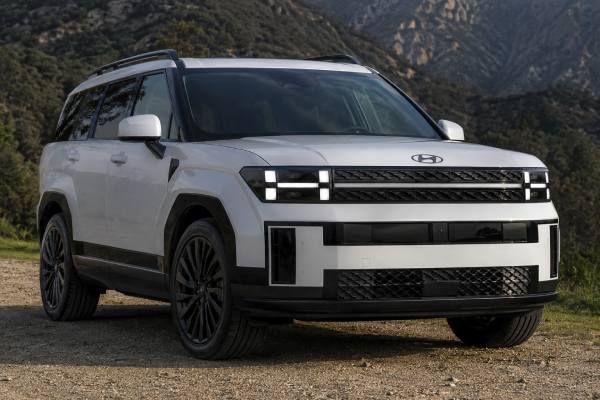
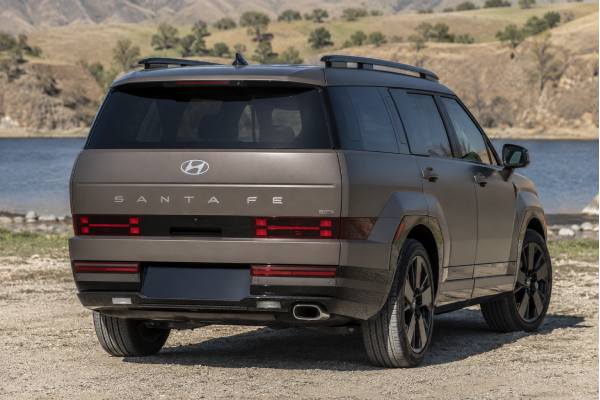

The MX5-generation Hyundai Santa Fe is a major change from the previous model: boxier, larger-feeling, more family-focused, and designed around hybrid and plug-in hybrid powertrains in many markets. The 1.6 T-GDi HEV 4WD version sits in the practical middle of the range. It has no plug-in charging requirement, uses a conventional 6-speed automatic rather than a dual-clutch gearbox, and adds all-wheel-drive traction for wet roads, winter use, gravel tracks, and light towing.
The key point is that this is not a performance SUV, even though the combined output is useful. It is a large hybrid family vehicle with seven-seat practicality in many versions, generous cargo room, strong safety technology, and a powertrain that rewards smooth driving more than aggressive throttle use. Specifications vary by country, trim, seating layout, and homologation standard, so the figures below focus on the 2024–2025 1.6 T-GDi HEV 4WD/AWD specification and highlight where local documents may differ.
Quick Overview
- The 1.6 T-GDi hybrid system gives smooth low-speed response, good urban efficiency, and a useful combined output of about 215 PS/160 kW.
- The 4WD system adds traction without using a separate rear electric motor; the electric motor is transmission-mounted and the rear axle is driven mechanically.
- The six-speed automatic is a practical advantage over the non-hybrid 2.5T dual-clutch setup sold in some markets.
- Early ownership checks should focus on recalls, software updates, hybrid cooling, 12 V battery health, brake corrosion, and correct oil service history.
- A typical official service rhythm in some markets is every 10,000 km or 6 months for oil and filter, though local schedules may allow different intervals.
Table of Contents
- Santa Fe MX5 AWD Buyer View
- Santa Fe MX5 HEV Specifications
- Santa Fe MX5 Trims and Safety
- Reliability, Issues, and Service Actions
- Maintenance Schedule and Buyer Checks
- Driving Performance and Efficiency
- Santa Fe Compared With Rivals
Santa Fe MX5 AWD Buyer View
The 2024–2025 Santa Fe MX5 1.6 T-GDi HEV 4WD is best understood as a large hybrid family SUV rather than a rugged off-roader. It has a tall, squared-off body, a long wheelbase, and a cabin designed around space, access, and technology. In many European and UK specifications, it is offered as a seven-seater as standard, with some markets or trims offering six-seat captain-chair layouts. The 4WD label usually refers to Hyundai’s active on-demand all-wheel-drive system, not a low-range four-wheel-drive system with locking differentials.
The powertrain combines a turbocharged 1.6-litre petrol engine, a transmission-mounted permanent-magnet synchronous motor, a small lithium-ion hybrid battery, and a 6-speed automatic transmission. The hybrid battery is not intended for external charging. Instead, it is charged by the engine and regenerative braking, then used for low-speed electric assistance, engine-off coasting in some conditions, smoother take-off, and extra torque during acceleration.
For normal ownership, the most appealing qualities are space, refinement, easy drivability, and equipment. The boxy shape helps the Santa Fe feel more useful than many sleeker SUVs because the cargo area is tall and square, the third row is easier to package, and outward visibility is generally good. The trade-off is that the car is physically large. At 4,830 mm long and 1,900 mm wide, it needs more space than a compact hybrid SUV in urban parking and narrow streets.
The 215 PS rating is adequate rather than exciting. The 4WD HEV is heavier than the 2WD version, and the official 0–100 km/h figure is around 9.8 seconds. That is quick enough for family use, motorway merging, and climbing hills with passengers, but it does not feel like a high-output SUV once loaded. The hybrid system is strongest in stop-start driving and moderate acceleration, where electric torque fills in before the petrol engine settles into its working range.
The Santa Fe HEV also avoids one concern associated with some non-hybrid Hyundai and Kia models: it does not use the wet dual-clutch transmission fitted to certain 2.5-litre turbo versions in other markets. The hybrid’s 6-speed automatic is smoother at low speed and better matched to family use, although it still needs proper fluid service and software updates when specified.
Buyers should pay close attention to market specification. A European 215 PS HEV, a UK 215 PS HEV, an Australian 172 kW hybrid, and a North American hybrid can share the same basic architecture but differ in output rating, towing limits, emissions standard, tyre packages, safety equipment, maintenance schedule, and warranty terms. This is especially important for imports and used examples, where the badge may look familiar but the service documentation, recall coverage, and parts catalog can differ.
Santa Fe MX5 HEV Specifications
The following tables summarize the 2024–2025 Santa Fe MX5 1.6 T-GDi HEV 4WD/AWD. Values are rounded where useful, and some fluids or service capacities must be verified by VIN because Hyundai publishes different regional service data.
| Powertrain and efficiency | Santa Fe MX5 1.6 T-GDi HEV 4WD |
|---|---|
| Engine code | Smartstream G1.6 T-GDi HEV, commonly listed as G4FT in some regional data |
| Engine layout | Transverse inline-4, DOHC, 4 cylinders, 16 valves |
| Bore × stroke | 75.6 × 89.0 mm (2.98 × 3.50 in) |
| Displacement | 1.6 L (1,598 cc) |
| Induction | Turbocharged |
| Fuel system | Gasoline direct injection |
| Compression ratio | 10.5:1 |
| Petrol engine output | about 160 PS / 117.6 kW at 5,500 rpm in European data |
| Petrol engine torque | 265 Nm (195 lb-ft), typically from about 1,500 rpm |
| Hybrid system output | 215 PS / 160 kW, often marketed as 215 hp |
| Hybrid system torque | 367 Nm (271 lb-ft) in commonly published European/UK data |
| Electric motor | Permanent-magnet synchronous motor, transmission-mounted |
| Motor count and axle | One traction motor integrated at the front transaxle; rear axle driven mechanically on 4WD models |
| Hybrid battery | 1.49 kWh lithium-ion or lithium-ion polymer, depending on regional description |
| System voltage | 270 V |
| Timing drive | Chain-driven camshafts |
| Rated WLTP combined economy | about 7.3 L/100 km for 4WD in European data, roughly 32 mpg US / 39 mpg UK |
| Real-world highway at 120 km/h | commonly about 8.0–9.5 L/100 km, depending on tyres, load, wind, temperature, and terrain |
| Transmission and driveline | Data |
|---|---|
| Transmission | 6-speed automatic |
| Gear ratios | 1st 4.639; 2nd 2.826; 3rd 1.841; 4th 1.386; 5th 1.000; 6th 0.772 |
| Reverse ratio | 3.385 |
| Final drive | commonly listed around 3.510 for HEV |
| Drive type | Active on-demand 4WD/AWD |
| Differential type | Open differentials with electronic traction and stability control; no low range or locking differential |
| Chassis and dimensions | Data |
|---|---|
| Front suspension | MacPherson strut |
| Rear suspension | Multi-link |
| Steering | Rack-mounted motor-driven power steering |
| Steering lock-to-lock | 2.53 turns |
| Turning circle | about 11.6 m (38.1 ft) kerb-to-kerb diameter |
| Front brakes | Ventilated discs, 325 mm (12.8 in) |
| Rear brakes | Ventilated discs, 325 mm (12.8 in) |
| Common tyre sizes | 235/60 R18 or 255/45 R20, depending on trim and market |
| Ground clearance | 177 mm (7.0 in) |
| Approach / departure / breakover | approximately 17.4° / 20.9° / 15.3° in some regional data |
| Length | 4,830 mm (190.2 in) |
| Width | 1,900 mm (74.8 in), excluding mirror variation by market |
| Height | about 1,770–1,780 mm (69.7–70.1 in), depending on roof rails and market |
| Wheelbase | 2,815 mm (110.8 in) |
| Kerb weight | about 1,965–2,095 kg (4,332–4,619 lb) for 7-seat 4WD European/UK-style data |
| GVWR | about 2,675 kg (5,897 lb) for many 7-seat 4WD versions |
| Payload | about 580–710 kg (1,279–1,565 lb), depending on trim and seating |
| Fuel tank | 67 L (17.7 US gal / 14.7 UK gal) |
| Cargo volume | VDA: about 628 L (22.2 ft³) seats up in 6/7-seat form; up to about 1,949 L (68.8 ft³) seats down |
| Performance and capability | Data |
|---|---|
| 0–100 km/h | about 9.8 seconds for 4WD HEV |
| Top speed | 180 km/h (112 mph) |
| 100–0 km/h braking distance | Not consistently published; tyre condition and surface matter more than the paper number |
| Braked towing capacity | commonly 1,110 kg (2,447 lb) in European/UK 215 PS HEV data; higher in some other regions |
| Unbraked towing capacity | 750 kg (1,653 lb) |
| Roof load | about 100 kg (220 lb), where specified |
| Fluids, service capacities, and torque values | Practical notes |
|---|---|
| Engine oil | 0W-20 synthetic is commonly specified for the 1.6 T-GDi HEV; service capacity is about 4.8 L / 5.1 US qt with filter in several service references |
| Oil standard | Use the VIN-specific Hyundai-approved oil standard; API SP / ILSAC GF-6 or regional equivalents are typical for late petrol hybrids |
| Coolant | Hyundai-approved long-life ethylene-glycol coolant; use the correct hybrid cooling-loop fluid and mix ratio specified locally |
| Automatic transmission fluid | Hyundai/Kia-approved ATF for the 6-speed automatic; some service schedules show about 4 L for a service quantity, but total capacity requires service-manual confirmation |
| Transfer case / rear differential | Hyundai-approved hypoid gear oil; exact grade and capacity must be checked by VIN |
| Brake fluid | DOT 4 or Hyundai-specified equivalent; replace by time as well as condition |
| A/C refrigerant | Usually R-1234yf on late European-market vehicles; charge mass is label-specific |
| A/C compressor oil | Use the compressor and refrigerant-specific oil listed on the under-bonnet label or service manual |
| Wheel nut torque | 107–127 Nm (79–94 lb-ft) is a common Hyundai range |
| Engine oil drain plug torque | about 39 Nm (29 lb-ft) in many service references; replace the sealing washer |
| Safety and assistance | Summary |
|---|---|
| Euro NCAP | 2024 rating: 4 stars with standard equipment; 5 stars with optional Safety Pack in European testing |
| Euro NCAP standard scores | Adult 84%, Child 88%, Vulnerable Road Users 70%, Safety Assist 69% |
| Euro NCAP Safety Pack scores | Adult 84%, Child 88%, Vulnerable Road Users 77%, Safety Assist 79% |
| IIHS | 2024 Santa Fe received Top Safety Pick; headlights rated Acceptable; front crash prevention rated Good in listed categories |
| ADAS availability | AEB, pedestrian/cyclist detection, lane assistance, speed assistance, blind-spot systems, rear cross-traffic systems, driver monitoring, and adaptive cruise vary by trim and region |
Santa Fe MX5 Trims and Safety
Trim names vary widely. In the UK, the early MX5 Santa Fe range was positioned around Premium, Ultimate, and Calligraphy grades. In Australia, SANTA FE, Elite, and Calligraphy names are used. Other European markets use different grade names and package combinations. The important point is not the badge alone, but the mechanical and safety equipment behind it.
Most 1.6 T-GDi HEV 4WD versions share the same core powertrain: turbo hybrid engine, 6-speed automatic, active AWD, MacPherson front suspension, multi-link rear suspension, and ventilated disc brakes. Functional differences are more likely to come from tyres, seating configuration, driver-assistance packages, towing homologation, lighting equipment, audio, cabin materials, and parking assistance systems than from major mechanical changes.
Typical grade differences include:
- Base or lower trims: 18- or 20-inch wheels depending on market, cloth or synthetic upholstery, core SmartSense safety systems, dual digital displays, rear camera, parking sensors, and basic connected services.
- Mid trims: leather-appointed upholstery, upgraded audio, navigation-based smart cruise control in some markets, surround-view camera, blind-spot view display, power tailgate, and more cabin convenience features.
- High trims: Nappa leather in some regions, six-seat captain-chair option, premium audio, remote parking functions, panoramic or dual-panel sunroof, digital key, ventilated seats, more exterior trim detailing, and broader parking collision-avoidance features.
Quick identifiers are useful when inspecting a used vehicle. The 4WD/AWD model may have a rear differential and prop shaft visible underneath, a drivetrain badge or drive-mode menu, and terrain modes such as Snow, Mud, and Sand in some markets. Calligraphy-type grades often have higher-grade seat trim, larger wheel packages, more cabin lighting, a premium audio system, and more advanced parking-camera views. The VIN and build sheet are still the best way to confirm equipment because dealer descriptions often simplify hybrid, AWD, and safety-package details.
Safety is a strong part of the Santa Fe’s appeal, but the details matter. Euro NCAP gave the 2024 Santa Fe a dual rating: 4 stars with standard equipment and 5 stars when fitted with the optional SmartSense safety pack. The tested model was a Santa Fe HEV AWD, which makes the result directly relevant to this version. The difference between the two ratings is mainly active safety content and vulnerable-road-user performance, not a basic weakness in the body structure.
The standard safety package generally includes multiple airbags, stability control, anti-lock braking, hill-start assistance, multi-collision braking in some markets, lane keeping, forward collision avoidance, driver attention or driver monitoring systems, intelligent speed assistance, blind-spot assistance, rear cross-traffic assistance, and seatbelt reminders. Higher trims or packages may add rear automatic braking, remote parking, surround-view monitoring, blind-spot camera views, and more advanced highway driving support.
Child-seat provisions are also a strength. Depending on seating layout and market, the Santa Fe offers ISOFIX/LATCH-type anchorages and top-tether provisions for the rear rows. Anyone planning to use three child seats, a rear-facing infant seat, or the third row should test the exact seats in the exact vehicle because cushion height, belt-buckle access, captain chairs, and third-row access can change the practical result.
After windscreen replacement, bumper repair, front-end repair, wheel alignment, suspension work, or body repair near radar/camera locations, ADAS calibration should not be treated as optional. Lane support, forward collision avoidance, adaptive cruise, parking collision avoidance, and camera-based speed systems depend on correct sensor position and calibration. A car that has had crash repair should have documentation showing that calibrations were completed correctly.
Reliability, Issues, and Service Actions
The MX5 Santa Fe is still a relatively new generation, so long-term reliability patterns are not as mature as they are for older Santa Fe models. Early assessment should therefore separate proven facts from sensible inspection points. The hybrid system itself is based on Hyundai/Kia architecture already used across several models, but the MX5 body, wiring layout, interior electronics, ADAS integration, and trim systems are newer.
The most important early ownership item is recall verification. U.S.-market vehicles have had safety actions involving items such as main floor wiring harness routing on some 2024 Santa Fe and Santa Fe HEV vehicles, where harness contact near the passenger-side second-row folding hinge could trigger airbag warning lights or affect airbag operation. Other market-specific actions have involved equipment such as sunshade switch hardware, rearview camera installation, side-curtain-airbag installation on certain later vehicles, and other production or software issues. Not every action applies to every country or VIN, so the correct process is to check the official Hyundai or national recall database, then confirm dealer completion records.
Common and plausible inspection areas are best grouped by severity:
| Area | Prevalence | Severity | What to look for |
|---|---|---|---|
| Software updates | Common early-life item | Low to medium | Infotainment glitches, ADAS warnings, camera issues, hybrid control refinements, navigation or connectivity faults |
| 12 V battery weakness | Occasional | Low to medium | No-start condition, warning messages, repeated low-voltage faults, erratic electronic behavior |
| Brake corrosion | Occasional, climate-dependent | Low to medium | Rust lips on discs, pulsing, scraping noise after wet parking, reduced rear brake use due to regeneration |
| Wiring and connector issues | Rare to occasional | Medium to high | Airbag light, camera fault, blind-spot warnings, water intrusion signs, damaged harness clips |
| Turbo GDI operating stress | Usage-dependent | Medium | Oil dilution from short trips, poor oil history, rough running, carbon build-up symptoms, coolant or oil leaks |
| AWD driveline neglect | Occasional on high-use vehicles | Medium | Rear differential noise, transfer-case seepage, driveline clunk, mismatched tyres |
| Hybrid battery degradation | Rare this early | High if out of warranty | Reduced assist, hybrid warnings, abnormal cooling-fan operation, state-of-health concerns |
For the petrol engine, the key is maintenance discipline. The 1.6 T-GDi uses turbocharging, direct injection, tight oil-control requirements, and frequent stop-start operation in hybrid use. Poor oil quality, extended intervals under short-trip use, repeated cold starts, and low oil level are more damaging than mileage alone. Symptoms such as cold-start rattle, chain correlation faults, misfires, fuel smell in oil, or unexplained oil consumption deserve proper diagnosis rather than a simple reset.
The timing system is chain-driven, so there is no routine timing-belt replacement interval. That does not mean it should be ignored. Timing-chain stretch, guide wear, tensioner problems, or cam/crank correlation faults should be investigated if there is rattle at start-up, poor running, warning lights, or stored diagnostic codes. Correct oil viscosity and change frequency are the first line of prevention.
For the hybrid system, the high-voltage battery is small and power-focused, not a long-range traction battery like a BEV pack. It normally cycles within a controlled state-of-charge window, which helps durability. Still, buyers should ask for any available hybrid battery state-of-health data, check for warning lights, confirm the hybrid cooling air path is clean, and listen for unusual fan noise. The DC–DC converter is important because it charges the 12 V system; repeated 12 V failures should not be dismissed without checking charging behavior.
The 6-speed automatic generally suits the hybrid better than a sporty dual-clutch gearbox would. Watch for delayed engagement, harsh shifts, flare between gears, shudder under light load, or repeated adaptation resets. A software update may fix some drivability complaints, but burnt fluid, leaks, or mechanical noise require inspection. Because this is a 4WD model, tyre matching matters: uneven tyre circumference can load AWD components and confuse stability systems.
Pre-purchase checks should include complete service history, proof of recall completion, evidence of correct oil and filter changes, brake-fluid replacement, hybrid-system checks, tyre-matching history, and a diagnostic scan of all modules. A well-maintained early Santa Fe HEV 4WD should be a sound ownership prospect, but a neglected one can be expensive because it combines turbo-petrol, hybrid, AWD, ADAS, and high-content interior systems.
Maintenance Schedule and Buyer Checks
Maintenance intervals vary by market, climate, fuel quality, and usage. Some official regional schedules for the Santa Fe MX5 1.6 T-GDi HEV show oil and filter service every 10,000 km or 6 months, while other markets may publish different normal-service intervals. Short trips, heavy city driving, towing, cold starts, mountain use, dusty roads, and long idling should be treated as severe service.
| Item | Practical interval | Notes |
|---|---|---|
| Engine oil and filter | 10,000–15,000 km or 6–12 months, depending on market; use shorter interval for severe service | Use 0W-20 Hyundai-approved synthetic oil; keep receipts showing grade and specification |
| Engine air filter | Inspect at each service; replace about every 40,000 km or sooner in dust | A clogged filter hurts economy and turbo response |
| Cabin air filter | 10,000–20,000 km or annually | Replace more often in dusty or polluted areas |
| Brake fluid | About every 40,000 km or 2 years in many schedules | Regenerative braking does not remove moisture from brake fluid |
| Brake pads and rotors | Inspect every service | Check for corrosion, uneven rear rotor use, and sticking caliper slide pins |
| Spark plugs | Often around 70,000–100,000 km, depending on market | Use the exact heat range and specification for the turbo hybrid engine |
| Coolant | Inspect regularly; replace by official time/mileage | Hybrid cooling loops and inverter-related cooling must use the specified coolant |
| Transmission fluid | Inspect at scheduled points; replace under severe service or by local schedule | The 6AT may show a service quantity around 4 L in some schedules; total capacity is service-manual specific |
| Transfer case and rear differential oil | Inspect for leaks; replace under towing, water exposure, or severe use | AWD components are often neglected on family SUVs |
| HSG / auxiliary belt | Inspect regularly; some schedules show replacement around 80,000 km | Hybrid starter-generator belt condition matters for smooth hybrid operation |
| Tyre rotation | About every 10,000 km | Keep all four tyres matched by size, model, wear, and pressure |
| Wheel alignment | Check annually or after impacts | Important for tyre wear, ADAS behavior, and highway stability |
| 12 V battery | Test annually after year two; expect replacement around 3–5 years depending on climate | Low voltage can create misleading electronic fault symptoms |
| HV battery health | Check during major services or pre-purchase inspection | Look for warning lights, abnormal cooling-fan behavior, and diagnostic codes |
For a used purchase, inspect the car cold. A warm engine can hide start-up rattle, rough idle, delayed transmission engagement, and coolant seepage. Check the coolant reservoir level before and after a test drive, look under the engine for oil leaks, and inspect the rear differential and transfer case for seepage. In the cabin, test every powered seat, folding seat mechanism, sunshade, tailgate, camera view, USB port, wireless charger, and driver-assistance warning.
The third row and cargo area deserve special attention because this vehicle is often used as family transport. Look for broken trim, damaged seat latches, water entry around the tailgate, torn cargo plastics, and evidence of heavy towing or commercial use. If the car has a towbar, ask whether it is factory-approved and whether trailer wiring was coded correctly.
For hybrids, do not skip the diagnostic scan. A basic engine-code reader is not enough. A proper scan should read the hybrid control unit, battery management system, transmission control, ABS/ESC, ADAS modules, airbag module, body control module, and infotainment-related systems. Stored low-voltage codes, airbag warnings, radar errors, camera calibration faults, or intermittent communication faults can reveal problems that are not visible on a short test drive.
Recommended versions depend on priorities. A mid-to-high trim with documented recalls, smaller wheels where available, complete service records, and no accident history is usually a better long-term buy than a visually impressive high-trim car on expensive tyres with gaps in maintenance. The 18-inch tyre package, where available, should ride better and reduce tyre cost. The 20-inch package looks sharper but can be more sensitive to potholes, tyre noise, and replacement price.
The long-term durability outlook is cautiously positive if maintenance is kept conservative. The Santa Fe HEV uses proven hybrid ideas, a conventional automatic transmission, and a relatively modest hybrid battery. Its risk is complexity: there are more modules, sensors, cooling circuits, and comfort features than in a simpler petrol SUV. Owners who keep software updated, service fluids on time, protect the brakes from corrosion, and resolve warning lights early are likely to get the best results.
Driving Performance and Efficiency
The Santa Fe HEV 4WD drives like a large, comfort-biased hybrid SUV. Around town, the electric motor helps the car move away smoothly, and the petrol engine often joins with less drama than expected. It is not silent like a full EV, but it can feel relaxed in traffic because the motor fills the low-speed torque gap and reduces the need for heavy revs.
Throttle response is best in gentle to moderate driving. Press the accelerator lightly and the Santa Fe feels polished, with the hybrid system blending engine and motor assistance cleanly. Ask for a quick overtake at higher speed and the engine becomes more audible, the gearbox may drop one or two ratios, and the car reminds you that it is moving roughly two tonnes of SUV. Sport mode sharpens response, but it does not turn the Santa Fe into a sporty vehicle. Eco mode is usually the most natural setting for daily use.
The 6-speed automatic is a good match for comfort. It avoids the low-speed hesitation that some dual-clutch systems can show in parking manoeuvres, hill starts, or stop-go traffic. Gear changes are usually smooth, although the transmission can still hunt on rolling hills if the vehicle is loaded and the driver asks for repeated small speed changes. Correct software and clean fluid are important for keeping shift quality consistent.
Ride quality depends heavily on wheels. Eighteen-inch tyres give the best balance because their taller sidewalls absorb sharp edges and reduce impact harshness. Twenty-inch tyres improve appearance and steering precision but can introduce more road noise and firmness, especially on broken urban surfaces. The Santa Fe’s long wheelbase helps stability, but its height and weight mean it prefers smooth inputs. It corners securely rather than eagerly.
Steering is light and accurate enough for a family SUV. Feedback is limited, but the car tracks well at motorway speeds and feels composed in crosswinds for its shape. The main urban drawback is size. The square body helps with visibility, and cameras make parking easier, but the 11.6 m turning circle and 1.9 m width are noticeable in tight streets and old multi-storey car parks.
Braking feel is typical for a modern hybrid: slightly blended at low speeds because the system is balancing regenerative and friction braking. Most drivers adapt quickly. The important ownership point is that friction brakes can corrode if the car spends much of its life using regenerative braking and then sits wet. Periodic firm braking in safe conditions and regular inspections help keep rotors clean.
Real-world economy depends strongly on use. In urban and suburban driving, the hybrid system can be effective, especially if traffic speeds are moderate and the battery has enough opportunity to recover energy. Expect roughly 6.5–8.0 L/100 km in many city or mixed suburban conditions. On faster roads, the Santa Fe’s weight and upright body reduce the hybrid advantage. At 100–120 km/h, 7.5–9.5 L/100 km is a realistic broad range, with winter tyres, roof bars, headwinds, cold weather, and heavy loads pushing it higher.
Cold weather has two effects. First, the petrol engine must run more often for cabin heat and emissions warm-up. Second, the battery and tyres are less efficient. Winter consumption can easily worsen by 10–25 percent depending on trip length. Short winter journeys are the least efficient because the engine and cabin never fully stabilize.
The 4WD system adds confidence rather than off-road ability. It can send torque rearward when the front axle needs support, and terrain modes help tune throttle, transmission, and stability-control behavior for snow, mud, or sand. It does not have low range, locking differentials, or the underbody clearance of a proper off-roader. With suitable tyres, it is good for winter roads, wet grass, gravel driveways, and light trails. With road-biased tyres, traction remains the limiting factor.
Towing is possible but should be planned carefully. In European/UK 215 PS HEV data, the braked tow rating is commonly 1,110 kg, which is modest for a vehicle of this size. Other markets may list higher ratings, so use the VIN plate and local approval documents rather than assuming. With a trailer, expect higher fuel consumption, more engine noise on grades, and more brake heat. Keep weight distribution conservative, respect towball limits, and service transmission and AWD fluids more carefully if towing is frequent.
Santa Fe Compared With Rivals
The Santa Fe HEV 4WD competes in a difficult space because buyers may compare it with seven-seat hybrids, plug-in hybrids, diesel SUVs, and large petrol family crossovers. Its main strengths are cabin packaging, comfort, equipment, hybrid smoothness, and safety technology. Its weaknesses are modest towing capacity in some markets, average high-speed fuel economy, and the cost and complexity that come with a highly equipped hybrid SUV.
The Kia Sorento HEV is the closest mechanical rival. It shares broad Hyundai/Kia hybrid thinking, offers three-row practicality, and can feel slightly more conventional in styling. The Sorento may appeal to buyers who want a familiar SUV shape and similar mechanicals. The Santa Fe feels newer, more distinctive, and more interior-focused, but the better buy often comes down to trim, warranty, price, and availability.
The Toyota Highlander Hybrid, where sold, is a strong reliability-led alternative. It is smoother in some conditions, has a long hybrid reputation, and may offer better long-term confidence for conservative owners. The Santa Fe counters with a more modern cabin layout, stronger technology feel, and in some markets more flexible equipment. The Toyota may be the safer bet for pure long-term reputation; the Hyundai may feel fresher and better equipped for the money.
The Honda CR-V e:HEV is usually more efficient and easier to manage in town, but it is generally a smaller, five-seat-focused vehicle in many markets. It suits buyers who do not need a third row and want a refined hybrid system with lower running costs. The Santa Fe is the better fit when space, luggage height, rear-seat flexibility, and family-hauling capacity are more important.
The Mazda CX-80 is an interesting rival because it offers a more premium-feeling longitudinal platform in some markets, with diesel and plug-in hybrid options depending on region. It can tow more in some forms and may feel more driver-focused. The Santa Fe is easier-going, boxier, and more practical in cargo shape, while the Mazda may appeal to those who value steering feel, cabin materials, or towing.
The Skoda Kodiaq is another practical alternative in Europe. It is not always a direct hybrid match, but it offers excellent packaging, efficient engines, and strong value. Compared with the Kodiaq, the Santa Fe feels larger, more SUV-like, and more heavily equipped, while the Skoda may be cheaper to run and easier to park.
For used buyers, the best choice depends less on brochure numbers and more on the individual vehicle. A Santa Fe HEV 4WD with complete service history, recall proof, matching tyres, clean diagnostics, and conservative use is more attractive than a rival with patchy records. The Hyundai’s biggest advantage is that it combines the easy manners of a hybrid with a large, square, genuinely useful cabin. Its biggest caution is complexity: it is a car to maintain properly, not a car to run casually until warning lights appear.
References
- Hyundai SANTA FE | Technical Data | Updated: August 2024 2024 (Technical Data)
- Hyundai SANTA FE | Technical specifications | April 2024 2024 (Technical Data)
- SANTA FE 2024 – Car & User Manual 2024 (Owner’s Manual)
- Euro NCAP | Hyundai SANTA FE 2024 (Safety Rating)
- 2024 Hyundai Santa Fe 2024 (Safety Rating)
Disclaimer
This article is for informational purposes only and is not a substitute for professional diagnosis, repair, inspection, or official service information. Specifications, torque values, service intervals, fluids, procedures, recalls, towing limits, and safety equipment can vary by VIN, market, production date, trim, and fitted options. Always verify critical information against the official owner’s manual, service documentation, VIN plate, recall database, and a qualified Hyundai repair source.
If this helped, please share it on Facebook, X/Twitter, or your preferred community to support our work.