


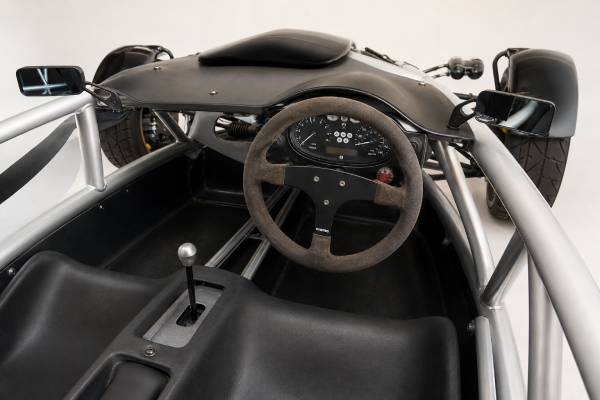
The Ariel Atom 160 occupies an unusually interesting place in the first-generation range. It keeps the compact Rover K-Series engine, five-speed manual gearbox, narrow early chassis, and remarkably low mass of the original Atom, but adds the freer-breathing, variable-valve-control character buyers expected from the quicker versions. It is fast enough to feel serious on a circuit without turning every throttle movement into a test of restraint.
Identification is the first challenge. Period guides, later databases, and sales advertisements do not always use the same output label for the middle Rover-powered Atom; references to 160, 165, and other nearby figures can describe closely related specifications. A buyer should therefore establish the individual car’s factory build, engine configuration, and subsequent modifications rather than relying on a badge or seller’s estimate. Once correctly identified, a sound Atom 160 offers a persuasive balance: more urgency than the 120, less mechanical intensity than the 190, and the direct, low-inertia responses that define the earliest cars.
Table of Contents
- How to Identify the Rover-Powered 160
- VVC Engine and Vehicle Specifications
- Why the 160 Is the Range’s Middle Ground
- VVC Engine Health, Cooling, and Timing Service
- Geometry, Controls, and Tire Choice
- Preservation, Storage, and Sympathetic Upgrades
- Authentication and Pre-Purchase Decisions
How to Identify the Rover-Powered 160
The safest way to identify an Atom 160 is through its chassis record and engine specification, not the number printed in an advertisement. Early Ariel production was low-volume, cars could be ordered with options, and many examples have been upgraded, rebuilt, or re-described during more than two decades of ownership.
The 160 belongs to the first Atom generation and uses the 1.8-liter Rover K-Series rather than the Honda engine fitted to Atom 2. It is normally associated with Rover’s Variable Valve Control system, commonly abbreviated VVC, and a five-speed manual transaxle. The basic packaging is unmistakable: the engine sits transversely behind the seats within the visible spaceframe, and the suspension is operated through exposed wishbones and inboard dampers.
Nomenclature is less tidy. Contemporary model summaries often describe a progression from the 120 to outputs around 140 or 165 hp before the 190. Some technical databases list a 160-hp VVC version. That does not make every 160 advertisement wrong, but it means the label alone cannot prove originality. Power may have been rounded, quoted in metric horsepower rather than mechanical horsepower, or changed by intake, exhaust, cam, ECU, and cylinder-head work.
Ask Ariel or a marque specialist to interpret the chassis number. Useful evidence includes the original invoice, build sheet, engine number, early photographs, service invoices, and records of factory-return work. Compare those documents with the physical car. A later dashboard, different dampers, larger brakes, or nonstandard wheels may be entirely legitimate, but each change should have a clear explanation.
The distinction matters for more than collectibility. Engine parts, ECU calibration, timing procedures, cooling components, gear ratios, wheel fitment, and even expected driving behavior can depend on the actual specification. A car advertised as a 160 but rebuilt with a 190-style engine needs to be maintained as the engine it now contains, not as the name on the registration document suggests.
VVC Engine and Vehicle Specifications
The Atom 160 is an internal-combustion, gasoline-powered two-seater with a naturally aspirated Rover K-Series four-cylinder, a five-speed manual gearbox, and rear-wheel drive. The VVC cylinder head is the defining mechanical feature: it varies inlet-cam timing to broaden the engine’s useful range while retaining the light alloy architecture of the standard K-Series. The figures below describe the commonly published 160 specification; individual low-volume cars require chassis-specific confirmation.
| Specification | Value |
|---|---|
| Engine family | Rover K-Series VVC |
| Configuration | Transverse inline four-cylinder, mid-mounted |
| Displacement | 1,796 cc (1.8 L) |
| Valvetrain | DOHC, 16 valves, Variable Valve Control |
| Bore × stroke | 80.0 × 89.3 mm |
| Induction | Naturally aspirated |
| Maximum power | 160 hp at about 7,000 rpm |
| Maximum torque | About 174 Nm (128 lb-ft) at 4,500 rpm |
| Fuel type | Gasoline/petrol |
| Specification | Value |
|---|---|
| Transmission | Five-speed manual transaxle |
| Drive | Rear-wheel drive |
| Engine location | Behind the occupants, ahead of the rear axle |
| Clutch operation | Single dry-plate clutch |
| Driver aids | No conventional stability or traction-control system |
| Specification | Value |
|---|---|
| Construction | Tubular steel spaceframe with minimal composite panels |
| Body style | Open two-seat roadster |
| Front suspension | Independent double wishbones, pushrod-operated inboard dampers |
| Rear suspension | Independent double wishbones, pushrod-operated inboard dampers |
| Steering | Unassisted rack and pinion |
| Front brakes | 240 mm ventilated discs in commonly published specification |
| Rear brakes | 240 mm discs in commonly published specification |
| Specification | Value | Context |
|---|---|---|
| Length | 3,410 mm (134.3 in) | First-generation published figure |
| Width | Approximately 1,800 mm (70.9 in) | Minor source differences occur |
| Height | Approximately 1,200 mm (47.2 in) | Can change with setup and screen |
| Wheelbase | 2,345 mm (92.3 in) | Common first-generation figure |
| Published weight | Approximately 456 kg (1,005 lb) | Equipment and weight definitions differ |
| Common tire size | 185/60 R14 front and rear | Many surviving cars use later packages |
| Measure | Typical published figure | Important influence |
|---|---|---|
| Power-to-weight | About 351 hp per metric tonne at 456 kg | Calculated from published output and mass |
| Acceleration | Quicker than the 120 and below the 190’s headline pace | Launch, gearing, tires, and test method |
| Top-speed character | Strongly limited by exposed-body aerodynamic drag | Screen, weather, gearing, and driver position |
A precise acceleration or top-speed number is less useful than it appears because road tests did not always use identical specifications, and some later summaries merge neighboring outputs. The car’s condition, tires, alignment, and engine tune can now create a larger difference than a historical tenth of a second.
Why the 160 Is the Range’s Middle Ground
The Atom 160’s main strength is usable intensity. It has enough power to make the lightweight chassis feel genuinely rapid, yet its naturally aspirated delivery remains progressive and gives the driver time to work with the car rather than merely manage wheelspin.
Compared with the 120, the VVC engine rewards revs. The stronger upper range changes how the car is driven: a lower gear and a committed run toward 7,000 rpm produce the performance, while the 120 feels more dependent on its earlier torque. The VVC mechanism is intended to provide a broader spread than a fixed, aggressively timed cam, so the engine should not feel empty below its peak or suddenly switch personalities like an old-fashioned two-stage system.
Compared with the 190, the 160 is less demanding of every supporting component. It asks less from the cooling system, clutch, gearbox, brakes, and rear tires, although age and track use remain important. The driver can apply the throttle earlier on corner exit and use a greater portion of the engine’s range on ordinary roads. That makes it attractive to owners who value interaction more than the fastest possible lap.
The sensations are magnified by exposure. With no conventional body surrounding the occupants, wind, induction sound, exhaust note, front-tire movement, and suspension action are all visible or audible. A conventional 160-hp hatchback may feel ordinary; the same nominal output in an early Atom feels immediate because the car weighs around half as much and filters almost nothing.
Braking is another source of pace. The discs are modest by modern performance-car standards, but they slow very little mass. A well-maintained standard system should provide decisive braking and clear pedal feedback. Large aftermarket brakes may add heat capacity for long sessions, yet they can also increase unsprung mass or upset balance if chosen without a coherent setup.
The car’s open-wheel aerodynamics become obvious at speed. Acceleration fades as drag rises, and a driver’s helmet and shoulders are part of the airflow. This is why the Atom’s most memorable performance lies between corners rather than in a maximum-speed run. Its natural habitat is a technical road or circuit where low inertia, short braking distances, and rapid direction changes matter.
Driving one well requires calm inputs. The steering is light once moving but very direct; the car reacts quickly to hands, pedals, road camber, and tire temperature. Trail braking or lifting suddenly in a fast bend can rotate the chassis more rapidly than a heavier car. The 160 is approachable only in relative terms. It still has no electronic safety net to correct a poor decision.
VVC Engine Health, Cooling, and Timing Service
A healthy VVC K-Series can be lively and durable, but cooling-system condition and correct timing work are non-negotiable. The engine’s reputation for head-gasket trouble should prompt disciplined inspection, not the assumption that every car is either doomed or permanently cured by one previous repair.
Start with the cooling circuit. The mid-engine layout places the radiator and engine apart, so hoses, joints, bleed points, and coolant routing must all be sound. Air trapped after service can create local hot spots. Look for dried coolant residue, staining around joints, chafed hoses, loose clips, a damaged expansion tank, and evidence that the radiator has been struck by debris. The fan should operate correctly, and temperature should remain stable during idling, normal driving, and the cool-down after a harder run.
Check fluids only when safe. Oil contaminated with coolant, coolant containing oil, persistent bubbling, unexplained loss, or white exhaust vapor after full warm-up deserve investigation. None of these signs should be dismissed because the seller says the head gasket has already been changed. The quality of the repair matters: liner height, head condition, fasteners, gasket type, rail specification, and assembly procedure all affect the result.
Timing service is more involved on a VVC engine than on the basic 120. The main cam belt, tensioning system, and the VVC-related drive components must be handled with the correct locking and alignment procedures. Piston-to-valve contact is possible if timing is wrong. A receipt should state what was replaced, when, at what mileage, and by whom. A vague claim of “belt done” is not equivalent to a documented service.
The VVC mechanism should operate quietly and consistently. Excessive rattle, unstable idle, fault codes, weak high-rpm performance, or an engine that feels reluctant to rev can have several causes, including oil condition, sensor faults, timing errors, worn components, or calibration issues. Diagnosis should be systematic. Replacing parts at random is expensive and can introduce new problems.
Oil choice and level are particularly important in a car exposed to high cornering loads. Follow the engine builder’s or Ariel’s current guidance for the individual specification. Check level frequently, especially before track use, and investigate consumption rather than simply topping up indefinitely. The sump, breather arrangement, and any oil-control modifications should be identified on a modified car.
A service schedule should be based on time and use, not odometer reading alone. Ariel’s broader guidance for Atoms uses annual or low-mileage intervals, while enthusiast buying guides stress regular attention to fluids, timing equipment, and chassis joints. A car that covers only a few hundred miles each year still ages: coolant degrades, brake fluid absorbs moisture, fuel goes stale, seals harden, and belts remain under tension.
Before buying, request a cold start. Listen for bearing knock, valvetrain noise beyond a brief start-up period, exhaust leaks, and an uneven idle. Watch oil pressure and temperature instruments without assuming old senders are accurate. A compression or leak-down test can help when performed and interpreted properly, but it should complement—never replace—a complete history and cooling-system assessment.
Geometry, Controls, and Tire Choice
An early Atom’s precision depends on small mechanical joints and a correct alignment. A powerful engine cannot compensate for worn rod ends, mismatched dampers, bent wheels, stale tires, or geometry adjusted by guesswork.
The exposed wishbones make the suspension easy to see, but not necessarily easy to judge. Inspect every rod end for corrosion, looseness, rough movement, and damaged seals or boots where fitted. Check that locknuts are secure and that adjustment threads show sensible engagement. Play can appear as steering vagueness, clicks over surface changes, or inconsistent toe under braking.
Powder coat deserves a slow visual examination. Stone chips are normal on a used open-frame car; cracked coating around welds, localized fresh paint, flattened tubes, or distorted pickup points are more serious. Compare left and right sides. Repairs should be supported by photographs and specialist invoices. A beautifully refinished frame can be excellent, but fresh coating can also conceal why work was needed.
Alignment should suit the use. A circuit-focused setup with aggressive camber and toe may produce rapid turn-in on smooth asphalt but tramline, wear tires, and feel nervous on the road. Ride height must preserve damper travel and avoid contact with speed humps or curbs. Corner weighting can be worthwhile, but only after the chassis, dampers, bushings, bearings, and tires are confirmed healthy.
Original-size 14-inch tires help explain the car’s light steering and progressive breakaway. Wider later wheels may increase grip and expand tire choice, but offset, overall diameter, clearance, bearing load, and steering effort all matter. Ask why a change was made and whether the original parts remain with the car. Never fit a tire solely because its nominal size fits the rim; load rating, speed rating, compound, age, and intended temperature range are crucial.
Track-oriented tires need heat. On a cold or damp road, a less aggressive road tire may produce more predictable grip. Date codes can matter more than tread depth because an Atom may be stored for long periods. Inspect sidewalls for cracking and flat spots, and set pressures from a known baseline for the exact tire rather than copying another owner’s numbers.
Control condition is equally important. The brake pedal should remain firm, the throttle should return cleanly, and the clutch should engage consistently. Verify that seat and harness adjustment hold the driver securely without restricting control movement. Old harnesses may look presentable while no longer meeting event rules or current safety expectations.
Preservation, Storage, and Sympathetic Upgrades
Preserving an Atom 160 means keeping it mechanically active while protecting exposed components from moisture and neglect. Long-term static display is not automatically kinder than regular, properly prepared use.
Dry, ventilated storage is preferable to sealing a damp car beneath an impermeable cover. Clean road salt, insect residue, and track debris from the chassis, radiator, suspension, and brake areas, but avoid forcing water into connectors, bearings, or instruments. Allow the car to dry fully. Corrosion inhibitor may be appropriate on selected metal parts, provided it cannot contaminate brakes, tires, belts, or hot exhaust surfaces.
Fuel management matters during lay-up. Old gasoline can lose volatility and leave deposits. Follow safe storage practice for the fuel available in the owner’s market, and do not repeatedly start the engine for a few minutes without reaching full operating temperature. Short starts add condensation and may not recharge the battery. A quality battery maintainer, regular inspection, and a planned return-to-service routine are more useful.
Exercise the brakes and clutch carefully after storage. Surface rust on discs may clear, but a sticking caliper, seized handbrake mechanism where fitted, or contaminated fluid needs repair. Rotate tires or support the vehicle correctly during extended storage, using only approved lifting points. Never place loads on thin floor or body panels.
Upgrades should solve a defined problem. Better dampers can improve control if the originals are worn; modern instruments can improve reliability; a carefully engineered oil system can protect a track-driven engine. Changes become questionable when they are undocumented, poorly packaged, or incompatible with the rest of the car. An oversized wheel package, extremely stiff spring rates, or an unproven ECU map may reduce the qualities that make the 160 desirable.
Keep removed original parts, labels, calibration notes, and installation invoices. Reversibility protects historical value and gives the next owner a route back to factory form. Wiring modifications need particular care because exposed looms face vibration and weather. Crimp quality, strain relief, fusing, routing away from heat, and waterproof connectors matter more than cosmetic neatness.
Road legality can change with jurisdiction and modification. Lighting, mirrors, noise, emissions equipment, registration category, and helmet rules should be checked locally. A modification accepted at one inspection or track may not be legal elsewhere. Documentation is therefore part of usability, not merely a collector’s concern.
Authentication and Pre-Purchase Decisions
The best Atom 160 is the car whose identity, condition, and use history all make sense together. Treat a missing history, unexplained specification, or poor cold-start behavior as a reason to investigate further, not as a bargaining detail to ignore.
Begin before viewing. Request the chassis number, photographs of the frame and engine bay, a list of modifications, tire dates, and copies of major invoices. Ask whether the car has been crashed, returned to Ariel, used competitively, stored outdoors, or converted between road and track specifications. A seller’s openness is informative, although documents still need to support the story.
At the car, inspect in a fixed sequence. Confirm identity plates and document numbers. Examine the frame from front to rear, including suspension pickup points, floor edges, radiator area, and rear structure. Check fasteners for witness marks, mismatched hardware, or repeated movement. Look beneath fresh paint and new panels for the reason they were fitted.
Then evaluate the engine cold. Confirm fluid levels, hose condition, belt history, and absence of leaks before starting. Let it warm naturally, observing idle, fan operation, instruments, coolant behavior, and exhaust. After a cautious drive, inspect again for fresh seepage or pressurization. The gearbox should select all five ratios without crunching, and the clutch should not slip or drag.
The test drive should reveal a coherent car. It should brake straight, steer accurately, and settle after a bump. Some kickback and noise are inherent; persistent pull, oscillation, clunks, or sudden changes in balance are not. Compare tire brand, age, size, and pressure on all corners before blaming the chassis.
Budget for immediate baseline work even on a good example. Fluids, filters, brake inspection, geometry, tire replacement, harness review, and timing-service confirmation create a known starting point. If records are incomplete, assume age-sensitive work is due and price it with a specialist before purchase.
A factory-standard car with complete provenance may command the strongest collector interest, but originality is not the only sensible goal. A professionally upgraded 160 can be the better driver’s car when changes are documented and the original balance is retained. The poorest choice is an apparently cheap example whose engine output, chassis condition, and wiring cannot be explained.
The 160’s appeal is its equilibrium. It has enough revs and speed to feel meaningfully more urgent than the base car, but it still encourages full-throttle use, momentum, and accurate control. Authentication takes effort because early records and output labels can conflict, yet that effort protects both the purchase and the driving experience. Buy the individual chassis, not the number in the advertisement.
References
- Atom – Ariel Motor Company 2026
- Fiche technique Ariel Atom I 160 2000-2004 – Auto titre 2026
- Ariel Atom: used car buying guide | evo 2013
- Ariel Atom (2000-): PH Pocket Buying Guide 2016
- 2001-present Ariel Atom buying guide from Magneto magazine – Magneto 2024
- Atom Service Kit – Ariel Motor Company 2026
Disclaimer
This guide provides general information rather than a diagnosis or workshop procedure for a particular chassis. Confirm specification, parts, fluid requirements, service intervals, road legality, and repair methods with Ariel or a qualified specialist using the car’s build number, market, and fitted equipment. Share the guide with an owners’ group or enthusiast community when it helps another buyer preserve an early Atom.