

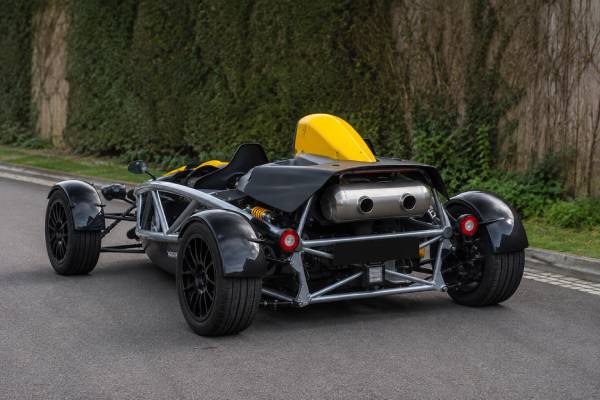
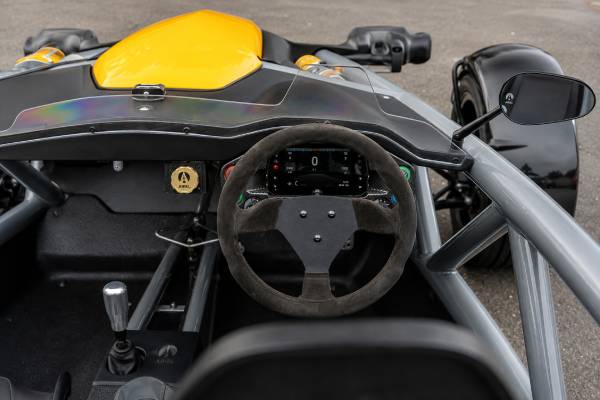
The Ariel Atom 4 350 is best understood as a factory-defined power specification for the fourth-generation Atom, not as a wholly separate model line. Ariel raises the turbocharged 1,996 cc Honda K20C engine from the standard 320 bhp through coordinated exhaust and ECU changes, with the exact road legality and hardware depending on whether the car uses a sports catalyst or a track-only decat arrangement. That distinction is important because many modified Atom 4s can be advertised as “350,” yet similar peak numbers do not prove identical parts, calibration, emissions compliance, torque delivery, or thermal protection. The strongest example has an original build sheet or Ariel invoice showing the upgrade, a known ECU file, and service records that match its use. In performance terms, the additional output sharpens an already traction-limited car rather than transforming its basic character. Chassis setup, tyre age, brake specification, and driver technique still determine whether the extra power becomes speed or wheelspin. This guide explains the genuine 350 package, its technical foundation, and the checks that matter most.
Table of Contents
- Defining a Real Atom 4 350
- Atom 4 350 Technical Reference
- Thirty Extra Horsepower in Context
- Exhaust, Mapping, and Compliance
- Keeping Performance Repeatable
- Buying Proof, Not Claims
- Building the Right Ownership Package
Defining a Real Atom 4 350
A genuine Atom 4 350 is an Atom 4 whose K20C powertrain has received Ariel’s specified 350 bhp upgrade or an equivalent documented factory-authorized installation. The key evidence is not a badge or dyno screenshot, but an invoice identifying the exhaust hardware and ECU reflash.
Ariel’s current option information describes the upgrade as a combination of hardware and software. Depending on intended use, that can include a sports catalytic converter or a decat pipe together with revised engine calibration. The parts affect exhaust backpressure, emissions, noise, boost control, fuelling, ignition, and torque delivery, so the package should be considered as a system.
The distinction from the standard 320 bhp car is narrow but meaningful. Both use the same fourth-generation tubular chassis, Honda K20C 2.0-litre turbo engine architecture, six-speed manual transmission, rear-wheel drive, digital AIM-based instrumentation, and pushrod suspension. The 350 does not automatically include a particular brake package, differential, damper, traction-control system, windscreen, or wheel option.
That means the label cannot describe the whole car. One 350 may be a road-oriented UK build with a sports catalyst, quieter exhaust, compliant suspension, and weather equipment. Another may have a decat pipe, AP brakes, double-adjustable dampers, track tyres, and a trailer-only routine. Both can be authentic, but their legal status, noise, weight, maintenance load, and value differ.
The assignment’s 2020–present date range is a practical scope rather than proof of a universal model-year introduction. Atom 4 production began in 2018, and factory options evolve without the rigid annual changeovers common to mass-produced cars. Verify the exact order date, completion date, registration date, and option list.
A seller may also use “350” to describe wheel horsepower, estimated crankshaft power, or an independent tune. Ask which. Ariel’s published bhp figure is an engine-output specification. A chassis-dyno result is affected by drivetrain loss, tyre pressure, correction method, gear choice, and dyno type, so it cannot be compared directly without context.
Atom 4 350 Technical Reference
The 350 remains a gasoline-only, mid-engined, rear-wheel-drive Atom 4 with a direct-injected and turbocharged Honda K20C inline-four. The output upgrade sits within a highly configurable vehicle, so the technical reference below separates shared architecture, 350-specific elements, and a clearly identified North American chassis specification.
| Specification | Value |
|---|---|
| Engine family | Honda K20C inline-four |
| Displacement | 1,996 cc (2.0 L) |
| Bore × stroke | 86.0 × 85.9 mm |
| Block, head, and sump | Aluminium alloy |
| Valvetrain | Chain-driven DOHC, 4 valves per cylinder, i-VTEC |
| Fuel delivery | High-pressure direct gasoline injection |
| Induction | Turbocharged and intercooled |
| Maximum power | 350 bhp with the Ariel power upgrade |
| Element | Published description |
|---|---|
| Calibration | Ariel ECU reflash for increased output |
| Road-oriented exhaust route | Sports catalytic converter package, subject to market approval |
| Track-oriented exhaust route | Decat pipe option for permitted off-road or circuit use |
| Standard-output comparison | 320 bhp at 6,500 rpm and 420 Nm at 3,000 rpm |
| Boost controls | Three-stage variable boost controller available according to build |
| Driver aids | Adjustable traction and launch control available according to build |
| Specification | Value |
|---|---|
| Transmission | 6-speed manual with reverse |
| Drive | Rear-wheel drive |
| Differential | Limited-slip unit available; confirm exact build |
| 0–60 mph | 2.8 seconds for the published 320 bhp Atom 4 baseline |
| 0–100 mph | 6.8 seconds for the published 320 bhp Atom 4 baseline |
| Top speed | 162 mph for the published standard Atom 4 |
| Component | Published specification |
|---|---|
| Suspension | Double unequal-length wishbones with pushrod-operated inboard dampers |
| Standard dampers | JRi single-adjustable units with Eibach two-piece springs |
| Front brakes | 290 mm vented discs with four-piston Brembo calipers |
| Rear brakes | 290 mm vented discs with four-piston calipers |
| Front wheels and tyres | 16 × 7 in; 195/50 R16 Toyo Proxes R888R |
| Rear wheels and tyres | 17 × 9 in; 255/40 R17 Toyo Proxes R888R |
| Published weight | 1,312 lb (595 kg) |
| Specification | Value |
|---|---|
| Length | 3,520 mm (138.6 in) |
| Width | 1,880 mm (74.0 in) |
| Height | 1,122 mm (44.2 in) |
| Wheelbase | 2,390 mm (94.1 in) |
| Front/rear track | 1,600 / 1,615 mm |
| North American fuel capacity | 10.56 US gal (40.0 L) |
Ariel does not need a unique acceleration claim for the 350 to make the upgrade meaningful. Launch traction limits a low-mass rear-drive car, while the extra output is more likely to appear in higher-speed acceleration and shorter time between corners. Quoting an unsupported 0–60 figure would imply a precision that tyre and surface conditions do not allow.
Thirty Extra Horsepower in Context
The increase from 320 to 350 bhp is less important than how the revised calibration delivers torque. In a car near 600 kg, a modest percentage change in engine output can be very noticeable once the tyres are hooked up, but it cannot create grip that is not present.
At low speed, full throttle may already exceed available traction in the standard car. The 350 therefore does not guarantee a faster launch, especially on cold R888Rs, damp asphalt, or an uneven road. A progressive pedal and lower boost mode can produce more useful acceleration than an aggressive map selected because it has the highest number.
Above launch speeds, the additional airflow and reduced exhaust restriction can make the car pull harder through the middle and upper gears. That is where the upgrade feels most coherent: overtaking response, acceleration from a fast corner, and the rate at which the car reaches its aerodynamic limit all increase without changing the underlying controls.
The exposed Atom shape has high drag compared with a smooth closed car. Wheels, suspension, occupants, and frame sit in the airflow, so peak power increasingly fights drag as speed rises. This is why the experience is dominated by acceleration and immediacy rather than by a radically higher maximum speed.
Driver workload also rises. The chassis communicates tyre load clearly, but events happen faster. A throttle input that would merely adjust line in a lower-powered car can create wheelspin; a small lift at high speed can shift balance abruptly; and an early upshift can arrive while the driver is still unwinding steering. Professional instruction is a better first response than stiffer springs or more boost.
The optional traction system can help meter slip, but it works within the grip available. Verify that wheel-speed sensors, tyre diameters, calibration, and control settings are correct. A system tuned around one tyre package may react differently after a diameter change. Learn the intervention progressively rather than discovering it at the edge of a fast corner.
The limited-slip differential, if fitted, has a large effect on power delivery. Its type, preload, ramp characteristics, and oil influence how the car rotates and how both rear tyres share torque. Documentation is valuable because “LSD fitted” does not explain its behaviour.
Gear selection remains manual, and the standard transmission is part of the car’s appeal. Deliberate shifts preserve synchronizers and stability. The driver should not imitate a sequential gearbox by forcing the lever through ratios without proper clutch and throttle technique.
For lap time, fresh tyres, a stable brake pedal, accurate alignment, and consistent temperatures often produce a greater gain than the 30 bhp upgrade. The 350 makes most sense after those fundamentals are controlled.
Exhaust, Mapping, and Compliance
The exhaust choice defines whether a 350 package is suitable for road use, track use, or both. A sports catalyst, decat pipe, silencer, and ECU map cannot be mixed casually because emissions, noise, backpressure, heat, and boost control are connected.
A sports catalytic converter can support increased flow while retaining an emissions-control device, but its approval is not universal. Local regulations may require a specific certification, onboard diagnostics readiness, visual inspection, or a measured emissions result. The seller’s statement that a car “passes where I live” does not establish legality elsewhere.
A decat pipe removes the catalyst and is normally intended for closed-course use where permitted. It can increase noise and exhaust smell, alter turbine response, and make public-road use unlawful. It may also require a dedicated calibration to control fault monitoring and fuelling. Buyers should ask whether the original catalyst and map are included.
Noise is a practical performance limit. Circuits increasingly enforce static and drive-by limits, and a high-flow exhaust that adds power can also exclude the car from desired events. Obtain recent measured results, understand the test method, and confirm whether alternative silencers are available. A repackable or track silencer may be more valuable than another few horsepower.
Calibration provenance should be explicit. Record the ECU software version, map supplier, fuel octane, ethanol tolerance, boost-mode behaviour, rev limit, traction-control configuration, and any safeguards for temperature or pressure. Save a copy before updates. Battery support is essential during programming because interrupted flashing can immobilize the car.
Data logging can validate the package without chasing a dyno number. Review actual versus requested boost, air-fuel ratio, fuel pressure, ignition correction, intake-air temperature, coolant temperature, throttle position, and misfire counts. Logs should be taken under controlled conditions by a qualified operator, not through an unsafe road pull.
The K20C’s direct-injection system works at high pressure. Fuel-system modifications or diagnosis should be performed by specialists with the correct depressurization procedures and tools. A weak high-pressure supply may appear only at high load, so stable idle alone proves little.
Heat shielding needs inspection after exhaust changes. Look for body-panel discoloration, brittle connectors, cooked hoses, melted clips, and insufficient clearance around the turbine, catalyst, and silencer. Exhaust supports should carry the system without applying bending loads to the turbocharger.
Insurance companies may treat the 350 package as a factory option, a declared modification, or a competition change depending on paperwork and market. Provide the exact invoice and exhaust configuration rather than describing the car only by its nominal output.
Keeping Performance Repeatable
The maintenance goal is not to reproduce one strong acceleration run; it is to keep power, temperatures, braking, and handling consistent through a full road journey or track session. That requires trend records and short inspection intervals.
Begin with fluids. Use the oil grade and service procedure specified for the Atom installation and its market. Check the level at the instructed temperature and orientation, because cooler and hose volume can change the fill from a donor-car reference. Track users should shorten intervals and inspect the filter for metallic debris.
Monitor oil consumption rather than assuming every high-output Honda uses some. A rising rate can indicate turbo sealing, crankcase ventilation, bore condition, or leaks. Examine the compressor inlet and charge path for abnormal oil accumulation, and inspect catch-can contents where fitted.
Cooling performance should be logged across consecutive laps. Clean radiator and intercooler fins, verify fan operation, inspect side-pod ducting, and check hose clamps and abrasion points. After coolant work, follow the approved bleed procedure; the long plumbing and unusual layout can trap air.
The high-flow exhaust deserves regular fastener and crack inspection. Thermal cycling can loosen supports or create fatigue around welds. Check catalyst or decat joints, oxygen-sensor wiring, turbo connections, and nearby heat barriers. Any new exhaust note should be investigated rather than celebrated automatically.
Spark plugs provide useful evidence. Use the specified heat range and gap for the calibration, and compare all cylinders. Deposits, damaged electrodes, or one unusually clean plug can reveal fuelling, ignition, or coolant problems. Coil and injector connectors should be secure and protected from heat.
For the drivetrain, note clutch engagement and shift quality at every outing. Repeated launch-control use is a severe duty cycle. Inspect gearbox oil according to the correct interval, driveshaft boots, CV joints, differential seals, mounts, and hub bearings. A slight change caught early is cheaper than a failure under full torque.
Brake preparation includes measuring pads, checking both faces of discs, testing pedal consistency, recording fluid age, and confirming bias. Track pads may be poor when cold and noisy on road. Select compound for the operating range rather than for the most aggressive marketing description.
Suspension inspection must include rod ends, pushrods, bellcranks, dampers, uprights, steering joints, and fasteners. Wash gently, dry thoroughly, and avoid forcing water into bearings or electronics. After a kerb strike or off-track excursion, check geometry before the next session.
Tyres should be managed by date, heat cycles, and hot pressure. A hardened semi-slick can make the 350 feel unpredictable and trigger more intervention from the traction system. Do not solve an old-tyre problem with damper clicks.
Finally, maintain an event log. Record ambient conditions, fuel, boost mode, maximum temperatures, tyre pressures, alignment, faults, maintenance, and driver comments. Repeatability becomes visible when the data is organized.
Buying Proof, Not Claims
A buyer should pay for a verified specification and healthy chassis, not for the seller’s horsepower language. The 350 label is easy to claim, so provenance carries unusual weight.
Request the original order, completion invoice, and every later receipt. Look specifically for the 350 bhp upgrade, catalyst or decat hardware, ECU reflash, boost controller, traction control, limited-slip differential, brakes, dampers, wheels, and tyres. Confirm part numbers on the car where practical.
Ask for the ECU details and original calibration. A dyno sheet should identify the date, fuel, dyno type, correction standard, measured location, and boost setting. A graph with no vehicle identification or setup information is advertising, not proof.
Match the chassis number and registration records. Determine the manufacturer shown on the title, the year assigned by the authority, and whether emissions or inspection requirements will change after transfer. Verify insurance before paying a deposit.
Inspect the frame for cracks, bent tubes, local refinishing, grinding, floor damage, and asymmetry. The Atom’s structure is visible, but repairs can still be disguised. Suspension pickup points, rod ends, pushrods, bellcranks, and uprights should be checked for play or impact marks. An alignment and corner-weight report can reveal damage that photographs miss.
Arrange a genuinely cold start. Check fluid levels, warning lights, smoke, unusual chain or bearing noise, fuel smell, and idle quality. Once warm, verify stable temperatures, fan operation, clean boost, and no fault codes. A specialist should review a controlled data log if the purchase value justifies it.
Test every gear and observe clutch behaviour under an appropriate load. Check the differential, CV joints, wheel bearings, steering, and brake pedal. Vibrations should be traced rather than attributed automatically to the car’s minimalism.
Inspect the exhaust path closely. Confirm whether the catalyst is present, whether oxygen sensors and heat shields are correctly installed, and whether the registration permits the configuration. Ask for original parts removed during an upgrade; they can be valuable for resale, road use, or noise compliance.
Price immediate consumables. Four tyres, brake discs and pads, damper service, harness replacement, and a clutch can turn a cheap car into an expensive one. Availability matters too, especially for bespoke bodywork or damaged uprights.
The ideal pre-purchase inspector understands both modern Honda turbo data and lightweight spaceframe chassis. One skill without the other leaves half the car unchecked.
Building the Right Ownership Package
The right Atom 4 350 is not merely the fastest example available; it is the car whose equipment, legal status, support network, and driver fit match the intended use. Decide those requirements before being persuaded by carbon panels or a dyno number.
For road-biased ownership, prioritize a compliant catalyst, manageable noise, progressive tyres, suitable suspension, clear mirrors, lighting, weather provisions, and registration certainty. The 350’s mid-range performance is already more than public roads can safely use in many conditions, so drivability has greater value than maximum boost.
For track use, prioritize temperature control, brake repeatability, tyre supply, data, restraints, tow points, and spares. Confirm the circuits’ noise limits and whether they permit the exhaust configuration. A trailer may be sensible because it carries tools and avoids relying on a track-worn car for the journey home.
Driver fit must be tested in person with a helmet. Check pedal reach, steering clearance, harness geometry, shoulder support, and sight line. A car that is physically wrong for the driver will never be a good purchase, regardless of specification.
Budget for instruction. The 350’s acceleration can make an inexperienced driver feel fast while masking inconsistent braking and corner technique. Coaching produces safer, more repeatable speed and reduces tyre and component abuse.
When comparing with the 320, ask whether the 30 bhp increase supports a real objective. The standard car may be easier to insure, quieter, and simpler to verify. The 350 makes sense for an owner who values stronger higher-speed acceleration and accepts the exhaust and calibration responsibilities.
The Atom 4R is a different proposition. Its 400 bhp engine, extensive cooling changes, sequential paddle-shift transmission, Öhlins TTX dampers, and optional aero move it toward a track-focused flagship. The 4RR goes further again with a hand-built 525 bhp engine and motorsport-grade systems. Neither should be used as a reason to dismiss the 350; the manual Atom 4 remains lighter in concept, less specialized, and often more engaging at attainable speeds.
Alternatives such as a Caterham, Lotus Exige, Radical road-legal model, or track-prepared Porsche provide different compromises in weather protection, luggage, dealer support, and crash structure. The Ariel’s purpose is exceptionally narrow and honest: exposed low-mass performance with minimal isolation.
Resale quality follows documentation. Preserve the original invoice, catalyst, ECU files, dyno records, alignment sheets, event logs, and photographs of every change. A future buyer will value a coherent 350 far more than an undocumented collection of nominally faster parts.
References
- Atom – Ariel Motor Company 2026
- Ariel Atom, Ariel Nomad, Ariel North America Ariel Atom 4 Specifications & Press Release 2026
- Ariel Atom, Ariel Nomad, Ariel North America Atom 4 2026
- Ariel Atom, Ariel Nomad, Ariel North America The Ariel Atom 4 2018
- Ariel Atom 4R boosts Honda powerplant to 400bhp 2023
- New Ariel Atom 4R revealed – extreme 400bhp Atom priced from £64,950 2023
Disclaimer
This guide is informational and does not replace Ariel documentation, professional inspection, or legal advice. Atom 4 350 hardware, calibration, emissions compliance, brakes, tyres, and options vary by market and individual order. Confirm the VIN, invoice, ECU file, catalyst status, fuel requirement, service instructions, and local road or track rules for the exact vehicle. Please share this article with another buyer if it helps distinguish documented engineering from an unsupported power claim.