

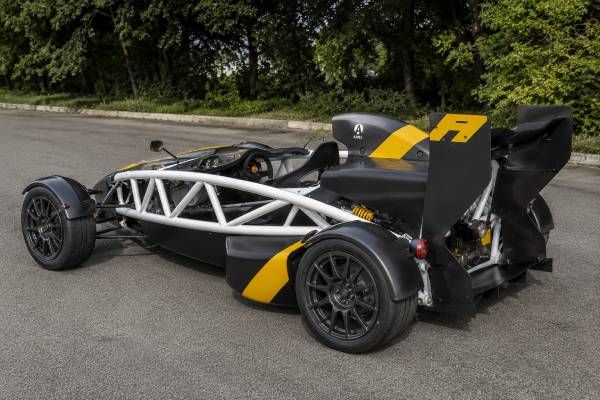
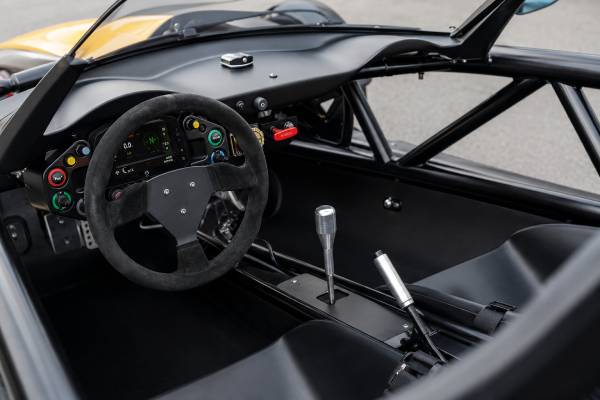
The Ariel Atom 4R is the track-focused flagship that moved the fourth-generation Atom beyond a power upgrade and into a different engineering category. Unveiled at the 2023 Goodwood Festival of Speed, it combines a 400 bhp, 500 Nm turbocharged Honda K20C engine with much larger cooling systems, a Quaife six-speed sequential gearbox, pneumatic paddle shifting, Öhlins TTX36 dampers, aero-profile suspension links, and available carbon brakes, carbon wheels, and switchable ABS. The result is not merely a faster manual Atom 4. Its controls, service needs, heat management, braking options, and driver workload are closer to those of a road-legal competition machine. Because Ariel builds cars to order, the word “4R” still does not identify every installed component: the aero package, braking system, wheel material, spring choice, traction and launch controls, data equipment, and road accessories can differ. A buyer therefore needs the original build specification and a specialist inspection. This guide explains what is fundamental to the 4R, what remains optional, and how to operate and preserve one responsibly.
Table of Contents
- From Atom 4 to 4R
- Atom 4R Factory Data
- Sequential Drivetrain and Controls
- Cooling, Aero, and Unsprung Mass
- Operating Protocol
- Condition, Provenance, and Value
- Deciding Whether the 4R Fits
From Atom 4 to 4R
The 4R takes the Atom 4 platform and re-engineers the systems that limit sustained track performance: engine cooling, charge-air temperature, gearshift speed, suspension control, aerodynamic load, braking mass, and electronic intervention. Its 400 bhp output is only one part of the package.
The standard Atom 4 uses a 320 bhp Honda K20C engine and a conventional six-speed manual. Ariel’s 350 bhp option adds exhaust and software changes, but the 4R moves to 500 Nm, three selectable boost positions, additional radiators, a much larger intercooler, and a sequential transmission developed around rapid full-load shifts.
Ariel states that revised intake geometry and the additional left-side radiator increase engine-cooling capacity by 55 percent. The right-side pod houses an air-to-air intercooler with 75 percent more area. Those figures reveal the model’s purpose: it must repeat hard laps rather than produce one impressive dyno run.
The gearbox changes the driver’s task. A Quaife six-speed sequential unit with reverse uses pneumatic paddle actuation. Upshifts can be completed at full throttle without the clutch, and automated throttle blipping supports downshifts. Ariel says five downshifts can be performed in less than one second. That speed is useful, but it also demands correct air pressure, electronic calibration, oil, warm-up, and mechanical inspection.
The chassis receives Öhlins TTX36 dampers with road- or track-oriented spring choices, machined uprights, and aerodynamically shaped wishbones and pushrods. Optional wings and a splitter add downforce, while carbon-composite brakes and carbon wheels can remove a large amount of unsprung and rotating mass.
Switchable ABS appeared as a major 4R development. The system offers twelve positions plus off, allowing sensitivity to be matched to wet, dry, and changing conditions. It complements optional launch and traction control but does not convert the car into an electronically protected supercar. All systems can be defeated, and none can overcome cold tyres, standing water, or poor judgement.
The 4R’s road-legal status should not be confused with ordinary road suitability. It remains open, extremely light, noisy, weather-exposed, and capable of reaching speed almost instantly. Its engineering makes sense for an owner who will understand and maintain the systems rather than simply tolerate them.
Atom 4R Factory Data
The Atom 4R is a rear-wheel-drive ICE vehicle with a mid-mounted, turbocharged and direct-injected 2.0-litre Honda K20C engine. Its defining specification is the 400 bhp and 500 Nm powertrain combined with a pneumatic sequential gearbox and extensive cooling, suspension, and electronic upgrades.
| Specification | Value |
|---|---|
| Engine | Ariel-tuned Honda K20C inline-four |
| Displacement | 1,996 cc (2.0 L) |
| Bore × stroke | 86.0 × 85.9 mm |
| Valvetrain | Chain-driven DOHC, 4 valves per cylinder, i-VTEC |
| Fuel system | Direct gasoline injection |
| Induction | Turbocharged with enlarged air-to-air intercooler |
| Maximum power | 400 bhp |
| Maximum torque | 500 Nm (369 lb-ft) |
| Boost selection | Three cockpit-selectable positions |
| Specification | Value |
|---|---|
| Gearbox | Quaife 6-speed sequential plus reverse |
| Shift actuation | Pneumatic paddle-shift electronic system |
| Upshift operation | Full-throttle clutchless shifts supported |
| Downshift operation | Automatic throttle blip |
| Published downshift capability | Five downshifts in under one second |
| Drive | Rear-wheel drive |
| Control options | Adjustable traction and launch control |
| System | 4R provision |
|---|---|
| Engine-cooling increase | 55 percent compared with standard Atom 4 system |
| Left side pod | Additional cooling radiator |
| Intercooler area increase | 75 percent |
| Right side pod | Enlarged air-to-air intercooler |
| Air intake | Revised intake geometry |
| Aero package | Front and rear wing system available according to specification |
| Component | Specification |
|---|---|
| Dampers | Öhlins TTX36, Ariel-specific valving |
| Springs | Optimized road or track choices |
| Suspension links | Aero-section wishbones and pushrods |
| Uprights | Machined aluminium |
| ABS | 12-position switchable system plus off |
| Brake option | Carbon-composite discs weighing less than half the standard discs |
| Wheel option | Purpose-made carbon wheels |
| Combined optional saving | Up to 26 kg for carbon wheels and brakes versus standard parts |
| Measure | Claim |
|---|---|
| 0–60 mph / 0–100 km/h | Under 2.7 seconds |
| 0–100 mph | Under 6.5 seconds |
| Top speed | Approximately 170 mph (274 km/h) |
| Body type | Open two-seat tubular-frame road and track car |
| Production introduction | Goodwood Festival of Speed, July 2023 |
Weight, brake material, wheel material, aero, spring rate, road equipment, and data systems depend on the order. Published independent weights should not be blended with a differently optioned car. Obtain the build sheet and, if weight is important, scale the actual vehicle with its current fuel and equipment.
Sequential Drivetrain and Controls
The sequential transmission is the 4R’s most significant operational difference. It can shift far faster than a manual H-pattern gearbox, but it also replaces familiar road-car tolerance with a system that needs pressure, calibration, and precise servicing.
A sequential gearbox selects ratios in a fixed order through a drum or selector mechanism. The paddles command pneumatic actuators rather than moving a conventional lever directly across an H pattern. Reverse remains available, but procedures for engaging neutral and reverse should be learned from the vehicle documentation before driving.
The clutch is generally required for pulling away and stopping, while correctly calibrated upshifts can occur at full throttle. The ECU briefly manages engine torque as the next ratio engages. Downshifts use an automatic throttle blip to match engine speed. If cut duration, air pressure, sensor data, or mechanical adjustment is wrong, the system can produce harsh engagement, missed shifts, or accelerated dog wear.
Do not judge the gearbox only by whether it changes gear in a short demonstration. Check operation cold and hot, at low and high engine speeds, and under an appropriate supervised load. Review shift logs if available. Repeated errors in one ratio, declining air pressure, delayed actuation, or neutral selection problems need specialist diagnosis.
The pneumatic circuit should be inspected for leaks, damaged lines, secure fittings, compressor or reservoir behaviour, and correct pressure. A slow leak can leave the car apparently normal at start-up but unable to execute repeated shifts. Electrical connectors, paddle switches, gear-position sensors, and the control unit must remain dry and secure.
Gearbox oil is a service item with a duty cycle. Use Quaife and Ariel guidance for grade, quantity, and interval. Circuit use creates more shifts and heat per mile than road use, so operating hours and shift count can be more meaningful than odometer distance. Inspect drained oil and magnetic plugs for abnormal debris.
The driveline also includes differential, driveshafts, CV joints, hubs, and mounts. Five rapid downshifts may be electronically possible, but they still transfer torque through mechanical parts and rear tyres. The system should refuse damaging commands outside its programmed limits; never test those protections deliberately.
Boost, traction, launch control, and ABS add layers of driver choice. Learn them one at a time. Start with conservative boost and intervention settings, warm tyres, and a dry open environment. Record which setting was used because a numbered switch position has no meaning without the corresponding calibration notes.
The twelve-position ABS system allows fine tuning of intervention, but lower intervention is not automatically faster. A surface with bumps, damp patches, or cold tyres may benefit from a more protective setting. Brake-pressure technique remains essential because ABS cannot create grip and may lengthen stopping on some loose surfaces.
The 4R’s controls should feel integrated rather than theatrical. When maintained and calibrated, shifts, boost response, traction, and braking support the driver. When undocumented, they multiply uncertainty. Preserve software versions and setup sheets with the same care as mechanical invoices.
Cooling, Aero, and Unsprung Mass
The 4R’s large cooling and mass-reduction changes are designed to preserve performance over time, not just improve specifications on paper. They alter how the car should be inspected and set up.
The left-side additional radiator increases heat-rejection capacity for the engine circuit. The right-side enlarged intercooler lowers charge temperature before air enters the engine. Both side pods depend on clean airflow, sealed ducting, functioning fans or pumps where used, and correct bleeding. Rubber pickup and debris should be removed after every circuit day without crushing fins.
Temperature logging should include coolant, intake air, and oil where instrumentation permits. Look at trends over consecutive laps and after a restart. A system that recovers poorly during a cool-down lap may have blocked airflow, trapped air, a weak pump, or a calibration issue. Never normalize repeated temperature warnings because the car still produces power.
The optional aero package adds wings that generate load with speed. Downforce can improve high-speed grip and braking, but it also changes axle balance, spring requirement, ride height, and stress at mounting points. Use Ariel setup information for wing positions and inspect brackets, fasteners, endplates, and composite surfaces for cracks.
Aero balance cannot be tuned by appearance. More rear wing may improve confidence but increase understeer; more front load can sharpen turn-in but reduce stability if the rear is not matched. Ride-height changes alter the platform and may change splitter clearance. Adjustments should be made with data and driver feedback, one step at a time.
Aero-profile wishbones and pushrods reduce drag compared with round exposed links while retaining structural function. They remain suspension components first. Inspect them for stone damage, bending, play at rod ends, and finish cracking. Do not attach straps or lifting equipment to them unless the manufacturer explicitly approves it.
Carbon-composite brake discs dramatically reduce unsprung and rotating mass. That can improve wheel control, steering response, and acceleration, but the discs require material-specific inspection, temperature management, pad compatibility, and replacement criteria. Conventional iron-disc habits do not apply. Obtain remaining-life measurements and supplier reports when buying a car with this option.
Carbon wheels add another large reduction. Inspect them using the manufacturer’s procedure after impacts or tyre changes. Cosmetic surface marks may be harmless or significant; only trained assessment can distinguish them. Tyre technicians need appropriate equipment and experience to avoid bead or rim damage.
The combined 26 kg saving quoted for carbon wheels and brakes is enormous in a car of this mass, but it also represents expensive specialist components. A road-biased owner may prefer iron brakes and metal wheels for lower replacement cost, wider service access, and more tolerance of everyday damage.
Whatever the specification, alignment and corner weights should be established with the driver or ballast, intended fuel load, and aero settings. The 4R’s performance depends on the whole platform working together rather than on any single premium component.
Operating Protocol
The safest and most economical way to use a 4R is to follow a formal operating sequence. Warm-up, pre-session checks, progressive loading, cool-down, and post-session inspection protect the engine, gearbox, tyres, brakes, and driver.
Before start-up, inspect for leaks, check oil and coolant by the prescribed procedure, confirm tyre condition and pressure, look through the side-pod cooling faces, and ensure the pneumatic shift system is healthy. Check wheel fasteners, brake pedal, steering movement, harnesses, seat, throttle return, mirrors, and any fire system.
At start, allow pressure and temperature to stabilize. Do not use high rpm or boost simply because coolant begins to rise; oil, gearbox, and dampers warm at different rates. Verify warning lights, gear display, air pressure, battery voltage, and control-system status before moving.
The first laps should build temperature in tyres, brakes, engine oil, and gearbox without harsh inputs. Test the brake pedal and shift system at moderate load. If any warning, missed shift, unusual vibration, or fluid smell appears, return to the pits rather than attempting to clear it with harder driving.
During a session, monitor trends rather than waiting for an alarm. Rising intake temperature can reduce performance and increase knock sensitivity. A changing brake pedal can indicate heat or fluid problems. Increasing steering effort or vibration may point to tyre pickup, pressure growth, wheel damage, or suspension movement.
Use downshifts to select the correct gear, not to create braking that the rear tyres cannot absorb. The automated blip improves matching but cannot prevent instability if a ratio is requested too early or the surface is compromised. Respect system protections and the manufacturer’s shift procedure.
After hard laps, complete a controlled cool-down without lugging the engine. Allow airflow through radiators and brakes, avoid parking with components at maximum temperature, and follow Ariel’s shutdown advice. Do not apply a parking brake against extremely hot discs if the installed system could be affected.
Once safe to touch, inspect the car. Measure hot tyre pressures, check for cuts and pickup, look for leaks, examine brake and wheel condition, review suspension witness marks, and download data. The value of a log is highest while the driver’s observations are fresh.
Between events, service according to hours, temperatures, and shift count. Engine oil and filters, gearbox oil, brake fluid, pads, plugs, air filter, pneumatic components, dampers, rod ends, and fasteners all deserve scheduled attention. Keep records with part numbers and measured wear.
Transport should use approved tie-down points and suitable ramp angles. An enclosed trailer protects expensive aero and carbon parts. Secure loose bodywork and never load straps through wishbones or pushrods because they appear convenient.
Storage requires a maintained battery, dry environment, fresh suitable fuel, clean cooling surfaces, protected intake openings, and prevention of tyre flat spotting. Avoid repeated short starts that never bring fluids fully to temperature.
Condition, Provenance, and Value
A 4R’s value depends on proof that its complex systems are original, correctly configured, and maintained. Low mileage does not substitute for gearbox, temperature, brake, and chassis records.
Start with the Ariel build sheet. It should identify the 4R powertrain, sequential gearbox, dampers, spring choice, brakes, wheels, aero, ABS, traction and launch control, bodywork, road equipment, and data options. Match these to part numbers and photographs on the car.
Verify ECU and gearbox-controller software, engine maps, boost positions, ABS settings, and data configurations. Request backups and change history. An undocumented software update can alter shift cuts, fuel requirement, intervention thresholds, or dashboard warnings without leaving visible evidence.
Inspect the frame for impact and repair. Look at lower tubes, floor, suspension pickups, side structures, and aero mounts. Fresh finish, local grinding, distorted brackets, or uneven alignment warrant measurement by a specialist. Ask specifically about spins, kerb strikes, and off-track excursions.
The engine should be assessed cold and hot. Check start quality, pressure, smoke, fluid condition, crankcase ventilation, turbo sounds, stable temperatures, and controlled boost. Review data from a representative session. Compression, leak-down, oil analysis, and borescope work may be justified by value or uncertain history.
The sequential gearbox deserves an independent report. Confirm shift pressure, actuator condition, dog wear indications, oil debris, sensor calibration, and service history. A gearbox that shifts quickly can still be approaching a scheduled inspection or rebuild.
Carbon brake discs and wheels, if fitted, need documented life and inspection. Ask for measurements, impact reports, pad compatibility, and tyre-fitting history. Their replacement cost must be considered in the offer. Iron brakes and metal wheels should also be checked for heat cracks, thickness, runout, and impact damage.
Tyres, harnesses, dampers, pneumatic seals, and fire equipment age with time even when mileage is low. A car displayed or stored for years may need substantial recommissioning. Obtain current parts and labour estimates.
Confirm road registration, emissions equipment, noise, lighting, and insurance. The 4R may be road legal as supplied, but later decat pipes, silencers, wings, or other changes can affect compliance. Cross-border transfer can create additional approval issues.
Use an inspector who understands Ariel chassis construction, K20C turbo data, Quaife sequential gearboxes, pneumatic shifts, and carbon components. The car’s rarity makes generalized inspection less acceptable, not more.
Deciding Whether the 4R Fits
The Atom 4R is appropriate for an owner who wants a road-legal car with competition-style controls and is prepared to manage it like track machinery. It is excessive for someone who mainly wants open-air road excitement without specialist procedures.
Driver fit is non-negotiable. Sit in the actual car with helmet and intended safety gear. Confirm pedal reach, paddle clearance, steering-wheel position, harness angles, shoulder support, view of the display, and ability to exit. Optional seats and cockpit equipment can change the result.
The sequential gearbox can make the 4R more focused and faster, but some drivers will prefer the manual interaction of a 320 or 350 bhp Atom 4. The manual cars are less complex and may be more enjoyable at road speeds. The 4R’s value emerges when rapid shifts, cooling capacity, and high-speed chassis control can be used responsibly.
Track access should be researched before purchase. Confirm noise limits, insurance exclusions, open-wheel or open-cockpit rules, rollover requirements, and whether the aero configuration is accepted. Budget for instruction, transport, tools, spares, tyres, brake materials, and specialist support.
Road use requires large margins. The car has no conventional weather enclosure, limited luggage space, high noise and airflow, and track-oriented tyres. Standing water, cold surfaces, road debris, and distracted traffic are more relevant than acceleration figures. Eye and hearing protection are sensible.
The 4R’s selectable systems allow adaptation, but they can also distract. Establish a default road mode and a documented track baseline. Do not change boost, ABS, traction, damping, tyre pressure, and wing angle simultaneously because the resulting behaviour cannot be interpreted.
Compared with the standard Atom 4, the 4R offers better sustained cooling, faster shifts, more output, and premium chassis hardware at a much higher price and service level. Compared with the 525 bhp 4RR, it is less extreme, less rare, and closer to the production K20C architecture. For many serious drivers, that makes the 4R the more usable flagship.
Alternatives include Radical road-legal models, lightweight race-derived specials, high-end Caterhams, and track-focused closed cars. A closed Porsche or Lotus provides weather protection and luggage; a dedicated race car can be easier to support within a series. The Ariel’s distinction is that it combines road registration with extraordinary exposure and directness.
Buy the 4R for its integrated system, not for a single specification. A well-documented example with appropriate options, known software, stable temperatures, healthy gearbox, and straight chassis will deliver far more value than a superficially spectacular car with uncertain history.
References
- ATOM 4R LAUNCHES AT GOODWOOD FOS 2023 – Ariel Motor Company 2023
- Atom – Ariel Motor Company 2026
- New Ariel Atom 4R revealed – extreme 400bhp Atom priced from £64,950 2023
- Ariel Atom 4R boosts Honda powerplant to 400bhp 2023
- Ariel Atom 4R review – how to make a Porsche 911 GT3 RS look tame 2024
- Ariel Atom, Ariel Nomad, Ariel North America Ariel Atom 4 Specifications & Press Release 2026
Disclaimer
This guide is for general information and cannot replace the build manual, specialist inspection, or motorsport and road-law advice for a particular vehicle. Atom 4R brakes, wheels, aero, software, suspension, and road equipment vary by order and market. Verify the chassis number, build sheet, service history, control-system configuration, fuel requirement, and local rules before purchase or use. Please share this guide with another enthusiast if it encourages careful verification and responsible operation.