
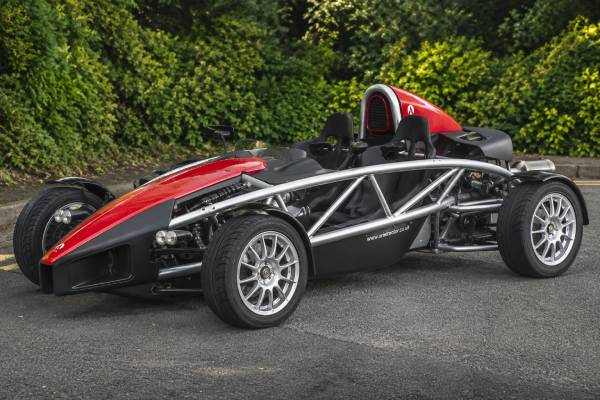
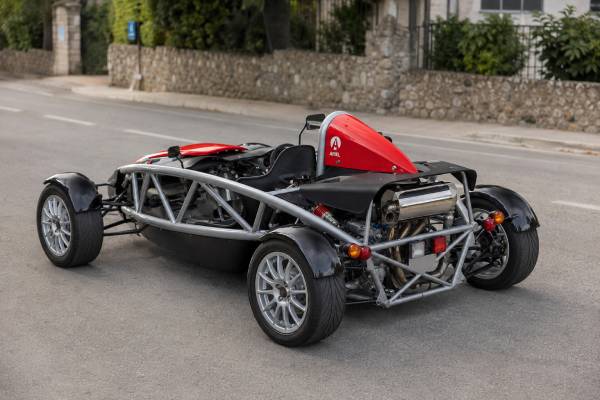
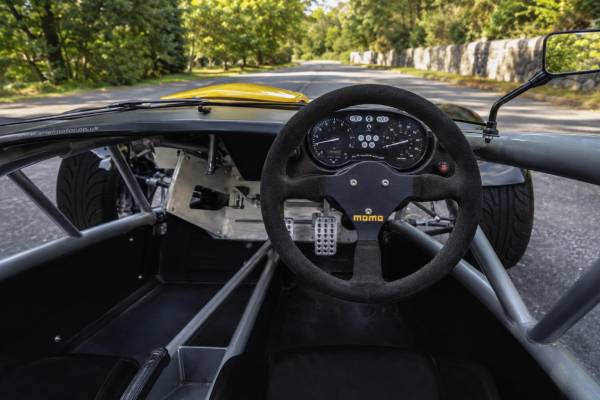
The Ariel Atom 190 is the sharpest factory expression of the Rover-powered first-generation Atom. Its 1.8-liter K-Series engine is tuned to produce 190 hp at high engine speed, giving a machine of roughly 500 kg a power-to-weight ratio that still looks serious today. More important, the output arrives through a naturally aspirated engine, a five-speed manual transmission, and a chassis without electronic stability control. The driver receives every reward—and every consequence—directly.
That specification makes the 190 desirable, but it also makes verification essential. Some cars have been upgraded from lower-output models, others have received replacement engines or later chassis hardware, and published weights differ according to equipment and measurement method. A genuine, well-documented car should feel cohesive rather than like a collection of maximum-performance parts. The buying priority is therefore not simply to find “190 hp.” It is to find a straight chassis, a properly built and cooled engine, a healthy gearbox, correct geometry, and records that explain how the car reached its present specification.
Table of Contents
- The First-Generation Flagship
- Atom 190 Specifications and Published Performance
- How the High-Revving K-Series Changes the Car
- Thermal Control, Lubrication, and Engine Life
- Braking, Grip, and Chassis Balance at 190 hp
- Originality, Upgrades, and Restoration Strategy
- Buying the Fastest Atom 1
The First-Generation Flagship
The Atom 190 was the performance summit of the original Rover-engined production family. It preserved the tiny dimensions and elemental construction of the earliest Atom while extracting substantially more power from the same 1.8-liter engine family.
The central idea remained lightness. The exposed steel spaceframe carried two occupants, a transverse mid-mounted engine, double-wishbone suspension, and only the composite surfaces needed for seating, instruments, and basic road use. There were no doors, roof, luggage compartment, or conventional windscreen in the normal sports-car sense. Reducing mass allowed Ariel to achieve extraordinary response without a large engine.
The 190 specification added a different kind of intensity from the 120. Its peak power is published at about 7,500 rpm, while maximum torque arrives much higher than in the base car. The engine therefore asks the driver to use revs and select gears deliberately. Driven gently, it may feel less effortless than the 120 at low speed; driven in its intended range, it becomes far more urgent.
This was still before the Honda-powered Atom 2 established the template many people now associate with Ariel. The Rover car has a distinct sound, gearbox feel, electrical architecture, cooling layout, and parts ecosystem. It should not be maintained using later Honda assumptions merely because both generations look similar from a distance.
The model’s status also creates identification problems. A lower-output Atom can receive cylinder-head work, cams, intake components, exhaust parts, and an ECU calibration that bring it near a claimed 190 hp. Such a car may be excellent, but it is not automatically identical to an original factory 190. Conversely, a documented factory car may no longer produce its advertised output if compression, fueling, ignition, cam timing, or exhaust condition has deteriorated.
Ariel’s records, the chassis number, period invoices, and engine-build documentation should be used together. The strongest cars have a history that connects the original order to later maintenance and modifications. Gaps are not always sinister in a low-volume vehicle of this age, but unexplained changes should reduce confidence and affect price.
Atom 190 Specifications and Published Performance
The Atom 190 is a naturally aspirated gasoline ICE vehicle with a transverse 1,796 cc Rover K-Series four-cylinder, a five-speed manual transaxle, and rear-wheel drive. Published sources commonly quote 190 bhp, 190 Nm, a mass near 500 kg, and a top speed around 217 km/h; lighter weight figures may reflect another equipment level or definition. The tables retain the source context rather than presenting all early Atoms as identical.
| Item | Published value |
|---|---|
| Engine family | Rover K-Series |
| Layout | Inline four-cylinder, transverse mid-engine |
| Capacity | 1,796 cc (1.8 L) |
| Valvetrain | DOHC, 16 valves |
| Induction | Naturally aspirated |
| Maximum power | 190 bhp (142 kW) at about 7,500 rpm |
| Maximum torque | 190 Nm (140 lb-ft) at about 6,000 rpm |
| Fuel | Gasoline/petrol |
| Item | Specification |
|---|---|
| Transmission | Five-speed manual |
| Driven wheels | Rear |
| Engine position | Behind the seats, ahead of the rear axle line |
| Steering assistance | None |
| Electronic stability control | Not fitted in standard early specification |
| Item | Specification |
|---|---|
| Primary structure | Exposed tubular steel spaceframe |
| Seating capacity | Two |
| Suspension | Independent double wishbones with pushrod-operated inboard dampers |
| Steering | Rack and pinion |
| Common tire fitment | 185/60 R14 front and rear in period data |
| Brakes | Four-wheel disc brakes; equipment can differ by build or upgrade |
| Measure | Published figure | Interpretation |
|---|---|---|
| Length | About 3,410 mm (134.3 in) | First-generation overall figure |
| Width | About 1,800 mm (70.9 in) | Sources differ slightly |
| Height | About 1,200 mm (47.2 in) | Setup and screen equipment affect it |
| Wheelbase | About 2,345 mm (92.3 in) | Commonly published |
| Published weight | Approximately 500 kg (1,102 lb) | One detailed 190 listing; lower figures may use another definition |
| Fuel capacity | Approximately 34 L (9.0 US gal) | Published 190 figure |
| Measure | Published result | Context |
|---|---|---|
| 0–60 mph | About 4.6 seconds | Period-style published claim |
| 0–100 km/h | About 4.8 seconds | Launch and test procedure matter |
| Top speed | About 217 km/h (135 mph) | Exposed aerodynamics strongly influence the result |
| Power-to-weight | About 380 bhp per metric tonne at 500 kg | Calculated from the quoted figures |
These figures describe a reference specification, not a guarantee for a surviving car. Wheel packages, brake upgrades, windscreens, emissions equipment, engine rebuilds, and road-registration hardware can change mass and performance. A chassis-specific inspection remains more useful than a generic specification sheet.
How the High-Revving K-Series Changes the Car
The 190’s defining behavior is the way it builds speed with revs. Maximum torque arrives around 6,000 rpm and peak power near 7,500 rpm, so the engine’s strongest performance lives far above ordinary cruising speed.
That delivery rewards a driver who plans. Entering a bend in too high a gear leaves the engine below its most energetic range; choosing the right ratio lets the car accelerate with surprising force despite the modest torque number. The five-speed gearbox therefore becomes an active part of the experience rather than a device used mainly to reach top gear.
In a lightweight car, 190 Nm is enough to move quickly, but it is less likely to overwhelm the rear tires abruptly than a later supercharged engine. The throttle can be used to trim the car’s line, and the naturally aspirated response is closely linked to pedal position. There is no boost threshold, bypass valve, or charge-cooling system between the driver and the rear axle.
The advantage is clarity; the cost is mechanical effort. Sustained high rpm places greater demands on oil control, valve-train condition, cooling, engine mounts, and gearbox synchronization. A car that spends its life on short road drives may never reveal a weakness that appears after several fast laps. Track evaluation should therefore build gradually, with fluid and fastener checks between sessions.
Sound and vibration can help diagnosis. A properly built engine should rev cleanly without misfire, detonation, or a sudden flattening of power. A harsh buzz at a particular speed may come from a loose panel, exhaust contact, mount, or bracket rather than the engine itself. Persistent metallic noise, smoke, unstable oil pressure, or temperature creep requires immediate attention.
The 190 also exposes differences in driver technique. Because the chassis is so light, late braking and abrupt steering are rarely the fastest method. The best laps come from maintaining balance, using small corrections, and placing the car accurately. A driver who relies on power to repair a poor entry will discover that 190 hp cannot replace momentum when the engine has fallen below its working range.
On the road, restraint is necessary. The strongest part of the rev range may correspond to speeds unsuitable for public conditions, and the open cockpit makes distractions more likely. Wind pressure, helmet lift, debris, and noise all increase with speed. The car’s performance is best appreciated where sight lines, runoff, and surface condition are controlled.
Thermal Control, Lubrication, and Engine Life
Engine life depends more on heat management and correct assembly than on the badge. The 190’s tuned K-Series should be treated as a specialist engine whose cooling, oiling, timing, and calibration must work as one system.
The cooling circuit extends between the rear engine and front radiator. Inspect every visible hose and union, plus areas hidden by panels. Look for abrasion, softened rubber, staining, damaged clips, and makeshift routing. The radiator should be clean enough to pass air but not crushed by stones. Confirm that the fan cuts in and that the temperature stabilizes after a hard run rather than continuing to climb in the paddock.
Bleeding procedure is critical after coolant work. Air pockets can create local overheating even when the dashboard gauge appears normal. The exact procedure depends on the installed expansion tank, pipework, and later modifications, so use the documentation for the individual chassis. Do not treat a generic Rover road-car procedure as automatically correct for an Atom.
The K-Series head-gasket subject requires nuance. A previous failure may have been repaired correctly and accompanied by improvements; it may also have been fixed cheaply without addressing liner height, head condition, cooling faults, or the cause of overheating. Ask for the machine-shop report, parts list, photographs, and specialist identity. A sticker saying “uprated gasket” proves very little.
Lubrication deserves the same attention. Establish the sump type, oil cooler arrangement, breather system, filter, and any accumulator or dry-sump equipment. Use the oil grade and level recommended for that engine build and operating conditions. Check before every track session and monitor consumption. Overfilling can be harmful, while a low level during sustained cornering risks pressure loss.
Oil pressure should be evaluated with a trusted instrument. Old senders and wiring can produce false alarms, but a suspicious reading must be checked with a mechanical gauge rather than ignored. Cut open the used filter during a baseline service if a specialist recommends it; debris can reveal bearing or valvetrain distress before a major failure.
Timing-belt history must be complete. Age matters even when mileage is low, and a tuned engine has little tolerance for incorrect timing. Replacement should include the related tensioning components and any VVC-specific drive parts fitted to the engine. The installer must understand the exact head, cam, and pulley arrangement because modified engines do not always match a standard workshop illustration.
Fuel and ignition calibration can destroy an otherwise sound engine. Verify the ECU type, map provenance, injector specification, fuel-pressure arrangement, and octane requirement. A car mapped years ago for a different exhaust or fuel may run poorly after later changes. Detonation at high load is not always audible in an open, noisy cockpit, making professional data logging and mixture checks valuable.
Braking, Grip, and Chassis Balance at 190 hp
The Atom 190 needs a balanced chassis more than it needs the largest available parts. Its low mass allows modest brakes and tires to work extremely hard, but worn joints or an incoherent upgrade can make the car unpredictable.
Inspect the spaceframe before judging anything else. Chips in powder coat are expected; bent tubes, cracked coating concentrated around a weld, ripples, flattened underside sections, or misaligned suspension pickups are not. Compare symmetry from several angles and look for recent refinishing. Any evidence of impact should be assessed by Ariel or a specialist familiar with the frame.
Rod ends and wheel bearings are consumable components on a track-used open car. Check for radial and axial play, corrosion, binding, and loose locknuts. Dirt and water can reach parts that are protected beneath a conventional body. Replacement intervals should reflect use, and any joint replaced should be followed by accurate alignment.
Brake condition is judged by consistency. The pedal should be firm, travel should remain stable after repeated stops, and the car should not pull. Inspect disc faces and edges for cracking, heat checking, heavy lips, or uneven deposits. Pads need enough material for the intended session, not merely the drive home. Flexible hoses, hard lines, master cylinders, and caliper seals all age even when the odometer barely moves.
Some cars have adjustable brake bias. Treat it as a setup tool, not a performance toy. An excessively rearward setting can cause instability, especially during trail braking or on a damp surface. Mark a known safe baseline and change one variable at a time with an experienced driver or engineer.
Tire selection controls the character of the car. Period 14-inch dimensions offer delicacy and manageable loads, while larger modern packages may provide more compound choices and grip. Offset, steering effort, scrub radius, bearing load, clearance, and overall gearing must all be considered. A wheel that physically bolts on is not necessarily appropriate.
Alignment should reflect the dominant use. Extreme negative camber and toe may suit a smooth circuit but punish road tires and make the car follow cambers. Ride height needs sufficient bump travel; lowering until the floor looks dramatic can place the suspension outside its intended range. Corner weighting is useful only after tire pressures, dampers, joints, and driver weight are accounted for.
Because the 190 has no electronic stability system, setup errors are not hidden. Rear toe change, mismatched dampers, old tires, or a sticking brake can produce a sudden response. A nervous car is not automatically “raw.” A correct Atom should be alert but intelligible, with reactions that build from the driver’s inputs.
Originality, Upgrades, and Restoration Strategy
A good restoration preserves the 190’s engineering logic rather than freezing every aging component in place. Safety-critical and consumable parts should be renewed, while historically important hardware should be documented and retained whenever practical.
Start by defining the car’s baseline. Photograph all sides, labels, frame numbers, wiring, suspension settings, brake components, engine details, and dashboard before dismantling. Record ride height, alignment, spring and damper markings, wheel offsets, tire sizes, ECU numbers, and hose routing. This evidence prevents a long project from becoming a guessing exercise.
Original engines and factory build records support value, but replacement does not automatically ruin a car. A professionally assembled K-Series with traceable internals and correct calibration may be safer to use than a tired original unit. The problem is uncertainty. “Rebuilt to 190 spec” should be accompanied by compression ratio, cam details, head work, bearing clearances, oiling system, dyno report, and builder information.
Cooling upgrades are sensible when they address known limitations without poor workmanship. A better radiator, improved hose materials, reliable fan control, and accurately located sensors can reduce risk. The installation should avoid unsupported hoses, sharp bends, electrical overload, or parts exposed to impact.
Brakes and dampers often evolve during ownership. Keep changes proportional. A fresh set of quality dampers built for the car can restore control; generic racing units with unsuitable travel may make it worse. Modern brake pads and fluid can increase consistency without replacing every component. Save removed factory parts and invoices so future owners understand the progression.
Electrical restoration deserves specialist attention. Early low-volume looms may have been altered for alarms, cameras, data loggers, road lighting, and replacement instruments. Remove abandoned branches, protect circuits with appropriate fusing, route wires away from exhaust heat, and use sealed connectors where exposed. An intermittent sensor fault can mimic an engine problem and spoil confidence in the car.
Cosmetic refinishing should follow structural inspection. Powder coating a frame before checking alignment can hide evidence. Once the chassis is confirmed, use a process that protects threads, bearing seats, identity markings, and bonding surfaces. Reassemble with correct fasteners and torque procedures rather than replacing everything with decorative hardware of unknown grade.
A restored 190 should still feel light, responsive, and mechanically transparent. Adding heavy bodywork, oversized wheels, excessive audio or road equipment, and complicated electronics can dilute the very quality that makes the model significant. Improvement is most successful when it reduces risk without burying the original idea.
Buying the Fastest Atom 1
Buy an Atom 190 only after confirming that its speed is supported by its history. The most expensive failure scenarios involve a questionable tuned engine, a damaged frame, or a collection of track modifications with no coherent engineering record.
Request documents before traveling. The chassis number should connect to a factory specification or credible history. Ask for the engine builder, dyno sheet, ECU map, timing-belt invoice, cooling work, gearbox history, accident record, and recent geometry report. Determine whether the car was raced, used for instruction, hired commercially, or stored for long periods.
Mileage needs context. A low-mileage car may have old tires, stale fluids, corroded joints, hardened seals, and repeated short heat cycles. A higher-mileage example maintained by one specialist may be healthier. Engine hours and track sessions, if recorded, are often more informative than road mileage.
Inspect the car cold and dry. Freshly washed tubes can hide leaks and make corrosion harder to see. Verify oil and coolant condition, look under the engine and gearbox, examine the radiator, and check for exhaust soot around joints. Confirm that all instruments illuminate and that warning lights are not bypassed.
During warm-up, listen and watch. The engine should hold a stable idle, accept throttle cleanly, and maintain normal temperature. The fan must operate. Check for smoke after overrun and throttle application, coolant odor, excessive crankcase pressure, and oil leaks that appear only when hot. Stop immediately if pressure or temperature becomes unsafe.
The gearbox should engage all five ratios without graunching. A high-rpm shift can expose weak synchronization, but such testing belongs in a controlled environment with the owner’s agreement. Clutch take-up should be progressive. Driveshaft joints, wheel bearings, and engine mounts should not produce repeated knocks under changing load.
A specialist road test should assess straight-line braking, steering self-centering, bump response, throttle balance, and symmetry left to right. The car should not require constant correction on a level surface. Confirm that poor behavior is not caused by tire pressure before assuming a major chassis fault, but do not accept “all Atoms wander” as an explanation.
Price the first service before agreeing a deal. At minimum, establish a baseline for engine oil, filter, gearbox oil, coolant, brake fluid, timing equipment, tires, brake wear, rod ends, wheel bearings, harnesses, and alignment. Add contingency for specialist engine work if documentation is weak.
A correct 190 is more than a fast early Atom. It represents the point at which Ariel pushed the original Rover package to its most focused road-going form. That makes mechanical integrity and historical clarity inseparable from performance. The right car delivers high-rpm excitement without sacrificing the delicate chassis response that gave the first Atom its reputation; the wrong one can turn an apparently simple machine into a difficult engineering project.
References
- Atom – Ariel Motor Company 2026
- Ariel Atom review, specs, stats, comparison, rivals, data, details, photos and information on SupercarWorld.com 2026
- Ariel Atom: used car buying guide | evo 2013
- Ariel Atom: buying checkpoints | evo 2013
- Ariel Atom (2000-): PH Pocket Buying Guide 2016
- Ariel Atom: Models, Specs, and Buyer’s Guide | Car & Classic 2026
Disclaimer
This article is an informational overview, not a substitute for factory data, professional inspection, or specialist engine advice. Confirm the individual car’s chassis identity, engine build, service intervals, fluids, fastener settings, road-registration requirements, and safety equipment before purchase or work. Share it with a prospective owner or marque group when the information supports a safer decision.