

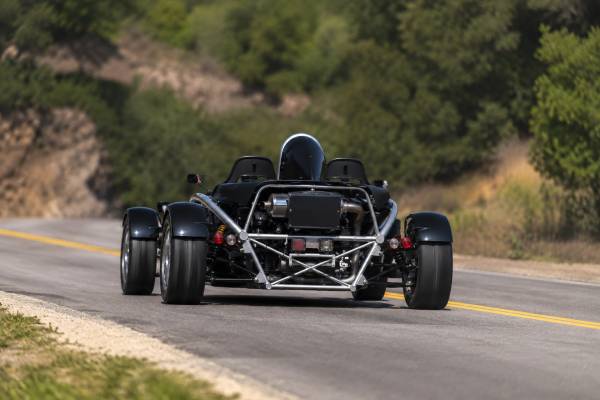
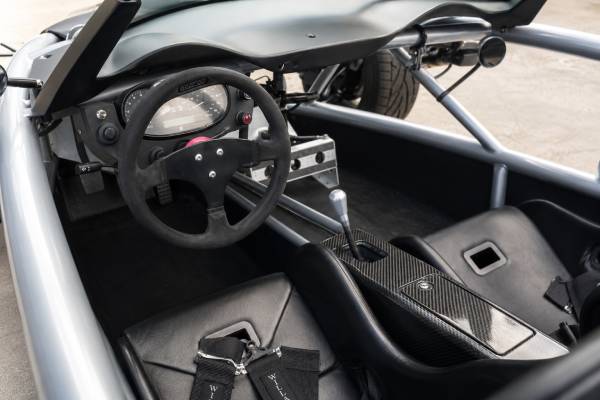
The Ariel Atom 2 220 is the model that established the Honda-powered Atom formula. Introduced with a naturally aspirated 2.0-liter K20A-family engine, six-speed manual gearbox, and rear-wheel drive, it combined the second-generation chassis with a powertrain known for strong high-rpm performance and unusually good parts support. At a published mass near 456 kg in early European specification, 220 hp was enough to make the car exceptionally fast without a supercharger.
Its apparent simplicity can be misleading. Atom 2 cars differ by market, year, factory option, and later modification; North American Brammo-built examples use different powertrains and are considerably heavier than the light British specification often quoted online. Even Honda-powered cars may have altered ECUs, exhausts, suspension, brakes, wheels, or engines. A useful evaluation therefore begins by defining the exact chassis. The best 220 is not necessarily the one with the highest dyno number. It is the one whose K20 installation, cooling, oil control, geometry, and service history remain coherent.
Table of Contents
- Why the 220 Was a Turning Point
- K20A 220 Specifications and Technical Layout
- Naturally Aspirated Performance on Road and Track
- K20 Service Priorities and Oil Control
- Atom 2 Chassis, Brakes, Wheels, and Alignment
- Market, Build, and Modification Differences
- How to Find a Sound Atom 2 220
Why the 220 Was a Turning Point
The Atom 2 220 replaced the original Rover-engine formula with a Honda powertrain that delivered more revs, a six-speed gearbox, and a broader long-term support network. It became the foundation from which Ariel developed naturally aspirated and supercharged Atom 2 variants.
The engine is derived from Honda’s K20A performance family and is mounted transversely behind the occupants. In this installation it is commonly quoted at 220 hp, with maximum power above 8,000 rpm. The gearbox gives six forward ratios, allowing the driver to keep the engine in its strongest range more easily than the five-speed Rover cars.
Ariel did not make the Atom conventional when it changed engines. The car remained an exposed tubular spaceframe with no doors, roof, practical luggage area, or normal weather protection. Steering and braking feedback stayed immediate because there was little mass and little isolation. The Honda powertrain improved usability and durability potential, but the ownership experience was still closer to a road-legal competition machine than a sports coupe.
The 220 also matters because it is often confused with later or parallel specifications. The 245-hp naturally aspirated car, 275-hp supercharged version, 300-hp supercharged derivatives, and 160-hp Type S all sit close in the Atom 2 story. In North America, Brammo-built Atom 2 cars commonly used GM Ecotec engines rather than the K20A. A seller may use “Atom 2” as though it identifies one mechanical specification; it does not.
Correct identity should come from the chassis number, factory correspondence, original invoice, and physical engine installation. Check the engine code, ECU, intake, exhaust, throttle arrangement, gearbox, differential, and build market. A car converted from another output may be excellent, but its maintenance needs and historical value differ from a documented factory 220.
The 220’s appeal is not that it is the rarest or most powerful Atom 2. It is that the powertrain and chassis are well matched. The engine makes its speed through revs rather than boost, the throttle response is linear, and the six-speed gearbox encourages involvement. For many drivers, that balance is easier to exploit than the later supercharged cars.
K20A 220 Specifications and Technical Layout
This version is a gasoline ICE vehicle with a naturally aspirated 1,998 cc inline four-cylinder, six-speed manual transmission, and rear-wheel drive. Early European data commonly list 220 bhp at 8,200 rpm, 196 Nm at 6,100 rpm, and a kerb weight near 456 kg. Those figures should not be applied to Brammo-built GM cars or to later Atom generations.
| Specification | Value |
|---|---|
| Engine family | Honda K20A performance family |
| Configuration | Inline four-cylinder, transverse mid-engine |
| Displacement | 1,998 cc (2.0 L) |
| Valvetrain | DOHC, 16 valves, Honda i-VTEC |
| Bore × stroke | 86.0 × 86.0 mm |
| Induction | Naturally aspirated |
| Maximum power | 220 bhp (164 kW) at about 8,200 rpm |
| Maximum torque | 196 Nm (145 lb-ft) at about 6,100 rpm |
| Published maximum engine speed | Approximately 8,600 rpm |
| Fuel | Premium gasoline/petrol appropriate to the calibration |
| Specification | Value |
|---|---|
| Transmission | Six-speed manual transaxle |
| Driven wheels | Rear |
| Engine location | Mid-mounted behind the occupants |
| Differential | Specification can include a limited-slip differential; verify the individual car |
| Electronic stability control | Not fitted as a conventional road-car system |
| Specification | Value |
|---|---|
| Construction | Tubular steel spaceframe with composite panels |
| Seating | Two |
| Suspension | Independent double wishbones with pushrod-operated inboard dampers |
| Steering | Unassisted rack and pinion |
| Common brake-disc diameter | 240 mm front and rear in early published data |
| Body format | Open roadster with exposed wheels |
| Measure | Published value | Note |
|---|---|---|
| Length | 3,410 mm (134.3 in) | Early Atom 2 figure |
| Width | 1,798 mm (70.8 in) | Published technical listing |
| Height | 1,195 mm (47.0 in) | Can vary with screen and setup |
| Wheelbase | 2,345 mm (92.3 in) | Published technical listing |
| Front/rear track | Approximately 1,600/1,600 mm | Published technical listing |
| Published kerb weight | Approximately 456 kg (1,005 lb) | Light European specification |
| Measure | Interpretation |
|---|---|
| Power-to-weight | About 482 bhp per metric tonne using 220 bhp and 456 kg |
| Acceleration character | Very rapid once the engine is kept in its high-rpm range |
| Maximum-speed limitation | Exposed wheels and cockpit create substantial aerodynamic drag |
| Primary performance advantage | Low inertia under acceleration, braking, and direction change |
Numbers for wheel sizes, fuel capacity, and mass can differ because options and market equipment changed. Record the installed parts before ordering replacements, and retain the original weight definition when comparing sources.
Naturally Aspirated Performance on Road and Track
The 220 delivers its best performance through revs and accuracy rather than supercharged torque. It is exceptionally responsive, but the engine needs the correct gear and sufficient rpm to show why the car feels so much faster than the output figure suggests.
Below the high-lift cam range, the K20A is tractable enough for road driving. As speed and load rise, the engine becomes more urgent and continues pulling toward its upper limit. The change is not an on/off switch, yet the contrast is clear enough that gear selection matters. A driver who short-shifts will experience a quick lightweight car; a driver who uses the upper range will experience the intended 220.
The six-speed gearbox supports that character. Ratios are closer than in the earlier five-speed package, reducing the drop in rpm after an upshift. Shift quality should be precise but not forced. Rushing a cold gearbox or leaning on the lever can damage synchronizers, while worn engine mounts or linkage components can make a healthy transaxle feel poor.
Throttle response is one of the naturally aspirated car’s strongest qualities. There is no supercharger belt, boost buildup, bypass behavior, or charge-temperature rise to manage. Small pedal changes can be used to balance the chassis. That directness makes the 220 an excellent teaching car, although “excellent” does not mean forgiving of every mistake.
The rear tires still carry a large burden. They must transmit acceleration while the car is turning, and little mass means load transfers quickly. Applying full throttle before the steering is unwound can break traction, particularly on old, cold, or damp tires. A limited-slip differential may help drive out of a bend, but it also changes the way the car reacts when both rear tires approach their limit.
Braking performance can be startling because there is so little kinetic energy relative to a normal road car. The pedal should give clear information, and a properly maintained standard system may be sufficient for many drivers. Track endurance depends on pad compound, fluid, disc condition, cooling, driver technique, and session length rather than disc diameter alone.
Aerodynamics shape the upper-speed experience. The Atom has a small frontal structure but exposed wheels, suspension, occupants, and cockpit openings. Drag rises rapidly and wind pressure becomes a physical load on the driver. The car’s most convincing pace is therefore found in acceleration zones and complex corners, not in chasing a maximum-speed number.
Road use requires an even larger safety margin. Surface changes, standing water, painted lines, debris, and crosswinds affect the car more than they affect a heavier, enclosed vehicle. Eye protection is essential, hearing protection can reduce fatigue, and clothing must account for wind chill. The 220 can be road legal, but it never behaves like an ordinary roadster.
K20 Service Priorities and Oil Control
The K20A is a strong engine when serviced correctly, but an Atom installation creates operating conditions very different from those in a Honda road car. High rpm, track cornering, exposed wiring, and a modified cooling path make inspection of the complete installation as important as the engine family’s reputation.
Oil level should be checked frequently and before every circuit session. Establish the exact sump, baffle, oil cooler, filter, and breather arrangement because cars may have been upgraded. Use the grade and fill procedure specified by Ariel or the engine builder. Too little oil risks pressure loss in sustained corners; too much can aerate oil or increase breathing problems.
Ask how oil pressure has been monitored. A dashboard gauge is useful only when the sender and wiring are trustworthy. If readings fluctuate, confirm with a calibrated mechanical test rather than assuming the display is wrong. Track cars benefit from trend records: hot idle pressure, pressure at a known rpm, oil temperature, and consumption can reveal change before a failure.
The K20 uses a timing chain rather than the Rover car’s conventional timing-belt schedule. That removes one periodic belt replacement, not the need for timing inspection. Chain tensioner condition, guides, oil quality, and cam timing remain important. Unusual rattle, cam-correlation faults, or poor high-rpm performance should be diagnosed promptly.
Valve clearance is a maintenance item on many performance Honda engines. Confirm the interval and procedure for the exact engine and cam specification. A modified cylinder head may need different clearances from a standard K20A. Records should identify whether checks were performed cold, which measurements were found, and what adjustments were made.
Cooling begins at the front radiator and ends at the rear engine. Inspect long hoses and pipes, bleed points, fan control, expansion tank, clamps, and protective routing. Stone damage can restrict the radiator. Air after service can create unstable temperature. A healthy system should warm consistently, hold temperature during load, and recover after a hard session.
Fuel calibration matters at high rpm. Determine ECU type, map supplier, injector size, fuel-pressure regulation, intake, exhaust, and required octane. A car may still run after an exhaust or airbox change while no longer maintaining the intended mixture. Professional logging on a load-bearing dyno is preferable to judging safety by exhaust sound or a single peak-power printout.
The six-speed gearbox needs the correct fluid and sensible warm-up. Inspect for leaks around driveshaft seals and casing joints. Difficulty engaging one ratio, especially during fast shifts, may indicate worn synchronizers or linkage issues. A limited-slip unit can require its own compatible lubricant and inspection, so identify the fitted differential rather than relying on the model name.
Ariel’s service guidance has traditionally emphasized annual or low-mileage attention. That suits an Atom because time, track events, and heat cycles matter. Brake fluid, coolant, hoses, tires, harnesses, battery, fuel, and rod ends can age while the odometer barely moves.
Atom 2 Chassis, Brakes, Wheels, and Alignment
A good Atom 2 220 should feel alert but consistent. If it darts unpredictably, changes line under braking, or needs constant correction, inspect tires, bearings, joints, dampers, and geometry before accepting the behavior as part of the car’s character.
Begin with the frame. The exposed powder-coated tubes make damage visible, but stone chips and weathering can distract from structural clues. Look for bends, flattened undersides, cracked coating around welds, asymmetry, repaired pickup points, and fresh finish concentrated in one area. A specialist should measure any chassis with an uncertain accident history.
Suspension links use adjustable rod ends. Check each for play, corrosion, binding, correct thread engagement, and secure locknuts. The U.S. owner manual for a related Atom 2 specification treats rod ends as closely monitored consumables and recommends replacement according to use. A European Honda car may not share every manual detail, but the principle is sound: exposed joints on a circuit car need regular inspection.
Dampers may be factory units or later replacements. Identify manufacturer, model, spring rate, length, and adjustment range. Mismatched click positions are not automatically wrong if the car has been corner weighted, but arbitrary settings can mask a deeper problem. Check for leakage, bent shafts, damaged spherical bearings, and insufficient bump travel.
Geometry should be measured by a shop familiar with lightweight, adjustable cars. Record camber, caster, toe, ride height, corner weights, tire pressures, and driver weight. Change only one group of settings at a time. A road setup usually benefits from stability and tire life; a circuit setup may prioritize rotation and temperature distribution.
Wheel and tire changes deserve engineering rather than fashion. Larger wheels can open access to modern tire compounds and brake packages, but they may add unsprung mass and alter steering geometry. Offset affects scrub radius and bearing load. Overall diameter affects gearing and clearance. Check wheel condition using appropriate crack inspection when track history is extensive.
Tire age, compound, and temperature are critical. A deep-tread tire can be unsafe if hardened. Semi-slicks may offer extraordinary grip when hot and poor feedback when cold or wet. Start with manufacturer pressure guidance and adjust from measured hot behavior, wear, and temperature rather than copying a number from another car.
Brakes need a complete-system review. Inspect master cylinders, balance mechanism if fitted, lines, hoses, calipers, discs, pads, and fluid. A large front upgrade without corresponding balance can lengthen stopping distance or make modulation worse. The lightest effective package is often preferable to the largest.
Market, Build, and Modification Differences
The phrase “Atom 2 220” should describe a Honda-powered specification, but market and build differences can still be substantial. Never combine British lightweight data with U.S. Brammo Ecotec specifications simply because the frame design looks related.
European cars commonly use the K20A-family engine and six-speed gearbox. North American Atom 2 production included GM L61 and supercharged LSJ engines with a five-speed gearbox, different curb mass, fuel system details, wheels, cooling capacities, and service parts. Registration hardware and lighting can further change weight.
Within Honda cars, optional brakes, dampers, limited-slip differentials, body panels, road equipment, wheel sizes, screens, and instrumentation affect the individual specification. Factory-installed equipment is usually supported by an invoice or build record. Later owner changes should be documented with parts and setup information.
Engine swaps need particular scrutiny. Honda K-series parts are interchangeable enough that a replacement may look correct while using a different block, head, compression ratio, cams, oil pump, or ECU. Record the stamped engine identity and compare it with invoices. A dyno number alone cannot establish internal specification or long-term safety.
The model-year label may also reflect registration rather than build completion. Low-volume cars can be assembled, sold, imported, and first registered in different calendar years. Use the chassis record when ordering parts or describing originality. The assignment period of 2003 through 2006 captures the early 220 era, but a particular car’s documentation controls.
Modifications should be judged as systems. A freer exhaust may need calibration; a higher rev limit may need valve-train and oil-pump changes; wider rear tires may change balance; stronger brakes may require bias adjustment. Ask who specified the package and whether there is test evidence beyond a seller’s impression.
Road compliance differs by jurisdiction. Mirrors, lighting, emissions equipment, noise, fenders, registration category, and inspection requirements may have changed since import. Confirm legality before purchase, especially when a car is being moved across national or state boundaries.
How to Find a Sound Atom 2 220
A sound 220 presents a consistent story from paperwork to test drive. The chassis identity, engine installation, service records, visible condition, and driving behavior should reinforce one another rather than require repeated excuses.
Before visiting, ask for the chassis number, engine code photographs, original invoice, current specification list, service records, accident history, track history, and recent videos of a cold start and full warm-up. Request tire date codes and details of the last oil, gearbox-fluid, coolant, and brake-fluid changes.
Inspect the car in daylight and before it is warmed. Look beneath panels, around suspension pickups, at radiator mounts, under the floor, and through the rear structure. Fresh paint, new fasteners, or new panels are not faults by themselves, but the seller should explain them. Confirm that chassis and registration numbers agree.
Check the engine bay for professional routing. Hoses and wiring should be supported, protected from exhaust heat, and clear of moving parts. Look for leaks around the cam cover, sump, filter housing, oil cooler, gearbox, and driveshaft seals. Check intake security and evidence of unfiltered air entry.
A cold K20 should start promptly and settle without prolonged chain rattle, smoke, or unstable idle. Let it reach operating temperature while observing fan operation, oil pressure, and coolant behavior. Do not accept a seller’s request to avoid a full warm-up because “it gets hot when stationary”; a functioning cooling system must manage normal stationary operation.
On the road, assess low-speed controls first. The clutch should engage progressively, the throttle should not stick, and the gearbox should select gears cleanly. Steering may follow road texture, but the car should not feel loose. Build speed gradually, checking braking symmetry, vibration, wheel-bearing noise, damper control, and engine response.
High-rpm testing belongs in a safe legal environment. The engine should pull cleanly through its intended range with no misfire, fuel cut below the expected limit, or falling pressure. Gear changes should remain clean when hot. Afterward, inspect for new leaks, coolant odor, loose fasteners, and tire contact.
Commission a marque specialist for the final assessment. A compression or leak-down test, ECU scan and log, oil-pressure verification, geometry measurement, chassis inspection, and brake review may reveal problems invisible during a short drive. The cost is small compared with an engine rebuild or frame repair.
Plan an immediate baseline service after purchase. Even with good records, check every fluid, filter, safety fastener, tire, brake component, rod end, wheel bearing, harness, and battery. Establish the fitted parts and document settings. That process turns an unfamiliar low-volume car into a known machine.
The Atom 2 220 remains one of the most coherent early Ariel specifications. It introduced the high-revving Honda powertrain without adding the thermal and traction demands of a supercharger. A correct example can be devastatingly quick, mechanically communicative, and comparatively straightforward to support. Its quality, however, comes from integration—not from assuming every K20-powered tube-frame car is the same.
References
- Atom – Ariel Motor Company 2026
- 2003 Ariel Atom 2: detailed specifications, performance and economy data 2026
- ARIEL Atom 2 Specs, Performance & Photos – 2003, 2004, 2005, 2006, 2007, 2008 – autoevolution 2026
- Ariel Atom: used car buying guide | evo 2013
- Ariel Atom: buying checkpoints | evo 2013
- Ariel Atom (2000-): PH Pocket Buying Guide 2016
Disclaimer
Use this article as a research starting point, not as chassis-specific workshop data. Build specification, service parts, fluid quantities, legal equipment, alignment, and safe procedures can differ by market, option, modification, and production date; confirm them from Ariel records and qualified inspection. Share the article with another owner when it helps separate Honda-powered cars from superficially similar Atom 2 variants.