

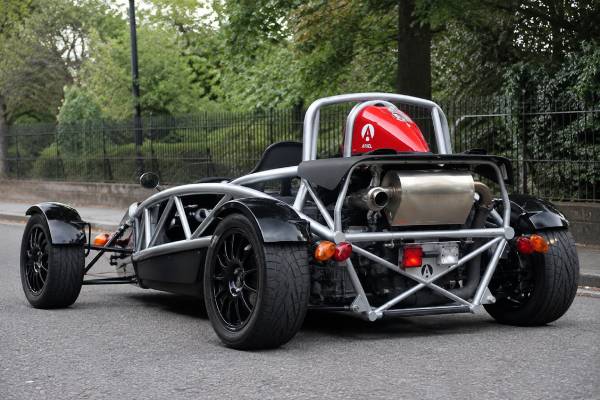
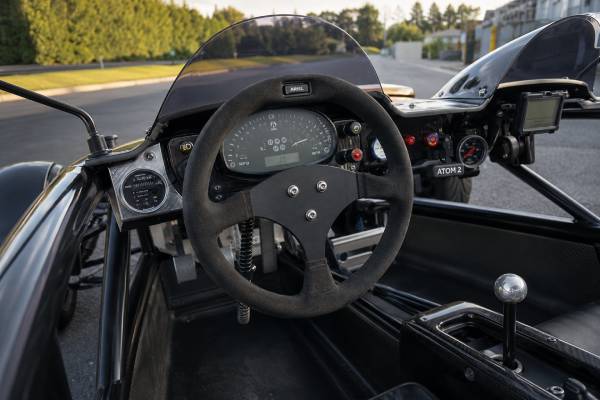
The Ariel Atom 2 275 is the early supercharged Honda model that turned the already rapid Atom 2 into a much more demanding machine. Its 2.0-liter K20A-family engine is commonly quoted at 275 bhp, and period specifications pair that output with approximately 550 kg, a six-speed manual gearbox, and a limited-slip differential. The frequently cited 0–60 mph time of 3.4 seconds explains the headline appeal, but it does not explain the car’s ownership demands.
A supercharger adds an entire layer of inspection: belt drive, brackets, pulleys, intake temperatures, bypass operation, calibration, and charge-cooling condition all matter. Launch grip and rear-tire quality become as important as peak output. The 275 name also needs careful authentication because naturally aspirated cars can be converted and later supercharged specifications can be described loosely. The right example is a coherent factory or professionally documented package. The wrong one may produce an impressive dyno sheet while hiding heat, fueling, gearbox, or chassis problems.
Table of Contents
- What the 275 Added to Atom 2
- Supercharged 275 Specifications
- Boost Delivery, Acceleration, and Traction
- Supercharger, Belt, and Charge-Temperature Care
- Engine, Gearbox, and Fluid Maintenance
- Making the Chassis Work With 275 hp
- Proving a 275 Before Purchase
What the 275 Added to Atom 2
The 275 added forced induction to Ariel’s Honda-powered Atom 2 without changing the car’s fundamental minimalism. The result was much stronger acceleration and midrange response, accompanied by greater heat, traction, and maintenance demands.
The underlying engine belongs to Honda’s K20A performance family. In the naturally aspirated 220, speed comes mainly from keeping the engine near the top of its rev range. The supercharged 275 retains high-rpm character but fills in the lower and middle range, so the car responds more forcefully before the driver reaches peak power. That changes corner-exit technique and makes small throttle inputs more consequential.
Period buying guides place the first supercharged Atom 2 in the mid-2000s, with the 275 specification appearing before higher-output 300-hp cars. The assignment period of 2005 and 2006 reflects the model’s core early-market window, although the engineering development began earlier. Low-volume production and registration timing mean the date on a title may not tell the full build story.
The supercharger installation is commonly associated with Jackson Racing hardware. It uses a mechanically driven compressor rather than an exhaust-driven turbocharger. Response is immediate because boost is tied to engine speed and throttle, but the drive belt, tension, pulley alignment, and mounting brackets become service items. Compressing air also creates heat, so intake-temperature control and calibration are central to engine safety.
The 275 should not be viewed simply as a 220 with an extra component. Fuel delivery, ECU mapping, ignition strategy, spark plugs, intake plumbing, exhaust flow, clutch loading, differential behavior, and cooling all need to match the output. Conversions can work extremely well when engineered as systems; they become risky when assembled from unrelated parts.
Its historical attraction lies in that transition. The car preserves the lighter and visually simple Atom 2 format while introducing the kind of acceleration that made the Atom famous beyond specialist circles. It is more dramatic than the naturally aspirated car and less developed than later factory supercharged models, which gives it both character and a greater need for informed ownership.
Supercharged 275 Specifications
The Atom 2 275 is a supercharged gasoline ICE car with a 1,998 cc Honda K20A-family engine, six-speed manual transmission, limited-slip rear differential, and open two-seat spaceframe body. Period figures commonly quote 275 bhp at 8,400 rpm, 260 Nm at 7,650 rpm, 550 kg, 0–60 mph in 3.4 seconds, and 150 mph. Because low-volume equipment differs, these values describe the recognized 275 specification rather than every surviving chassis.
| Specification | Published value |
|---|---|
| Engine family | Honda K20A performance family |
| Engine layout | Transverse inline four-cylinder, mid-mounted |
| Displacement | 1,998 cc (2.0 L) |
| Valvetrain | DOHC, 16 valves, i-VTEC |
| Bore × stroke | 86.0 × 86.0 mm |
| Induction | Mechanically supercharged |
| Maximum power | 275 bhp (205 kW) at about 8,400 rpm |
| Maximum torque | 260 Nm (192 lb-ft) at about 7,650 rpm |
| Fuel | Premium gasoline/petrol suitable for the calibration |
| Specification | Value |
|---|---|
| Gearbox | Six-speed manual transaxle |
| Drive type | Rear-wheel drive |
| Differential | Limited-slip differential in the commonly cited specification |
| Engine position | Behind the occupants, ahead of the rear axle |
| Traction and stability aids | No conventional electronic intervention |
| Specification | Value |
|---|---|
| Construction | Tubular steel spaceframe with composite panels |
| Body style | Open two-seat roadster |
| Suspension | Independent double wishbones with pushrod-operated inboard dampers |
| Steering | Unassisted rack and pinion |
| Weight distribution influence | Transverse mid-engine packaging concentrates mass near the center |
| Measure | Figure | Context |
|---|---|---|
| Length | Approximately 3,410 mm (134.3 in) | Atom 2 reference dimension |
| Width | Approximately 1,798 mm (70.8 in) | Wheel and panel equipment can affect it |
| Wheelbase | Approximately 2,345 mm (92.3 in) | Atom 2 reference dimension |
| Published weight | Approximately 550 kg (1,213 lb) | Period 275 specification |
| Measure | Figure | Important condition |
|---|---|---|
| 0–60 mph | About 3.4 seconds | Launch grip and test procedure strongly affect it |
| Top speed | About 241 km/h (150 mph) | Driver exposure and aero setup are significant |
| Power-to-weight | About 500 bhp per metric tonne | Calculated from 275 bhp and 550 kg |
The 550 kg figure should not be mixed with the lighter published mass of a basic 220 or the heavier curb weight of a North American GM-powered car. Screens, body panels, road equipment, brakes, wheels, and cooling hardware all influence the result.
Boost Delivery, Acceleration, and Traction
The 275’s acceleration is limited as much by rear-tire grip and driver technique as by engine output. A mechanically driven supercharger produces prompt torque, so the car can spin its tires before the driver has fully unwound the steering.
In the naturally aspirated 220, the driver often seeks the upper rev range to find maximum urgency. The 275 begins pulling harder earlier and continues toward a high power peak. The response can feel deceptively linear because there is no obvious turbo lag, yet the rate at which speed builds is far greater. That makes reference points arrive sooner and compresses the time available for braking and decision-making.
The quoted 3.4-second run to 60 mph assumes a clean launch on a suitable surface. Real results vary with tire compound, temperature, pressure, differential condition, clutch technique, surface preparation, driver mass, and measurement method. Repeated launch attempts generate clutch and driveline heat, and they reveal little about how well the car performs through a full lap.
Corner exit is more instructive. The limited-slip differential can distribute torque more effectively, but it cannot create grip. If both rear tires are cold or overloaded, both can slide. Progressive throttle application and smooth steering release are essential. A driver accustomed to stability control must remember that the Atom will not reduce power or apply a brake to recover from an optimistic input.
The short wheelbase and low polar moment let the car rotate quickly. That agility is a strength when the chassis is balanced and a risk when the driver lifts abruptly after overcommitting. Supercharged torque adds another way to alter yaw. Training in a controlled environment is more valuable than fitting the stickiest available tire and assuming grip will solve technique.
The brakes still benefit from low vehicle mass, but approach speeds can be much higher than in a 120 or 160. Heat capacity becomes more important during long sessions. Pad selection, fluid boiling point, disc condition, brake cooling, and pedal technique should be matched to use. Large hardware is not automatically necessary, but tired road components are unacceptable.
At very high speed, wind load becomes exhausting. A helmet can lift, the steering reacts to surface changes, and exposed-wheel drag increases rapidly. The 150-mph figure belongs to controlled testing conditions. The car’s defining performance is its ability to accelerate between bends, not its suitability for sustained maximum-speed travel.
Supercharger, Belt, and Charge-Temperature Care
A 275 should be inspected as a complete forced-induction system. The compressor may be mechanically straightforward, but belt alignment, bearings, bypass control, intake sealing, fuel delivery, and temperature management determine whether the engine receives safe, repeatable power.
Start with the belt path. Look for frayed edges, glazing, cracking, missing ribs, rubber dust, and inconsistent tracking on pulleys. A belt that walks toward an edge can indicate misalignment, worn bearings, incorrect spacers, a bent bracket, or a tension problem. Replacing the belt without correcting the cause only delays failure.
Rotate components by hand when the engine is off and safe to work on. Feel for roughness or excessive play in idlers, tensioners, and accessible supercharger drive parts. Confirm all brackets and fasteners are secure and free from cracks. A lightweight car transmits vibration directly, and a small bracket problem can become a major intake or belt failure.
The bypass valve allows the supercharger to reduce pumping work at light load. A sticking valve or damaged vacuum line can cause poor drivability, excess heat, weak boost, or inconsistent response. Inspect hoses for age and routing, and verify operation using the correct procedure. Do not assume a car is healthy merely because it reaches a peak boost reading.
Intake leaks affect both performance and fueling. Check couplers, clamps, manifold joints, vacuum ports, sensor seals, and any charge-cooling connections. Oil mist around a joint may reveal leakage. An unmetered-air problem can be particularly dangerous under load if it creates a lean mixture.
Compressed air heats up. The exact early 275 installation and later owner changes can differ, so identify whether the car uses an intercooling or charge-cooling arrangement and how it is monitored. Inspect pumps, reservoirs, heat exchangers, hoses, and bleed points where fitted. A system that appears full can still contain air or have a failed pump.
Intake-air temperature should be logged during sustained load, not judged only from a cool dyno pull. As temperature rises, the ECU may reduce ignition advance or power; an unsafe calibration may not. Repeatable lap performance is a better sign of system health than one spectacular number followed by heat soak.
Pulley changes require caution. A smaller supercharger pulley may raise boost, but it also increases compressor speed, belt load, intake temperature, fuel demand, and cylinder pressure. Safe operation may require injectors, pump capacity, calibration, charge cooling, spark plugs, and internal engine changes. A seller who cannot explain the pulley ratio and map should not describe the change as a simple upgrade.
Engine, Gearbox, and Fluid Maintenance
The Honda engine’s reputation does not exempt it from track-car maintenance. Oil pressure, fuel quality, valve clearance, cooling, gearbox fluid, and calibration must all be managed for the actual output and use.
Check engine oil before every serious drive and between track sessions. Determine the sump and baffle configuration because forced-induction cars may have been modified for better oil control. Use the engine builder’s specification for grade and level. Record hot pressure and oil temperature if instruments are fitted, and investigate any change rather than normalizing it.
The K20A uses a timing chain. Listen for persistent start-up rattle and investigate cam-timing or tensioner faults. High-output operation makes accurate valve timing important. A modified engine may have nonstandard cams, springs, or clearances, so service documents should identify the actual parts rather than saying only “K20.”
Valve-clearance checks protect performance and valve life. Tight clearances may reduce sealing when hot; excessive clearance can create noise and impact loads. The correct measurement depends on the camshaft and manufacturer procedure. A documented worksheet is more valuable than a stamp saying “major service.”
Spark plugs should match the boost level and calibration. Inspected plugs can reveal detonation, overheating, oil consumption, or mixture problems, although interpretation requires experience. Ignition coils, grounds, and connectors are exposed to vibration and heat. Misfire under boost must be diagnosed promptly because unburned fuel can damage the catalyst where fitted and mask a lean cylinder.
Cooling inspection includes the long front-to-rear circuit. Confirm radiator condition, fan control, coolant quality, hose support, bleed procedure, and stable temperature after load. The engine coolant and any charge-cooler circuit are separate systems where both are fitted; servicing one does not prove the other is working.
The six-speed gearbox and limited-slip differential carry more torque than in the 220. Use the correct fluid for the installed unit, inspect seals, and listen for bearing noise. Gear selection should remain clean when hot. Clutch slip may appear first in a high gear at strong boost, but testing must be performed carefully in a safe setting.
Fuel should meet the octane assumed by the map. Old fuel, a weak pump, blocked filter, or voltage drop can reduce delivery under load. Log pressure where possible and replace age-sensitive hoses with compatible materials. A low-mileage car can still have a tank contaminated by storage.
Annual or low-mileage service is a sensible minimum, with shorter intervals for track work. Build the schedule around operating hours, heat cycles, and fluid analysis rather than road mileage alone. The 275 rewards preventive maintenance because failures at full boost develop quickly.
Making the Chassis Work With 275 hp
The chassis must make the output usable, not merely survive it. Tire condition, differential behavior, rear alignment, damper control, and brake balance determine whether the 275 feels progressive or intimidating.
Inspect the frame for impact evidence before adjusting geometry. Look at lower rails, suspension pickups, radiator structure, engine mounts, and rear corners. Fresh powder coat or a replacement panel should have a documented reason. A geometry shop cannot align a bent frame into health.
Rear toe is especially important in a powerful lightweight car. Loose rod ends, incorrect locknut torque, or movement in a pickup can change stability under acceleration. Measure rather than eyeball. Check wheel bearings and driveshaft joints for play, and confirm engine and gearbox mounts control the powertrain without transmitting abnormal shock.
Dampers should keep the tires in contact with the surface without making the car skip over bumps. Excessive stiffness may feel sharp during a slow demonstration yet reduce grip on a real road or bumpy circuit. Identify spring rates and damper settings, then establish a repeatable baseline. Corner-weight the car with representative fuel and driver mass when serious setup work is undertaken.
Tire choice needs restraint. Very sticky rear tires can improve acceleration, but mismatched front grip may create understeer and place greater loads into bearings and suspension. Use compatible compounds and understand temperature windows. Replace by age and heat-cycle condition, not only tread depth.
Wheel dimensions affect more than appearance. Larger diameter or width changes unsprung mass, gearing, clearance, steering geometry, and the load on hubs. Verify offsets and inspect for cracking. Keep a record of spacer thickness, fastener engagement, and torque procedure.
Brake upgrades should preserve modulation. Check pedal-box adjustment and bias control where fitted. Mark a safe baseline and prevent accidental movement. Pads need compatible friction characteristics front to rear, and fluid should be replaced often enough for the operating temperature. After each event, inspect discs, hoses, fasteners, and caliper seals.
The safest setup is the one the driver can understand. Make a change, record it, and evaluate it under controlled conditions. Simultaneously changing tires, alignment, dampers, and brake bias makes it impossible to identify why the car improved or deteriorated.
Proving a 275 Before Purchase
A prospective buyer should prove three things: that the car is genuinely the specification claimed, that its forced-induction system is safe, and that the chassis can use the power consistently. Missing evidence in any one area should reduce the price or stop the purchase.
Ask for the original build record and chassis number first. Determine whether the supercharger was fitted by Ariel, by a recognized specialist, or as a later owner conversion. Obtain invoices for the kit, ECU, injectors, fuel system, clutch, differential, cooling, exhaust, and dyno calibration. A peak graph should include air-fuel ratio and relevant conditions where possible, not only horsepower.
Inspect the car cold. A seller who pre-warms it may be hiding chain noise, smoke, poor starting, or belt squeal. Check oil and coolant, look for rubber dust, inspect every visible pulley, and examine charge plumbing. Confirm that hoses and wiring are secured away from heat and belt movement.
Warm the car fully while observing both coolant and oil behavior. Verify fan operation and any charge-cooler pump. Listen for bearing noise at idle and with gentle changes in engine speed. Do not put hands or tools near a moving supercharger belt.
Electronic diagnosis is valuable. Scan for current, pending, and recently cleared faults. Log throttle position, manifold pressure, intake temperature, coolant temperature, fuel trims at light load, ignition behavior, and mixture under controlled full load. A car that feels fast can still be compensating heavily or approaching unsafe temperature.
The gearbox and clutch need a careful test. Selection should be clean cold and hot. Check for slip only in a suitable environment and avoid repeated launches. Listen for differential chatter beyond what the installed unit normally produces, driveshaft clicks, and mount movement.
Chassis inspection should include rod ends, dampers, bearings, tires, wheels, brakes, frame coating, floor, and pickup points. Ask for alignment and corner-weight sheets. Uneven tire wear may reveal poor settings or structural trouble. A powerful car on old tires should not be driven hard merely to satisfy a test drive.
After the drive, perform a hot reinspection. Look for coolant pushed from a reservoir, oil mist, loose clamps, fresh belt debris, fuel odor, or changing fluid levels. Heat-related faults often appear only after shutdown.
Budget a specialist baseline even when the car passes. Fluids, filters, plugs, belt inspection, calibration verification, brake service, geometry, tire review, and replacement of age-sensitive joints establish confidence. Reserve funds for a clutch, gearbox, or charge-cooling repair because parts availability and labor can be specialist-dependent.
The Atom 2 275 is compelling because the supercharger amplifies a chassis that was already extraordinary. It is not the version to buy on spectacle alone. A properly documented and thermally stable car offers immediate acceleration, precise throttle control, and a distinctive place in Ariel history. An undocumented conversion with uncertain fueling can turn the same basic ingredients into an expensive risk.
References
- Atom – Ariel Motor Company 2026
- Ariel Atom: buying checkpoints | evo 2013
- Ariel Atom: used car buying guide | evo 2013
- Ariel Atom (2000-): PH Pocket Buying Guide 2016
- 2001-present Ariel Atom buying guide from Magneto magazine – Magneto 2024
- Ariel Atom: Models, Specs, and Buyer’s Guide | Car & Classic 2026
Disclaimer
The information here cannot replace inspection, data logging, factory records, or advice from a technician familiar with the individual supercharged car. Verify chassis identity, boost hardware, calibration, fuel, service parts, fluid specifications, safety equipment, and legal requirements before driving or repairing it. Share this guide when it can help another buyer recognize the difference between a documented 275 and an unsupported power claim.