

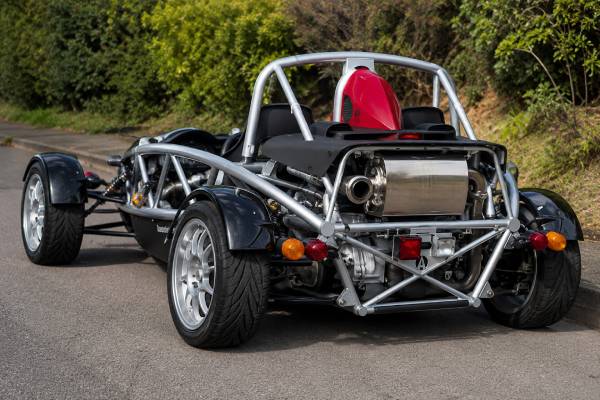
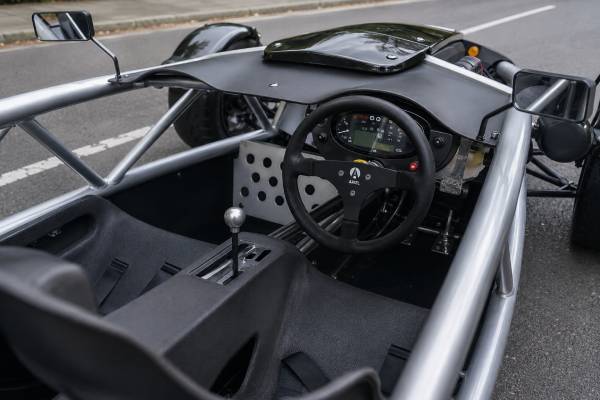
The 2006–2007 Ariel Atom 2 300 is best understood as a Brammo-built North American Atom with Honda’s K20A engine, a supercharger, and a six-speed limited-slip transaxle. That definition matters because period UK Atoms, Brammo cars, and later TMI-built cars can look nearly identical while differing in weight, cooling, brakes, wiring, body panels, and registration history. In the correct specification, the Atom 2 300 combines roughly 300 hp with a 612 kg (1,350 lb) quoted curb weight, exposing the driver to acceleration and steering feedback that still feel extreme today. It is also a hand-built, track-oriented machine approaching two decades old, so condition, documentation, and the quality of previous modifications matter more than mileage alone. A well-kept example can be remarkably dependable because of its Honda foundation. A neglected or poorly understood one can become an expensive sequence of cooling, wiring, suspension-joint, gearbox, and provenance problems.
Table of Contents
- Identifying the Brammo K20A Atom
- Supercharged K20A Specifications
- Performance and Driving Character
- Chassis, Brakes, and Track Setup
- Maintenance for an Early Atom
- Faults, Wear, and Inspection
- Buying, Provenance, and Ownership
Identifying the Brammo K20A Atom
The safest way to identify this version is by its builder records, vehicle identification details, engine installation, and original documentation—not by appearance. The open exoskeleton changed gradually, and many early Atoms have since received later wheels, dampers, dashboards, seats, aero parts, or body panels.
Brammo Motorsports manufactured the Atom 2 under licence in Oregon and offered both a General Motors Ecotec LSJ installation and a Honda K20A installation. The Honda car used a six-speed synchronized transaxle with a limited-slip differential, while the GM version used a five-speed. The assignment’s K20A, 300 hp, and 2006–2007 combination therefore points to the supercharged Honda-powered Brammo car rather than a UK-market Atom 2 described by lighter European figures.
This distinction prevents several common catalog errors. A quoted 456 kg weight is often associated with minimalist UK Atom 2 specifications, while Brammo’s manual lists 1,350 lb, or 612.36 kg, for its complete vehicle overview. The difference can reflect market equipment, windscreen and lighting hardware, chassis manufacture, body construction, safety equipment, and the source’s weight definition. Neither figure should be copied onto every Atom 2.
An owner should record the following before ordering parts:
- Vehicle identification number or Brammo product identification number.
- Builder name and build date shown on plates or invoices.
- Honda engine number and visible K-series casting details.
- Gearbox type, differential, shifter arrangement, and axle configuration.
- Supercharger brand, pulley size, belt routing, charge-cooling layout, and engine-management hardware.
- Brake caliper and rotor specification, because upgrades are common.
- Wheel size, offset, tire size, and stud or nut hardware.
- Any later Ariel, Brammo, TMI, or aftermarket revisions supported by receipts.
Do not assume that a car advertised as an “Atom 2 300” still has its original calibration. Pulley changes, injectors, exhaust systems, intercoolers, and ECU tuning can raise or lower output while leaving no obvious clue in a short sales listing. A dyno sheet is useful only when it identifies the car, date, fuel, correction standard, and measured wheel or engine output.
Supercharged K20A Specifications
This Atom is an ICE vehicle with a transversely mounted, supercharged 2.0-liter Honda inline-four driving the rear wheels through a six-speed manual transaxle and limited-slip differential. The most reliable period data for the Brammo car comes from its owner’s manual; performance figures and the 300 hp rating should still be checked against the individual build file because these cars were highly configurable.
| Specification | Value | Notes |
|---|---|---|
| Engine | Honda K20A inline-four | Aluminum block and cylinder head |
| Displacement | 1,998 cc (2.0 L) | Petrol engine |
| Bore × stroke | 86 × 86 mm | Square bore-and-stroke layout |
| Valvetrain | DOHC, 16 valves, i-VTEC | Chain-driven camshafts |
| Induction | Supercharged | Installation and charge cooling should be verified by build |
| Rated output | 300 hp (224 kW) | Model designation; confirm calibration on modified cars |
| Fuel | Premium unleaded petrol | Brammo manual requirement |
| Specification | Value |
|---|---|
| Transmission | Six-speed synchronized manual with reverse |
| Differential | Limited-slip differential |
| Drive type | Rear-wheel drive |
| Fuel capacity | 36.7 L (9.7 US gal) |
| Engine position | Transverse, behind the occupants |
| Vehicle capacity | Two occupants |
| Specification | Value | Definition or configuration |
|---|---|---|
| Body construction | Fiberglass or carbon-fiber composite panels | Non-structural panels over exposed frame |
| Quoted curb weight | 612.36 kg (1,350 lb) | Brammo owner’s-manual overview |
| Front wheel | 15 × 7.0 in, +35 mm offset | Period Brammo specification |
| Rear wheel | 16 × 7.0 in, +38 mm offset | Period Brammo specification |
| Recommended cold tire pressure | 124 kPa front; 138 kPa rear (18/20 psi) | Starting value, not a universal hot-track target |
| Specification | Value |
|---|---|
| Frame concept | Exposed tubular spaceframe |
| Suspension | Independent multi-link layout with pushrod actuation |
| Steering | Unassisted rack-and-pinion |
| Restraints | Competition-style harnesses |
| Minimum occupant guidance | Over 40 kg (88 lb) and 150 cm (4 ft 11 in) |
| Item | Published guidance |
|---|---|
| Engine-oil check | Before every track event or every 1,000 miles (1,600 km) |
| Oil filter | Replace with every oil change |
| Transmission fluid | Inspect for leaks before track use; change every 10,000 miles (16,000 km) |
| Air filter | Clean and re-oil every 5,000 miles (8,000 km) |
| Drive belt | Inspect for cracking or abnormal wear every 3,000 miles (4,800 km) |
| Wheel-nut torque | 108 N·m (80 lb-ft) |
The 300 hp rating gives a simple power-to-weight calculation of about 490 hp per metric tonne using Brammo’s 612 kg curb figure. That is not the same as a measured running weight with driver, fuel, tools, and accessories, but it explains why the car remains so forceful without relying on modern launch control or electronic stability systems.
Performance and Driving Character
The Atom 2 300 feels faster than its numbers because the driver sits low, open to the airflow, and only inches ahead of the engine. Acceleration is immediate once the supercharger is producing useful boost, but the real character comes from the combination of low inertia, manual controls, and almost no insulation.
Period 300 hp Atom 2 figures are commonly quoted around 2.7–3.0 seconds to 60 mph and roughly 150 mph at the top end, although tires, gearing, surface, weather, driver technique, and the exact car’s weight materially affect those results. Treat them as model-level claims rather than a guarantee for every Brammo build. A car with road tires and conservative alignment may be slower from rest but easier to manage than one on warmed track rubber.
The K20A is central to the experience. Below its high-rpm cam changeover it is tractable enough for gentle road use, while the upper rev range becomes much more urgent. Supercharging fills in the naturally aspirated engine’s thinner low- and mid-range response, so the 300 can accelerate hard without waiting exclusively for the final part of the tachometer. The delivery is still progressive compared with a large modern turbo engine, which helps a skilled driver meter power through the rear tires.
There are no normal-car layers between input and response. The unassisted steering transmits road texture, tire load, tramlining, and kickback. The brake pedal is firm because the system prioritizes modulation rather than boosted convenience. The short wheelbase and rear weight concentration make the car highly responsive to throttle position, brake release, and steering speed. Abrupt inputs can create instability long before the driver expects it, especially on cold tires.
Road use requires realistic expectations. Wind, rain, debris, insects, tire spray, and temperature are part of the cabin environment. A helmet may improve eye and face protection, but an unsuitable helmet at highway speed can also create lift and neck strain. Hearing protection is sensible. Loose objects must be secured because there is no conventional luggage compartment and anything dropped can reach pedals or exposed mechanical areas.
On track, speed should be built in stages. First establish brake condition and tire temperatures, then learn where the supercharger adds torque, and only then use full-throttle exits. A 300 hp Atom can exceed the driver’s processing capacity well before it exceeds the car’s mechanical grip.
Chassis, Brakes, and Track Setup
The chassis works best when the car is mechanically square, lightly loaded, and set up for its actual tires and use. Copying another owner’s alignment or damper clicks without matching ride height, spring rates, tire construction, and driver mass can make the car worse.
Pushrod suspension places the spring-damper units inboard and uses rockers to transfer wheel movement. This reduces some unsprung mass and leaves the wheel control hardware visible, but it also creates many joints and fasteners that deserve inspection. Rose joints or rod ends can develop play, contamination, corrosion, or stiffness. Bent pushrods, cracked brackets, loose locknuts, and mismatched left-to-right settings are warning signs.
The Brammo manual provides period alignment information, but it should not be treated as a universal prescription after eighteen or more years of modification. Before adjustment, a specialist should confirm:
- Chassis straightness and suspension pickup integrity.
- Wheel-bearing condition and hub runout.
- Tire size, construction, age, and pressure response.
- Corner weights with the normal driver and fuel load.
- Ride height and pushrod length on both sides.
- Steering rack centering and equal available lock.
- Camber, caster, and toe measured on calibrated equipment.
The brakes require the same methodical approach. Rotor heat checking, pad taper, caliper seal condition, hose rubbing, fluid age, pedal balance, and master-cylinder leakage matter more than cosmetic caliper appearance. The owner’s manual calls for rotor replacement when thickness reaches 19 mm or when cracking, physical damage, or pulsation is present. That limit applies to the period equipment described by the manual; upgraded rotors need their own manufacturer’s minimum thickness.
Brake bias is not a casual tuning knob. Moving too much braking effort rearward can lock the rear axle during trail braking or when the car is unloaded over a crest. Any adjustment should be documented, changed in small steps, and tested in a safe environment. Tires should be checked before and after each session, with hot pressures recorded rather than guessed.
A track-day preparation routine should include a torque check, fluid-level inspection, brake inspection, wheel-bearing check, harness check, fire-extinguisher check where fitted, and a slow first lap to detect leaks or unusual noises. The car’s visible construction makes inspection easier, not optional.
Maintenance for an Early Atom
The correct maintenance strategy is based on time, heat cycles, and track use rather than mileage alone. A car that covers 1,000 hard circuit miles may need more work than one that travels 5,000 gentle road miles, while a stored car can suffer from stale fuel, corroded connectors, old brake fluid, and flat-spotted tires.
Oil level is critical in any K-series Atom because sustained cornering and braking can expose the lubrication system to conditions rarely seen in the donor Honda. Check the level on the procedure and surface specified for the installed sump. Investigate consumption, aeration, pressure warnings, or metallic debris rather than simply topping up. Use the oil grade and filter appropriate to the actual engine build and ambient conditions; a modified supercharged engine may have requirements beyond a standard Honda road car.
The supercharger system adds several maintenance points:
- Inspect the belt for cracking, glazing, frayed edges, dust, or tracking problems.
- Check pulley alignment and bearing noise with the engine off.
- Verify charge-cooler pump operation and coolant level where fitted.
- Inspect hoses for rubbing near the frame, exhaust, and moving suspension.
- Look for intake leaks after the airflow meter or pressure sensor arrangement.
- Confirm that the ECU calibration matches injectors, pulley, fuel pressure, and exhaust.
Cooling problems should be diagnosed before the car is driven hard. Check the front radiator, long coolant pipes, hose joints, bleed points, expansion tank, fan operation, and any aftercooler circuit. Air trapped in a long mid-engine cooling system can cause inconsistent temperature behavior. A stable temperature at idle does not prove adequate cooling at full load.
The manual’s 10,000-mile transmission-fluid interval is a useful period reference, but track use, shift quality, and oil condition may justify earlier service. A balky shift can come from cable adjustment, worn bushings, clutch release problems, synchro wear, incorrect fluid, or drivetrain movement. Do not force the lever and assume every poor shift is “normal for an Atom.”
Brake fluid absorbs moisture even when the car is not driven. Replace it on time and more frequently for track use, using a fluid compatible with the seals and expected temperatures. Flush old fluid rather than mixing random products. Tires should be replaced for age, cracking, heat-cycle degradation, or flat spotting even when tread remains.
Storage is best approached like race-car layup. Clean and dry the chassis, stabilize fuel when appropriate, change contaminated oil, maintain the battery with a compatible charger, keep rodents away from wiring and intake ducts, and avoid sealing moisture under a non-breathable cover.
Faults, Wear, and Inspection
Most expensive surprises are visible or detectable during a careful inspection. The biggest risks are crash damage, undocumented modifications, neglected suspension joints, overheating history, gearbox wear, and registration complications—not an inherently fragile K20A.
Start with the frame in bright light. Look for chipped powder coating, corrosion bleeding from tube joints, dents, flattened tubes, grinding marks, fresh local paint, uneven brazing or welding, and alignment shims stacked differently from side to side. Inspect the floor, pedal area, roll structure, engine mounts, suspension brackets, and seat-belt anchors. A straight-looking body panel proves little because the panels are non-structural and replaceable.
Cold-start the engine. Listen for timing-chain rattle, supercharger-bearing noise, belt squeal, exhaust leaks, and valvetrain clatter that does not settle. Watch oil pressure and coolant temperature from cold. Check for smoke under acceleration and after overrun. A clean engine bay can be reassuring, but one freshly washed before inspection may conceal fluid traces.
During a road test, the car should track consistently on a level surface without binding steering or dramatic pull. Some tramlining is normal with wide, stiff tires, but wandering can indicate toe error, tire damage, worn rod ends, loose bearings, or chassis misalignment. The clutch should engage cleanly, and every gear should select both cold and hot. Test the limited-slip differential for noise or grabbing in low-speed turns.
Inspect these high-value areas closely:
- Rod ends, pushrods, wishbones, bell cranks, and their fasteners.
- Wheel bearings, hubs, studs, nuts, and wheel cracks.
- Brake rotor thickness, heat cracks, pad life, hoses, and pedal balance.
- Coolant pipe supports and hose chafing along the chassis.
- Fuel hoses, tank fittings, filters, and pump noise.
- Supercharger belt, pulleys, bypass operation, and charge-cooler circuit.
- Wiring splices, relays, grounds, immobilizer behavior, and battery isolation.
- Harness manufacturing dates, webbing damage, and mounting geometry.
A compression or leak-down test can be worthwhile when service history is thin, but results must be interpreted with the engine warm, battery healthy, throttle open, and test method recorded. An oil analysis after track use can reveal fuel dilution, coolant contamination, or abnormal wear, though one sample is not a complete diagnosis.
Buying, Provenance, and Ownership
Buy the best documented, least ambiguously modified car rather than the cheapest 300 hp example. Provenance determines parts compatibility, legal status, insurance options, and resale confidence in a way that ordinary mass-produced-car buyers may underestimate.
Ask for the original order sheet, Brammo build documentation, invoices, engine and gearbox records, ECU details, alignment sheets, dyno results, track logs, and registration paperwork. Contact the present Ariel or North American support organization with the identification numbers before money changes hands. Confirm whether the car is titled for road use, registered as a specially constructed vehicle, restricted to off-road use, or subject to local inspection requirements. Rules differ by jurisdiction and can change when a car crosses state or national borders.
A pre-purchase inspection should be performed by someone comfortable with tubular chassis, motorsport suspension, Honda K-series powertrains, and low-volume vehicle paperwork. A general used-car inspection that focuses on infotainment, air conditioning, and paint depth will miss the important issues.
Budget beyond the purchase price for immediate baseline work. Even a good car may need fresh fluids, filters, tires, harnesses, battery, rod ends, brake consumables, alignment, and a full fastener check. Transport to a specialist can be costly because many ordinary workshops will not have suitable lifts, geometry equipment, or willingness to work on the car.
The Atom 2 300 suits an owner who accepts preparation as part of the experience. It offers no weather protection, little storage, limited passive safety structure compared with a modern road car, and intense noise and exposure. It also provides direct controls, accessible mechanical parts, and performance that remains extraordinary without the mass and electronic mediation of a current supercar.
The strongest purchase is not necessarily the lowest-mileage one. Regularly exercised cars with detailed maintenance can be healthier than long-stored examples with hardened seals and stale systems. Prioritize straightness, correct assembly, stable temperatures, clean shifting, documented calibration, and legal clarity. When those elements are right, the supercharged K20A Atom can be both thrilling and unusually serviceable for such an extreme machine.
Before collection or delivery, confirm how the car will be loaded and restrained. Use ramps that protect the floor and nose, attach straps only to approved points, and prevent suspension or bodywork contact during transport. A written collection inspection with photographs creates a useful condition record before the first journey or workshop visit.
References
- Brammo Ariel Atom 2 2006 Specifications 2006 (Owner’s Manual)
- ARIEL ATOM 2 2006 Owners Manual (79 Pages) 2006 (Owner’s Manual)
- PH Heroes: Ariel Atom 2008
- Ariel Atom (2000-): PH Pocket Buying Guide 2016
- Ariel Atom 3 | PH Used Buying Guide 2022
- Atom – Ariel Motor Company 2026
Disclaimer
This article is for informational purposes and is not a substitute for professional diagnosis, inspection, or repair. Specifications, torque values, service intervals, and procedures can vary by VIN, market, builder, equipment, and later modification; verify every critical detail against the car’s official service documentation and component manufacturer instructions.
Please share this article on Facebook, X/Twitter, or your preferred enthusiast community if it helped you research an Ariel Atom.