
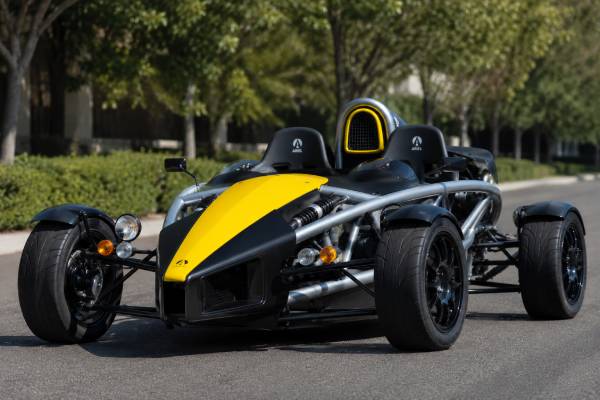
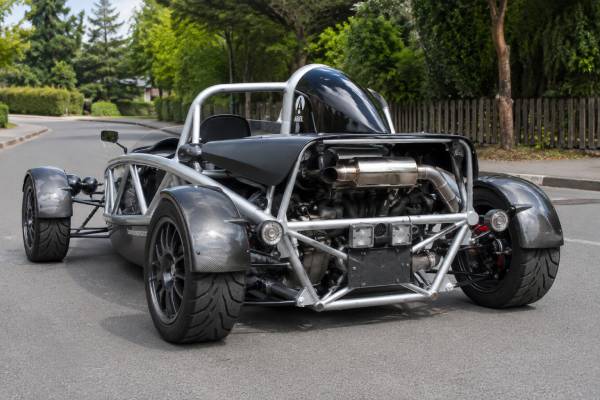
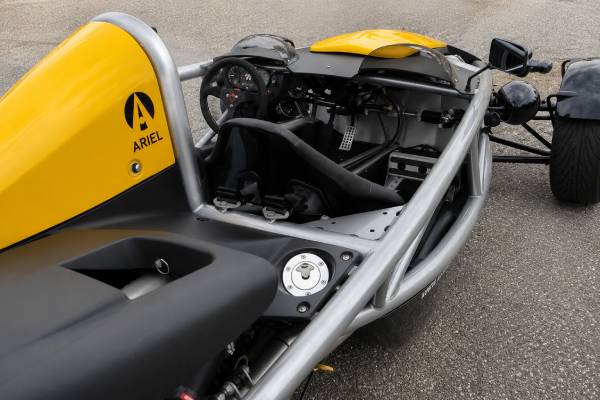
The Ariel Atom 2 LSJ Base is the least powerful factory supercharged Brammo specification, but “base” is a relative term. Its 2.0-liter GM Ecotec LSJ produces 205 hp and 200 lb-ft, uses an Eaton M62 supercharger with air-to-liquid charge cooling, and drives through a five-speed limited-slip transaxle. In a 1,350 lb open chassis, that output creates a very high power-to-weight ratio and immediate acceleration.
The Base model’s real advantage is system margin. It carries less boost and torque than the Stage 1, Stage 2, and Stage 3 versions while retaining the same basic forced-induction architecture. That can reduce thermal and driveline load when the car remains unmodified. The challenge is finding one that truly remains Base. Pulley swaps, ECU flashes, injectors, exhaust changes, and later stage hardware are common enough that the factory label cannot be trusted without inspection. A buyer should establish current calibration, supercharger speed, fuel delivery, belt arrangement, and engine health before applying any factory specification.
Table of Contents
- What “LSJ Base” Actually Means
- Base LSJ Specifications and Systems
- Eaton M62 Driving Character
- Aftercooler and Belt-System Health
- A Sensible Base-Stage Service Plan
- Chassis Loads at 205 hp
- Confirming an Unmodified Base Car
What “LSJ Base” Actually Means
The LSJ Base is the 205-hp starting point of Brammo’s supercharged GM Atom 2 range. It is not the naturally aspirated L61, and it should not be described using the 230-, 245-, or 300-hp stage data.
The LSJ engine uses a square 86 mm bore and stroke, a 9.5:1 compression ratio, electronic throttle, sequential fuel injection, and an Eaton M62 helical Roots-type supercharger. An air-to-liquid system removes heat from the compressed intake charge. The owner’s manual lists 205 hp and 200 lb-ft for the Base configuration.
Brammo paired the engine with a five-speed synchronized manual transaxle and limited-slip differential. The U.S. chassis has a manual-listed curb weight of 1,350 lb, staggered 15- and 16-inch wheels, and a 9.7-gallon fuel tank. This combination differs from the lighter British Honda Atom 2 that often appears in magazine summaries.
The Base car can be attractive for reliability because it operates at the lowest output in the LSJ stage ladder. That conclusion is valid only when the hardware and calibration remain Base. A smaller pulley, higher stage ECU, modified intake, or aftermarket exhaust can increase cylinder pressure and temperature. Even a car advertised at 205 hp may have an undocumented history of harder tuning.
Factory stage identification is complicated by parts overlap. The Base and Stage 1 use the same belt group in the Brammo manual, while Stage 2 and Stage 3 use a different shorter belt listing. Belt length alone does not prove engine output, but it can reveal that the current hardware does not match the seller’s description.
The Base’s performance is still serious. With approximately 306 lb per 100 hp, it reaches speeds quickly enough that braking points and road hazards arrive much sooner than expected. Its lower output mainly creates a wider margin for throttle application and heat management compared with the higher stages.
For ownership, the ideal Base car is not necessarily untouched. Updates to hoses, pumps, sensors, brakes, dampers, or uprights can improve reliability and safety. The goal is a documented, compatible package that preserves the 205-hp engine’s conservative character rather than a collection of invisible stage changes.
Base LSJ Specifications and Systems
The LSJ Base is a gasoline ICE vehicle with a supercharged 1,998 cc inline four-cylinder, five-speed manual limited-slip transaxle, and rear-wheel drive. The Brammo manual provides exact stage output and U.S.-chassis service data; these values should not be combined with European Atom weights or Honda capacities.
| Specification | Manual-listed value |
|---|---|
| Engine family/code | GM Ecotec LSJ Base |
| Configuration | Inline four-cylinder, transverse mid-engine |
| Displacement | 1,998 cc (2.0 L) |
| Bore × stroke | 86.0 × 86.0 mm |
| Compression ratio | 9.5:1 |
| Valvetrain | DOHC, 16 valves |
| Maximum power | 205 hp (153 kW) |
| Maximum torque | 271 Nm (200 lb-ft) |
| System | Specification |
|---|---|
| Supercharger | Eaton M62 helical Roots-type unit |
| Charge-temperature control | Air-to-liquid aftercooler/intercooler system |
| Throttle | Electronic throttle control |
| Fuel injection | Sequential electronic injection |
| Fuel grade | Premium unleaded gasoline |
| Manual stage range context | Published forced-induction range spans approximately 12–19 psi across LSJ variants |
| Specification | Manual-listed value |
|---|---|
| Transmission | Five-speed synchronized manual |
| Differential | Limited-slip |
| Drive | Rear-wheel drive |
| Curb weight | 612 kg (1,350 lb) |
| Seating | Two |
| Construction | Tubular frame with fiberglass or optional carbon-fiber panels |
| Position | Manual-listed fitment |
|---|---|
| Front wheel | 15 × 7 in, +35 mm offset |
| Rear wheel | 16 × 7 in, +38 mm offset |
| Front cold pressure | 124 kPa (18 psi) |
| Rear cold pressure | 138 kPa (20 psi) |
| Suspension | Independent pushrod-operated spring and damper units |
| Item | Manual-listed specification |
|---|---|
| Fuel tank | 36.7 L (9.7 US gal) |
| Engine oil | Six US quarts; synthetic 5W-30 listed |
| Transaxle fluid | Approximately 1.99 L (2.1 US qt) |
| Cooling system | Approximately 10.4 L (2.75 US gal) |
| Base/Stage 1 belt | 20 × 1,315 mm class; NAPA/Gates 25-060512 listed |
| Brake fluid | DOT 4 |
The pressure range in the table belongs to the LSJ family across stages, not a precise Base boost target. Confirm boost through the installed pulley, calibration, and manufacturer documentation rather than assigning the lowest number automatically.
Eaton M62 Driving Character
The M62 gives the Base car immediate, predictable torque without turbo lag. Its response follows engine speed and throttle closely, which makes the car easy to balance compared with a more abrupt boosted setup, but far more forceful than the naturally aspirated L61.
At light throttle, the bypass system reduces the compressor’s pumping demand. As the driver requests load, the bypass closes and the supercharger fills the engine more strongly. A healthy system should transition smoothly. Hesitation, surging, weak boost, or excessive whine can indicate bypass, belt, intake, sensor, or calibration faults.
The 200 lb-ft torque figure matters as much as 205 hp. It arrives in a vehicle with little mass over the tires, so lower gears can break rear traction. The limited-slip differential helps both tires contribute, but it can also make power oversteer develop more decisively when grip is exceeded.
Throttle mapping is electronic. Pedal position does not necessarily equal throttle-blade angle, and the ECU can shape response. A later tune may sharpen the pedal to feel more powerful without increasing output. That can make the car harder to modulate. During inspection, judge smoothness and repeatability rather than assuming aggressive response proves performance.
The Base car offers a useful learning curve. It accelerates hard enough to teach respect but leaves more time than a Stage 3 before the next braking point. On a technical circuit, the driver can focus on line and balance rather than constantly managing 300 hp. Tire wear and fuel use may also be lower.
Braking remains an essential part of performance. A car that reaches corner entry faster needs stable pedal feel, correct bias, and suitable tires. Low mass shortens stopping distances, yet repeated laps can still boil old fluid or overheat pads. The open chassis gives excellent access for inspection; owners should use that advantage between sessions.
The cockpit magnifies every event. Supercharger sound, intake roar, wind, stones, and tire movement surround the occupants. That sensory intensity can lead a driver to overestimate grip or misjudge speed. Build pace gradually and use objective references such as braking markers and data rather than sensation alone.
High-speed operation is physically demanding. Exposed wheels and occupants create drag and turbulence. A helmet may experience lift. The car is most effective in short acceleration zones and corners, not as a machine for sustained top-speed travel.
Aftercooler and Belt-System Health
The supercharger belt and aftercooler are the Base LSJ’s most important extra systems compared with the L61. Their condition determines whether boost remains stable and intake temperatures stay within the calibration’s safety margin.
Inspect the belt with the engine off. Look for cracking, glazing, frayed edges, missing ribs, contamination, and rubber dust. Dust concentrated near one pulley often points to misalignment or bearing wear. The Base/Stage 1 belt reference in the manual helps identify the intended length, but routing and hardware must still be compared with the actual car.
Check the tensioner and idlers for smooth movement. A seized or weak tensioner can let the belt slip at high load while appearing normal at idle. Misaligned brackets can cause repeated belt failure. Do not replace a shredded belt until every pulley, spacer, fastener, and driven component has been inspected.
Supercharger bearings create a characteristic sound, but harsh grinding, contact noise, or excessive shaft play is not normal. Oil service for the M62 should follow the supercharger manufacturer or specialist procedure for the installed unit. Do not add fluid through an assumed port without confirmation.
The bypass actuator and vacuum control must move freely. A failed-open bypass produces low boost; a failed-closed or incorrectly controlled system can add heat and poor light-load behavior. Inspect vacuum hoses for cracks and heat damage. Confirm operation with diagnostic data rather than wire ties or improvised tests.
The air-to-liquid aftercooler uses its own pump, heat exchanger, reservoir, and hoses where configured as described. Verify circulation when the engine is running, check level cold, and inspect for air pockets. A silent pump may be failed or simply difficult to hear; observe flow or electrical current using a safe test.
The front heat exchanger needs airflow. Clean debris carefully and inspect fins and mounts. Hoses should be protected from abrasion along the frame. A small leak can introduce air and reduce performance before leaving an obvious puddle.
Log intake temperature during repeated pulls or laps. A healthy Base system should manage heat more easily than the higher stages, but ambient temperature, pump condition, coolant mix, airflow, and pulley changes matter. A single dyno pull from a cold system does not represent sustained operation.
Boost leaks can occur at couplers, manifold joints, sensor seals, and vacuum ports. Look for oil mist, loose clamps, split rubber, and contact with the chassis. A leak may reduce measured boost while forcing the supercharger to work harder, and it can upset fueling if it affects measured air.
A Sensible Base-Stage Service Plan
The Base LSJ should be serviced by time, mileage, track events, and operating hours. Brammo’s manual provides short inspection intervals because the car is exposed and often used hard; a generic Chevrolet schedule is not sufficient by itself.
Check engine oil at every track event or every 1,000 miles as the manual directs. Use the specified synthetic 5W-30 unless the engine builder documents another requirement. Set level by the correct procedure after circulation, and record oil added between services.
Oil pressure and temperature should be monitored. A six-quart wet-sump system can still experience pressure problems under cornering if level, baffles, or pickup condition are wrong. Validate questionable dashboard readings. Inspect the oil filter for metallic material during baseline service when a specialist recommends it.
The LSJ uses chain-driven camshafts. Listen for persistent rattle and investigate cam-timing faults. Clean oil supports tensioner and guide life. An over-rev or missed shift can damage valves even when the chain is intact, so perform compression or leak-down testing when symptoms or history justify it.
Spark plugs should be inspected at every track event according to the manual. Use the heat range and gap appropriate to Base boost and calibration. A plug chosen for Stage 3 may not be ideal for a stock Base car. Compare cylinders for evidence of oil, heat, detonation, or mixture imbalance.
Fuel delivery must remain stable under boost. Premium fuel is required. Inspect pump wiring, filter history, injectors, regulator, lines, and tank condition. Long storage can cause contamination. Data logging of fuel pressure and mixture under controlled load provides better evidence than an idle test.
The engine cooling circuit and aftercooler circuit require separate checks. Verify levels, pumps, fan, radiator, heat exchanger, hoses, clamps, and bleed procedures. Replace coolant on the specified time or mileage basis and use compatible chemistry; mixing coolant types can create deposits.
The five-speed gearbox should receive the correct Saturn manual-transmission fluid listed by Brammo unless a replacement transaxle or differential requires something else. Check selection cold and hot, inspect seals, and investigate metal during fluid changes. Clutch hydraulic fluid and release operation deserve equal attention.
The air filter should be cleaned and re-oiled at the manual’s 5,000-mile point or sooner in dusty use. Do not over-oil it. Check the intake after the filter for dust; contamination there suggests poor sealing or filter maintenance.
Brake fluid, rod ends, wheel bearings, harnesses, tires, and battery complete the service plan. The manual’s 3,000-mile rod-end recommendation reflects use severity. Replace a joint for play or corrosion sooner rather than stretching a mileage interval.
Chassis Loads at 205 hp
At 205 hp, chassis condition determines whether the Base car feels friendly or unsettled. The output is low only relative to other LSJ stages; it is still enough to expose rear toe error, old tires, weak dampers, and brake imbalance.
Inspect the spaceframe from underneath and around every suspension pickup. Chips can be touched up after assessment, but crushed tubes, cracked weld areas, or unexplained repairs need professional measurement. Check radiator and engine-mount structures for impact or fatigue.
Rod ends should be treated as safety components. Clean them, inspect for play and binding, and check locknuts. Alignment can shift if an adjuster moves. A car that changes direction under throttle or braking may have rear toe variation rather than a difficult personality.
Dampers and springs should be matched. Record part numbers and adjustment positions. Excessive stiffness reduces grip on bumpy surfaces and can make wheelspin more likely. Check travel, leaks, bearings, and bump-stop contact. Set ride height with enough clearance and suspension movement for road use.
Wheel offsets should follow the manual or a documented engineered alternative. Spacers require correct fastener engagement. Inspect wheels for cracks, especially near spokes and bead seats. Wheel-bearing play can be masked by suspension movement, so isolate components carefully.
The manual’s 18/20 psi pressures are a starting point for the original type of setup, not a universal answer for every tire. Modern compounds, sizes, temperatures, and vehicle weight may require adjustment. Use measured hot pressure, temperature spread, and wear.
A limited-slip differential needs closely matched rear tire circumference. Unequal wear or pressure can make it work continuously. Check that both rear tires are the same model, size, age, and heat-cycle condition.
Brake balance should be stable and documented. Inspect pedal-box hardware, masters, hoses, calipers, pads, and discs. If an adjuster is accessible in the cockpit, mark a known position. Test changes only in a controlled environment and one step at a time.
Harness and seat mounting matter because the car can generate high deceleration. Confirm that webbing is undamaged, dates meet event requirements, and anchors load the frame correctly. A loose driver cannot control the car accurately, regardless of mechanical setup.
Confirming an Unmodified Base Car
The buying task is to determine the car’s present stage, not merely its original stage. A Base chassis with a pulley and tune must be inspected as the modified output it now makes, even when the title or invoice still says 205 hp.
Start with the VIN and Brammo build documentation. Ask for the original stage, engine number, transmission, options, and delivery equipment. Then request every later invoice involving the ECU, pulley, injectors, intake, exhaust, fuel pump, spark plugs, clutch, or cooling system.
Measure or identify the supercharger pulley rather than relying on color or seller memory. Compare belt part and routing with the Base/Stage 1 manual listing. Inspect injector part numbers and ECU calibration information. A scan tool may reveal calibration identifiers, but custom tunes need the tuner’s records.
A dyno sheet should include date, fuel, correction method, boost, mixture, intake temperature, and repeated runs. Wheel horsepower cannot be compared directly with the manual’s crank horsepower without context. A lower number does not automatically indicate a weak engine, and a high number may prove the car is not Base.
Inspect cold. Check the belt, pulleys, supercharger, aftercooler level, oil, coolant, fuel odor, wiring, frame, rod ends, tires, brakes, and harnesses. Look for abandoned wiring or capped hoses from previous stage changes. Verify that warning lights and pumps operate.
Warm the car gradually. Observe oil pressure, coolant temperature, aftercooler circulation, fan function, idle, and belt tracking. Scan for faults and inspect fuel trims at light load. A controlled load log should evaluate boost, mixture, ignition behavior, intake temperature, throttle, and fuel pressure.
Drive the chassis separately from the engine evaluation. Check straight-line braking, steering symmetry, bump control, gearbox selection, clutch, driveshafts, and differential. Do not perform repeated hard launches. They create heat and reveal less than a progressive load test.
After shutdown, inspect for hot leaks, coolant movement, belt dust, brake drag, and fuel odor. Review data before deciding that the car is healthy. Heat-soak behavior can be more informative than the first acceleration run.
Commission a specialist familiar with GM-powered Brammo Atoms. The combination is uncommon enough that a general performance shop may understand the LSJ but overlook chassis-specific joints, cooling routing, or documentation. Confirm parts supply for any custom component.
The best Base car offers a clear history and conservative calibration. Its 205 hp is already enough for exceptional response, while lower stage stress can support repeatable track use and easier road driving. Buying it as a platform for immediate modification misses the point; buying it as the most balanced supercharged U.S. Atom 2 can make excellent sense.
References
- BRAMMO ARIEL ATOM 2 2006 OWNER’S MANUAL 2026
- Ariel Atom (US) Useful documents 2026
- Ariel Atom, Ariel Nomad, Ariel North America Atom 4 2026
- Ariel Atom 2 | Gear Patrol 2010
- Palatov-Designed Ariel Atom Uprights – Lightweight Motorsports 2026
- Ariel Atom (2000-): PH Pocket Buying Guide 2016
Disclaimer
This article is an informational guide, not proof of a car’s current LSJ stage or a replacement for the Brammo manual and professional testing. Verify VIN, pulley, belt, calibration, fuel system, fluid requirements, chassis parts, safety equipment, and legal status on the individual vehicle. Share it with a buyer or owners’ group when it helps keep Base and upgraded specifications clearly separated.