

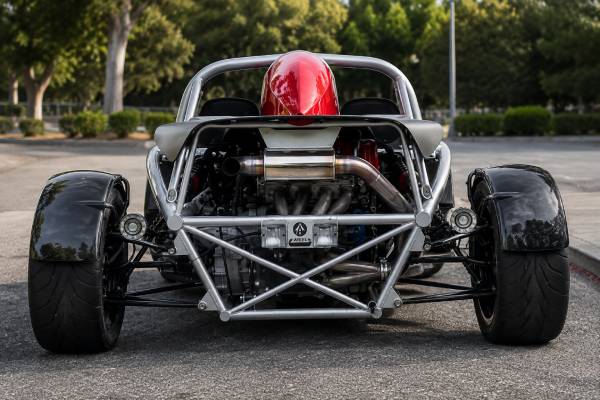
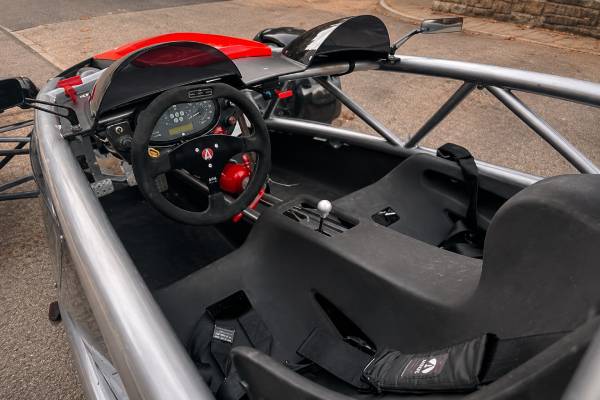
The Ariel Atom 2 LSJ Stage 2 raises the Brammo supercharged package to 245 hp and 215 lb-ft. It keeps the 2.0-liter GM Ecotec LSJ, Eaton M62 supercharger, air-to-liquid charge cooler, five-speed limited-slip transaxle, and 1,350 lb U.S.-specification chassis, but moves into a more demanding belt and heat-management category. The Brammo manual groups Stage 2 with Stage 3 for a shorter supercharger belt than the Base and Stage 1 cars.
That detail matters because Stage 2 is often treated as a minor tune. In reality, pulley drive, fuel delivery, ignition, charge temperature, spark-plug selection, and clutch condition all become more critical. Some cars have later aftermarket stages or turbo conversions, while others have been returned to 245 hp after harder use. The buyer must establish the present configuration through parts, calibration records, and load data. A healthy Stage 2 should deliver repeatable power without belt dust, falling fuel pressure, rising intake temperature, or gearbox distress.
Table of Contents
- Stage 2 Identity and Hardware Clues
- Stage 2 Specifications and Service Values
- Making 245 hp Usable
- The Shorter Belt System and Pulley Alignment
- Thermal, Fuel, and Oil Control
- Wear Beyond the Engine
- A Stage 2 Pre-Purchase Audit
Stage 2 Identity and Hardware Clues
Stage 2 is the 245-hp, 215-lb-ft LSJ specification in Brammo’s owner manual. Its output sits well above Stage 1, and its listed belt belongs to the Stage 2/3 group rather than the Base/1 group.
The engine remains an LSJ with an 86 mm square bore and stroke, 9.5:1 compression ratio, DOHC cylinder head, electronic throttle, and sequential injection. An Eaton M62 compressor forces air through an air-to-liquid cooling system. The engine is transversely mounted behind the occupants and sends torque through a five-speed synchronized transaxle with limited slip.
A stage badge cannot confirm this package. Brammo and later owners could change stages, and the same car may have accumulated several calibrations. A shorter belt is a useful clue, but belt length can also change with pulley, tensioner, idler, or accessory modifications. It must be interpreted with the complete drive layout.
Pulley diameter should be measured and photographed. Record crank, supercharger, and idler sizes where practical. Check injector part numbers, fuel-pump specification, ECU calibration, spark-plug type, intake, exhaust, and cooling changes. A Stage 2 claim is credible when all these pieces support the target, not when one dyno graph shows 245 at the wheels or crank without context.
The increased torque changes the chassis experience. Compared with Stage 1, the rear tires reach their limit sooner and the clutch and differential absorb more load. Compared with Stage 3, the car retains a useful margin in heat and traction. For many drivers, Stage 2 may be the strongest level that remains easy to exploit across a whole session.
Output provenance matters because an engine can make 245 hp briefly while operating outside safe fuel or temperature limits. Proper Stage 2 performance is repeatable after warm-up. Intake temperature, coolant, oil pressure, fuel pressure, and ignition response should stabilize rather than drift dangerously on consecutive runs.
The original VIN and build documents remain the first step. They establish what Brammo delivered. The current inspection establishes what the buyer is actually receiving. Both records should be kept because future parts orders and resale depend on understanding the progression.
Stage 2 Specifications and Service Values
The LSJ Stage 2 is a gasoline ICE vehicle with a supercharged 1,998 cc inline four-cylinder, five-speed manual transaxle, limited-slip differential, and rear-wheel drive. The figures below come from the Brammo Atom 2 manual and apply to the U.S. chassis rather than the lighter British Honda car.
| Specification | Manual-listed value |
|---|---|
| Engine family | GM Ecotec LSJ Stage 2 |
| Configuration | Transverse inline four-cylinder, mid-mounted |
| Displacement | 1,998 cc (2.0 L) |
| Bore × stroke | 86.0 × 86.0 mm |
| Compression ratio | 9.5:1 |
| Valvetrain | DOHC, 16 valves |
| Maximum power | 245 hp (183 kW) |
| Maximum torque | 292 Nm (215 lb-ft) |
| System | Specification |
|---|---|
| Supercharger | Eaton M62 helical Roots-type compressor |
| Charge cooling | Air-to-liquid aftercooler/intercooler |
| Throttle | Electronic control |
| Fuel injection | Sequential electronic injection |
| Fuel | Premium unleaded gasoline |
| LSJ family boost context | Manual describes approximately 12–19 psi across the variants |
| Specification | Manual-listed value |
|---|---|
| Transmission | Five-speed synchronized manual transaxle |
| Differential | Limited-slip |
| Drive | Rear-wheel drive |
| Curb weight | 612 kg (1,350 lb) |
| Suspension | Independent pushrod-operated spring and damper units |
| Steering | Manual rack and pinion |
| Position | Manual-listed value |
|---|---|
| Front wheel | 15 × 7 in, +35 mm offset |
| Rear wheel | 16 × 7 in, +38 mm offset |
| Front cold pressure | 124 kPa (18 psi) |
| Rear cold pressure | 138 kPa (20 psi) |
| Original layout | Staggered wheel diameter with rear-drive tire loading |
| Item | Manual-listed specification |
|---|---|
| Fuel capacity | 36.7 L (9.7 US gal) |
| Engine oil | Six US quarts; synthetic 5W-30 specified |
| Transmission fluid | Approximately 1.99 L (2.1 US qt) |
| Cooling capacity | Approximately 10.4 L (2.75 US gal) |
| Stage 2/3 belt | 20 × 1,295 mm class; NAPA/Gates 25-060505 listed |
| Brake fluid | DOT 4 |
The listed coolant capacity refers to the engine-cooling system in the manual context. Any separate charge-cooler reservoir and plumbing must be filled and bled according to its own configuration.
Making 245 hp Usable
Stage 2 performance depends on throttle discipline and rear-tire condition. The engine can produce 215 lb-ft immediately enough that an early full-throttle input overwhelms grip long before the chassis runs out of cornering ability.
The positive-displacement supercharger creates a broad response. Unlike a naturally aspirated engine that saves its strongest acceleration for high rpm, the LSJ pulls hard through more of the range. Unlike a large turbo, it does not wait for exhaust flow. That makes the car predictable, but also gives the driver less warning before speed increases.
A limited-slip differential improves drive when one rear tire is lightly loaded. It cannot compensate for unequal tire pressures, mismatched compounds, old rubber, or incorrect toe. If both tires exceed grip, the car will rotate under power. Electronic stability control is not present to intervene.
The low polar moment makes recovery fast in both senses: a small lift and steering correction can work when the slide is modest, but the car can also spin quickly if the driver lifts abruptly or countersteers late. Driver training should take place on a skid pad or controlled circuit, beginning with warm tires and conservative settings.
Stage 2’s additional upper-range power shortens braking zones. The car may feel composed while accelerating, then arrive at a familiar corner considerably faster than a Stage 1. Use data or consistent markers. Avoid judging speed solely by engine noise because supercharger whine and wind can distort perception.
Brakes benefit from low mass but still accumulate heat. The driver should use firm, decisive applications followed by release rather than dragging the pedal. Pad compound must operate in the expected temperature range. Old fluid can boil despite a large caliper, and poor bias can lock an axle before the tires reach their potential.
The manual tire pressures are a baseline for the original setup. Modern semi-slicks may need different hot targets. Measure temperatures across the tread and watch for sidewall rollover. The rear tires should match closely in circumference to avoid continuous differential action.
Road driving requires restraint because the car can move from legal to inappropriate speeds in a short throttle application. Eye protection, hearing protection, clothing, and secure loose objects are practical requirements. Wet painted lines and standing water can upset the lightweight chassis suddenly.
Stage 2 is most satisfying when power is treated as one element of a balanced lap. Smooth steering, stable braking, and early but measured throttle will usually outperform dramatic wheelspin. That approach also preserves the clutch, tires, and belt system.
The Shorter Belt System and Pulley Alignment
The Stage 2/3 belt reference is a practical identifier and a major service point. The manual lists a 20 × 1,295 mm-class belt, shorter than the 1,315 mm-class Base/Stage 1 belt, reflecting the higher-stage drive arrangement.
Confirm the part installed. A different brand may cross-reference correctly, while a different length may be required by nonstandard pulleys or idlers. Record belt number, effective length, width, routing, and tensioner position. Keep a known-correct spare with the car.
Inspect both belt surfaces. Cracks, missing ribs, edge cords, glazing, melted rubber, and oil contamination indicate trouble. A narrow polished line on one edge suggests that the belt is tracking against a pulley flange. Rubber dust should lead to an alignment and bearing check, not merely cleaning.
Pulley alignment can be measured with a straightedge or laser using safe workshop procedures. Check brackets for cracks, loose fasteners, missing spacers, and elongated holes. A supercharger or idler pulley slightly out of plane can destroy belts repeatedly at high rpm while appearing acceptable at idle.
Tensioner position and travel matter. An incorrect belt can place the tensioner near the end of its range, reducing its ability to absorb dynamic movement. A weak damper or spring can allow slip. Inspect the stop marks and compare movement with a known-good setup.
Rotate idlers and accessories by hand with the belt removed, noting roughness, play, or noise. Supercharger bearings and coupler condition should be evaluated by a specialist. Do not spin the unit aggressively or introduce contamination during inspection.
Pulley changes alter much more than belt length. A smaller supercharger pulley increases compressor speed and usually boost, raising charge temperature, fuel demand, cylinder pressure, and belt load. Stage 2 should not be pushed toward Stage 3 output without matching calibration and hardware.
Belt slip can mimic several faults. It may cause falling boost at high rpm, black dust, heat, inconsistent acceleration, or an apparent ignition problem. Data logging manifold pressure against rpm helps identify the pattern. A slipping belt can still produce a normal idle and part-throttle drive.
Protect nearby hoses and wiring. A failed belt can whip or shed cords into the engine bay. Routing should leave clearance under engine movement, and brackets should include proper strain relief. After replacement, observe tracking from a safe distance and reinspect after the first heat cycle.
Thermal, Fuel, and Oil Control
Stage 2 should be judged by its condition after repeated load, not by one cold acceleration run. Intake temperature, coolant stability, oil pressure, fuel pressure, and ignition activity reveal whether the package can sustain its advertised output.
The air-to-liquid charge cooler needs confirmed pump operation. Check reservoir level when cold, inspect hoses and clamps, and verify actual circulation. A pump can run intermittently because of a poor connector or relay. The front heat exchanger must be clear of debris and positioned for airflow.
Bleeding is critical. Air reduces contact between coolant and the heat-transfer surfaces, creating inconsistent temperatures. Follow the installed system’s procedure, which may differ after modifications. Mark reservoir levels and investigate loss rather than repeatedly topping up.
Log intake temperature at the manifold during consecutive pulls or laps. Compare rise and recovery. An ECU may reduce ignition advance as temperature increases, producing lower power but protecting the engine. A tune that disables sensible protection can make a hot car appear strong until damage occurs.
The engine-cooling circuit has its own radiator, fan, long pipes, cap, and expansion tank. Inspect stone damage, hose chafing, clamps, and electrical control. Verify that temperature remains stable after returning from track speed to low airflow in the paddock.
Fuel pressure should be measured under boost. Inspect pump voltage, filter, injectors, tank condition, and lines. Premium fuel must match the calibration’s octane basis. Old fuel or an ethanol content beyond the system’s intended range can affect mixture and material compatibility.
Spark plugs are useful after a controlled run. Compare all cylinders for heat, deposits, gap, and signs of detonation. Use the Stage 2-recommended plug rather than copying a Stage 3 build. A weak coil may fail only under boost, so wiring and grounds deserve close attention.
Oil level is checked at every event or every 1,000 miles according to the manual. Set it correctly, track consumption, and monitor pressure during cornering. Identify sump baffles, oil cooler, block cooler, and any remote system. Every added hose is a potential leak point that needs support and heat protection.
The chain-driven valvetrain depends on oil quality. Persistent rattle or cam faults require diagnosis. A missed downshift can over-rev mechanically beyond ECU control; an engine may still run afterward while having bent valves or reduced sealing.
Use multiple forms of evidence. Dyno logging, track data, plug inspection, fluid trend, and repeatable temperatures together provide confidence. One number or one gauge cannot validate the system.
Wear Beyond the Engine
Stage 2 ownership is not only about the supercharger. The clutch, gearbox, mounts, driveshafts, differential, rod ends, bearings, brakes, tires, and frame absorb the consequences of 245 hp in a very light car.
The five-speed transaxle should shift cleanly cold and hot. Use the specified Saturn manual-transmission fluid unless the installed unit requires another lubricant. Inspect drained oil for metal and check seals. A high-output car with a short-shift kit may have suffered hurried changes; examine linkage and synchronization rather than blaming fluid alone.
Clutch condition should be assessed under controlled load. Slip often appears in a taller gear at peak torque. Drag can make first and reverse difficult. Identify the clutch and flywheel because an aggressive racing assembly may be unpleasant on the road and transmit greater shock to the gearbox.
Mounts and brackets should be inspected for cracks or movement. Torque can pull the engine far enough to contact exhaust, frame, wiring, or hoses. Very rigid mounts reduce movement but increase vibration. Look for witness marks and loose fasteners.
Driveshaft joints and boots need regular inspection. Grease leakage, clicks, or vibration under load may indicate wear. Confirm fastener torque and safety marking where appropriate. The limited-slip differential needs matched rear tires and the correct lubricant.
The Brammo manual’s rod-end replacement guidance is intentionally conservative. At minimum, inspect each joint for play, corrosion, binding, and secure adjustment. Track curbs and road impacts can bend links or shift geometry. A car that feels unstable should be measured before it is driven harder.
Wheel bearings and uprights carry repeated cornering and braking loads. Some cars use upgraded assemblies. Document their design, replacement bearings, torque values, and wheel compatibility. Unknown custom parts can make future service difficult.
Brake fluid, pads, discs, calipers, masters, and balance system should be checked after events. The faster Stage 2 approaches corners, the greater the energy despite low mass. Inspect for cracks, taper, leaks, and heat damage. Mark bias and avoid casual changes.
Tires are consumables by age and heat cycle. Check pressures, cuts, flat spots, and contact with body or suspension. A sticky tire can hide poor geometry temporarily while increasing loads on bearings and frame.
A Stage 2 Pre-Purchase Audit
A Stage 2 audit should reconstruct the car’s configuration, test it cold and hot, and estimate the cost of returning every system to a known baseline. It is more thorough than a conventional sports-car pre-purchase inspection.
Request VIN records, original stage, every stage-change invoice, ECU information, pulley dimensions, belt part, injectors, fuel pump, intake, exhaust, clutch, differential, cooling upgrades, and dyno logs. Ask whether the engine has ever detonated, over-revved, overheated, thrown a belt, or lost charge-cooler circulation.
Inspect before start. Verify the 1,295 mm-class belt group or explain any difference. Look for dust, edge wear, bracket repairs, and nonstandard routing. Check aftercooler level, engine coolant, oil, fuel odor, leaks, wiring, hoses, frame, wheels, tires, brakes, rod ends, and harnesses.
Cold start should be prompt without prolonged chain rattle, smoke, or harsh supercharger noise. Observe oil pressure. During warm-up, verify engine fan and charge-cooler pump, scan the ECU, and monitor temperature. Check throttle and bypass operation.
A controlled data session should include boost versus rpm, intake temperature, coolant, oil pressure if available, fuel pressure, mixture, ignition response, throttle, and injector duty. Run enough repetitions to expose heat soak. Stop if any parameter moves outside a safe range.
Test the five-speed, clutch, differential, steering, brakes, dampers, and bearings progressively. Avoid launch demonstrations. Straight-line braking and bump response often reveal more about safety. Confirm that the car behaves symmetrically left and right.
Inspect after heat. Look for coolant pushed from reservoirs, belt debris, oil mist, fuel smell, brake drag, wheel-bearing heat, and loose clamps. Review logs before deciding. A fast impression can hide a failing pump or slipping belt.
Use a Brammo-aware specialist. A general LSJ shop may not inspect rod ends, spaceframe damage, pedal-box bias, wheel offsets, or long coolant routing. A marque specialist may need an LSJ tuner for calibration; the best inspection combines both disciplines.
Create a first-year budget for fluids, filters, belt, plugs, coolant, pump, tires, rod ends, bearings, brake service, clutch contingency, geometry, and data verification. Price custom parts before purchase.
A sound Stage 2 is a strong sweet spot in the U.S. range. It offers a clear performance increase, the more aggressive belt arrangement, and serious track pace without reaching Stage 3’s full output. Its worth comes from repeatability and traceability. A 245-hp label unsupported by temperatures, fuel pressure, and hardware records is only a claim.
References
- BRAMMO ARIEL ATOM 2 2006 OWNER’S MANUAL 2026
- Ariel Atom (US) Useful documents 2026
- Ariel Atom, Ariel Nomad, Ariel North America Atom 4 2026
- Travis Chaney’s Turbo Ariel Atom – S3 Magazine 2026
- Ariel Atom 2 | Gear Patrol 2010
- Palatov-Designed Ariel Atom Uprights – Lightweight Motorsports 2026
Disclaimer
This article cannot determine a vehicle’s present stage, calibration safety, or structural condition. Confirm the VIN, pulley system, belt, ECU, fuel and cooling hardware, fluids, service intervals, chassis joints, safety equipment, and legal status through Brammo documentation and specialist testing. Share it when it can help an owner audit a 245-hp car before hard use.