
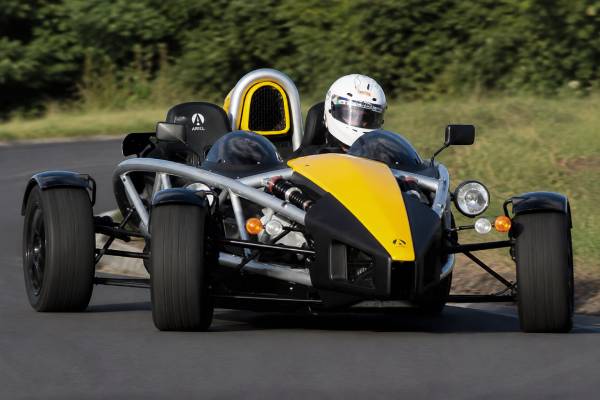
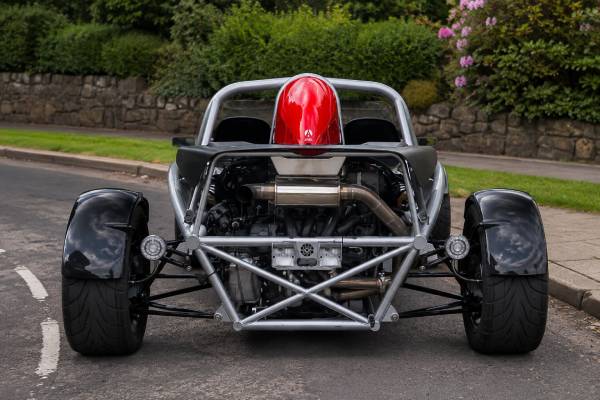
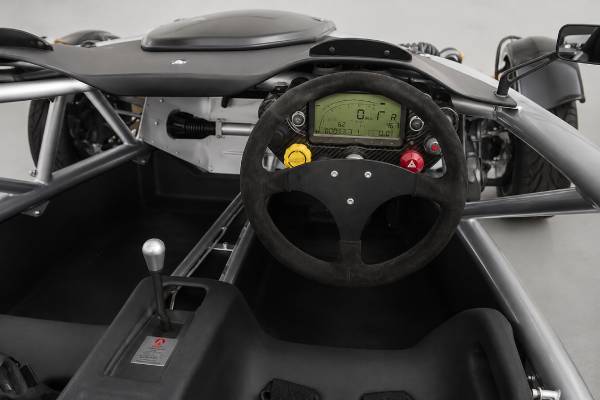
The Ariel Atom 2 LSJ Stage 3 is the highest-output GM supercharged specification listed in Brammo’s owner manual. Its 2.0-liter Ecotec LSJ produces 300 hp and 250 lb-ft through an Eaton M62 supercharger, air-to-liquid charge cooling, a five-speed manual transaxle, and a limited-slip differential. With a manual-listed curb weight of 1,350 lb, the output-to-mass relationship is extreme even before the open cockpit magnifies every acceleration, braking event, and surface change.
Stage 3 cannot be evaluated like a normal used sports car. The engine’s fuel system, pulley drive, ECU calibration, charge-cooler flow, oil pressure, and ignition behavior must be validated under repeated load. The clutch, gearbox, mounts, driveshafts, rear alignment, tires, and brakes also need evidence of condition. Many cars have been modified beyond factory Stage 3 or converted to turbocharging, so 300 hp may describe history rather than the current package. A trustworthy example is not merely fast for one pull; it remains stable in pressure, temperature, mixture, and chassis behavior through a complete session.
Table of Contents
- The Top of the Brammo LSJ Range
- Stage 3 Factory Specification
- Acceleration, Traction, and Driver Workload
- Keeping 300 hp Repeatable
- Protecting the LSJ and Transaxle
- Chassis Safety at Stage 3 Output
- The Stage 3 Purchase Protocol
The Top of the Brammo LSJ Range
Stage 3 raises Brammo’s LSJ Atom 2 to 300 hp and 250 lb-ft, the highest figures in the owner manual’s Base-through-Stage 3 progression. It uses the same basic U.S. chassis and five-speed architecture, but the operating margin becomes much smaller.
The output increase from Stage 2 is substantial: 55 hp and 35 lb-ft. In a 612 kg car, that changes more than straight-line acceleration. It raises the speed reached before braking, increases clutch and gearbox load, makes rear-tire temperature more critical, and adds heat to the forced-induction system. A setup that was adequate at 245 hp may not remain adequate at 300.
The engine is still the 1,998 cc LSJ with an 86 mm bore and stroke and 9.5:1 compression ratio. The Eaton M62 is mechanically driven, so response is immediate. Charge cooling uses an air-to-liquid circuit. Electronic throttle and ECU strategies control the engine, but the car does not provide conventional stability control to rescue an excessive throttle input.
Brammo groups Stage 3 with Stage 2 for the shorter belt reference. That shared part does not mean the stages are mechanically identical in every respect. Pulley ratio, calibration, injectors, fuel delivery, spark plugs, and supporting hardware need confirmation. A Stage 2 car may have been flashed or pulleyed toward 300 hp; a Stage 3 may have been de-tuned after problems.
The 300-hp label attracts modification. Turbo conversions, alternate superchargers, smaller pulleys, water-methanol injection, E85 calibrations, and built engines can all appear in the market. Some are excellent engineering projects, but none should be assessed using factory Stage 3 assumptions. Current hardware and fuel define the maintenance plan.
Stage 3’s historical importance comes from the audacity of combining 300 hp with an exposed, manually controlled chassis. It delivered the kind of acceleration figures that made the Atom internationally famous. Its ownership value depends on preserving that performance without turning the car into an untraceable test platform.
A skilled owner will treat the car as an integrated system. The engine, aftercooler, belt, fuel, gearbox, suspension, brakes, tires, and driver all have to work inside a narrow range. The reward is extraordinary response; the cost is a service and inspection standard closer to motorsport than ordinary weekend motoring.
Stage 3 Factory Specification
The Stage 3 is a supercharged gasoline ICE vehicle with a 1,998 cc GM LSJ inline four-cylinder, five-speed synchronized manual transaxle, limited-slip differential, and rear-wheel drive. The Brammo manual lists exact output, torque, U.S. curb weight, wheel fitment, capacities, and the Stage 2/3 belt reference.
| Specification | Manual-listed value |
|---|---|
| Engine family/code | GM Ecotec LSJ Stage 3 |
| Configuration | Transverse inline four-cylinder, mid-mounted |
| Displacement | 1,998 cc (2.0 L) |
| Bore × stroke | 86.0 × 86.0 mm |
| Compression ratio | 9.5:1 |
| Valvetrain | DOHC, 16 valves |
| Maximum power | 300 hp (224 kW) |
| Maximum torque | 339 Nm (250 lb-ft) |
| System | Specification |
|---|---|
| Supercharger | Eaton M62 helical Roots-type compressor |
| Charge cooling | Air-to-liquid aftercooler/intercooler |
| Throttle | Electronic throttle control |
| Fuel injection | Sequential electronic injection |
| Required fuel class | Premium unleaded gasoline appropriate to the calibration |
| Manual boost context | Approximately 12–19 psi across the LSJ stage family |
| Specification | Manual-listed or calculated value |
|---|---|
| Transmission | Five-speed synchronized manual transaxle |
| Differential | Limited-slip |
| Drive | Rear-wheel drive |
| Curb weight | 612 kg (1,350 lb) |
| Power-to-weight | Approximately 490 hp per metric tonne |
| Torque-to-weight | Approximately 554 Nm per metric tonne |
| Position or system | Manual-listed value |
|---|---|
| Front wheel | 15 × 7 in, +35 mm offset |
| Rear wheel | 16 × 7 in, +38 mm offset |
| Front cold pressure | 124 kPa (18 psi) |
| Rear cold pressure | 138 kPa (20 psi) |
| Suspension | Independent pushrod-operated spring and damper units |
| Steering | Manual rack and pinion |
| Item | Manual-listed specification |
|---|---|
| Fuel tank | 36.7 L (9.7 US gal) |
| Engine oil | Six US quarts; synthetic 5W-30 specified |
| Transaxle fluid | Approximately 1.99 L (2.1 US qt) |
| Engine-cooling capacity | Approximately 10.4 L (2.75 US gal) |
| Stage 2/3 belt | 20 × 1,295 mm class; NAPA/Gates 25-060505 listed |
| Brake fluid | DOT 4 |
The calculated ratios use the manual’s curb weight. Options, fuel load, driver, later wheels, body panels, and cooling changes alter the actual running mass. No factory acceleration figure should be borrowed from an unrelated high-output test without matching specification and procedure.
Acceleration, Traction, and Driver Workload
Stage 3 acceleration is traction-limited in the lower gears and attention-limited everywhere. The car gains speed so quickly that smooth inputs and advance planning become essential safety tools.
The M62 produces torque promptly. There is no long turbo delay to give the driver time to reconsider. A small increase in pedal angle can add significant rear-tire load, especially once the bypass closes and the engine reaches strong boost. Electronic throttle mapping may shape the response, so the current ECU tune strongly influences controllability.
At 250 lb-ft, the rear tires can be overwhelmed even on dry pavement. The limited-slip differential helps both tires transmit torque, but once both are saturated the rear can move quickly. Old or cold semi-slicks are particularly dangerous because they may provide little warning before breakaway.
Launch figures attract attention, yet repeated standing starts are hard on the clutch, differential, driveshafts, mounts, and tires. They also depend heavily on surface and technique. A safer assessment uses progressive acceleration in a controlled environment while recording clutch behavior, boost, pressure, and temperature.
Corner exit requires patience. The driver should unwind steering before asking for full power and use a gear that avoids a sudden torque spike. If oversteer begins, abrupt throttle closure can transfer load forward and accelerate rotation. Training should include controlled recovery rather than experimenting on public roads.
Braking workload rises because Stage 3 reaches higher entry speeds. Low mass still helps, but kinetic energy increases with the square of speed. A small speed increase creates a disproportionate heat increase. Track pads, fluid, discs, calipers, and cooling must be selected as a system.
Steering remains unassisted and highly communicative. It can transmit road camber and kickback as well as grip. A driver who grips the wheel too tightly may feed disturbances back into the car. Relaxed hands and deliberate inputs improve accuracy.
The open cockpit creates physical workload. Wind pressure, heat, noise, helmet lift, debris, and vibration reduce concentration. A 20-minute session in an Atom can be more tiring than the same time in an enclosed car. Hydration, hearing protection, and session length should be planned.
Wet conditions sharply reduce the usable throttle range. Standing water can pull at exposed front tires, and wide rear tires may aquaplane. Road markings and metal covers become meaningful hazards. Stage 3 is not a car in which electronic systems will quietly manage those changes.
The performance is most rewarding when the driver uses only what conditions support. A clean lap at partial throttle can be faster and safer than repeated corrections at full power. Stage 3 should expand capability, not force every drive to become a demonstration.
Keeping 300 hp Repeatable
A healthy Stage 3 must repeat its performance after the engine and charge system are fully warm. The primary validation targets are intake temperature, fuel pressure, air-fuel ratio, ignition response, coolant stability, and belt speed.
Begin with the charge-cooler circuit. Confirm pump operation electrically and by observing circulation. Inspect reservoir, heat exchanger, hoses, clamps, bleed points, and wiring. A pump can operate intermittently as temperature or vibration changes, so test through a complete session.
Air in the circuit reduces cooling. Bleed using the installed configuration’s method and mark the cold level. Check for unexplained loss. A tiny leak may not leave a puddle because airflow spreads coolant across the frame.
The front heat exchanger needs clean fins and unobstructed airflow. Body panels or added screens can reduce flow. A larger exchanger may improve capacity but also add coolant mass and require correct pump sizing. Modifications should be supported by temperature data.
Log intake-air temperature at the manifold. Watch the starting value, rate of rise, maximum, and recovery between runs. Compare ignition advance or knock response at the same time. Power loss as temperature rises may be protective; no response at unsafe temperature may indicate a calibration that lacks margin.
The engine-cooling circuit is separate. Inspect radiator, fan, coolant type, cap, expansion tank, long pipes, and bleed points. Stage 3 heat can become most visible after a fast lap when vehicle speed falls and underbody airflow changes. Verify temperature at idle after load.
Fuel delivery must be tested at maximum demand. Measure pressure, injector duty, voltage, mixture, and fuel temperature if available. Premium gasoline should meet the tune’s exact octane standard. A car mapped for ethanol fuel needs compatible lines, pump, injectors, cold-start strategy, and a reliable method of measuring blend.
The supercharger belt needs stable grip. Compare boost against rpm. Falling boost, dust, or temperature near a pulley can indicate slip. The 1,295 mm class is the factory Stage 2/3 reference, but nonstandard pulley systems need their own engineering record.
Heat shields and airflow protect wiring, fuel lines, and panels. Inspect after a hot shutdown for softened insulation, discolored connectors, or contact. Exhaust cracks can direct heat toward critical parts. A high-output car should have no unsupported line near the exhaust or belt.
Repeatability also includes recovery. Coolant and intake temperatures should return toward baseline between sessions. A system that only becomes hotter throughout the day may be undersized, poorly bled, or operated beyond its intended duty cycle.
Protecting the LSJ and Transaxle
Stage 3’s engine and gearbox need a motorsport-style routine. Oil level, pressure, plugs, chain condition, clutch, fluid, mounts, and over-rev history should be documented, not assumed.
Check engine oil at each track event or every 1,000 miles in line with the Brammo manual. Set level with the correct procedure. Track consumption and inspect for leakage around sump, filter, cooler, lines, cam cover, and breather system. The manual mentions a six-quart sump and block oil cooler context; later cars may add remote hardware.
Monitor oil pressure through corners and at hot idle. Validate sensors with a mechanical gauge. A brief drop under load is not acceptable. If the car uses baffles, an accumulator, or dry-sump conversion, inspect every valve, hose, mount, and tank for correct operation.
Synthetic 5W-30 is listed in the manual, but a built engine may have a documented different requirement. Do not choose thicker oil to hide low pressure without diagnosis. Oil analysis and filter inspection can reveal bearing, ring, or coolant problems.
Spark plugs should be inspected after track use. Stage 3 cylinder pressure makes heat range and gap important. Compare all cylinders. Signs of detonation, melted electrodes, cracked insulators, oil, or unusual cleanliness require immediate investigation. Coil performance and grounds should be tested under load.
The timing chain, guides, and tensioner depend on clean oil. Persistent start-up rattle or cam faults need attention. A mechanical over-rev from a wrong downshift cannot be prevented by the ECU limiter; compression and leak-down testing may be justified after an incident.
The five-speed transaxle should use the correct fluid for its actual differential and internals. Inspect drained oil and magnetic plugs. Test every ratio cold and hot. Synchronizer wear, bearing noise, and gear damage may become evident only after sustained temperature.
Clutch slip is more likely at 250 lb-ft. Identify the installed clutch, pressure plate, flywheel, and hydraulics. An aggressive unit can shock the gearbox and make launches inconsistent. A progressive clutch that holds torque is preferable to one selected only for a high advertised capacity.
Mounts, brackets, driveshafts, and CV joints take repeated load reversal. Inspect boots, grease, fasteners, frame attachment, and contact marks. A drivetrain that moves excessively can throw belts, damage exhausts, and pull on hoses. A drivetrain mounted too rigidly can fatigue the frame and accessories.
Service intervals should shorten with track use. Engine oil, gearbox fluid, brake fluid, plugs, filters, coolant, belts, and inspections are scheduled by events and hours. A low road mileage is not evidence of low mechanical stress.
Chassis Safety at Stage 3 Output
Stage 3 needs a straight, tight chassis and fresh tires before its engine is used fully. Power cannot compensate for a cracked frame coating around a stressed joint, worn rod end, weak bearing, or unknown alignment.
Inspect the tubular frame from front impact structure to rear engine mounts. Look beneath panels and along lower rails. Stone chips are routine; crushed tubes, distortion, repaired pickup points, localized new powder coat, or cracks around welds deserve specialist measurement.
The Brammo manual recommends close rod-end attention and gives a 3,000-mile replacement reference. Inspect each joint for looseness, corrosion, binding, and secure locknuts. Record part numbers and alignment before replacement. Geometry must be measured afterward.
Wheel bearings and uprights face high cornering loads. Some owners install upgraded upright assemblies. Verify engineering provenance, bearing specification, torque procedure, wheel compatibility, and replacement supply. A stronger-looking custom part without documentation is not automatically safer.
The original wheels are listed as 15 × 7 +35 front and 16 × 7 +38 rear. Check actual wheel dimensions, spacers, fastener engagement, cracks, and bends. A Stage 3 car often receives wider rear wheels; confirm clearance and bearing loads.
Tires should be matched by model, compound, age, and heat cycle. The manual’s 18/20 psi cold pressures are only a starting point for compatible tires. Use temperature and wear data. A rear tire that is several millimeters different in circumference can keep the limited-slip differential working continuously.
Dampers and springs need enough travel. Excessive stiffness and low ride height can cause skipping and floor contact, reducing traction when power is applied. Record adjustments and corner weights. Develop road and track settings separately.
Brakes must be inspected as a system: pedal box, bias control, master cylinders, lines, hoses, calipers, pads, discs, fluid, and wheel fasteners. Use DOT 4 fluid of appropriate performance and replace it frequently. Mark a safe bias position.
Seats, harnesses, helmet, eye protection, and steering-wheel release are not accessories. Verify anchor condition, webbing dates, latch function, and driver fit. A securely supported driver can modulate pedals and steering more accurately during high acceleration and braking.
Track inspection should occur before, between, and after sessions. Check wheel fasteners only with the correct temperature and procedure, inspect tires and joints, and look for fluid or belt debris. Stage 3 can turn a small developing fault into a major event quickly.
The Stage 3 Purchase Protocol
A Stage 3 purchase should proceed only after documentary, mechanical, electronic, and chassis evidence agree. A short drive and clean paint are not enough for a 300-hp low-volume car.
Obtain the VIN, original Brammo build, stage-upgrade records, ECU files, dyno logs, pulley measurements, belt part, injectors, pump, fuel type, cooling upgrades, oil system, clutch, gearbox, differential, wheel package, and accident history. Ask directly about over-revs, overheating, detonation, belt failures, pump failures, and off-track incidents.
Determine whether the car is still M62-supercharged. Turbo or alternate-supercharger conversions require a completely different article and inspection plan. If returned to factory style, ask what parts and calibration were restored and whether the engine was assessed after the previous configuration.
Inspect cold. Check oil and coolant, aftercooler level, belt, pulleys, frame, mounts, wiring, hoses, fuel system, rod ends, uprights, bearings, wheels, tires, brakes, seats, and harnesses. Photograph part numbers. Look for rubber dust, heat damage, abandoned wiring, and fresh repairs.
Start and warm the car without load. Verify oil pressure, chain noise, supercharger sound, fan, charge-cooler pump, throttle, and gauges. Scan for active, pending, permanent, or recently cleared faults where supported. Confirm that warning lamps have not been disabled.
Perform controlled data logging. Required channels include rpm, throttle, boost, intake temperature, coolant, fuel pressure, mixture, ignition or knock response, and oil pressure if available. Use repeated pulls or laps only after the chassis and tires are safe. Stop at the first abnormal trend.
Evaluate the transmission and clutch under progressive load. Check all five ratios, differential behavior, driveshaft vibration, and mount movement. Repeated launches are unnecessary. A rolling test provides more diagnostic value with less abuse.
Test chassis behavior at moderate speed. The car should brake straight, steer symmetrically, and settle after bumps. Clunks, wandering, inconsistent rear response, or tire rub need resolution before full power. Measure alignment and corner weights.
Inspect hot. Look for pushed coolant, belt dust, fuel odor, oil mist, brake drag, and heat damage. Compare data from the first and last run. Stage 3 health is demonstrated by consistency when hot.
Use specialists in both Brammo chassis and LSJ calibration. One shop may not cover every discipline. Obtain written estimates for any correction and confirm availability of custom parts. Include a contingency for clutch, gearbox, pumps, belt system, and tires.
A correct Stage 3 is a remarkable machine precisely because so little separates the driver from 300 hp. That purity leaves no room for casual maintenance or vague history. The best car is not the one with the most aggressive tune; it is the one whose engine, temperatures, pressures, chassis, and documentation remain controlled when the spectacle has worn off.
References
- BRAMMO ARIEL ATOM 2 2006 OWNER’S MANUAL 2026
- Ariel Atom (US) Useful documents 2026
- Ariel Atom, Ariel Nomad, Ariel North America Atom 4 2026
- Ariel Atom 2 | Gear Patrol 2010
- Travis Chaney’s Turbo Ariel Atom – S3 Magazine 2026
- Palatov-Designed Ariel Atom Uprights – Lightweight Motorsports 2026
Disclaimer
This article is not certification of a car’s output, calibration, structural condition, or fitness for road or track use. Verify VIN, current induction system, fuel, ECU, pressures, temperatures, fluids, belt drive, chassis components, safety equipment, and legal requirements with Brammo records and qualified specialists. Share it when it encourages a complete Stage 3 inspection rather than a purchase based only on acceleration.