


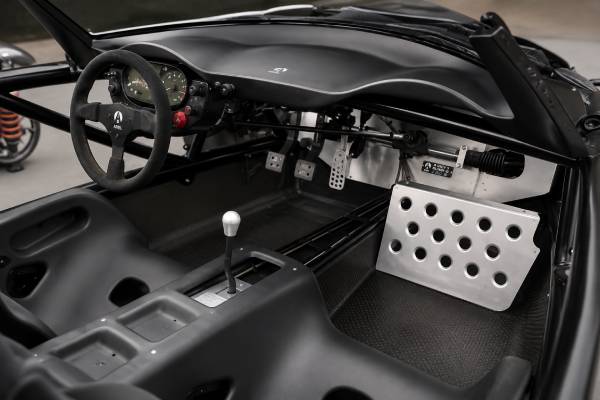
The 230 bhp North American Ariel Atom 3 is the comparatively simple K24-powered Atom: naturally aspirated, light, mechanically direct, and fast enough to expose every weakness in tyres, alignment, or driver technique. Its 2.4-litre Honda K24Z7 gives broader low- and mid-range torque than the earlier 2.0-litre cars, yet it avoids the added heat and plumbing of the turbocharged Atom 3S and 3RS. That makes the 230 a particularly appealing road-and-track ownership proposition, provided the individual car has been assembled, maintained, and set up correctly. Model-year labels are less useful than build records because North American Atoms were low-volume machines with substantial option variation. A buyer should therefore verify the chassis plate, engine code, brake package, dampers, wheel sizes, registration status, and any later modifications rather than relying on an advertisement’s shorthand. This guide explains what the 230 is, how its engineering affects the driving experience, what to maintain, and how to inspect one intelligently.
Table of Contents
- Where the 230 Fits in the Atom Range
- Atom 3 230 Technical Data
- K24 Character and Real Performance
- Making the Chassis Work
- A Service Plan Based on Use
- Inspection Before Purchase
- Living With an Open-Cockpit Car
Where the 230 Fits in the Atom Range
The Atom 3 230 is the naturally aspirated 2.4-litre North American model, built by TMI AutoTech under licence for Ariel. It is the sensible reference point for the later Atom 3 family because the turbocharged 3S and 3RS use the same broad chassis idea but add substantially more power, heat, and complexity.
That description needs a market qualifier. British Atom 3 and Atom 3.5 cars are commonly associated with 2.0-litre Honda K20 engines, while the later North American Atom 3 adopted the 2,354 cc K24Z7. Online listings frequently blend specifications from the two production streams. A North American 230 should therefore be identified through its manufacturer information, chassis number, engine stamping, and build sheet rather than through its body colour or the generic “Atom 3” name.
The K24 version’s appeal is balance. At roughly 1,350 lb, 230 bhp is not a modest output. The power-to-weight ratio remains stronger than that of many conventional supercars, and the absence of a turbocharger means throttle response is clean and predictable. The engine does not deliver the sudden mid-range surge of a 3S, but it allows a driver to meter rear-tyre load accurately and to use more of the rev range without arriving at very high speed quite as abruptly.
Individual equipment can vary considerably. North American buyers could specify different body panels, windscreens, lighting, harnesses, seats, brakes, dampers, wheels, limited-slip arrangements, and track-oriented accessories. Cars may also have been updated after delivery. The right way to describe one is not “standard” or “fully loaded,” but as a documented list of installed components.
The production dates in advertisements can also be imprecise. Low-volume cars may have a frame fabrication date, engine installation date, invoice date, state title year, and first-registration year that are not identical. For parts and valuation, the chassis number and build specification are more useful than an assumed model-year changeover.
Atom 3 230 Technical Data
The Atom 3 230 is a mid-engined, rear-wheel-drive gasoline car with a naturally aspirated Honda K24Z7 and a close-ratio six-speed manual transaxle. Its core advantage is a very low mass without forced-induction hardware, so the most meaningful specifications are output, weight, gearing, brakes, tyre fitment, and chassis dimensions.
| Specification | Value |
|---|---|
| Engine | Honda K24Z7 inline-four, aluminium block and head |
| Displacement | 2,354 cc (2.4 L) |
| Bore × stroke | 87.0 × 99.0 mm |
| Valvetrain | Chain-driven DOHC, 4 valves per cylinder, i-VTEC |
| Induction | Naturally aspirated |
| Fuel system | Electronic multi-port fuel injection |
| Maximum power | 230 hp at 7,200 rpm |
| Maximum torque | 220 lb-ft (298 Nm) at 4,300 rpm |
| Fuel capacity | 10 US gal (37.9 L) |
| Specification | Value |
|---|---|
| Engine position | Transverse mid-engine |
| Transmission | Close-ratio 6-speed manual |
| Drive | Rear-wheel drive |
| Differential | Limited-slip differential on the published 230 specification |
| Construction | Bronze-welded tubular steel spaceframe |
| Body | Open two-seat exoskeleton roadster |
| Measure | Figure | Context |
|---|---|---|
| Weight | Approximately 1,350 lb (612 kg) | Published North American specification |
| 0–60 mph | Approximately 3.3 seconds | Manufacturer estimate |
| 0–100 mph | Approximately 7.2 seconds | Manufacturer estimate |
| Quarter-mile | Approximately 11.2 seconds | Manufacturer estimate |
| Specification | Value |
|---|---|
| Front suspension | Unequal-length double wishbones with inboard pushrod-operated dampers |
| Rear suspension | Unequal-length double wishbones with inboard pushrod-operated dampers |
| Steering | Unassisted rack and pinion |
| Brake discs | 290 mm ventilated discs |
| Brake actuation | Unassisted hydraulic system |
| Tyres | Track-oriented fitments varied with wheel option and build |
| Dimension | Value |
|---|---|
| Length | 3,410 mm (134.3 in) |
| Width | 1,890 mm (74.4 in) |
| Height | 1,195 mm (47.0 in) |
| Wheelbase | 2,345 mm (92.3 in) |
| Track | 1,600 mm (63.0 in) |
These figures describe the published North American K24 car, not every option combination. A windscreen, larger wheels, upgraded brakes, different dampers, additional bodywork, or road equipment can change weight and behaviour. Performance figures are manufacturer estimates obtained under favourable conditions; tyre temperature, surface grip, launch technique, elevation, and driver mass have unusually large effects in such a light vehicle.
K24 Character and Real Performance
The naturally aspirated K24 makes the 230 progressive rather than tame. Its long 99 mm stroke supplies useful torque before the upper rev range, while the absence of boost gives the driver a direct relationship between pedal position and rear-axle demand.
That broad torque curve suits road driving. The car does not need to be held at maximum rpm to feel urgent, and a higher gear can often be used through medium-speed bends without waiting for a compressor to respond. On track, the same characteristic reduces the chance of a sudden torque increase disturbing the rear tyres as steering lock is removed.
The engine remains a high-output installation in an unusual environment. It sits behind the occupants with limited acoustic insulation and little thermal shielding compared with a production Honda. Mechanical sounds that would be hidden in a saloon are obvious. Injector tick, chain noise at start-up, valvetrain sound, gearbox whine, and intake resonance can all be heard clearly. Diagnosis should therefore be based on changes, oil pressure, fault data, leak-down or compression evidence, and informed inspection rather than on the mere presence of noise.
Acceleration depends heavily on traction. A power-to-weight calculation may suggest exotic-car performance, but the first few metres are governed by rear tyre compound, temperature, pressure, surface, clutch technique, and the absence of substantial mass over the driven axle. A poorly launched 230 can be slower than its headline figure; a well-driven car on warm tyres can feel more immediate than a much more powerful conventional vehicle.
At higher speed, aerodynamic drag rises sharply because the wheels, suspension, occupants, and frame are exposed. The Atom is therefore more impressive in acceleration and response than in relaxed high-speed cruising. A windscreen can reduce direct blast but adds turbulence and changes the pressure around the cockpit. Helmets, eye protection, and secure loose clothing are practical equipment, not theatrical accessories.
The six-speed gearbox is central to the experience. Shift quality should be positive without baulking, grinding, or a tendency to leave gear under load. Clutch take-up should be smooth and the limited-slip differential should not produce abnormal banging or binding. Because many cars have seen standing starts or circuit use, drivetrain condition matters more than the Honda engine’s reputation for durability.
A stock 230 also has a useful tuning lesson: more power is not automatically an upgrade. Forced-induction conversions alter cooling load, fuelling, clutch demand, tyre requirement, calibration, and resale clarity. A carefully maintained naturally aspirated car is often easier to use consistently and easier to sell than a modified example with impressive dyno numbers but incomplete documentation.
Making the Chassis Work
The Atom 3 chassis rewards accuracy, and setup errors are felt immediately because there is little mass or compliance to disguise them. Before buying expensive parts, establish correct ride height, corner weights, alignment, tyre condition, damper settings, and control-joint freedom.
The double-wishbone suspension uses pushrods to operate inboard springs and dampers. This keeps unsprung components compact and makes the mechanical action visible, but it also means every rod end, spherical bearing, fastener, and mounting point is exposed to water, grit, tyre debris, and careless cleaning. A visual inspection should look for play, corrosion, cracked boots where fitted, bent pushrods, witness marks, and fasteners that have moved relative to their paint marks.
Alignment is not a generic road-car exercise. Toe changes measured in small increments can alter stability, turn-in, tyre temperature, and steering feel. Camber that works on a smooth circuit and hot semi-slick tyres may make a road car nervous, reduce wet grip, and wear the inner shoulders. The useful setup is the one that matches the actual tyre, driver, circuit surface, and road use—not the most aggressive numbers copied from a forum.
Corner-weighting is particularly valuable after damper replacement, spring changes, accident repair, or a major change in driver and passenger loading. The goal is not merely identical scale readings. It is balanced diagonal loading at the intended ride height with the driver or representative ballast in place, while retaining adequate pushrod and damper travel.
Tyres are the Atom’s primary safety system. Check the four-digit date code, heat-cycle history, flat spotting, tread cracking, shoulder wear, and evidence of pickup from track use. A semi-slick can retain tread depth while becoming hard and slow. Cold pressure is only a starting point; hot pressures and temperature spread across the tread reveal more about whether the tyre and alignment are working.
The unassisted brakes need the same disciplined approach. A firm pedal with short travel is normal; a long or inconsistent pedal is not. Inspect disc faces and mounting hardware, pad thickness on both sides of each caliper, fluid age, hose routing, and any heat damage near the uprights. Different pad compounds front and rear can alter balance dramatically, so record what is installed before changing only one axle.
Damper adjusters should move through their ranges and produce a perceptible but not theatrical change. Do not assume the highest setting is the fastest. Excessive low-speed damping can reduce compliance and grip, while an over-soft car can run out of platform control under braking or through fast direction changes. Return unknown settings to a documented baseline and change one variable at a time.
A Service Plan Based on Use
The most effective Atom maintenance schedule is based on operating hours and severity, not mileage alone. A 1,000-mile season of short road trips is different from 1,000 miles of high-rpm circuit running, repeated heat soak, kerb strikes, and trailering contamination.
For the K24Z7, Ariel North America’s oil guidance should take priority over generic internet recommendations. The company’s technical material lists the appropriate viscosity and capacity by installation; for this family, 0W-20 and an approximately five-quart service fill are common reference points, but the final level must be checked by the approved procedure on the exact car. Filter choice, oil cooler volume, hose changes, and engine position can affect the amount required.
Oil should be inspected for fuel smell, metallic debris, water contamination, and abnormal consumption. Track-driven cars benefit from shorter intervals and periodic analysis because oil temperature and sustained lateral load matter more than the calendar. An unexplained drop in pressure, rising temperature, or repeated need to top up should be investigated before further hard running.
Cooling-system service deserves equal attention. Confirm the correct coolant type, inspect the front radiator and long coolant lines, look for chafing at clamps, and check the expansion system when cold. Air trapped after service can create local overheating even when the dashboard display appears acceptable. Follow the Ariel bleeding procedure, raise or position the car as directed, and verify heater-independent circulation because the Atom does not mirror a normal Honda chassis layout.
The exposed drivetrain and suspension require frequent torque and condition checks. Before a track event, inspect wheel fasteners, brake hardware, rod ends, pushrods, engine mounts, exhaust supports, fluid leaks, throttle operation, harness dates, seat mounts, steering joints, and battery retention. After the event, repeat the inspection while tyre pickup and fresh witness marks are still visible.
Brake fluid should be selected for the actual temperature demand and replaced before moisture lowers its boiling point. Pads should be changed with enough material remaining to control heat; running them to a road-car minimum can overheat pistons and seals. Record disc thickness and condition rather than relying only on appearance.
Fuel should not be allowed to age in a lightly used car. The small tank makes fresh filling easy, while extended storage can create injector deposits and moisture issues. Use the octane required by the calibration, keep the battery on an appropriate maintainer, protect exposed electrical connectors from direct pressure washing, and rotate or support the tyres to avoid flat spots during long storage.
A maintenance log should include date, mileage, operating hours if available, events attended, fluids and brands, torque checks, alignment values, tyre heat cycles, fault codes, and photographs. That record improves troubleshooting and substantially strengthens a future sale.
Inspection Before Purchase
Buy the best-documented chassis and installation, not the lowest odometer reading. The Honda engine is only one component in a hand-built, exposed, frequently track-used car, and a strong engine cannot compensate for a bent frame, tired joints, poor wiring, or an uncertain title.
Begin with identity. Match the chassis plate, vehicle identification number, invoice, registration, and engine information. Confirm who manufactured the car and where it is legally registered. Rules for kit, reconstructed, specially constructed, or manufacturer-titled vehicles differ by jurisdiction, and a valid title in one state does not guarantee simple transfer elsewhere.
Ask for the original build sheet and all later invoices. Create a list of every non-standard component: ECU, intake, exhaust, cams, clutch, differential, brakes, dampers, springs, wheel sizes, tyres, body panels, lighting, windscreen, and safety equipment. A modification is not automatically bad, but it needs a known supplier, a clear purpose, and evidence that the related systems were addressed.
Inspect the frame in bright light. Look for distorted tubes, fresh paint, local grinding, unusual welds, cracked coating around joints, asymmetrical suspension pickup points, and floor or side-panel damage. Stone chips are normal; ripples, heat marks, or repairs without documentation require specialist assessment. Measure alignment and corner weights if accident history is uncertain.
A cold start is more useful than a warmed demonstration. Verify that the engine is genuinely cold, watch oil-pressure behaviour if instrumentation is fitted, listen for persistent chain or bearing noise, and check for smoke. After warm-up, confirm stable temperature, clean throttle response, fan operation, charging voltage, and absence of coolant smell or fluid seepage.
During a road or track test, the steering should be precise around centre without free play. The car should brake straight, hold a line, and shift cleanly at both low and high rpm. Vibration can come from tyre pickup or flat spots, but it can also indicate bent wheels, worn bearings, driveshaft issues, or alignment damage. Do not accept “they all do that” without isolating the cause.
Examine consumables as a group. Four old tyres, thin pads, heat-checked discs, leaking dampers, expired harnesses, and a tired clutch can turn an apparently fair price into an expensive first season. Obtain replacement pricing before negotiating because low-volume parts and specialist labour can be more costly than the familiar Honda badge suggests.
Finally, arrange a pre-purchase inspection with a shop that understands Atoms or comparable spaceframe track cars. A conventional dealership checklist may miss rod-end play, frame alignment, race-harness age, corner-weight imbalance, calibration quality, or exposed wiring problems.
Living With an Open-Cockpit Car
The Atom 3 230 works best for an owner who values sensation and mechanical involvement above weather protection, luggage capacity, and effortless transport. It can be road registered in many places, but legality, insurance, emissions requirements, and equipment rules must be confirmed locally before purchase.
Access is physical. Occupants step over the frame, lower themselves into fixed or minimally adjustable seating, and manage harnesses in a confined space. A test fit with the intended helmet is essential. Check steering-wheel reach, pedal position, knee clearance, harness angle, and the ability to operate the clutch fully without lifting from the seat.
Weather changes the risk profile quickly. Rain reaches controls and electrical connectors, standing water can overwhelm semi-slick tyres, and cold conditions reduce available grip. A windscreen does not turn the Atom into a sealed roadster. Carry eye protection, hearing protection, suitable clothing, and a plan for securing anything that could leave the cockpit.
Transport strategy affects ownership cost. Some owners drive to events, while others use an open or enclosed trailer to preserve tyres, carry tools, and avoid being stranded after a mechanical problem. Confirm trailer width, ramp angle, tie-down points, and local towing requirements. Never attach straps to vulnerable suspension members simply because they are easy to reach.
The 230’s relative simplicity is a major advantage. It offers authentic Atom steering and braking feel without the thermal burden of a large turbo system, and its usable torque makes it less demanding on ordinary roads than an early high-revving 2.0-litre car might appear. It can also be the better learning platform: speed comes from braking, line choice, balance, and throttle timing rather than from relying on a huge power reserve.
Alternatives depend on the desired experience. A Caterham offers a similarly exposed format with different weight distribution and heritage. A Lotus Elise or Exige adds a windscreen, doors, and bodywork while retaining low mass. A modern track-focused coupe is easier to insure and use but cannot reproduce the Atom’s visual exposure or unassisted controls. Within the Ariel family, a 3S adds turbocharged urgency, while an Atom 4 brings a newer chassis and turbo K20C architecture at a higher purchase and maintenance level.
Value is driven by specification, documentation, legal status, and condition more than by nominal year. Originality can help, but well-executed updates from recognized suppliers may be desirable. The strongest car is one whose history explains exactly what it is, why each change was made, and how it has been serviced.
References
- Ariel Atom, Ariel Nomad, Ariel North America History – Ariel North America 2026
- 2014-Current Ariel Atom 3 and Ariel Atom 3S – Reference Material 2018 (Reference Manual)
- Ariel Atom Oil Specifications and Capacities 2026 (Service Reference)
- Ariel Cooling System Bleeding 2026 (Service Procedure)
- Ariel Atom 3 – ACE Performance 2026
- Ariel Atom 3 | PH Used Buying Guide 2021
Disclaimer
This guide is for general informational purposes. Ariel Atoms are low-volume, individually specified vehicles, and equipment, output, legal status, service requirements, and dimensions can differ by build and market. Verify the chassis number, build sheet, installed parts, manufacturer instructions, and local registration rules before purchasing, servicing, modifying, or driving a particular car. Please share this guide with another owner or buyer if it helps them make a better-informed decision.