


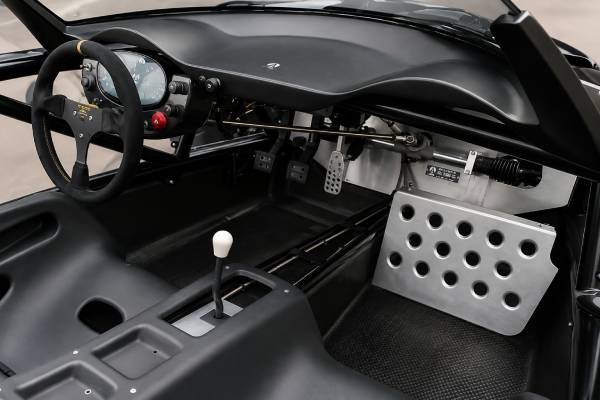
The North American Ariel Atom 3 245 paired the third-generation chassis with a Japanese-market Honda K20A, Hondata management, and a close-ratio six-speed transaxle. Built under licence at Virginia International Raceway by TMI AutoTech after production transferred from Brammo, it was related to the British Atom 3 but not interchangeable with every UK specification. The naturally aspirated 245 was the mechanical baseline: no supercharger belt, no added boost heat, and an engine that asked the driver to use its upper rev range. That simplicity is attractive today, yet it does not make the car maintenance-free. Exposed suspension joints, track use, storage conditions, registration history, and build-specific options can matter more than odometer mileage. This guide treats the 2008–2012 K20A 245 as a North American licensed-production model, distinguishes it from K20Z4 and later K24 cars, and explains how to evaluate its performance, service requirements, and documentary history.
Table of Contents
- North American Atom 3 Identity
- K20A 245 Specs and Equipment
- A Rev-Led Driving Experience
- Service by Use, Not Odometer
- Registration, Storage, and Aging
- Buying a TMI-Built 245
North American Atom 3 Identity
A North American Atom 3 245 should be identified by builder, chassis record, engine, and installed equipment before any specification is assigned to it. TMI AutoTech began producing the Atom 3 at Virginia International Raceway after Brammo’s Atom operation ended, and the resulting cars used a Honda-only powertrain strategy that differed from many earlier American Atom 2s.
This production history matters because online listings frequently blend three separate groups. Brammo-built Atom 2s can have Honda K20A or supercharged General Motors Ecotec power. TMI’s early Atom 3 used the 2.0-litre K20A in 245 hp naturally aspirated and 300 hp supercharged forms. Later North American Atom 3 production adopted 2.4-litre Honda K24 variants, eventually including the turbocharged Atom 3S. A frame that looks broadly similar can therefore surround a very different engine, cooling layout, weight, wiring system, and parts requirement.
The K20A car is usually easy to distinguish physically once the rear installation is inspected, but documentary confirmation remains necessary. Record the chassis number, engine code and number, ECU type, dash type, and builder plate. Ask TMI’s successor organisation or an experienced North American Ariel specialist for available build information. An advertisement that says only “Honda 2.0” or “245 package” is insufficient, especially after years of engine swaps and tuning.
TMI’s Atom 3 was closer to the UK third-generation concept than the previous North American Atom 2. Period reporting described frame, suspension, seating, and damper changes, including specifically tuned Bilstein dampers. However, American cars still had market-specific construction, option pricing, road-registration circumstances, and sometimes heavier equipment. Quoting a very low UK dry-weight figure for a North American car can therefore be misleading.
The naturally aspirated 245 also deserves to be separated from its supercharged sibling. Both use the K20A and a six-speed manual, but the 300 option added a non-intercooled Jackson Racing supercharger and approximately 7 psi of boost. A car now carrying a supercharger may have started as a 245, and a car returned to naturally aspirated form may retain altered fueling, pulleys, exhaust components, or paperwork. The original build sheet resolves questions that appearance alone cannot.
For ownership, provenance is practical rather than merely historical. Correct identification determines the right oil capacity, belt list, ECU support, replacement components, alignment baseline, and resale description. It also helps avoid ordering K20Z4-specific UK parts or later K24 components that do not fit.
K20A 245 Specs and Equipment
The model’s core specification is a naturally aspirated 1,998 cc K20A producing 245 hp and 170 lb-ft, mounted transversely behind two occupants and connected to a six-speed manual transaxle. Chassis equipment varied widely because brakes, dampers, wheels, windscreens, body panels, and track hardware were selectable.
| Item | North American Atom 3 245 |
|---|---|
| Engine | Honda K20A i-VTEC inline four |
| Displacement | 1,998 cc |
| Construction | Aluminium block and head, DOHC, four valves per cylinder |
| Induction | Naturally aspirated |
| Power | 245 hp at 8,400 rpm |
| Torque | 170 lb-ft at 5,800 rpm |
| Management | Hondata-based calibration |
| Oil control | Baffled sump reported on period TMI specification |
| Item | Specification |
|---|---|
| Layout | Rear-mid-engine, rear-wheel drive |
| Transmission | Honda six-speed manual transaxle |
| Differential | Limited-slip differential in the cited North American specification |
| Shift mechanism | Cable-operated manual linkage |
| Seating | Two fixed or adjustable-position seats, option dependent |
| Measure | Period North American figure |
|---|---|
| Wheelbase | 92.3 in / 2,345 mm |
| Length | 134.3 in / 3,411 mm |
| Width | 72.0 in / 1,829 mm in the cited test specification |
| Height | 47.0 in / 1,194 mm |
| Published weight | 1,375 lb in cited period reporting |
| Fuel capacity | 40 liters in later TMI reference material |
| System | Typical equipment |
|---|---|
| Frame | Welded tubular steel spaceframe |
| Suspension | Double unequal-length wishbones with pushrod-actuated coil-overs |
| Dampers | Bilstein standard-era fitment; multi-adjustable options available |
| Steering | Quick, unassisted rack and pinion |
| Brakes | Four-wheel discs; optional Alcon four-piston package |
| Measure | Expected range or context |
|---|---|
| 0–60 mph | About 3.0 seconds under favourable test conditions |
| Top speed | Approximately 140–155 mph depending on gearing and setup |
| Character | Power concentrated at high rpm with immediate naturally aspirated response |
The safest way to use these tables is as an identification framework. A windscreen, full lighting package, road hardware, alternative wheels, upgraded brakes, adjustable dampers, or additional protection can move the actual mass substantially. Likewise, an ECU recalibration or exhaust does not prove that the engine still produces its original figure. A current dyno test can describe present condition, while the build sheet describes original specification.
A Rev-Led Driving Experience
The 245’s defining quality is the way speed builds with engine rpm rather than boost pressure. It is exceptionally quick by ordinary standards, but its progressive naturally aspirated delivery gives the driver more room to learn the Atom 3 chassis than the supercharged version provides.
Below the high cam’s most aggressive range, the K20A is flexible enough to circulate without constant shifting. Period drivers noted that the car could remain in one gear through a small course when conditions were poor. That usability should not be confused with a torque-heavy character. Maximum performance arrives when the driver keeps the engine in the upper half of the rev range and uses the short, accurate six-speed gearbox.
The throttle response is valuable on a car with so little inertia. A small lift transfers load forward immediately; an abrupt lift in a loaded corner can rotate the rear rapidly. The absence of supercharger torque does not remove this trait, because it comes from layout, low mass, short responses, and the driver’s relationship with the controls. Smooth release and progressive reapplication are more important than bravado.
The steering conveys front-tyre load without hydraulic or electric assistance. At parking speed it requires effort, but once moving it is light and exceptionally direct. A correctly set up car should not feel loose around centre. Tramlining can come from tyre construction, pressure, toe settings, worn joints, or road surface. The answer is to diagnose the system, not to normalise every nervous response as part of the model’s personality.
The 245’s narrower performance envelope can be an advantage on real roads. More of the throttle travel can be used without instantly overwhelming cold rear tyres, and the engine encourages deliberate downshifts. The sound and vibration build toward the red line, making acceleration an event without requiring supercharged thrust at every exit. For many owners, this is the version that best preserves the connection between action and consequence.
On track, the naturally aspirated car rewards momentum. Braking too early and relying on power to recover costs more than it does in the 300. Clean lines, stable releases, and correct gear choice produce speed. This can make the 245 a better training platform, although its acceleration and grip are still far beyond a typical road car. Instruction from someone familiar with lightweight, mid-engine machinery is a worthwhile first upgrade.
Tyres have an outsized influence on the experience. Period American tests used combinations such as 205/50R15 front and 225/45R16 rear, but current cars may wear different wheels and compounds. A road-biased tyre warms more readily and copes better with standing water; a track tyre offers more dry grip after reaching temperature but can be treacherous when cold. Age and heat cycles matter as much as tread depth.
Braking performance depends on pedal control because conventional driver aids are generally absent. The car needs relatively little energy to stop compared with a heavy sports car, so standard brakes can be effective. Larger Alcon hardware adds thermal capacity and pedal sophistication, not permission to ignore fluid age or pad condition. A hard pedal with predictable modulation is preferable to an over-assisted sensation.
Service by Use, Not Odometer
Mileage alone is a poor service measure for an Atom 3 245. A low-mileage track demonstrator can have experienced hundreds of full-load shifts and heat cycles, while a higher-mileage road car may have accumulated gentler running but more weather exposure.
Establish a known fluid baseline after purchase. Use the oil grade and capacity specified for the actual engine and builder documentation, not a generic UK Atom chart or a later K24 guide. Later TMI service material calls for a quality synthetic engine lubricant, Honda-specified fluid in the manual transaxle, compatible DOT 3 or DOT 4 hydraulic fluid, and shorter intervals when the car is used hard. The principle is applicable, but the exact quantities and procedures must match the K20A installation.
Engine oil should be checked frequently, especially before and after track running. The car can generate sustained lateral load, and the engine operates at high rpm when used as intended. Investigate consumption trends rather than merely topping up. An unexplained increase can indicate leakage, ring or valve-seal wear, excessive crankcase pressure, or oil-control trouble. Cut open the filter periodically on a heavily tracked car to look for metallic debris.
Valve clearance is part of K-series care. A documented check at the appropriate interval is more reassuring than a seller’s statement that Honda engines never need adjustment. Listen for an abnormal top-end tick, but do not diagnose clearances by sound alone. The engine should be checked cold using the correct procedure and specifications.
The transmission requires clean fluid and a clutch that releases fully. Difficulty engaging gears can stem from linkage adjustment, cable wear, clutch hydraulics, synchronisers, or drivetrain mounts. Inspect the master and slave cylinders for leaks, check pedal travel, and note whether the problem changes with temperature. A short, precise shift is normal; grinding and forced engagement are not.
The chassis should be inspected before every serious event. Check rod ends, pushrods, wishbones, upright hardware, steering joints, wheel bearings, brake lines, driveshafts, mounts, and fasteners. TMI’s later maintenance material specifically calls out rod ends, steering rack, suspension components, drive axles, hoses, lines, mounts, and wheel bearings. That list reflects the exposed car’s actual priorities.
Brake fluid is time-sensitive even when the pads look new. Moisture lowers boiling resistance and promotes internal corrosion. Replace it on a sensible schedule and bleed until the pedal is consistent. Examine flexible lines for abrasion where they pass the frame. Measure discs and pads, inspect calipers for leakage, and ensure any adjustable bias mechanism moves freely and is set deliberately.
Cooling-system service includes more than replacing coolant. Inspect the long pipes and hose connections between the rear engine and front radiator, verify fan operation, and bleed air properly. Temperature should stabilise in traffic and under load. White residue around a joint, intermittent heaterless-system gurgling, or a level that repeatedly changes deserves investigation.
Storage preparation is equally important. Fresh oil, stabilised fuel, a maintained battery, clean dry surfaces, and protection from rodents and moisture prevent many problems. Later TMI instructions warn against jump-starting sensitive electronics and recommend battery isolation for extended storage. Whether the exact electrical architecture matches should be checked, but cautious charging and a healthy battery are always preferable to voltage spikes.
Registration, Storage, and Aging
For a North American Atom, legal identity can be as important as mechanical condition. Registration routes differ by state or province, and a title that worked for one owner may not transfer cleanly to another jurisdiction.
Review the title, manufacturer’s certificate or origin documents, assembly records, VIN or chassis identification, emissions paperwork where applicable, and every prior registration. The Atom has been treated variously as a specially constructed vehicle, kit, replica, or other category. Do not assume that a current plate guarantees future acceptance after an interstate sale. Contact the destination authority before purchase and use the exact documents, not a verbal description.
Road equipment also varies. Windscreens, fenders, mirrors, lighting, reflectors, parking brakes, mufflers, and licence-plate mounts may have been installed for inspection and later removed. Confirm what the local rules require and whether the original parts accompany the car. Recreating a compliant package can be expensive, especially when mounting points or wiring have been altered.
Environmental exposure leaves clear evidence because there is almost no enclosed body. Inspect the lower frame rails, suspension pickups, fasteners, pedal box, seat mounts, harness hardware, electrical connectors, and instrument housing. Powder-coat chips can allow corrosion to spread beneath the surface. Salt exposure is particularly serious. A car transported on an open trailer in winter may receive contamination without ever being driven on the road.
Composite panels age differently from the frame. Fading, clouding, star cracks, and worn fastener holes can be cosmetic, but fresh panels on one corner may also follow an impact. Look behind them. A small excursion can bend wishbones or brackets while leaving the central frame intact; a larger one can distort the structure. Compare left and right pickup geometry and seek a specialist measurement when anything appears asymmetric.
Harnesses, seats, and safety equipment have dates and condition limits. Webbing damaged by ultraviolet light or stored damp should not be trusted because the odometer is low. Examine stitching, adjusters, mounting angles, and anchor hardware. Verify that a helmet and head-restraint system are compatible with the seat and harness if the car will be used on track.
Tires may look nearly new for years because the car is light and mileage is low. Date codes, hardening, flat spots, and heat cycles reveal more than tread depth. Replace questionable tyres before judging chassis balance. Likewise, fuel cells or aluminium tanks, hoses, seals, and filters age even when the vehicle is stationary. Smell for fuel, inspect connections, and investigate staining immediately.
A battery tender, indoor storage, and a cover do not prove good stewardship. Ask how often the car was run to full temperature, whether coolant and brake fluid were changed by time, how the frame was cleaned, and whether the tyres were unloaded during long storage. Good answers usually come with records.
Buying a TMI-Built 245
The best TMI-built Atom 3 245 is the car with a clear North American build identity, unambiguous legal documents, and evidence of methodical use. Low mileage and cosmetic shine rank below frame integrity, correct setup, and service history.
Begin remotely by requesting photographs of the chassis plate, engine code, ECU, rear powertrain, front and rear suspension, underside, brakes, wheels, dash, and title identifiers. Ask for the original order or build sheet. List every claimed option and match it to the photographs. A seller who cannot distinguish a damper brand or brake package may simply be unfamiliar; a seller whose description changes when challenged requires caution.
At inspection, start cold and keep the car stationary while checking fluids and exposed systems. Look beneath the engine and gearbox for fresh cleaning or seepage. Check coolant level and hose condition. Turn on the master electrical system, verify immobiliser behaviour, inspect the dash for warnings, and confirm charging voltage after start. The engine should settle to a stable idle without persistent smoke or heavy mechanical noise.
Use a lift or safe stands to check the structure and suspension. Every spherical joint should move without binding and show no unacceptable play. Check wheel bearings, CV joints, driveshaft boots, steering rack mounts, wishbone welds, and pushrods. Inspect the floor and lower rails for impact. Verify wheel condition and correct fasteners. If the car uses two-piece brakes, evaluate disc hardware according to the manufacturer’s limits rather than by appearance alone.
A road or track test should progress from control operation to load. Confirm clutch take-up, gear selection, steering centre, pedal consistency, and temperature stability before approaching high rpm. The K20A should rev cleanly and pull with increasing intensity. Hesitation near the cam change, misfire under load, smoke after overrun, or oil-pressure warnings require diagnosis. Do not conduct maximum acceleration on cold tyres or an unknown calibration.
Ask how the car was used. Track days are not automatically harmful; they often encourage frequent inspection. More concerning signs are repeated standing-start demonstrations, missed-shift stories, no fluid log, old tyres, and no geometry records. A car maintained by a track specialist may be a safer purchase than an untouched display vehicle.
Commission compression or leak-down testing when engine history is uncertain. Review ECU data for over-revs if accessible. Check that the engine, gearbox, and calibration correspond to one another. Modifications should have invoices and a clear purpose. Intake and exhaust changes without a known map may reduce drivability even when they look desirable.
Plan an initial recommissioning budget. Replace unknown fluids, service the filters, inspect valve clearance, align and corner-weight the chassis, renew dated tyres or harnesses, and correct exposed wiring. Carry appropriate spares and tools for events, but avoid turning the car into a mobile parts shelf. Reliability comes from preparation, not from assuming every failure can be fixed trackside.
The naturally aspirated 245 occupies a useful position in Atom history. It delivers the K20A’s full high-rpm character without the extra belt, heat, and calibration dependencies of the 300, while the TMI-built Atom 3 chassis gives it a more developed foundation than the earlier North American car. Bought with accurate documentation and maintained according to use, it remains a remarkably transparent machine for learning, road enjoyment where legal, and sustained circuit work.
References
- Ariel Atom 3
- Ariel Atom 3: First Drive
- Ariel Atom 3 and Ariel Atom 3S Reference Material
- Ariel Atom 3 | PH Used Buying Guide
- 2001-present Ariel Atom buying guide from Magneto magazine
- Ariel Atom 3S – Ariel North America
Disclaimer
North American Ariel Atom specifications, legal classifications, fluids, equipment, and service procedures vary by builder, build date, jurisdiction, and modification history. Confirm the chassis identity, K20A engine, factory record, title status, and installed components with the relevant manufacturer or qualified specialist before purchase or maintenance. Consult the destination registration authority before relying on an existing title. Use high-performance capability only in legal, controlled conditions, and share this guide when it can help another owner verify and preserve a correctly specified Atom 3 245.