

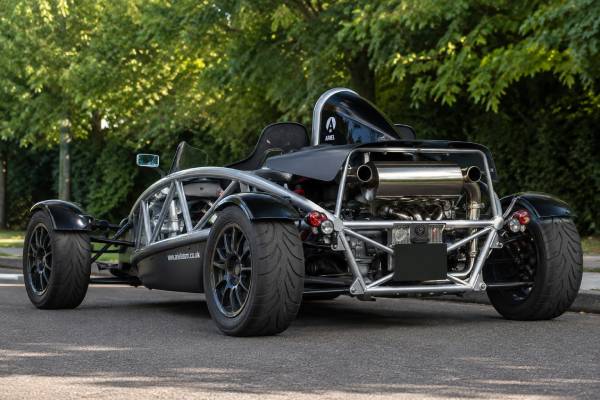
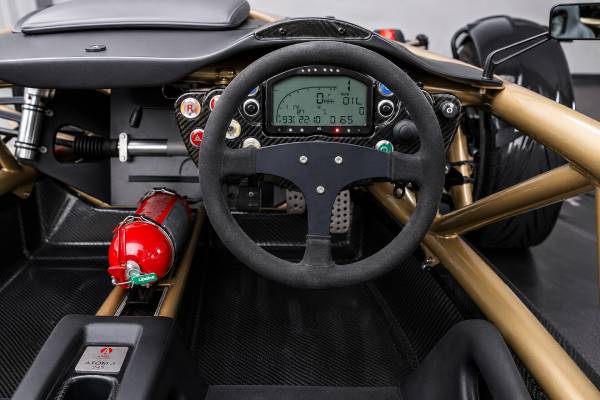
The naturally aspirated Ariel Atom 3 245 is often the most coherent version of the third-generation car. Its 2.0-liter Honda K20Z4 produces 245 hp at 8,200 rpm, but the absence of a supercharger keeps weight, heat, and torque delivery comparatively simple. In a machine weighing around half a tonne, that is already enough for a claimed 0–60 mph time near 2.7 seconds. More important, the engine rewards accurate shifts and progressive throttle use instead of relying on a broad wall of boost. The Atom 3 also improved the earlier car with a stiffer frame, revised suspension, a better gear-change mechanism, and practical detail changes while retaining the exposed pushrod chassis and unassisted controls. As a used purchase, the 245 can be less expensive to maintain than a forced-induction model, but it is not a casual ownership proposition. Track history, chassis condition, rod-end wear, tire age, registration status, and the exact factory option list determine whether an example is a sharp, dependable driver or a costly reconstruction project.
Table of Contents
- The Case for the Naturally Aspirated 245
- K20Z4 Atom 3 Specifications
- VTEC, Gearing, and Real Performance
- What the Atom 3 Chassis Changed
- Road Use, Track Use, and Setup
- Service Needs and Aging Components
- How to Buy the Right Atom 3 245
The Case for the Naturally Aspirated 245
The 245 is fast enough to expose every weakness in driver technique while remaining easier to meter than the supercharged 300. That balance makes it particularly attractive for owners who value steering, braking, and corner-entry precision over the strongest possible straight-line acceleration.
Ariel introduced the Atom 3 in 2007 with the newer European Civic Type R engine, commonly identified as the K20Z4. The company remapped the engine and changed the intake and exhaust to raise output beyond the donor Honda’s rating. Contemporary road tests noted that the i-VTEC changeover arrived earlier and the engine continued to pull to roughly 8,600 rpm, giving the car a long, dramatic upper range.
The model name is straightforward only at first glance. Advertisements may call the engine K20, K20Z, K20Z4, or simply Honda Type R. Some registration databases list model year by first registration rather than build date, and cars ordered late in the Atom 3 run can carry later lighting or option details. Use the chassis number and Ariel’s records to establish the actual specification.
The naturally aspirated car has several practical advantages over a 300:
- No supercharger belt, pulley, bypass valve, or charge-cooling circuit to maintain.
- Lower thermal load around the engine bay during repeated use.
- Less low- and mid-range torque trying to overwhelm cold rear tires.
- A lighter installation in typical specification.
- Easier diagnosis because intake pressure and calibration are less complex.
- A power delivery that encourages learning the gearbox and maintaining momentum.
Those advantages do not make it slow. A 245 hp Atom can accelerate harder than many contemporary supercars because it has so little mass to move. It also places fewer electronic filters between the driver and the consequences of a mistake. There is normally no stability control and no conventional cabin structure to reduce the sensation of speed.
The 245 should not be dismissed as the “entry” Atom. For road driving, tight circuits, driver coaching, and owners who want to use full throttle more often, it can be the more satisfying choice. The 300’s extra torque matters most on longer straights and in higher gears; it does not automatically make a poorly driven car quicker over a complete lap.
K20Z4 Atom 3 Specifications
This is a gasoline ICE vehicle with a transverse, naturally aspirated K20Z4 mounted behind the seats and driving the rear wheels through a six-speed manual transaxle. Factory options were extensive, so weights, brakes, dampers, wheels, and road equipment should be verified against each car’s build sheet.
| Specification | Value | Notes |
|---|---|---|
| Engine code | Honda K20Z4 | European Civic Type R-derived installation |
| Configuration | Inline-four, DOHC, 16 valves, i-VTEC | Aluminum block and cylinder head |
| Displacement | 1,998 cc (2.0 L) | Naturally aspirated petrol engine |
| Bore × stroke | 86 × 86 mm | Square geometry |
| Compression ratio | 11.5:1 | Period European specification |
| Fuel delivery | Multi-point fuel injection | Electronic engine management |
| Fuel-tank capacity | Approximately 40–42 L (10.6–11.1 US gal) | Period documentation differs by tank and market |
| Specification | Value | Condition |
|---|---|---|
| Maximum power | 245 hp (180 kW) at 8,200 rpm | Published factory-era figure |
| Maximum torque | 210 N·m (155 lb-ft) at 6,100 rpm | Published factory-era figure |
| 0–60 mph | 2.7 seconds | Claimed period figure; launch surface and tires are critical |
| 0–100 mph | 7.5 seconds | Claimed period figure |
| Top speed | 240 km/h (149 mph) | Claimed period figure |
| Quoted weight | 500 kg (1,102 lb) | Cited period figure; equipment and weight definition affect comparison |
| Specification | Value |
|---|---|
| Gearbox | Close-ratio six-speed manual with reverse |
| Clutch | Hydraulically operated single-plate clutch |
| Drive type | Rear-wheel drive |
| Differential | Open or limited-slip depending on factory option and build |
| Shift mechanism | Revised Atom 3 cable/remote arrangement |
| Final drive | Honda transaxle; ratio must be checked by gearbox specification |
| Specification | Value |
|---|---|
| Body style | Open two-seat exoskeletal sports car |
| Length | 3,410 mm (134.3 in) |
| Width | 1,798 mm (70.8 in) before wider wheel or body effects |
| Height | 1,195 mm (47.0 in) |
| Wheelbase | 2,345 mm (92.3 in) |
| Front and rear track | 1,600 mm (63.0 in) |
| Seating | Two occupants in a fixed composite seat unit |
| System | Typical Atom 3 specification |
|---|---|
| Frame | Tubular steel spaceframe with non-structural composite panels |
| Suspension | Unequal-length wishbones with pushrod-actuated coilovers |
| Steering | Unassisted rack-and-pinion, about 1.7–1.75 turns lock to lock |
| Standard brake concept | Disc brakes with manual pedal effort; larger Alcon packages optional |
| Common wheel diameters | 15 in front and 16 in rear |
| Common tire widths | 195 mm front and 225 mm rear in a period fitment |
The broad fuel-capacity and equipment wording is intentional. Ariel built cars to order, and period market brochures do not always describe the same tank, wheel, brake, or road package. A shorter, verified table is more useful than pretending every Atom 3 245 left the factory identically.
VTEC, Gearing, and Real Performance
The engine produces its best performance through revs and close gear spacing, so the 245 rewards anticipation more than brute-force throttle. Letting the engine fall too far below its strong range can make it feel ordinary; keeping it above the cam changeover turns the car into a very different machine.
Ariel’s intake, exhaust, and calibration make the K20Z4 more vivid than it is in a Civic Type R. The intake is close to the driver’s head, the exhaust has little distance to mute combustion pulses, and the car’s low mass allows every change in torque to affect acceleration immediately. Contemporary testers described the induction note as dominating the experience.
The published 210 N·m torque peak arrives at 6,100 rpm, while maximum power comes at 8,200 rpm. That narrow gap between peak torque and peak power explains why the upper half of the tachometer matters. The engine is usable below that point, but maximum acceleration requires the driver to select the correct ratio before corner exit rather than relying on a large reserve of low-speed torque.
The six-speed gearbox is therefore part of the powertrain, not an afterthought. Atom 3 changes improved the feel compared with some earlier remote shifters. A healthy system should select each ratio cleanly with a precise gate. Excessive side play, refusal to engage when hot, crunching on fast shifts, or jumping out of gear deserves diagnosis.
Acceleration claims near 2.7 seconds to 60 mph depend on traction and technique. The engine may have enough power, but a standing start is limited by rear-tire temperature, surface grip, clutch engagement, and wheelspin. Repeated launch attempts create heat in the clutch and differential without revealing much about the car’s cornering ability. For a buyer, a smooth pull through third and fourth gear is more informative than a dramatic launch.
The quoted top speed around 149 mph also needs context. An Atom’s aerodynamic drag rises rapidly because the wheels, suspension, occupants, and roll structure are exposed. Screens, wings, mudguards, mirrors, tire sizes, and gearing all alter the result. High-speed stability depends on ride height, alignment, tire condition, and aero balance; reaching a catalog number should never be the purpose of a road test.
The naturally aspirated engine is especially responsive to driver mass and added equipment. A passenger, full road pack, large windscreen, and luggage can represent a significant percentage increase over the bare car’s weight. The car remains fast, but braking distance, tire temperature, and balance change. Set pressures and damping for the actual load.
What the Atom 3 Chassis Changed
The Atom 3 was an evolution aimed at greater stiffness, better suspension behavior, and improved usability without insulating the driver. It retained the familiar exposed frame but revised enough geometry and hardware that parts should not be assumed interchangeable with an Atom 2.
The tubular frame is both the visual identity and the primary structure. Its open construction makes cracks, corrosion, dents, and repairs easier to see than on a closed monocoque, provided the inspector looks from every angle. Stone chips in powder coating should be repaired before corrosion spreads under the finish. Fresh paint over one small area can indicate a harmless cosmetic repair or a concealed structural intervention.
Pushrod suspension transfers wheel movement through rods and bell cranks to inboard dampers. This arrangement reduces clutter at the wheel and can lower unsprung mass, but it introduces multiple joints. Each rod end must move freely without play, and each locknut must be secure. A seized joint can place bending loads into a component designed mainly for tension and compression.
Ariel offered several damper choices over the production run. Standard road-biased units, adjustable packages, and higher-end track dampers can transform the car. The label on the damper matters less than its condition and setup. Leaking seals, mismatched springs, damaged adjusters, excessive preload, or unequal settings can make an expensive package perform badly.
The unassisted steering is fast. That gives superb response but magnifies toe errors, tire pressure differences, worn bearings, and road cambers. A car that follows every rut may simply be on aggressive tires, but it may also have poor geometry. Measure before changing parts.
Brakes were also configurable. Basic cars can have relatively modest discs and calipers because the vehicle is so light, while track-oriented examples may have Alcon four-piston systems and adjustable bias. Larger brakes add heat capacity, but they do not shorten every stop if tires are the limit. A balanced, fresh standard system can be better for road use than a poorly maintained racing setup with cold pads.
Later Atom 3 cars benefited from ongoing component changes, including stronger wheel-bearing solutions around 2010 on some specifications. That is useful history, but it does not prove a particular car has the later parts. Identify hubs and bearings by invoice or component number.
Road Use, Track Use, and Setup
The 245 works on both road and track when its setup matches the task. A very low, stiff, toe-out track configuration can be exhausting and nervous on uneven roads, while a compliant road setup may overheat tires or roll more than desired during long circuit sessions.
For road use, prioritize bump travel, predictable wet behavior, and a tire that works from cold. The absence of doors and meaningful weather protection means clothing and eye protection are part of the vehicle system. A windscreen or deflector reduces some airflow but can add drag and turbulence. Secure phones, tools, and keys so they cannot reach the pedals or exposed driveline.
For track use, establish a baseline rather than chasing someone else’s setup sheet. Record:
- Cold and hot tire pressures.
- Ambient and track temperature.
- Driver and fuel load.
- Ride height at fixed reference points.
- Damper settings from a known position.
- Camber, caster, toe, and corner weights.
- Brake pad compound and remaining thickness.
- Maximum coolant and oil temperatures.
Start each day with a mechanical inspection. Check wheels, nuts, hubs, rod ends, pushrods, brake hoses, fluid levels, harnesses, and the underside for contact. Warm the engine and gearbox before sustained high rpm. Use a cool-down lap and do not hold the brake pedal firmly after a very hot stop, which can transfer uneven heat into the rotors.
The naturally aspirated car encourages carrying speed. That can be educational because poor lines cannot be hidden by extra torque. It can also tempt the driver to enter too fast. The correct progression is to improve braking consistency and corner exit first, then raise entry speed gradually.
Wet conditions demand caution. The car’s low mass means little energy is required to accelerate a tire into wheelspin, while standing water can upset a very light front axle. Road-legal track tires may have limited water evacuation. Reduce speed well before visible puddles and avoid abrupt steering or throttle changes.
Service Needs and Aging Components
A good 245 is mechanically simple by specialist-car standards, but age now matters as much as mileage. Hoses, seals, wiring, harnesses, tires, brake fluid, rod ends, and dampers can deteriorate while the odometer barely moves.
The K20Z4 is robust when lubricated and cooled correctly. Track use places unusual demands on the sump, so check oil level before every event and investigate pressure changes. Use the engine-oil specification appropriate to the exact build, climate, and usage; do not assume the donor Honda interval or oil is automatically ideal for a lightweight track car with a different sump and cooling environment.
Valve clearance should be checked on schedule and when noise, misfire, or performance changes. The timing chain has no simple belt-style replacement interval, but chain stretch, tensioner condition, guide wear, and startup noise still require attention. Spark plugs should be correct for the calibration and inspected for deposits, overheating, or inconsistent cylinder color.
The cooling system runs through long pipes between the rear engine and front radiator. Inspect supports, hose joints, bleed points, fan operation, pressure cap, and the radiator face. A small leak may evaporate before leaving a puddle. Temperature instability after coolant service can indicate trapped air.
Gearbox service should use the specified Honda-compatible manual-transmission fluid. Shift quality can deteriorate from old fluid, cable adjustment, worn shifter bushings, clutch drag, or synchro wear. Diagnose the linkage before condemning the transaxle, but do not continue forcing a grinding gear.
Suspension care is unusually visible. Clean road dirt from joints without blasting water into seals, then check free movement and play. Replace rod ends with the correct specification and orientation; cheap motorsport-look parts are not an acceptable substitute. Have dampers serviced by an approved specialist when leakage, fade, or inconsistent adjustment appears.
Brake fluid should be replaced by time and more often with track use. Inspect rotors for cracks and thickness, pads for taper, calipers for seal damage, and hoses for chafing. Harnesses have age limits for competition and can also suffer UV or abrasion damage on road cars.
Storage needs active management. Keep the battery on a suitable maintainer, use fresh stabilized fuel when appropriate, protect the intake from pests, and move or support the car to prevent tire flat spotting. Clean salt and moisture from the frame promptly.
How to Buy the Right Atom 3 245
The right car is the one with a straight chassis, verified factory specification, healthy high-rpm engine, clean gearbox, and documented maintenance. Mileage and paint condition are secondary to those fundamentals.
Begin with provenance. Request the original Ariel order, invoice, chassis number, registration history, service records, track-day notes, setup sheets, and receipts for every modification. Ask Ariel to confirm the build. Identify whether the car is genuinely a K20Z4 245 and whether the limited-slip differential, brakes, dampers, wheels, road pack, and body panels were original or later additions.
Inspect the chassis in bright light and from underneath. Look for chipped coating, rust, dents, local repainting, distorted suspension brackets, unusual welds, and mismatched shims. Check panel fit only as supporting evidence; composite panels are easy to replace and do not prove structural condition.
A cold start should be clean, with stable oil-pressure indication and no persistent chain rattle. Let the engine reach full temperature. It should pull smoothly through the i-VTEC transition and toward the upper range without misfire, fuel starvation, smoke, or temperature rise. A seller who refuses a controlled high-load test may have a reasonable safety concern, but then arrange a specialist inspection or dyno check.
Check the clutch engagement and every gear both cold and hot. Listen for differential or bearing noise on overrun. Confirm the car tracks straight, the steering returns consistently, and the brakes stop without pull or vibration. Some tire roar and driveline noise are normal; changing noises with load are more important.
Budget for a baseline service even when records are good. Fresh fluids, filters, plugs, tire inspection, geometry, corner weighting, brake assessment, fastener check, and battery test create a known starting point. Replace expired harnesses and old tires before using the performance.
A 245 with sensible road equipment can be the most usable Atom 3, while a sparse, aggressively set up example may be ideal for a trailer and circuit. Choose according to intended use rather than buying every expensive option. The naturally aspirated car’s strength is clarity: a responsive engine, close gearbox, light chassis, and direct controls. Preserve that balance and it delivers the essential Atom experience without the added heat and complexity of boost.
References
- Ariel Atom 3 (2007 – 2013) review, history and specs 2007
- Ariel Atom 3 245 2009
- Driven: Ariel Atom 245 2010
- Ariel Atom 3 | PH Used Buying Guide 2022
- ATOM 3.5 2013 (Technical Brochure)
- NEW 525bhp ARIEL ATOM ANNOUNCED – THE ATOM 4RR 2025
Disclaimer
This article is for informational purposes and does not replace professional diagnosis, inspection, or repair. Specifications, torque values, intervals, and procedures vary by VIN, market, equipment, and modification; confirm all critical information in the car’s official Ariel and component service documentation.
Please share this guide on Facebook, X/Twitter, or another automotive community if it helped you evaluate an Atom 3 245.