


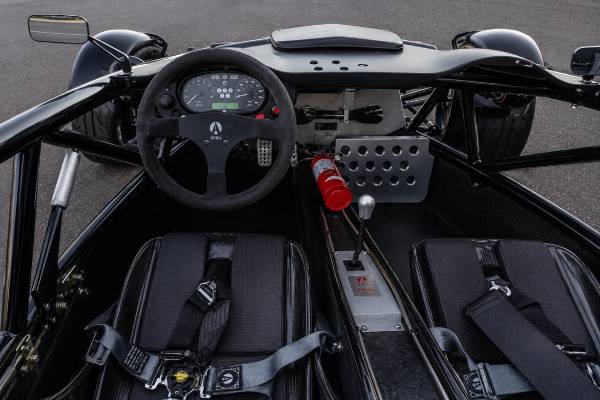
The 2012–2014 North American Ariel Atom 3 300 combined TMI AutoTech’s later Atom 3 chassis with Honda’s 2.4-litre K24Z7 and an optional supercharger package that raised output from the naturally aspirated car’s 230 hp baseline to the 300 hp class. It differs fundamentally from earlier 2.0-litre K20A 300s and from the later 365 hp turbocharged Atom 3S. The longer-stroke K24 produces stronger low- and mid-range torque, so the car does not need the same five-figure-feeling rev chase as a K20-powered Atom. That usability brings different concerns: torque load on the clutch and transaxle, heat from forced induction, calibration quality, road-equipment weight, and uncertainty created by individually specified builds. Surviving examples show substantial variation in bodywork, windscreens, brakes, dampers, exhausts, and legal identity. This guide establishes the K24Z7 model’s technical baseline and explains how to verify, service, drive, and buy a supercharged 2.4-litre Atom 3 responsibly.
Table of Contents
- The K24 Transition in North America
- K24Z7 Atom 3 300 Specifications
- Long-Stroke Torque in a Light Chassis
- Supercharger, Calibration, and Cooling
- Maintaining the TMI-Built Platform
- Verification, Road Test, and Purchase
The K24 Transition in North America
The K24Z7 Atom 3 belongs to a distinct North American phase in which TMI replaced the earlier 2.0-litre K20A with a 2.4-litre Honda engine. The change increased everyday torque and supported a new range of naturally aspirated, supercharged, race, and later turbocharged derivatives.
TMI’s documented base Atom 3 specification used a 2,354 cc K24 rated at 230 hp at 7,200 rpm and 220 lb-ft at 4,300 rpm. It came with a six-speed close-ratio manual, limited-slip differential, Wilwood four-piston brakes, JRi dampers, a glass windscreen, road lighting, and a 10-gallon aluminium fuel tank. That package was materially different from the sparse, lighter UK Atom often used as a comparison.
The 300 hp car was an optional forced-induction version of this platform. Period owner and dealer material describes 2013–2014 supercharged 2.4-litre cars, and surviving examples confirm the combination of a K24, six-speed transaxle, limited-slip differential, and TMI chassis. Because each Atom was built to order, the exact compressor, pulley, exhaust, brake package, body panels, wings, seats, and damper choice must be verified for the individual chassis.
This is also why the year range can be confusing. A 2012 registration may describe a late K20A car, an early K24 car, or a special race-related build. A 2014 vehicle can be a 230 hp naturally aspirated Atom 3, a 300 hp supercharged car, or a different TMI derivative. The VIN or chassis number, original invoice, engine identification, and factory records carry more authority than the registration year alone.
The later Atom 3S should not be used as a direct specification source for the 300. It retained the 2.4-litre K24Z7 family but added a fully intercooled turbocharger system, twin aerodynamic side pods, additional radiators, traction control, and 365 bhp. Some service principles and dimensions overlap, while the induction, cooling, calibration, and performance packages do not.
The K24Z7 itself comes from a mass-produced Honda performance application, but installation in an Atom changes its operating environment. The engine sits transversely behind the occupants, works with long coolant runs to a front radiator, and can experience sustained lateral acceleration and frequent high-load shifts. Donor-engine reputation is therefore only a starting point. Reliability depends on Ariel-specific oil control, cooling, wiring, mounting, exhaust, and calibration.
For a buyer, the correct identity statement should be precise: TMI-built North American Atom 3, 2.4-litre K24Z7, supercharged 300 hp package, with a list of documented options. Anything less leaves too much room for an engine swap, later conversion, or inaccurate advertisement.
K24Z7 Atom 3 300 Specifications
The verified foundation is a 2,354 cc Honda K24 with 87 × 99 mm bore and stroke, six-speed limited-slip transaxle, and TMI’s North American Atom 3 structure. The 300 hp rating applies to the supercharged option, while torque and detailed induction hardware should be taken from the car’s build and calibration records.
| Item | Specification |
|---|---|
| Engine family | Honda K24Z7 i-VTEC inline four |
| Displacement | 2,354 cc |
| Bore × stroke | 87.0 × 99.0 mm |
| Construction | Aluminium block, cylinder head, and sump |
| Valve gear | Chain-driven DOHC, four valves per cylinder |
| Base Atom 3 output | 230 hp at 7,200 rpm |
| Base Atom 3 torque | 220 lb-ft at 4,300 rpm |
| Item | Model description |
|---|---|
| Induction | Belt-driven supercharger package |
| Nominal output | 300 hp |
| Management | Hondata-based electronic control on TMI specification |
| Fuel delivery | Multipoint injection, continuous-flow electric pump, twin filters |
| Item | Specification |
|---|---|
| Transmission | Six-speed close-ratio manual with reverse |
| Clutch | Hydraulically operated |
| Differential | Limited slip |
| Driven wheels | Rear |
| Fuel tank | 10 US gallons / approximately 40 litres |
| Fuel pump | Continuous-flow 3.5 bar electric system in base specification |
| System | Documented specification |
|---|---|
| Frame | Tubular low-carbon steel with aluminium bulkheads |
| Suspension | Unequal-length fabricated wishbones, pushrod-actuated JRi dampers |
| Steering | Unassisted rack and pinion, approximately 1.7 turns lock to lock |
| Base brakes | Wilwood four-piston calipers with 290 mm vented discs |
| Pedal box | Tilton adjustable unit with paired master cylinders |
| Windscreen | Full glass screen with wiper on standard later TMI road specification |
| Measure | Figure |
|---|---|
| Length | 3,410 mm |
| Width | 1,890 mm |
| Height | 1,195 mm |
| Wheelbase | 2,345 mm |
| Track | 1,600 mm |
| Base-platform weight | Approximately 1,350 lb before build-specific changes |
The tables intentionally avoid assigning one torque figure, intercooler layout, or curb weight to every supercharged car. A surviving 2013 example can carry carbon panels, wings, a single-piece seat, adjustable dampers, road lighting, and other equipment that changes mass. Engine output may also differ after a track exhaust, pulley change, ECU revision, or rebuild.
Long-Stroke Torque in a Light Chassis
The K24Z7 changes the Atom’s personality by delivering substantial torque at much lower engine speed than the earlier K20A. In a car around 1,350 lb, that makes ordinary throttle openings produce immediate acceleration and reduces the need to chase the red line.
The 99 mm stroke is central to the difference. Compared with the square 86 × 86 mm 2.0-litre architecture, the K24 displaces more air per revolution and reaches its base torque peak at approximately 4,300 rpm. A supercharger raises the available cylinder charge further, so the 300 can exit a corner or pass traffic without the same downshift that a naturally aspirated 2.0-litre car might need.
This flexibility is useful, but it can make the car deceptively difficult. The engine sounds less frantic at the moment the rear tyres are asked to transmit a large load. A driver who waits for dramatic high-rpm noise before moderating the pedal may already have exceeded available grip. Cold R-compound tyres, damp pavement, or a cambered road magnify the problem.
Throttle mapping therefore matters. A well-calibrated car should translate pedal movement into torque progressively rather than delivering an abrupt step. Inspect the throttle mechanism for free travel, correct return springs, and clean cable routing. Verify that the ECU calibration is intended for the installed throttle body, supercharger, injectors, intake, exhaust, and fuel.
The six-speed close-ratio transaxle keeps the engine in a productive range, while the limited-slip differential helps both rear tyres contribute. More torque also raises driveline stress. Standing starts, wheel hop, and harsh clutch engagement can damage mounts, driveshafts, CV joints, differential components, and gearbox synchronisers. A 300 hp label should not be treated as permission for repeated launch demonstrations.
Clutch condition is especially important. The pedal should move smoothly, disengage fully, and take up consistently hot or cold. Slip under peak torque can appear first in a taller gear at moderate rpm. Drag can make the gearbox seem worn by resisting engagement. Inspect the Tilton pedal box, master and slave cylinders, hose routing, mounting brackets, and any fluid leakage before condemning internal components.
The chassis remains exceptionally responsive. Its quick unassisted steering and low polar inertia reveal toe, tyre, and damper changes immediately. The stronger midrange can turn a small setup issue into an acceleration stability problem. If the car wanders under power, measure rear toe, wheel bearing play, rod-end condition, differential behaviour, tyre construction, and pressures rather than accepting the symptom as normal.
Braking capacity is generous for the mass. The documented later TMI base package used 290 mm vented discs and four-piston Wilwood calipers, with Alcon upgrades available on some cars. The adjustable pedal box and separate master cylinders permit brake-bias tuning, but an incorrect setting can lock one axle prematurely. Mark and document the safe baseline before track experimentation.
The glass windscreen and road equipment make the K24 Atom more usable than a bare aero-screen car, although they add drag and change airflow. At high speed, the exposed wheels and cockpit still dominate aerodynamics. Acceleration is the model’s strength; maximum speed is not the reason to choose it.
Supercharger, Calibration, and Cooling
A 300 hp K24Z7 Atom is reliable only when the compressor, fuel system, calibration, lubrication, and cooling work as a matched package. The fact that 300 hp is modest for a tuned K24 does not excuse undocumented hardware or inadequate temperature control.
First identify the induction system. Photograph the compressor, brackets, pulleys, belt path, intake manifold, throttle body, bypass valve, injectors, airbox, and any charge-cooling components. Record part numbers. Supercharged K24 cars have existed in different configurations, and later owner changes may not match the original TMI option.
Belt alignment is visible and measurable. Look for edge wear, belt dust, polished pulley flanges, cracked ribs, and improvised spacers. Check tensioner travel and bearing noise through cold start, warm idle, and load. A belt that slips near the power peak can create fluctuating boost and an apparently intermittent misfire.
The bypass valve should move freely and close under load. A leaking valve can reduce output; one that remains closed can increase heat and poor part-throttle behaviour. Vacuum hoses must be heat-resistant, secured, and free from splits. Because the engine is exposed, hoses can be damaged by debris or careless maintenance.
Fuel delivery must be tested under load. The base TMI specification used a 3.5 bar pump and twin filters, but a supercharged calibration may require different injectors, pressure strategy, or pump capacity. Verify what is installed. An idle pressure reading cannot prove adequate flow at high rpm. Log fuel pressure, injector duty, air-fuel ratio, and knock response where the management permits.
Charge temperature is configuration dependent. If no intercooler is fitted, repeated operation can heat soak the intake and cause the ECU to reduce ignition advance. If a charge-cooling system is present, inspect its pump, reservoir, heat exchanger, bleed points, hoses, and sensor data. A non-functioning pump may leave the car feeling normal on the road but vulnerable during a long session.
The main cooling circuit uses a front radiator and long lines to the rear engine. Inspect guards, pipes, clamps, hose ends, expansion tank, cap, and fan control. Bleeding must remove trapped air. The system should reach and hold a stable operating range in traffic and on track. A level that repeatedly falls, coolant residue, or pressure after a cold start requires diagnosis.
Oil management deserves special attention because the K24Z7 can experience sustained lateral load far beyond its donor application. Confirm the sump and baffling fitted to the car. Check oil level by the correct procedure before every event. Use pressure and temperature monitoring where possible. A pressure warning during a corner is a stop condition, even if it clears immediately on the straight.
Exhaust changes affect calibration and heat. A track exhaust can reduce restriction and noise attenuation while increasing radiant exposure around wiring, hoses, bodywork, and the passenger compartment. Check supports, clearances, flex sections, shielding, and local discoloration. Confirm that the current ECU map accounts for the exhaust and that the road system accompanies the sale if needed for noise or registration compliance.
Maintaining the TMI-Built Platform
The K24 Atom 3 should be serviced by time, mileage, track hours, and component condition. Its exposed construction makes inspection easy, but it also exposes joints, wiring, brakes, and coatings to water, grit, ultraviolet light, and transport damage.
Begin with the available TMI reference material for the exact generation. Later Atom 3 guidance lists synthetic engine oil, Honda manual-transmission fluid, DOT 3 or DOT 4 brake fluid, a 40-litre fuel capacity, and 18 psi front/20 psi rear starting tyre pressures. Those values are useful references, but build-specific documentation takes priority, especially after wheel, tyre, brake, or engine changes.
Replace unknown fluids immediately after purchase. Record oil quantity, filter part, transmission-fluid quantity, brake-fluid type, and coolant mixture. Label dates discreetly and maintain a log. A low odometer does not preserve fluid. Brake fluid absorbs moisture, coolant inhibitors age, fuel oxidises, and engine oil can become contaminated by repeated short runs.
Valve-clearance inspection is part of K-series maintenance. The correct interval depends on use, but a documented check is valuable on any car that spends time near its rev limit. Listen for unusual valvetrain noise and review any over-rev data. Compression and leak-down tests provide a baseline when history is incomplete.
The chassis should be inspected before and after events. Examine rod ends, wishbones, pushrods, bellcranks, steering rack, uprights, wheel bearings, driveshafts, CV boots, brake hoses, and mounts. Check every accessible weld and lower rail for impact or coating damage. TMI’s quality-control process at build does not eliminate the effects of later kerb strikes or off-track excursions.
JRi dampers need periodic service. Non-adjustable units can still lose gas pressure, oil, or damping consistency; adjustable units can seize or drift. Compare left and right response, inspect shafts and seals, and have the set dyno tested when performance is uncertain. Spring markings and installed rates should match the intended road or track use.
Wheel and tyre care should reflect the staggered sizes and low mass. Verify wheel condition inside and out, correct offsets, tyre date codes, and fastener torque. Tyres can age out before wearing out. Store spare sets clean and dry, and record heat cycles for competition compounds.
Brake inspection should include disc thickness, cracking, pad depth, caliper seals, line abrasion, pedal-box hardware, master-cylinder leakage, and bias setting. A vented disc may look substantial yet be below its service limit. Use the manufacturer’s dimensional criteria, not visual judgement alone.
Electrical reliability depends on clean connections and stable voltage. Check the master switch, RFID immobiliser, charging system, starter, dash, lights, wiper, fan, fuel reading, and sensor alarms. TMI guidance cautions against jump starting because voltage spikes can damage sensitive electronics. Remove and charge a depleted battery with appropriate equipment instead.
Storage should be dry and ventilated. Clean insects and rubber debris from the radiator, remove salt immediately, protect exposed metal, stabilise fuel, maintain the battery, and prevent rodents from nesting around wiring and intake components. A cover trapped against a damp chassis can accelerate corrosion rather than prevent it.
Verification, Road Test, and Purchase
Buy a K24Z7 Atom 3 300 only after confirming that the vehicle began as, or was professionally converted to, the specification being advertised. The most valuable evidence is a chain from chassis record to engine identity, supercharger hardware, calibration, service, title, and current condition.
Request the TMI build sheet, original invoice, chassis number, assigned VIN records, title history, engine code, and photographs of the induction system. Confirm whether the car was delivered naturally aspirated and later supercharged. A later conversion can be excellent, but it should be described and priced accurately.
Registration is a separate risk. North American Atoms may carry state-assigned VINs and specially constructed vehicle titles. A surviving 2013 supercharged example, for instance, was titled under an Arizona-assigned identifier. Verify that every number matches and that the destination jurisdiction will accept the transfer. Windscreen, lights, fenders, parking brake, exhaust, and emissions requirements can change after a move.
Review invoices chronologically. Look for oil and filter changes, valve checks, transmission service, brake fluid, coolant, belt replacement, damper work, rod-end replacement, wheel inspection, alignment, corner weights, clutch work, and ECU tuning. Track use is not automatically negative. Unrecorded track use combined with old safety equipment and no temperature logs is.
Inspect the car cold. Check oil and coolant, then observe starting, idle, smoke, charging voltage, warning lamps, fuel reading, fan operation, and hot restart. Listen for timing-chain noise, belt chirp, pulley-bearing rumble, exhaust leaks, and gearbox noise. Some mechanical sound is normal in an open car, but changes with temperature or load deserve attention.
Raise the car safely and examine the frame, underside, suspension, steering, brakes, driveshafts, mounts, and plumbing. Look for fresh powder coat, new components on one corner, bent pushrods, cracked panels, or local welding. Measure alignment when damage is suspected. A straight central chassis is more important than flawless carbon bodywork.
On the test drive, establish basic control quality before boost. The steering should be accurate, the brake pedal firm, the clutch consistent, and the gearbox clean through all ratios. Temperatures should stabilise. Warm the tyres and apply load progressively in a legal setting. The engine should produce a strong, continuous surge without hesitation, belt flare, smoke, or detonation-like noise.
Ask for a current calibration report. Useful data include fuel type, injector and pump specifications, pulley or boost level, air-fuel ratio, intake temperature, coolant temperature, ignition correction, rev limit, and dyno conditions. A single peak-power graph without these details is marketing, not validation.
Budget to create a fresh baseline after purchase. Replace unknown fluids, inspect valve clearance, verify belts and filters, service dated tyres and harnesses, align and corner-weight the chassis, and correct wiring or cooling issues. Price scarce options according to their current condition. Carbon panels, wings, upgraded dampers, and premium brakes add value only when sound and supported.
The 2.4-litre 300 is appealing because it combines the Atom’s exposed responses with a broader, easier torque curve than the K20 cars. Its strongest examples are not necessarily the highest dyno numbers. They are the cars whose supercharger system is documented, whose cooling remains stable, whose driveline has not been abused by launches, and whose TMI identity and legal status are clear.
References
- Ariel Atom 3 – ACE Performance
- No Roof. No Doors. No Compromise.
- Ariel Atom 3 and Ariel Atom 3S Reference Material
- Supercharged 2013 Ariel Atom 3
- Ariel Atom 3S – Ariel North America
- Ariel Atom 3 | PH Used Buying Guide
Disclaimer
North American K24 Atom 3 specifications vary by TMI build date, factory options, later conversion, state registration, and engine calibration. Verify the K24Z7 identity, original 300 hp supercharger package, current boost and fuel system, chassis record, VIN or assigned identifier, and all service procedures with qualified specialists. Do not assume Atom 3S turbo specifications apply to a supercharged 300. Conduct performance driving only in controlled, legal conditions, and share this guide when it can help another buyer document and maintain a correctly identified 2.4-litre Atom 3.