


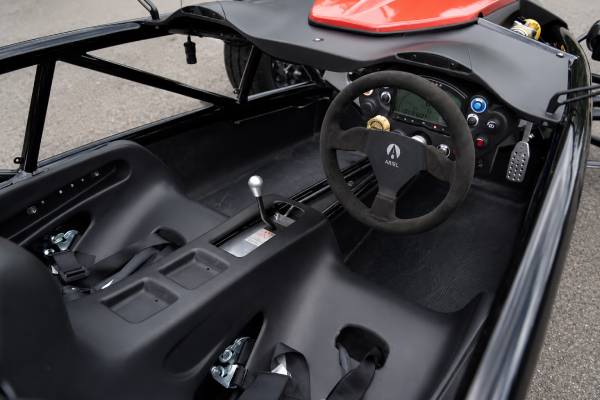
The Ariel Atom 3.5 310 is the supercharged version that turned a familiar formula into a more mature, more usable, and still astonishingly fast road-and-track machine. Its 2.0-liter Honda K20Z4 engine retained the high-revving i-VTEC character of the naturally aspirated Atom, but Ariel’s supercharger installation lifted output to 310 hp and added the urgency needed to make almost any gear feel effective. The 3.5 chassis also mattered: greater torsional stiffness, revised geometry, updated instrumentation, and numerous detail changes made the car easier to place and easier to live with than an earlier Atom 3 without diluting its exposed, mechanical nature.
This guide focuses on UK- and European-market Atom 3.5 cars built with the 310 hp K20Z4 package. It explains the specifications that can be stated confidently, where period publications conflict, how the powertrain behaves, what setup choices alter the experience, which maintenance items deserve priority, and how to inspect a used car. Because Atoms were highly configurable, a chassis number, factory build record, and invoice history remain more authoritative than a generic model label.
Table of Contents
- Why the 310 Version Matters
- Atom 3.5 310 Technical Data
- Supercharged K20Z4 Character
- Chassis, Steering, and Braking
- Road and Track Setup
- Maintenance and Thermal Control
- Used-Buying Checks
Why the 310 Version Matters
The Atom 3.5 310 matters because it combines the usable six-speed manual layout of the regular car with enough supercharged output to deliver genuine hypercar-level acceleration. It is not merely an Atom 3 with another ten horsepower: the 3.5 platform brought structural, ergonomic, and calibration changes that made the whole car more coherent.
Ariel introduced the 3.5 as an evolution rather than a clean-sheet replacement. The exposed tubular frame, mid-mounted transverse Honda engine, rear-wheel drive, tandem-low seating position, and pushrod-operated suspension remained recognizable. Underneath that continuity, the chassis was reported to be about 15 percent stiffer in torsion, drawing lessons from the Mugen and V8 programs. A stiffer platform gives suspension settings a more consistent foundation; the dampers and springs control wheel movement rather than spending part of their travel working around frame deflection.
The supercharged model’s output rose from the preceding 300 hp specification to 310 hp through revised engine management. That numerical increase sounds modest, but period testing emphasized stronger midrange response rather than a dramatic change at the top of the rev range. This is important in an Atom because acceleration is already traction-limited in the lower gears. More useful torque between corners can save a downshift, while a smoother calibration can make the car less abrupt when the rear tires are lightly loaded.
The 310 also sits at a useful point in the Atom lineage. It retains a conventional H-pattern manual gearbox and mechanical simplicity absent from the more specialized 3.5R, yet it provides substantially more thrust than the 245 hp naturally aspirated 3.5. For owners who want road usability, occasional touring, track-day speed, and reasonable parts familiarity, that combination can be more attractive than the headline-grabbing sequential model.
However, “Atom 3.5 310” does not define every fitted component. Ariel sold a configurable, low-volume car, and customers could specify road or track-biased dampers, alternative brake packages, different wheels, aero parts, windscreens, lighting equipment, and numerous comfort or competition items. A period road test may describe a car with 290 mm Alcon brakes and road dampers, while a market brochure can list smaller standard brakes and a lower published weight. Those are not automatically contradictions; they may describe different equipment levels and weight definitions.
The practical implication is simple: identify the exact car before judging it. Factory invoices, the chassis plate, engine number, ECU documentation, and option records should establish whether a used Atom was built as a 310, later converted, or modified outside Ariel’s normal specification. Provenance has direct mechanical value because it tells a technician which consumables, settings, and replacement parts belong on that particular chassis.
Atom 3.5 310 Technical Data
The Atom 3.5 310 is an internal-combustion, mid-engine, rear-wheel-drive two-seater powered by a supercharged 1,998 cc Honda K20Z4 four-cylinder engine and a six-speed manual transaxle. The most dependable published facts concern engine architecture, peak power, gearing, core dimensions, and acceleration; torque, weight, and brake hardware must be tied to the specific source or car because period figures and options differ.
| Item | Specification |
|---|---|
| Engine | Honda K20Z4 inline-four, transversely mounted behind the occupants |
| Displacement | 1,998 cc |
| Bore × stroke | 86.0 × 86.0 mm |
| Valvetrain | Chain-driven DOHC, four valves per cylinder, i-VTEC |
| Induction | Mechanically supercharged |
| Maximum power | 310 bhp; period sources place the peak around 8,400–8,600 rpm |
| Fuel delivery | Electronic multi-point fuel injection |
| Item | Specification |
|---|---|
| Transmission | Six-speed H-pattern manual transaxle |
| Driven wheels | Rear |
| 1st / 2nd / 3rd | 3.266 / 2.130 / 1.517 |
| 4th / 5th / 6th | 1.147 / 0.921 / 0.738 |
| Reverse | 3.580 |
| Measure | Published figure | Context |
|---|---|---|
| 0–60 mph | 2.7 seconds | Period manufacturer and road-test claim |
| 0–100 mph | 6.8 seconds | Period manufacturer and road-test claim |
| Maximum speed | About 155–162 mph | Differences reflect publication, gearing, and stated test basis |
| Published weight | 475 kg | Market brochure figure; definition and equipment basis should be checked |
| Period test-car weight | 520 kg | Road-test specification with optional equipment |
| Item | Specification |
|---|---|
| Length | 3,410 mm |
| Width | 1,798 mm in a period market brochure; wheel and tire packages can increase overall width |
| Height | 1,195 mm |
| Wheelbase | 2,345 mm |
| Front / rear track | 1,600 / 1,600 mm |
| Fuel-tank capacity | 42 liters in period European-market literature |
| Seating | Two occupants in a composite twin-seat unit |
| Item | Specification |
|---|---|
| Chassis | Bronze-welded steel tubular spaceframe with aluminum bulkheads |
| Suspension | Double unequal-length wishbones with pushrods, bell cranks, coil springs, and dampers |
| Steering | Unassisted rack and pinion, approximately 1.7–1.75 turns lock to lock |
| ABS | Not fitted to the period specification |
| Instrumentation | LCD display with expanded information and data-logging capability on 3.5-era cars |
One figure intentionally omitted from these tables is a universal peak-torque value. Contemporary sources do not agree: some printed data appear to confuse newton-meters and pound-feet, while road-test wording describes a much larger forced-induction figure. Repeating one number without qualification would create false precision. The correct approach for a particular car is to use its Ariel build record, original calibration information, and a healthy-car dyno trace taken with known correction standards.
Supercharged K20Z4 Character
The 310 hp K20Z4 delivers its best experience when the driver treats it as a high-revving Honda engine with added area under the torque curve, not as a low-speed muscle engine. The supercharger improves response immediately, but the engine still becomes more intense as revs rise and the i-VTEC system moves into its high-lift operating range.
A mechanically driven supercharger connects boost production to engine speed. There is no exhaust-energy delay of the type associated with a large turbocharger, so throttle response is direct and predictable. In a 500 kg-class car, even modest throttle changes can alter rear-tire load quickly. The absence of lag is therefore useful for balancing the chassis, but it also demands accurate pedal inputs when exiting a corner or crossing a wet surface.
The six-speed manual is central to the character. Its ratios keep the engine near the responsive part of the rev range, and the conventional shift pattern preserves a level of involvement that the later paddle-shift 3.5R approaches differently. First gear is extremely short in practical terms because the car has so little mass. On a brisk road, second and third often cover most meaningful acceleration; on a circuit, the correct gear depends on corner radius, tire temperature, and whether the surface lets the car accept full throttle.
Drivers should not use the quoted 2.7-second sprint as a technique target. A perfect launch asks the clutch, driveshafts, differential, engine mounts, and tires to absorb a large transient load. Repeated standing starts can consume expensive components without improving the car’s performance once it is moving. A progressive launch that limits wheelspin and clutch slip is mechanically kinder and usually more repeatable on an imperfect surface.
Fuel quality and calibration must match. A modified pulley, intake, exhaust, injector set, or ECU map can alter airflow and combustion margin even when peak power remains near 310 hp. The safest ownership standard is a documented combination calibrated by Ariel or a specialist familiar with this exact installation. A dyno printout alone is insufficient unless it identifies boost, air-fuel ratio, intake temperature, fuel used, and the correction method.
Chassis, Steering, and Braking
The Atom 3.5 chassis rewards precision more than aggression, and the 310’s acceleration makes calm steering and braking inputs especially important. Its low mass reduces inertia, but it does not eliminate the consequences of poor alignment, cold tires, worn dampers, or an abrupt driver.
The 3.5 frame’s additional torsional stiffness helps preserve suspension geometry under load. That improvement can be felt as consistency: the car responds more faithfully to a given steering, brake, or throttle input. Revised road geometry was also intended to make the car less nervous than an earlier Atom 3. “More forgiving” is relative, however. There is still no stability-control system waiting to correct a large mistake, and the unassisted steering communicates surface changes immediately.
The pushrod suspension packages springs and dampers inboard, reducing unsprung mass and leaving the exposed wishbones clearly visible. That visibility is useful during inspection. Bent wishbones, damaged rod ends, fretting around joints, cracked powder coating, loose fasteners, and uneven tire wear are easier to spot than on a fully bodied car. The same exposure means road grit, water, and track debris reach those components directly.
Setup changes have a large effect because the car is light. A small toe alteration can change high-speed stability; excessive negative camber can reduce braking contact on the road; a ride-height change can disturb corner weights and bump-steer behavior. Adjustable hardware is not proof of a good setup. The best evidence is a recent geometry sheet showing target and measured values, plus notes on driver mass, fuel load, wheel package, and intended use.
Brakes require car-specific identification. Some literature describes 240 mm standard discs, whereas test cars and optioned examples used 290 mm Alcon assemblies with four-piston calipers. Do not order pads or discs from the model year alone. Measure the rotor, identify the caliper, record pad shape and thickness, and confirm whether the car has adjustable brake bias. A competition pedal box set aggressively toward the rear can make a damp-road stop unexpectedly unstable.
No ABS means the driver must manage lockup. The Atom’s low mass lets it decelerate brutally, but front-wheel lock can occur before the driver expects it when tires are cold or the surface changes. Correct technique is a progressive initial application followed by increasing pressure as load transfers, then a controlled release near turn-in. A hard stamp on the pedal is not a substitute for building tire load.
Tires are the dominant tuning component. Age, compound, construction, pressure, and temperature can transform the car more than a modest suspension adjustment. A road-biased tire may communicate progressively and work in cool conditions; a track-focused tire can offer far more grip once hot but feel wooden or treacherous before reaching its operating window. Inspect date codes and heat-cycle history, not tread depth alone.
Road and Track Setup
A road-usable Atom 3.5 310 should be set up for compliance, stable braking, and predictable tire behavior before chasing lap time. The fastest-looking combination of stiff dampers, maximum camber, and aggressive aero can make the car slower and less trustworthy on the surfaces most owners actually use.
For the road, begin with Ariel’s road baseline or a reputable specialist’s documented equivalent. Keep enough ride height to protect the nose, floor, exhaust, and suspension from compressions. Choose dampers that let the wheels follow broken pavement, and avoid using tire pressures copied from a heavier sports car. Pressures should be established cold, checked hot, and adjusted in small steps while observing wear and behavior.
On track, preparation starts with condition rather than upgrades. Check wheel-nut torque, tire integrity, brake-pad depth, disc condition, fluid level, coolant hoses, supercharger belt, oil level, battery security, harness condition, and every visible suspension joint. Verify that the throttle returns freely and that nothing can contact the pedal box. Mark critical fasteners where appropriate so movement is easier to identify between sessions.
Warm-up should build temperatures progressively. The first laps are for confirming brake feel, steering center, throttle response, and fluid temperatures. Cold semi-slicks can offer less grip than ordinary road tires, and an Atom can rotate quickly when a rear tire lets go. Add pace only when the car repeats the same behavior through several corners.
Aero equipment changes more than appearance. Front and rear wings alter load distribution, top-speed behavior, and sensitivity to ride height. Fitting a rear wing without an appropriate front balance can add understeer; fitting both without checking mounts and chassis settings can introduce new loads. The owner should have installation documentation and a setup rationale, not merely a claim that the parts are “factory style.”
Maintenance and Thermal Control
The K20Z4 core is durable, but a supercharged Atom should be maintained according to load and time rather than ordinary passenger-car mileage. Short track sessions can create more oil, coolant, belt, brake, and joint stress than hundreds of gentle road miles.
Engine oil is the first priority. Use the viscosity and specification appropriate to the engine build, climate, and Ariel or specialist guidance; do not assume the donor Honda’s longest road interval remains suitable. Check level on consistent ground using the correct procedure, record consumption, and shorten change intervals for repeated high-temperature use. Cut open the used filter when investigating a noise or after a severe overheat, because debris can reveal a problem before oil pressure falls.
The supercharger drive deserves a routine visual and tactile inspection. Look for glazing, edge damage, cracking, rubber dust, misalignment, contaminated pulleys, and abnormal bearing noise. Belt tension should follow the installation’s procedure rather than guesswork. Over-tension can damage bearings; under-tension can create slip, heat, and inconsistent boost. Record the belt part number and carry a known-correct spare on long trips or circuit days.
Cooling-system condition matters because the engine is behind the occupants while the radiator is remote. Inspect the full coolant path, not just the engine bay: front radiator, pipes, hose connections, bleed points, expansion arrangement, fan operation, and any areas vulnerable to stone damage. Air trapped after service can create unstable temperature behavior. A car that runs normally at idle but overheats under sustained load may have airflow, bleeding, pump, radiator, or combustion-gas issues.
Intake temperature can rise during repeated full-load operation. The regular 310 should not be assumed to have the charge-cooling system of a 3.5R; inspect the actual installation. Heat soak can reduce power and knock margin even when the dashboard coolant reading appears acceptable. A specialist can log intake-air temperature, ignition correction, fueling, and boost under controlled load to establish whether the system is healthy.
Valve-clearance checks, spark plugs, ignition coils, filters, and fuel delivery should follow documented intervals and condition. Use spark plugs with the specified heat range and gap for the calibrated boost level. A high-rpm misfire may feel like a fuel or limiter issue but can begin with plug wear, coil weakness, low voltage, injector problems, or a slipping belt. Diagnose rather than replacing parts at random.
Chassis maintenance is equally important. Clean exposed suspension and frame areas gently, then inspect welds, coatings, rod ends, spherical bearings, pushrods, bell cranks, dampers, steering joints, engine mounts, and brake hoses. Do not direct aggressive pressure washing into bearings, electrical connectors, intake openings, or the instrument panel. Corrosion beginning beneath damaged powder coating should be assessed and repaired before it spreads.
Brake fluid should be selected for the car’s temperature duty and changed frequently enough to preserve a firm pedal. Track pads can transfer material unevenly if used cold or stored after a hard session without cooling. Measure rather than eyeball pad and disc condition. Check caliper dust boots or seals where fitted, bleed screws, hard-line supports, and the balance-bar mechanism.
Storage requires a dry, ventilated environment, a maintained battery, clean fluids, and protection from rodents and moisture. Avoid leaving a wet car under an impermeable cover. Roll or support the car in a way that prevents tire flat-spotting, and operate controls periodically only when that can be done without creating condensation through repeated short engine runs. A proper full-temperature drive is preferable to idling for a few minutes.
Used-Buying Checks
The best Atom 3.5 310 is the car with a traceable factory identity, a coherent specification, and maintenance evidence that matches its use. Cosmetic perfection matters less than straight structure, correct components, stable temperatures, healthy fluids, and honest records.
Begin with identity. Match the chassis number across the frame plate, registration documents, invoices, and Ariel records. Confirm the original engine, output package, steering side, road equipment, brakes, dampers, wheels, differential, windscreen, and aero options. A later supercharger conversion is not automatically undesirable, but it should be described as a conversion and supported by parts and calibration documentation rather than priced as an untouched factory 310.
Inspect the frame in strong light. Look for non-factory welds, ripples, scraped lower tubes, deformed pickup points, cracked coating, corrosion, and mismatched refinishing. Pay special attention to areas near wishbone mounts, engine supports, seat structure, and any point that could have contacted a trailer or curb. Stone chips are normal; distortion and undocumented repairs are not.
Check all four corners for symmetry. Compare wishbones, rod ends, uprights, dampers, pushrods, brake assemblies, wheel offsets, and tire sizes. Steering should move smoothly without tight spots or play. Uneven tire wear can indicate an aggressive but deliberate setup, yet the seller should be able to produce geometry data. A car that “just needs alignment” after a curb strike may need much more.
The engine should be assessed completely cold, then fully hot. Verify fluid levels before start-up. Watch for smoke, delayed oil-pressure indication, unstable idle, fuel smell, belt noise, coolant leaks, and warning lights. During the drive, apply load progressively and confirm clean delivery through the rev range. Recheck for coolant expansion, oil misting, loose connections, and new noises afterward.
Transmission operation should be positive without excessive crunching, clutch slip, or jumping out of gear. Some gear noise is expected in an exposed installation, but selection quality should remain consistent hot and cold. Test the limited-slip differential gently for chatter or binding and inspect driveshaft boots and joints. Evidence of repeated hard launches should prompt a closer look at clutch, mounts, shafts, and differential.
Road-legal equipment must match the jurisdiction where the car will be used. Verify lights, indicators, mirrors, horn, mudguards, parking brake, emissions equipment, number-plate provisions, tires, harness approvals, and any required inspection documentation. A vehicle that was legal in one country or under an earlier registration route may not automatically satisfy another authority today.
Service history should show more than oil-change dates. Strong records include brake-fluid changes, coolant work, valve-clearance checks, belt replacement, plug specification, geometry sheets, damper service, tire dates, brake measurements, ECU calibration, track-day checks, and any incident repair. Ask who performed the work and whether the specialist still supports the fitted parts.
Finally, judge the configuration against your real use. A road-focused car with compliant dampers, sensible tires, wind protection, and standard bodywork may provide more enjoyment than a heavily winged, stiffly sprung example. Conversely, a dedicated circuit buyer should value fresh safety equipment, documented corner weights, proper cooling, suitable brakes, and spares. The right Atom is not the one with the longest option list; it is the one whose hardware, history, and intended use agree.
References
- Driven: Ariel Atom 3.5 supercharged
- Ariel Atom 3.5 launched
- Ariel Atom 3.5 (2013 – 2018) review, history and specs
- 2013 Ariel Atom 3.5 Specifications
- Ariel Atom 3 | PH Used Buying Guide
- Our History
Disclaimer
Specifications, option availability, road-legality requirements, service procedures, and published performance figures can differ by production date, market, individual build, later modification, and test method. Verify the chassis number, Ariel build record, installed hardware, current regulations, and workshop information for the exact car before purchasing, servicing, modifying, or driving it on road or track. Share this guide with another Atom owner or buyer who would benefit from a careful, car-specific inspection.