


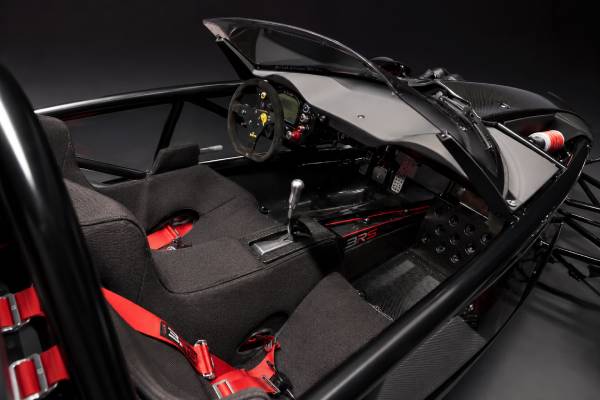
The Ariel Atom 3RS is the most highly developed production form of the North American Atom 3 platform: a 425 bhp turbocharged K24-powered car weighing roughly 1,450 lb, with a strengthened engine, larger charge-cooling system, reinforced transmission specification, and wider five-lug wheel package. Its performance is easy to describe but difficult to put in context. The 3RS has around three times the power-to-weight ratio of an ordinary sports car, virtually no body enclosure, and very little mass to absorb careless throttle, braking, or steering inputs. It is also rare enough that build-specific details matter more than a generic model description. Engine internals, turbo hardware, ECU calibration, cooling arrangement, dampers, brakes, wheels, and optional equipment should all be verified against the individual build file. This article focuses on the engineering that separates a genuine 3RS from a modified Atom 3 or 3S, the checks required to preserve it, and the evidence a buyer should demand before treating a low-volume 425 bhp exoskeleton car as a sound purchase.
Table of Contents
- Why the 3RS Is Different
- Verified 3RS Specification
- Boost, Fuelling, and Thermal Load
- Putting 425 hp to the Ground
- Event Preparation and Servicing
- Authenticity and Condition Checks
- Who Should Own a 3RS
Why the 3RS Is Different
The 3RS is not simply an Atom 3S with a more aggressive software file. Ariel North America specified internal engine reinforcement, a higher-capacity turbo and intercooling package, stronger drivetrain components, wider five-lug wheels, and chassis hardware intended to support 425 bhp and 365 lb-ft.
Its 2.4-litre engine belongs to the Honda K24 family used in the North American Atom 3, but the published 3RS package includes forged pistons, H-beam connecting rods, upgraded fasteners, a multi-layer steel head gasket, a short-runner intake manifold, a BorgWarner turbocharger, and an enlarged air-to-water charge cooler. Those parts address combustion pressure, airflow, and heat—not just peak dyno output.
The model also needs to be separated from the 3R. The limited-production North American Atom 3R used a supercharged 2.0-litre K20Z3 and extensive carbon equipment at roughly 300 bhp. The 3RS instead uses the turbocharged 2.4-litre architecture and a substantially higher torque figure. Similarly, a 365 bhp 3S that has later received a tune or turbo change is not automatically a factory 3RS.
Authenticity is therefore documentary. The build invoice, chassis number, engine specification, turbo identification, wheel hubs, transmission hardware, ECU information, and correspondence from Ariel North America or the builder are more persuasive than badges. Because these cars were assembled in small numbers and could be ordered with options, some variation is legitimate, but each deviation should have a traceable explanation.
The 3RS’s value lies partly in that engineering coherence. A complete package designed around a target output is preferable to an unknown collection of parts. It also makes correct servicing possible because the owner knows which filters, plugs, fluids, clutch, brake pads, dampers, wheels, and calibration support the installation.
Although the assignment period is 2018–2020, title year and completion date can differ on low-volume vehicles. Use the exact chassis record rather than assuming that every 3RS follows a conventional annual model cycle.
Verified 3RS Specification
The Atom 3RS is a gasoline-only, mid-engined, rear-wheel-drive ICE car. Its defining specification combines a forged-internal 2.4-litre turbocharged Honda K24, a six-speed limited-slip transaxle, high-capacity liquid charge cooling, double-adjustable JRi dampers, and a five-lug wheel package wider than the earlier 3S arrangement.
| Specification | Published 3RS value |
|---|---|
| Base engine family | Honda K24 inline-four |
| Displacement | 2.4 L (2,354 cc K24 architecture) |
| Block and head | Aluminium alloy |
| Internal upgrades | Forged pistons, H-beam connecting rods, upgraded rod bolts and tool-steel head studs |
| Head sealing | Multi-layer steel head gasket |
| Induction | BorgWarner turbocharger with air-to-water intercooling |
| Intake manifold | Short-runner performance design |
| Maximum power | 425 bhp |
| Maximum torque | 365 lb-ft (495 Nm) |
| System | 3RS provision |
|---|---|
| Charge cooler | Enlarged air-to-water intercooler core |
| Charge-cooler location | Side-pod heat-exchanger system |
| Engine coolant radiator | Front-mounted aluminium radiator with long coolant circuit |
| Engine management | Performance ECU calibration matched to the turbo installation |
| Fuel requirement | Use the octane and fuel specification stated for the individual calibration |
| Exhaust | High-flow turbo exhaust installation |
| Specification | Value |
|---|---|
| Engine position | Transverse mid-engine |
| Transmission | Strengthened close-ratio 6-speed manual |
| Drive | Rear-wheel drive |
| Differential | Limited-slip differential |
| Fuel capacity | Approximately 10 US gal (37.9 L) |
| Published vehicle weight | Approximately 1,450 lb (658 kg) |
| Specification | Value |
|---|---|
| Suspension layout | Unequal-length double wishbones with pushrod-operated inboard dampers |
| Dampers | JRi double-adjustable coil-over units |
| Hub pattern | Five-lug 3RS package |
| Front wheel | 16 × 7 in |
| Rear wheel | 17 × 9 in |
| Published tyre family | Toyo Proxes R888R |
| Steering | Unassisted rack and pinion |
| Dimension | Value |
|---|---|
| Length | 3,410 mm (134.3 in) |
| Width | 1,890 mm (74.4 in) |
| Height | 1,195 mm (47.0 in) |
| Wheelbase | 2,345 mm (92.3 in) |
| Track | 1,600 mm (63.0 in) |
Ariel North America’s public 3RS material emphasizes the hardware and output rather than publishing a complete set of acceleration figures. That is preferable to repeating unsupported internet estimates. Actual results depend strongly on tyre preparation, launch method, surface, gearing, atmospheric conditions, and whether the car retains its original calibration and wheel package.
Boost, Fuelling, and Thermal Load
The central ownership issue is heat management. Producing 425 bhp from 2.4 litres in a lightweight open car is mechanically achievable, but repeated full-load use creates demanding temperatures in the charge air, coolant, oil, turbine housing, exhaust, gearbox, and nearby wiring.
The enlarged air-to-water intercooler reduces inlet temperature by transferring heat into a separate liquid circuit. That system only works when its pump, reservoir level, hoses, bleed condition, and heat exchanger are healthy. A car can feel normal during a short road test yet suffer rising charge temperature over successive laps. A buyer or track user should therefore log intake-air temperature, coolant temperature, and—where fitted—oil temperature rather than relying on a single dashboard gauge.
Heat soak affects more than power. High inlet temperature can cause ignition correction, reduced boost targets, or richer protection strategies. Repeated thermal cycling ages hose ends, electrical connectors, turbo oil lines, exhaust mounts, and insulation. Inspect every component near the turbine housing for hardening, discoloration, chafing, or evidence that a line has touched a hot surface.
Fuel quality is calibration-critical. The correct octane, ethanol content, injector capacity, fuel pressure, and ECU map must agree. Do not assume that a map created for one regional premium fuel is safe on another. If the car has switchable maps or an ethanol blend calibration, obtain written instructions describing the required fuel, how the map is selected, and what safeguards are enabled.
A proper pre-purchase data log is more informative than a loud demonstration pull. Useful channels include commanded and actual boost, air-fuel ratio, short- and long-term trim where applicable, ignition correction, fuel pressure, throttle position, intake temperature, coolant temperature, and battery voltage. The log should be reviewed by someone familiar with the specific ECU and K24 turbo installation.
Turbo condition should be assessed cold and hot. Check compressor inlet cleanliness, shaft movement within the manufacturer’s acceptable range, oil residue, smoke after overrun, boost-control hoses, wastegate operation, and unusual siren or contact noise. The exhaust should be supported without loading the turbo flange, and heat shielding should protect the chassis and body panels.
Crankcase ventilation matters at this output. Excess pressure can force oil past seals or into the intake. Inspect catch-can routing, drain arrangement, hose condition, and evidence of excessive oil collection. A leak-down test, compression test interpreted consistently, and oil analysis can reveal more than an odometer reading.
The forged components improve strength but do not make abuse harmless. Piston clearance, bearing condition, calibration, warm-up discipline, detonation control, and oil supply remain decisive. Avoid full load until fluids are genuinely warm, and use a cool-down procedure that prevents heat from being trapped around the turbo after a hard session.
Putting 425 hp to the Ground
The 3RS is traction-limited in the lower gears, so its fastest and safest setup is not necessarily the one with the most boost or the stiffest suspension. Usable performance comes from progressive torque delivery, healthy tyres, correct differential action, precise alignment, and a driver who unwinds steering before demanding full power.
The five-lug 16- and 17-inch wheel package provides room for wider rubber and stronger hub hardware than the earlier four-lug arrangement. That does not remove the need to verify wheel offset, stud engagement, bearing condition, and clearance at full steering and suspension travel. A wheel that fits statically can contact a pushrod, brake hose, or body panel under load.
R888R tyres are road legal in many markets but behave more like track-oriented equipment than ordinary road tyres. They need temperature, dislike deep standing water, and can become substantially less effective with age and heat cycling even when tread remains. Record date codes and event history. Replace tyres as a set when balance matters rather than fitting one fresh axle against one hardened axle.
The limited-slip differential must transmit a very high torque-to-mass ratio. Listen for unusual clunks, binding, or asymmetrical drive. Inspect driveshaft boots, CV joints, hub bearings, mounts, and gearbox casing for leaks or movement. A clutch that holds during a gentle road test may slip in a high gear at full boost, so any controlled load test should be performed only when conditions and legality allow.
Suspension settings should begin with a known baseline from the builder or an experienced Atom specialist. The JRi dampers provide separate adjustment, which can improve platform control but also allows a badly mismatched setup. Count and record clicks from a defined end stop without forcing the adjuster. Change one axis at a time and evaluate braking stability, mid-corner support, power-down traction, and tyre temperature.
Alignment targets must reflect use. More negative camber and reduced compliance may improve a smooth circuit lap but make the car follow road cambers, reduce wet braking, and wear tyres unevenly. Toe settings are particularly influential on such a light, unassisted car. After any hard kerb strike or spin across rough ground, recheck alignment and inspect every rod end rather than assuming the steering wheel alone will reveal damage.
Braking performance comes from low mass as much as hardware. The pedal should remain firm and repeatable, with no pull or judder. Inspect pad taper, disc condition, fluid, caliper seals, line routing, and master-cylinder balance where adjustable equipment is fitted. A very aggressive pad can make initial response difficult to meter and may not reach its working range on the road.
Aerodynamic accessories should be treated as structural and setup components, not decoration. Wings and splitters change load with speed and can alter balance, spring requirement, ride height, and mounting stress. Verify that any aero system is engineered, securely mounted, and accompanied by setup information.
Event Preparation and Servicing
A 3RS should be prepared for every track event as if it were a competition car, even when it remains road registered. The inspection must cover fluids, fasteners, heat protection, tyres, brakes, restraints, controls, and data—not only the engine oil.
Start several days before the event. Check oil level by the builder’s procedure, inspect the filter and drain areas, and confirm the correct lubricant for the exact engine and cooler arrangement. Ariel North America publishes oil guidance for its Atom installations, but a built 3RS may have additional volume or a service instruction tied to its engine package. Never fill solely from a generic K24 capacity figure.
Inspect both cooling circuits. Verify coolant concentration, reservoir levels when cold, pump operation, fan operation, hose security, radiator cleanliness, and bleed condition. The front radiator and long plumbing can retain air after service. The charge-cooler circuit should show circulation and should not contain loose debris or kinked lines.
Review spark plugs at suitable intervals. Their heat range, gap, deposits, and electrode condition can show whether combustion is healthy. A plug that looks different from the others deserves investigation before full-load running. Coil connectors should latch securely and remain protected from heat and vibration.
Before each session, torque wheel fasteners with a calibrated wrench, check tyre pressures, inspect tread and sidewalls, and look for stones or pickup that could create imbalance. Confirm throttle return, brake lights if required, steering freedom, harness condition, seat mounting, battery security, fire extinguisher status, and the absence of fluid beneath the car.
After each session, do not immediately grab hot wheel or suspension hardware. Once safe, inspect for leaks, loose fasteners, changing pedal travel, tyre damage, heat discoloration, and body or undertray contact. Record hot tyre pressures and temperatures. A sudden change from one corner often identifies an alignment, damper, brake, or driving problem before it becomes a failure.
Service intervals should be shortened according to hours at load. Engine oil, gearbox fluid, brake fluid, plugs, filters, and drive components all age faster under repeated circuit use. Oil analysis and filter inspection establish trends. The useful question is not “How many miles since service?” but “How many hot sessions, starts, shifts, and heat cycles has the system completed?”
Cleaning should be controlled. Avoid forcing water into connectors, rod ends, bearings, ECU plugs, or the intake. Remove rubber pickup and debris by hand, clean radiators without bending fins, and dry the car before storage. A lightly oiled corrosion protectant may be appropriate on selected exposed metal, but keep it away from brakes, tyres, belts, and hot exhaust parts.
For storage, use fresh fuel appropriate to the calibration, maintain the battery, prevent tyre flat spotting, and keep rodents away from wiring and intake openings. Run the engine only when it can reach full operating temperature; repeated short starts can add moisture and fuel to the oil without providing useful protection.
Authenticity and Condition Checks
A genuine, healthy 3RS should be proven through records and inspection, not through its badge or claimed horsepower. The buyer’s task is to establish identity, understand every modification, and determine whether the chassis and powertrain have survived their likely use.
Ask for the original invoice, build sheet, chassis identification, engine documentation, dyno reports, ECU map files or calibration notes, and correspondence with Ariel North America or TMI AutoTech. The records should explain the forged engine, BorgWarner turbo, charge cooler, transmission specification, five-lug hubs, wheels, dampers, brakes, and optional body or aero parts.
Compare those records with the car. Photograph part numbers and installation details. An aftermarket replacement is not necessarily undesirable, but an unexplained turbo, unknown injectors, unmarked ECU, improvised wiring, or missing boost-control documentation changes both risk and value. Confirm whether the stated 425 bhp is crankshaft output, wheel output, or an estimate; those numbers are not interchangeable.
Inspect the spaceframe methodically. Look for cracked coating around welds, fresh local paint, bent tubes, unusual gussets, floor damage, misaligned panels, and suspension pickup points that differ side to side. Track use is expected; hidden accident repair is not. A specialist can measure alignment, corner weights, wheelbase, and pickup geometry if the history is incomplete.
A cold engine examination should include fluid condition, start behaviour, oil pressure if available, smoke, crankcase pressure, leaks, and abnormal mechanical noise. Once warm, verify stable temperatures, both cooling circuits, clean throttle response, boost control under a supervised test, and the absence of misfire or fault codes. Compression, leak-down, oil analysis, and a borescope inspection are reasonable on a car at this output and value.
The gearbox, clutch, differential, driveshafts, and hubs deserve equal weight. Check for shift resistance, gear disengagement, clutch slip, CV noise, bearing play, and fluid leakage. Ask whether the transmission has been opened, which ratios and differential are installed, and who performed the work.
Review consumables with replacement cost in mind. Old semi-slicks, worn brake discs, tired dampers, expired harnesses, and heat-damaged bodywork can represent a significant bill. Verify that replacement wheels and bespoke parts remain available before assuming a low purchase price leaves room for easy refurbishment.
Legal status is jurisdiction-specific. Match VIN and title, verify emissions and inspection requirements, confirm that the registered manufacturer and year align with the paperwork, and obtain an insurance quotation before committing. A car legally driven in one region may face different equipment or registration standards in another.
A pre-purchase inspection should be performed by an Atom-experienced specialist who can read the ECU data and recognize the builder’s hardware. A general performance shop may understand the K24 engine yet miss spaceframe, pushrod suspension, corner-weight, or low-volume registration issues.
Who Should Own a 3RS
The 3RS suits an experienced driver who wants extreme acceleration and exposed mechanical feedback, has access to specialist support, and accepts that preparation and consumables are part of every serious outing. It is a poor choice for anyone seeking a casual, weatherproof, low-attention supercar substitute.
The cockpit offers almost no isolation. Heat, wind, stones, tyre noise, drivetrain sound, and vibration are direct. Entry requires stepping over the frame, luggage space is minimal, and rain can turn track-oriented tyres into a major limitation. Helmet fit, eye protection, hearing protection, harness geometry, and secure clothing should be checked before assuming the car is usable for a particular driver.
On road, restraint matters more than opportunity. Full boost in a low gear can overwhelm the rear tyres before the driver has time to process the speed gain. Public-road bumps, cambers, standing water, cold tyres, and traffic make the published output largely irrelevant. The car is most rewarding when controls are used progressively and the driver leaves a large margin.
On circuit, instruction and data are better upgrades than more power. A coach can help the owner learn brake release, steering rate, throttle timing, and tyre management. Logging temperatures and pressures then turns subjective impressions into setup decisions. The 3RS is capable of hiding driving errors with acceleration on a straight, but those errors reappear in tyre wear, heat, and inconsistent laps.
Ownership infrastructure should be planned. An enclosed trailer protects the car and carries spares; a suitable tow vehicle, ramps, tie-down method, tools, fluids, spare pads, and wheels all add cost. Specialist labour may require transport over a long distance. Confirm storage security and ventilation because the car is both conspicuous and exposed.
Compared with a 3S, the 3RS offers more output and factory-engineered high-load hardware but places greater demands on fuel, cooling, tyres, and drivetrain. Compared with an Atom 4, it has the older North American chassis architecture and a built K24 rather than the newer turbo K20C package. A conventional track car such as a Porsche Cayman, Lotus Exige, or dedicated race saloon is easier to live with and may be faster over a long session in mixed conditions, but none delivers the same unfiltered sensation.
The best 3RS is not necessarily the lowest-mileage car. It is the example with a traceable specification, disciplined service history, stable data, straight chassis, healthy cooling systems, and an owner who can explain how it was warmed, driven, inspected, and stored. Rarity makes documentation more important, not less.
References
- Ariel Atom, Ariel Nomad, Ariel North America Ariel Atom 3RS 2026
- Ariel Atom Oil Specifications and Capacities 2026 (Service Reference)
- 2014-Current Ariel Atom 3 and Ariel Atom 3S – Reference Material 2018 (Reference Manual)
- Ariel Cooling System Bleeding 2026 (Service Procedure)
- Ariel Atom, Ariel Nomad, Ariel North America History – Ariel North America 2026
- Ariel Atom 3 | PH Used Buying Guide 2021
Disclaimer
This article provides general information, not mechanical, legal, motorsport, or purchasing advice for a specific car. Atom 3RS equipment and calibration can differ by build, market, and later modification. Confirm the VIN, original build documents, installed hardware, ECU map, fuel requirement, service instructions, and local road rules with qualified specialists before purchase or operation. Please share this guide with another Ariel enthusiast if it helps preserve a well-documented car.