


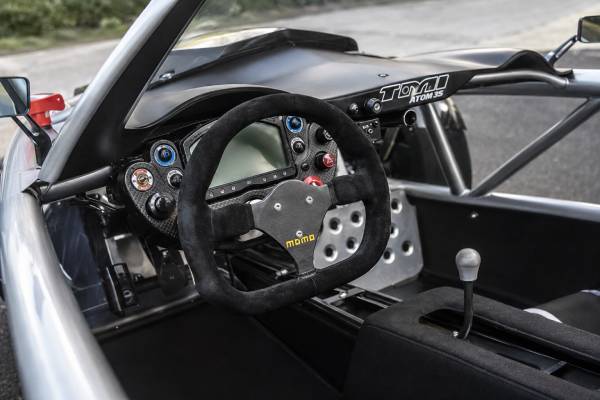
The Ariel Atom 3S is the North American turbocharged Atom that turned the dependable Honda K24Z7 into a 365 bhp engine package and placed it in a car weighing about 1,450 lb. That combination explains the headline acceleration, but it does not fully describe the 3S. Its real character comes from immediate steering, exposed suspension, strong mechanical grip, a close-ratio six-speed manual, and the need for disciplined throttle inputs when boost arrives. It was built under licence by TMI AutoTech for Ariel North America, so its 2.4-litre turbo layout should not be confused with the British Atom 3.5 and 3.5R, which used different 2.0-litre supercharged Honda engines. For buyers, the most important questions are not simply mileage and cosmetic condition. Build specification, track history, cooling-system health, turbo installation, brake condition, tyre age, and evidence of informed maintenance matter far more on such a light, highly stressed machine.
Table of Contents
- What the Atom 3S Is
- Verified Atom 3S Specifications
- How the Turbo K24 Package Works
- Chassis, Brakes, and Track Setup
- Maintenance and Heat Management
- Used Atom 3S Inspection Guide
- Ownership Fit, Value, and Alternatives
What the Atom 3S Is
The Atom 3S is best understood as the turbocharged flagship of the later North American Atom 3 range. It combines the Virginia-built tubular chassis with a 2.4-litre Honda K24Z7, a turbocharger, air-to-water charge cooling, a limited-slip six-speed transaxle, adjustable dampers, and four-piston Alcon brakes.
Ariel North America announced the 3S in late 2014 and sold it alongside the naturally aspirated Atom 3. The “S” did not denote a mild option pack. It changed the engine’s output from roughly 230 bhp in the standard K24 car to 365 bhp and 310 lb-ft, while adding the cooling and control hardware required to make that output usable. The 3S therefore occupies a specific place in Atom history: it is neither the British 310 bhp supercharged Atom 3.5 nor the later 425 bhp North American 3RS.
That distinction matters when ordering parts. A search based only on “Ariel Atom 3” can lead to K20 components, K24 parts, British chassis references, or North American hardware. Owners should identify the manufacturer, build plate, engine code, brake package, wheel pattern, ECU calibration, and installed options before buying consumables or commissioning work.
The 3S is also a low-volume, individually configured car. Windscreens, carbon panels, sequential gearboxes, aerodynamic parts, harnesses, damper specifications, and road equipment varied. Two examples from the same year may feel and weigh differently. Treat the factory specification as a baseline, then document the exact car in front of you.
Its appeal is unusually direct. There is almost no mass between the driver and the road, no conventional body to isolate airflow or noise, and little electronic filtering. At road speed it feels busy and vivid. At track speed the same qualities become useful information: tyre loading, steering effort, rear traction, brake response, and engine temperature are easy to sense. The price of that clarity is exposure, limited luggage space, demanding weather protection, and a much smaller margin for careless inputs than in a modern closed sports car.
Verified Atom 3S Specifications
The Atom 3S is a gasoline-only, mid-engined, rear-wheel-drive ICE vehicle. Its defining hardware is the turbocharged 2,354 cc Honda K24Z7, six-speed manual transaxle with limited-slip differential, side-pod charge-cooling system, and a tubular two-seat chassis weighing about 658 kg in Ariel North America’s published specification.
| Specification | Value |
|---|---|
| Engine | Honda K24Z7 inline-four, aluminium block and head |
| Displacement | 2,354 cc (2.4 L) |
| Valvetrain | Chain-driven DOHC, 4 valves per cylinder, i-VTEC |
| Induction | Turbocharged with air-to-water intercooler |
| Fuel injection | Indirect multi-port grouped injection |
| Engine management | Proprietary Hondata calibration |
| Maximum power | 365 bhp at 7,500 rpm |
| Maximum torque | 310 lb-ft (420 Nm) at 4,400 rpm |
| Fuel-tank capacity | 10 US gal (37.9 L), aluminium tank |
| Specification | Value |
|---|---|
| Transmission | 6-speed manual |
| Drive type | Rear-wheel drive |
| Differential | Limited-slip differential |
| Clutch | Performance clutch |
| Main coolant radiator | Front-mounted aluminium radiator |
| Secondary radiator | Right side pod |
| Charge cooler | Air-to-water system in left side pod |
| Measure | Claimed result | Condition |
|---|---|---|
| Vehicle weight | 1,450 lb (658 kg) | Ariel North America published figure |
| 0–60 mph | Under 2.8 seconds | Manufacturer claim |
| 0–100 mph | 6.7 seconds | Manufacturer claim |
| Quarter-mile | Approximately 10.7 seconds | Manufacturer claim |
| VIR Full Course | 1 minute 58 seconds | Published track result |
| Specification | Value |
|---|---|
| Front suspension | Double unequal-length wishbones, pushrod-operated inboard dampers |
| Rear suspension | Double unequal-length wishbones, pushrod-operated inboard dampers |
| Dampers | Adjustable JRi units with two-piece coil springs |
| Brake calipers | Alcon Motorsport four-piston, front and rear |
| Brake discs | 290 mm two-piece ventilated discs |
| Front wheels | 15 × 7 in motorsport wheels |
| Rear wheels | 16 × 8 in motorsport wheels |
| Front tyres | 205/50 R15 Toyo R888R |
| Rear tyres | 245/45 R16 Toyo R888R |
| Specification | Value | Notes |
|---|---|---|
| Length | 3,410 mm (134.3 in) | North American Atom 3 chassis |
| Width | 1,890 mm (74.4 in) | Published overall width |
| Height | 1,195 mm (47.0 in) | Published configuration |
| Wheelbase | 2,345 mm (92.3 in) | Published specification |
| Track | 1,600 mm (63.0 in) | Published specification |
| Engine-oil viscosity | 0W-20 | Ariel North America service guidance |
| Approximate oil capacity | 5.5 US qt (5.2 L) | Confirm for the exact installation and filter |
The numbers are dramatic, but the 3S is traction-limited at low speed. Tyre temperature, surface quality, wheel alignment, differential behaviour, and driver technique can change a launch more than a small difference in engine output. Published acceleration should therefore be treated as evidence of capability, not a repeatable promise on public roads.
How the Turbo K24 Package Works
The 3S gains its speed by combining a broad-torque K24 engine with forced induction, not by relying only on very high engine speed. The result is stronger mid-range acceleration than the naturally aspirated Atom 3 and a more forceful boost transition that requires deliberate throttle control.
The K24Z7 began as a robust 2.4-litre Honda four-cylinder with chain-driven camshafts and i-VTEC. In the 3S, Ariel North America added a turbocharger, dedicated intake and exhaust hardware, larger cooling capacity, an air-to-water intercooler, upgraded fuel delivery, and a proprietary Hondata calibration. The charge cooler removes heat from compressed intake air before it reaches the engine. Lower intake temperature improves knock resistance, protects consistency, and helps the ECU maintain the intended ignition and boost strategy.
The side pods are functional parts of the powertrain. One houses charge-cooling equipment; the other supports the engine’s cooling circuit. Damage, blocked airflow, weak pumps, trapped air, or poor hose routing can therefore affect performance long before the car shows an obvious mechanical failure. Owners should resist treating side-pod panels as cosmetic covers.
Turbo response defines the way the car must be driven. In a heavier vehicle, 310 lb-ft is merely strong. In a 1,450 lb Atom, it can overcome rear grip quickly, especially in a lower gear, on cold R888R tyres, or over a bump. The safest fast technique is to finish most braking in a straight line, establish steering angle, and then add throttle progressively as the car opens its line. Snapping to full throttle because the engine feels calm below boost can create a sudden traction event.
The six-speed manual makes the 3S engaging but also places responsibility on the driver. A rushed downshift can unsettle the rear axle. A poor upshift can shock the clutch and driveline. Rev-matching, firm but unforced lever movement, and avoiding clutch slip during launches reduce wear. Cars fitted with optional sequential hardware require a different inspection and service plan; do not assume the manual-transmission maintenance advice applies unchanged.
Fuel quality matters because a high-output turbo engine has less detonation margin than the standard K24. Use the fuel grade specified by Ariel North America or the car’s documented calibration, buy from a busy station, and avoid sustained boost if stale fuel, incorrect fuel, excessive intake temperature, or an engine warning is suspected. An aftermarket tune without records should be treated as an unknown engine configuration, even if the seller describes it as a minor change.
Chassis, Brakes, and Track Setup
The Atom 3S does not need radical alignment or maximum damper stiffness to feel fast. A sound baseline setup, fresh tyres, equal corner function, and predictable brake balance usually produce a better and safer car than aggressive settings copied from another owner.
Its suspension uses unequal-length wishbones and pushrods to operate inboard JRi dampers. This reduces unsprung mass and exposes the hardware for inspection, but it also means every rod end, fastener, bell crank, bearing, and spring platform is easy to adjust—and easy to misadjust. Before changing settings, record ride height, spring preload, damper clicks, toe, camber, tyre pressures, and driver weight. Make one change at a time.
For road use, excessive negative camber and toe-out can make the car nervous, accelerate inner-shoulder wear, and increase tramlining. For track use, a road alignment may overwork the tyre’s outer shoulder. The correct compromise depends on tyre construction, circuit, speed, and whether the car runs an aero package. A specialist familiar with lightweight pushrod cars should align and corner-weight it with the normal driver, fuel load, and commonly carried passenger weight represented.
The Alcon four-piston package has enormous braking potential because the car is so light. Brake feel should be firm and repeatable, not long or spongy. The cockpit-adjustable bias system is useful, but an incorrect setting can lock one axle prematurely. Mark a known-safe baseline and prevent casual adjustment by unfamiliar drivers. On track, watch pad thickness, disc cracking, heat checking, fluid age, and caliper dust seals. A car may still stop hard while components are approaching their service limits.
R888R tyres provide high dry grip but are sensitive to temperature, age, standing flat spots, and wet conditions. Tread depth alone is not enough. Read the date codes, inspect for cracking, check shoulder wear, and ask how the car was stored. Old track tyres can look presentable yet offer sharply reduced grip. Tyre pressure should be set from measured hot behaviour rather than copied from a conventional road car.
Useful track-day priorities are simple:
- torque-check critical wheels and suspension fasteners using the correct build documentation;
- inspect hoses, clamps, side-pod ducts, and fluid levels before the first session;
- warm the engine, gearbox, brakes, and tyres progressively;
- run short initial sessions and note coolant, oil, and intake-temperature behaviour;
- allow a proper cool-down lap without sitting stationary immediately after a hot run;
- recheck tyre condition, pad wear, leaks, and fastener witness marks between sessions.
Maintenance and Heat Management
Preventive maintenance is cheaper than chasing an intermittent heat or boost problem. The highest-value routine is a condition-based inspection before and after hard use, supported by conservative fluid changes and records tied to hours, track days, and mileage.
The published 0W-20 and approximate 5.5-quart oil guidance is a starting point, not permission to fill blindly. Confirm the exact sump, filter, oil cooler, and any engine modifications. Check oil on level ground using Ariel’s specified procedure. Overfilling can create aeration or breather problems; underfilling can expose the engine during sustained acceleration and cornering. Track-driven oil should be evaluated by time and heat cycles, not only road mileage.
Cooling-system bleeding deserves special attention because the Atom has long pipe runs and remote heat exchangers. Air pockets can cause unstable temperatures, poor heater-free circulation, or local hot spots. Follow the Ariel North America bleed procedure for the installed cooling layout, confirm pump operation in the charge-cooler circuit, and inspect the front radiator and side-pod cores for debris. Repeated topping-up is not normal; find the leak or trapped-air cause.
The turbocharger benefits from clean oil and sensible temperature management. Avoid high load immediately after a cold start. After hard running, use a cool-down period with light engine load so temperatures can stabilise. Do not repeatedly blip the throttle while stationary after a track session. Inspect oil and coolant lines for abrasion, heat damage, loose fittings, and staining. Any change in spool noise, smoke, boost delivery, or oil consumption deserves investigation.
Because the car is exposed, electrical connectors, grounds, switches, and the digital dash can suffer from moisture or careless washing. Do not pressure-wash bearings, connectors, the intake, or exposed controls. Dry the car after rain, maintain the battery with an appropriate charger during storage, and check immobiliser fobs before a trip. A small battery can appear healthy until heat and repeated starts reveal weakness.
A practical maintenance rhythm includes:
- pre-drive checks of tyres, wheel security, oil, coolant, brake fluid, leaks, and pedal feel;
- frequent cleaning and inspection of suspension joints and bell-crank bearings;
- brake-fluid replacement based on track exposure and moisture, not appearance alone;
- gearbox-fluid service according to the exact transaxle and usage;
- annual review of harness age, mounting condition, extinguisher status, and road-light operation;
- documented valve, spark-plug, filter, and fuel-system service based on Ariel and engine-builder guidance.
Never substitute a generic Civic service schedule for the complete car. The base engine has Honda origins, but its installation, calibration, cooling, fuel system, exhaust, and operating loads are specific to the Atom 3S.
Used Atom 3S Inspection Guide
Buy the history and build specification before buying the paint colour. A well-documented track car can be a better purchase than a low-mileage car that sat with old fuel, old tyres, trapped coolant, and undocumented tuning.
Start with identity. Confirm that the car is a genuine Ariel North America 3S and record the chassis number, engine code, build year, manufacturer plate, registration status, and original invoice. North American road legality varies by jurisdiction, and Ariel North America states that its vehicles are not federally homologated as ordinary production cars. Verify title, inspection, insurance, and registration requirements before paying a deposit.
Next, compare the current hardware with the build sheet. Look for changes to the turbocharger, wastegate, boost control, fuel injectors, fuel pump, ECU, intercooler, exhaust, clutch, differential, brakes, wheels, and suspension. Modifications are not automatically bad, but they must be supported by invoices, calibration details, and a clear reason. A seller who cannot identify the tune or fuel requirement is transferring risk to the buyer.
Inspect the chassis in bright light. Look for bent tubes, cracked coatings, corrosion beneath damaged powder coat, poor repairs, flattened jacking areas, and evidence of impact around suspension pickups. Examine wishbones, pushrods, rod ends, uprights, bell cranks, and damper mounts for play or mismatched parts. Tyre rub, unequal ride height, or an off-centre steering wheel can indicate setup error or prior damage.
Run the engine from cold. It should start cleanly, settle predictably, and build temperature without surging or coolant smell. Watch for smoke, fuel odour, oil leaks, coolant staining, unstable voltage, warning lights, and excessive mechanical noise. During a supervised road or track test, verify smooth boost, clean full-load fueling, consistent temperatures, straight braking, positive shifts, and predictable limited-slip action. A pre-purchase inspection should include logs or diagnostic data when available, not just a brief drive.
Budget immediately for age-sensitive consumables unless records prove they are current. Tyres, brake fluid, engine oil, gearbox oil, coolant, battery, filters, belts, hoses, pads, and harnesses may all need attention. On an Atom, replacing these items is not cosmetic recommissioning; it establishes the safety and thermal baseline needed to evaluate the car properly.
Ownership Fit, Value, and Alternatives
The Atom 3S suits an experienced driver who values response, mechanical visibility, and track capability more than weather protection or effortless speed. It is a poor choice for someone seeking a conventional weekend car that can be parked anywhere, driven in all conditions, and serviced by any general workshop.
Compared with the 230 bhp Atom 3, the 3S offers a major increase in mid-range and straight-line performance, along with more complex thermal and fuel-system demands. The naturally aspirated car is easier to deploy, simpler to inspect, and often more satisfying at lower road speeds. The 3S earns its additional complexity when the owner has access to suitable roads or circuits and is prepared to manage tyres, heat, and boost responsibly.
Compared with the 425 bhp 3RS, the 3S is less extreme. The 3RS adds forged engine internals, a larger turbo and intercooler, stronger driveline choices, larger five-lug wheels, and more specialised suspension. Buyers should not assume a modified 3S is equivalent to a factory 3RS; the complete package and validation work matter more than a dyno number.
The later Atom 4 is a different proposition rather than a simple replacement. Its all-new chassis, K20C turbo engine, improved cabin space, modern electronics, revised aerodynamics, and wider factory support make it easier to use and develop. The 3S remains appealing because it is compact, rare, mechanically transparent, and tied to the North American K24 era.
Value depends heavily on provenance and specification. Desirable equipment can include quality dampers, big brakes, documented road equipment, carbon panels, an appropriate roll-over package, and a clean build history. Yet expensive options do not compensate for a questionable tune, overheating history, chassis repair, or impossible registration. The best car is the one whose configuration matches its intended use and whose owner can explain every important change.
Before purchase, calculate the complete first-year cost: transport, tax, insurance, registration work, specialist inspection, initial fluids, tyres, pads, track noise compliance, trailer arrangements, safety equipment, and driver training. An Atom often costs little to consume compared with a heavy supercar, but it rewards preparation. The strongest ownership plan is to begin with a conservative setup, learn the car below its limit, keep detailed records, and increase pace only after temperatures, braking, alignment, and tyre behaviour are understood.
References
- Ariel Atom, Ariel Nomad, Ariel North America Ariel Atom 3S – Ariel North America 2026
- Ariel Atom Oil Specifications and Capacities 2026 (Service Reference)
- 2014-Current Ariel Atom 3 and Ariel Atom 3S – Reference Material 2018 (Reference Manual)
- Ariel Cooling System Bleeding 2026 (Service Procedure)
- Ariel Atom, Ariel Nomad, Ariel North America History – Ariel North America 2026
- Ariel Atom, Ariel Nomad, Ariel North America Ariel Atom 3RS 2026
Disclaimer
This article is for informational purposes and is not a substitute for professional diagnosis, inspection, or repair. Specifications, torque values, fluid requirements, service intervals, and procedures can vary by chassis number, market, installed options, and later modifications. Verify all work against the official Ariel North America documentation for the exact car and use a qualified specialist where appropriate.
Please share this guide on Facebook, X/Twitter, or your preferred enthusiast community if it helped you understand the Atom 3S and supports more independent technical coverage.