

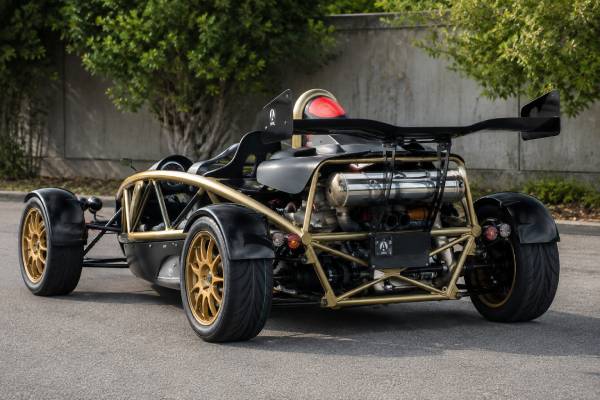
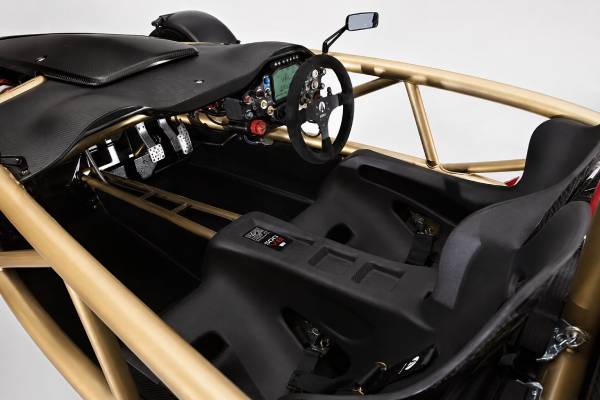
The Ariel Atom 500 V8 turned the minimalist Atom into a limited-production machine with race-car hardware throughout. Its 3.0-litre Hartley-designed naturally aspirated V8 used a flat-plane crankshaft, eight individual throttle bodies, dry-sump lubrication, and a five-figure rev limit, while a Sadev six-speed sequential gearbox shifted through pneumatic paddles. Ariel announced a 25-car series and quoted more than 500 hp in its most powerful form, although road-test cars were also supplied in approximately 475 hp trim. That distinction matters when authenticating a surviving example: “Atom 500” is the model identity, not proof that every car always operated at an identical output. Chassis bracing, bronze welding, magnesium wheels, adjustable aerodynamics, bespoke controls, and a data-rich display make the V8 far more specialised than a four-cylinder Atom. This guide explains the engineering, performance, maintenance burden, and provenance checks required for one of Ariel’s rarest and most technically demanding cars.
Table of Contents
- A Limited Series, Not an Engine Swap
- Atom 500 V8 Specifications
- The Hartley V8 and Sadev Driveline
- Chassis, Aerodynamics, and Driver Systems
- Race-Car Maintenance for Road-Legal Use
- Authenticity, Inspection, and Collection
A Limited Series, Not an Engine Swap
The Atom 500 V8 was engineered as a complete limited-edition vehicle, not created by placing a V8 into an ordinary Atom 3 chassis. Ariel changed the frame, suspension, gearbox, controls, cooling, bodywork, wheels, and aerodynamic package to support performance beyond the four-cylinder range.
Ariel announced production of 25 cars, with most already spoken for when full specifications were released in 2010. Each V8 chassis received additional bracing around the engine bay and a distinctive gold powder-coat finish. The visual signature was not mere decoration: it separated the limited-series structure from standard cars and reflected extensive bronze welding. Carbon-fibre front and rear aerofoils, composite and carbon panels, magnesium wheels, and aero-section suspension members reinforced the model’s competition emphasis.
The engine was designed by John Hartley in the United States and built for Ariel as a compact 3.0-litre V8. It was not a conventional production-car donor engine. The architecture combined elements familiar from motorcycle-derived racing engines with bespoke crankcase, crankshaft, valvetrain, induction, lubrication, and management systems. That origin is central to ownership because service support, parts supply, and rebuild knowledge are specialist matters.
Output requires careful wording. Launch material described more than 500 bhp and a 900 bhp-per-tonne ratio at a quoted 550 kg. Autocar later tested a road-trim example at 475 bhp at 10,500 rpm and stated that 500 bhp at 10,600 rpm was optional. A car advertised as an Atom 500 may therefore be authentic while carrying documentation for a 475 bhp calibration. Current engine configuration, ECU map, rev limit, exhaust, and dyno data must be considered together.
Weight also varies by definition. Ariel’s launch figure was 550 kg, while Autocar measured 650 kg fully fuelled in its tested road car. Fuel, road equipment, occupant-related hardware, test instrumentation, options, and measurement protocol explain why a nominal figure cannot be applied blindly. For purchase or transport planning, weigh the actual car on calibrated scales.
The model’s reputation often centres on its claimed sub-2.3-second 0–60 mph time and 200 mph potential. Instrumented road testing produced 60 mph in 3.02 seconds and 100 mph in 5.7 seconds with two occupants, showing both the extraordinary speed and the variability of launch-dependent numbers. The most useful interpretation is that the V8’s rolling acceleration is relentless, while standing-start performance remains limited by traction, shifting strategy, surface, and mechanical sympathy.
Atom 500 V8 Specifications
The Atom 500 combines a naturally aspirated 3.0-litre V8, pneumatic paddle-shift sequential transmission, dry-sump lubrication, and a reinforced Atom chassis. The following tables distinguish Ariel’s launch specification from measured road-test values where the two differ.
| Item | Specification |
|---|---|
| Configuration | 90-degree compact V8, naturally aspirated |
| Displacement | 3.0 litres |
| Crankshaft | Flat-plane |
| Valve gear | Chain-driven DOHC, four valves per cylinder |
| Internal components | Forged pistons and race-specification rotating assembly |
| Induction | Eight individual throttle bodies, sequential fuel injection |
| Lubrication | Dry sump |
| Exhaust | Ceramic-coated stainless system in launch specification |
| Measure | Documented figure |
|---|---|
| Road-test output | 475 bhp at 10,500 rpm |
| Optional high-output form | 500 bhp at approximately 10,600 rpm |
| Road-test torque | 268 lb-ft at 7,750 rpm |
| Quoted rev capability | Approximately 10,500 rpm or higher by configuration |
| Launch power-to-weight claim | About 900 bhp per tonne using Ariel’s quoted 550 kg figure |
| Item | Specification |
|---|---|
| Gearbox | Sadev six-speed sequential racing transmission |
| Shift actuation | Pneumatic paddle system |
| Upshift time | Approximately 40 milliseconds |
| Downshift time | Approximately 50 milliseconds |
| Downshift capability | Up to five downshifts in less than one second |
| Differential | Adjustable limited-slip differential |
| Ratios | Interchangeable gearsets and final-drive choices |
| Measure | Figure |
|---|---|
| Ariel launch mass | 550 kg quoted |
| Autocar fully fuelled test mass | 650 kg |
| Ariel 0–60 mph claim | Less than 2.3 seconds |
| Autocar 0–60 mph test | 3.02 seconds |
| Ariel 0–100 mph claim | 5.4 seconds |
| Autocar 0–100 mph test | 5.7 seconds |
| Maximum-speed claim | Up to 200 mph depending on gearing and configuration |
| System | V8 equipment |
|---|---|
| Frame | Bronze-welded tubular chassis with extra engine-bay bracing |
| Suspension members | Chromoly aerofoil-section wishbones and pushrods |
| Dampers | Remote-reservoir aluminium monotubes with three-way damping adjustment |
| Spring adjustment | Four-way spring-stiffness system |
| Wheels | Lightweight magnesium |
| Aero | Adjustable carbon-fibre front and rear wings |
| Electronic aids | Adjustable traction control, launch control, and wet/dry settings |
No table can substitute for the individual vehicle’s build documentation. Gear ratios, engine map, road equipment, aerodynamic settings, brake specification, and later factory updates may differ. Because only a very small number exist, photographs and descriptions from another V8 should never be assumed to prove what a particular chassis originally carried.
The Hartley V8 and Sadev Driveline
The engine and gearbox behave more like endurance-racing components than mass-production road-car units. They demand warm-up discipline, logged operating data, specialist inspection, and scheduled life management even when the car is road registered.
The flat-plane crankshaft permits evenly spaced exhaust pulses and helps the compact V8 rev extremely quickly. Individual throttle bodies reduce the volume between each throttle plate and intake valve, producing immediate response. The driver does not wait for boost; power rises with rpm, and the engine’s relatively modest 268 lb-ft peak torque arrives high in the range. Acceleration feels explosive because the car is light and the ratios keep the engine close to its power band.
That speed of response places demands on lubrication. A dry-sump system stores oil in a separate tank and uses scavenge stages to evacuate the crankcase. It supports high lateral acceleration and reduces windage, but adds pumps, hoses, fittings, a tank, and a specific checking procedure. Oil level cannot be judged like a conventional wet-sump road engine. The correct temperature, running state, and timing after shutdown must be followed exactly according to the build documentation.
Dry-sump hoses should be inspected for age, abrasion, heat damage, and fitting security. A minor seep at road-car pressure can become serious at racing flow rates. The tank breather, catch system, pump drive, and filters require equal attention. Oil analysis is particularly valuable because it can reveal bearing, valvetrain, or gear wear before a symptom becomes audible.
Valve-train condition matters at 10,500 rpm. Springs, retainers, cam drive, clearances, and lubrication must remain within specification. A missed downshift or incorrect pneumatic command can produce an over-rev with little warning. ECU and gearbox logs should be downloaded after events and reviewed for maximum rpm, pressure alarms, temperature excursions, and shift faults.
The Sadev sequential gearbox is not a conventional synchromesh manual. The driver selects the next ratio in sequence, and pneumatic actuation moves the mechanism in tens of milliseconds. Flat upshifts rely on coordinated ignition or fuel cut, while downshifts require correct blipping and control logic. The clutch is primarily needed for starting and stopping rather than every moving shift.
Air pressure and shift-system health are therefore essential. Check the compressor or pressure source, reservoir, lines, solenoids, sensors, actuator, and electrical supply. Slow, incomplete, or inconsistent shifts should never be overcome by repeated paddle commands. A failed engagement at high load can damage dogs, forks, or gears. Review the system’s pressure trace and fault codes before assuming the gearbox itself is defective.
Gear ratios could be selected for customer use. A circuit-oriented stack can make the car astonishingly responsive yet unsuitable for sustained road speed, while a long final drive may support a high maximum speed at the cost of acceleration. Confirm the installed ratios from records or direct measurement. Replacement gearsets and differential setup should be handled by a specialist with Sadev experience.
The engine and gearbox also need coordinated maintenance. A fresh engine beside a tired transmission is not a complete rebuild. Establish hours, starts, shifts, over-revs, oil changes, and rebuild history for both. If records are missing, budget for inspection rather than assuming low road mileage indicates low component use.
Chassis, Aerodynamics, and Driver Systems
The V8 chassis is adjustable enough to transform its behaviour, but that range creates risk when settings are undocumented. A sound baseline should precede experimentation with dampers, springs, ride height, tyre pressure, wing angle, differential, traction control, or launch strategy.
Additional frame bracing manages the V8 installation and gearbox loads. Bronze welding and the gold finish are important authenticity details, but condition matters more than appearance. Inspect every accessible joint for cracking, impact, corrosion beneath damaged coating, or evidence of repair. Any local repainting around a suspension pickup or engine bay brace warrants measurement and documentary explanation.
The chromoly aerofoil-section wishbones and pushrods reduce drag and unsprung mass while offering race-car geometry. They are not cosmetic substitutes for ordinary arms. Inspect for dents, bends, surface corrosion, damaged threads, and rod-end play. A small bend changes alignment; straightening without engineering approval can compromise strength.
Remote-reservoir dampers separate gas and fluid and provide high-speed compression, low-speed compression, and rebound adjustment. The spring system adds further stiffness choices. These controls should be mapped and recorded. Count clicks or turns only from the manufacturer’s prescribed reference, never by forcing an adjuster against its stop. Service history should include seals, oil, gas pressure, shafts, and dyno confirmation where available.
Autocar found the factory baseline stiff on a bumpy road and noted that the car responded strongly to tyre-pressure, ride-height, and damper changes. That is a useful ownership lesson: poor road behaviour may reflect a circuit setup rather than an inherent flaw. Conversely, softening everything can allow platform movement that compromises aero and geometry. Adjustments need a clear objective and data.
The front and rear wings produce meaningful high-speed load only when set within an engineered range. Wing angle changes balance, drag, and suspension demand. Check endplates, mounts, fasteners, carbon condition, and alignment. A repaired wing or improvised bracket must be evaluated structurally because failure at speed can alter balance instantly.
Magnesium wheels save unsprung mass but require specialist care. Inspect for corrosion, cracks, impact damage, and coating deterioration using an appropriate non-destructive method. Confirm age, repair history, and torque procedure. Do not assume an apparently straight wheel is safe, and do not use inappropriate chemical cleaners on magnesium.
The electronics give the driver tools unusual for an early Atom. Adjustable traction and launch control, wet and dry modes, shift settings, and an LCD with programmable alarms can make the car safer and more repeatable when calibrated correctly. They can also conceal faults if sensors drift or alarms are disabled. Verify every displayed pressure and temperature against a known reference.
The display can monitor air, water, oil, and gearbox temperature as well as fuel, oil, and manifold pressure. Configure alarms conservatively with the engine specialist and test them. Data logging should be downloaded, named by event, and retained with service records. On a vehicle this rare, logs form part of provenance.
Driver fit is a safety system. The two-place seat shell may require tools to adjust, and tall drivers can lose elbow room or fail to achieve full pedal control. Set the seating position, harness, steering wheel, mirrors, and head restraint before starting. The V8’s acceleration, noise, and wind load create physical strain; a poor position magnifies it.
Race-Car Maintenance for Road-Legal Use
A road registration does not turn the Atom V8 into a mileage-based road car. Maintenance should follow engine hours, gearbox hours, shifts, starts, heat cycles, component life limits, and inspection findings.
Build a master record from every surviving source: Ariel build sheet, Hartley engine documentation, Sadev records, ECU and dash configuration, damper specification, brake data, wheel serial information, aero settings, and service invoices. Photograph labels and engravings before they fade. Store electronic map and configuration backups in multiple locations.
Before running, check fluids according to their specialist procedures. Preheating may be required or beneficial depending on engine guidance. Confirm oil pressure immediately after start, allow temperatures to rise gradually, and avoid high rpm on cold oil. The gearbox also needs temperature before repeated high-load shifts. A water-temperature gauge alone does not show readiness.
Oil and filters should be changed on a schedule set by the engine builder and adjusted for use. Sample the oil and inspect filters. Record the quantity removed and added. The dry-sump tank, lines, pumps, and breathers need periodic leak and integrity testing. Any pressure alarm, metallic debris, or unexplained consumption should stop operation.
The pneumatic shift system needs dry, leak-free air and stable voltage. Drain or service components according to specification, inspect hoses, test pressure retention, and confirm shift timing. Battery weakness can produce control faults that resemble mechanical problems. Maintain the battery correctly and avoid uncontrolled jump-starting.
Sequential transmissions have wear limits for dogs, selector components, bearings, and gears. Oil changes and magnetic-plug inspection reveal trends, but they do not replace scheduled strip inspection. Track shift count and note every missed or refused shift. A gearbox that still operates can already be near a service limit.
Inspect the valve train and cam drive at the engine builder’s interval. Compression and leak-down trends can support diagnosis, but high-rpm engines require more than cylinder sealing checks. Borescope inspection, oil analysis, filter debris, crankcase pressure, and ECU data provide a fuller picture. Establish a proactive rebuild threshold rather than waiting for failure.
Chassis inspection should occur before and after each serious event. Check wheel bearings, rod ends, pushrods, wishbones, fasteners, driveshafts, brake lines, wing mounts, and floor. Measure alignment and corner weights after any impact or excursion. Recheck wing and wheel fasteners with the correct method.
Brake service depends on the installed hardware and use. Measure discs, pads, and hardware; replace fluid frequently; inspect caliper seals; and monitor pedal travel. The V8’s speed can generate substantial braking energy despite low mass. A soft or changing pedal is a stop condition.
Tyres can be difficult to warm because each is lightly loaded. Track temperature, pressure, age, and heat cycles. Do not chase grip by dropping cold pressure below a safe structural limit. Magnesium wheels and specialist tyres should be stored correctly, away from moisture, UV exposure, and damaging chemicals.
Long-term storage needs a written recommissioning plan. Preserve the fuel system, rotate or service the engine only as instructed, maintain the battery, protect exposed metal, and control humidity. Before return to use, inspect hoses, seals, tyres, extinguishing equipment, harnesses, and fluids. Starting the engine briefly each month may cause more condensation than benefit if it never reaches proper temperature.
Authenticity, Inspection, and Collection
The Atom 500 V8 should be purchased like a historic competition car: identity, continuity, and component history are as important as whether it starts. Its rarity makes undocumented replacement parts and incomplete records disproportionately significant.
Confirm the chassis number directly with Ariel and request the original specification. Verify the gold chassis finish, bronze-welded construction, additional bracing, V8 bodywork, carbon wings, magnesium wheels, chromoly suspension, display, switch panel, traction and launch controls, Sadev gearbox, and Hartley engine identity. Do not use any single visual cue as proof; a complete set of matching details is required.
Establish the engine’s exact state. Is it a 475 bhp road calibration or the 500 bhp option? What rev limit is programmed? When was it built or rebuilt, by whom, and with which components? Are dyno sheets corrected and dated? Are ECU maps backed up? An authentic 475 bhp car should not be devalued merely because the model name contains 500, but its description must be accurate.
Repeat the process for the gearbox. Record the casing and serial information, ratio stack, final drive, differential settings, pneumatic hardware, software, and rebuild dates. Ask for shift-count data. A spare gearset, actuator, wheel, wing, body panel, or engine component can add substantial practical value because supply may be limited.
Commission independent inspections by people who understand the relevant systems. Ariel expertise, Hartley-engine knowledge, Sadev transmission experience, damper specialists, composite inspection, and magnesium-wheel assessment may involve several professionals. A general supercar inspection is not enough.
Run the car only after static checks. Verify oil-pressure build, fluid circulation, pneumatic pressure, sensor plausibility, charging voltage, fire system, master switch, throttle operation, and alarm functions. Warm it in stages. The test should focus first on system health, not acceleration. Review the data log after each run.
Look for accident evidence throughout the structure. New gold coating, local welds, mismatched fasteners, replacement suspension members, repaired carbon, altered wing mounts, or unexplained geometry differences require documentation. A professionally repaired car can remain valid, but its history and measurements must be transparent.
Legal status varies by country and jurisdiction. Confirm registration, emissions treatment, lighting, noise, road equipment, import documents, taxes, and transferability before purchase. A car registered in one location may be usable only on track elsewhere. Transport insurance and secure loading also deserve planning because low clearance, exposed aero, and unusual width can complicate collection.
Valuation should include future support. A lower purchase price cannot compensate for an engine of unknown hours, a gearbox needing overhaul, corroded magnesium wheels, missing electronics, or undocumented crash repair. Conversely, complete factory provenance, spare parts, recent specialist rebuilds, preserved configuration files, and continuous logs support both usability and collectability.
Ownership demands restraint. Repeated launch-control demonstrations add wear without revealing the V8’s finest qualities. Its real distinction is the integration of high-revving naturally aspirated power, sequential shifting, adjustable chassis systems, and exposed engineering. Preserving that integration is more important than modifying the car to chase a modern peak-power comparison.
A properly documented Atom 500 V8 remains one of the clearest examples of a small manufacturer applying race-car thinking to a road-capable two-seater. It deserves the same disciplined maintenance and archival care as a competition machine, because that is effectively what it is—one with number plates, a passenger seat, and an extraordinarily small production run.
References
- V8 Ariel Atom Gets 900bhp Per Tonne
- Ariel Atom V8 unveiled
- Road test rewind: Ariel Atom V8
- Autocar5*
- NEW 525bhp ARIEL ATOM ANNOUNCED – THE ATOM 4RR
- Ariel Atom 3 | PH Used Buying Guide
Disclaimer
Atom 500 V8 output, mass, gearing, road equipment, service limits, and legal status vary by individual chassis and configuration. Verify the factory build record, Hartley engine specification, Sadev gearbox identity, electronic maps, component hours, safety equipment, and registration with Ariel and qualified specialists before purchase or operation. Do not apply ordinary road-car service assumptions to a high-revving dry-sump engine or sequential race transmission. Use its performance only in controlled, legal conditions, and share this guide when it can help preserve accurate history and responsible care of an Atom V8.