

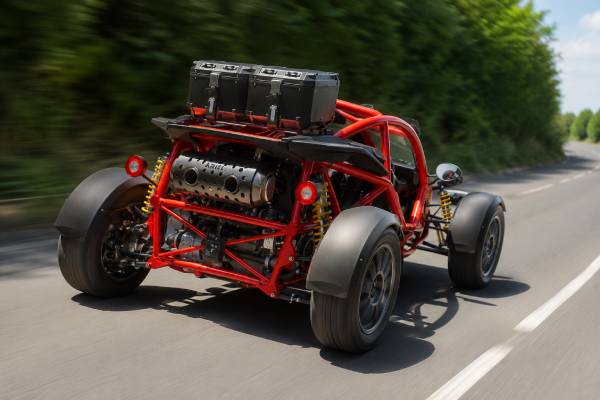
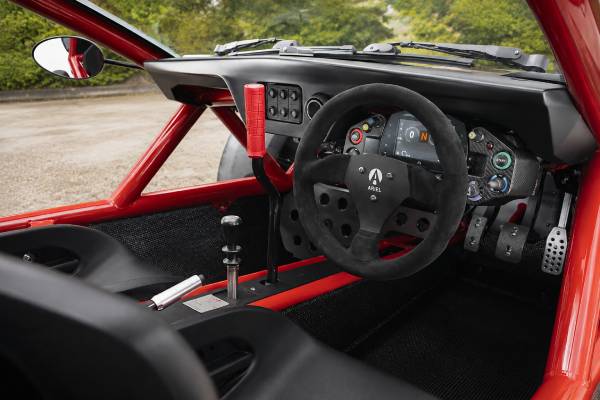
The 260 bhp Ariel Nomad 2 is the standard-power version of Ariel’s second-generation all-terrain sports car, and almost every important system changed from the original. The Ford 2.3 ST turbo engine brings 380 Nm from 2,500 rpm, the larger tube chassis is over 60 percent stiffer in torsion, the wheelbase and track grew, and the car gained a 70-liter fuel tank, full-width intercooler, dual-stage off-road filtration, 288 mm brakes, TFT instrumentation, and a central electronic body-control system. Yet Ariel kept the essentials: low weight, rear-wheel drive, exposed long-travel suspension, manual steering, two seats, and bespoke construction. Announced on July 10, 2024, the Nomad 2 entered customer production in March 2025. This guide focuses on the 260 bhp base map rather than the optional 305 bhp adjustable-power package, explaining the verified specification, new chassis behavior, turbocharged drivetrain, option choices, maintenance needs, and early-production buying considerations.
Table of Contents
- A Clean-Sheet Second-Generation Nomad
- Nomad 2 260 bhp Specifications
- How the Ford 2.3 ST Changes the Driving Experience
- Chassis, Suspension, and Braking Redesign
- Specifying a 260 bhp Car for Its Real Mission
- Maintenance for the New Turbo-Electronic Platform
- Ordering, Inspecting, and Owning an Early Nomad 2
A Clean-Sheet Second-Generation Nomad
Ariel described the Nomad 2 as a ground-up redesign with only three components carried over from the first Nomad. The visual family resemblance is strong, but the structure, suspension geometry, engine, electronics, cooling, fuel system, brakes, cockpit, and dimensions are new.
The larger chassis uses 63.5 mm, 51 mm, and 38 mm diameter steel tubes and increases torsional stiffness by more than 60 percent. Greater stiffness gives the suspension a more stable platform, allowing Ariel to tune wheel movement rather than relying on frame flex. Anti-dive and anti-squat geometry were added to control pitch under braking and acceleration.
The powertrain transition is equally significant. The old naturally aspirated Honda K24 gave way to a Ford 2.3 ST direct-injection turbo engine. In standard form it produces 260 bhp at 5,900 rpm and 380 Nm at only 2,500 rpm. That low-speed torque changes gear choice, throttle use, and traction management. The six-speed manual remains, but the driver no longer needs high engine speed to access strong acceleration.
Ariel also enlarged systems that matter away from paved roads. The fuel tank rose to 70 liters, cooling uses a front radiator and high-mounted full-width intercooler, and the intake is positioned high with dual filtration and a vacuator valve. The standard 16-inch Yokohama Geolandar tires retain a useful sidewall while the 288 mm brakes increase disc size over Nomad 1.
The new car weighs 715 kg in the published specification, 45 kg more than the original Nomad 1 baseline. That increase is modest relative to the added chassis material, larger fuel capacity, turbo and intercooler hardware, stronger brakes, electronics, and wider dimensions. At 260 bhp, the nominal power-to-weight ratio remains about 364 bhp per metric tonne.
Production timing matters for buyers. Ariel announced the car on July 10, 2024, showed and tested development vehicles, and announced that the first customer builds were underway on March 12, 2025. A vehicle described as a 2024 customer-production Nomad 2 should therefore be checked carefully against factory records; the assignment’s 2025–present range reflects actual customer production.
Nomad 2 260 bhp Specifications
The following tables use Ariel’s published standard specification. Optional equipment can change weight, braking, differential behavior, suspension, wheels, tires, cooling, and electronics.
| Specification | Factory value |
|---|---|
| Engine | Ford 2.3 ST inline four-cylinder |
| Displacement | 2,267 cc (2.3 liters) |
| Bore × stroke | 87.6 × 94 mm |
| Construction | Aluminum-alloy block and cylinder head |
| Valvetrain | Chain-driven DOHC, four valves per cylinder |
| Induction | Twin-scroll turbocharger |
| Fuel injection | Direct injection |
| Maximum power | 260 bhp at 5,900 rpm |
| Maximum torque | 380 Nm (280 lb-ft) at 2,500 rpm |
| Fuel pump | Continuous-flow electric pump, 4.0 bar |
| Fuel tank | 70 liters, aluminum |
| System | Factory specification |
|---|---|
| Radiator | Front-mounted fabricated radiator |
| Charge cooling | High-mounted full-width intercooler |
| Intake | High-level directed intake |
| Filtration | Dual-protection filter system with vacuator valve |
| Exhaust manifold | Fabricated stainless steel |
| Silencer | Stainless steel with twin outlets |
| Ignition | Electronic coil-on-plug |
| Body control | Central electronic control system |
| Security | Thatcham immobilizer |
| Driver display | Digital TFT with gearshift lights |
| Specification | Factory value |
|---|---|
| Transmission | Six-speed manual plus reverse, aluminum-alloy casing |
| Drive type | Rear-wheel drive |
| Limited-slip differential | Optional in Ariel’s configurator |
| Chassis | Bronze-welded steel tube with aluminum bulkheads |
| Main tube diameters | 63.5, 51, and 38 mm |
| Chassis stiffness change | More than 60 percent greater torsional stiffness than Nomad 1 |
| Steering | Manual rack and pinion, two turns lock to lock |
| Steering column | Collapsible offset type |
| Steering wheel | 305 mm suede-covered racing wheel |
| Specification | Factory value |
|---|---|
| Suspension layout | Double unequal-length fabricated wishbones front and rear |
| Geometry | Anti-dive and anti-squat features |
| Uprights | CNC-machined billet aluminum |
| Outboard joints | Sealed ball joints |
| Inboard joints | Rubber joints |
| Dampers | Outboard K-Tech units |
| Springs | Eibach alloy-steel coils |
| Front brakes | 288 mm ventilated discs |
| Rear brakes | 288 mm discs |
| Wheels and tires | 8J × 16 alloys with Yokohama Geolandar 235/70R16 front and rear |
| Measure | Factory value |
|---|---|
| Length | 3,400 mm |
| Width | 1,860 mm |
| Height | 1,475 mm |
| Wheelbase | 2,396 mm |
| Track | 1,635 mm front and rear |
| Approach angle | 48 degrees |
| Departure angle | 64 degrees |
| Published weight | 715 kg |
| 0–60 mph | 3.4 seconds |
| Top speed | 134 mph (216 km/h) |
The published performance applies to Ariel’s test context, not every tire, surface, load, and option combination. A winch, spare wheel, windscreen, large dampers, beadlock wheels, or passengers can change mass and acceleration.
How the Ford 2.3 ST Changes the Driving Experience
The Ford engine’s defining feature is torque at low engine speed. The standard Nomad 2 reaches its 380 Nm peak at 2,500 rpm, nearly 2,000 rpm earlier than the first Nomad’s K24 torque peak. That gives the driver strong in-gear response without chasing the upper rev range.
Turbocharging changes throttle strategy. Exhaust flow drives the turbine, so load, rpm, gear, and pedal position influence how quickly torque arrives. Ariel developed the system for a broad and predictable range, but the rear tires still receive a much larger torque request than in the original car. On a loose surface, a steady pedal can be more effective than repeated corrections that make boost and tire slip oscillate.
The standard 260 bhp calibration is not a consolation setting. At 715 kg, it produces a power-to-weight ratio far beyond most road cars, while the 380 Nm peak gives it greater low-speed force than the naturally aspirated Nomad 1. The lower map may actually be preferable for owners who prioritize road touring, mixed weather, training, or loose surfaces where 305 bhp cannot be used consistently.
Gear selection becomes less frantic. The six-speed manual allows the driver to use a taller ratio and ride the torque, reducing shifts through a rough section. However, asking for full boost at very low rpm in a high gear creates high cylinder pressure and drivetrain load. A responsive gear is healthier and gives better control than lugging the engine.
The turbo and intercooler create a heat-management cycle. Compressed air leaves the turbo hot, then passes through the high-mounted full-width intercooler. Mud, insects, bent fins, poor airflow, or heat soak can reduce charge cooling and cause the engine management to protect itself. A temporary reduction in performance on a hot, slow route may be a rational control response rather than an immediate engine fault, but repeated or extreme behavior needs diagnosis.
Turbocharger care begins with clean oil, correct warm-up, and sensible cool-down after high load. Avoid full power before oil temperature is established. After a hard run, reduce load and maintain airflow rather than switching off instantly at peak temperature. The precise procedure should follow Ariel’s guidance for the individual car.
The direct-injection fuel system operates differently from the earlier multi-port K24. High-pressure components, injectors, sensors, and calibration require appropriate diagnostic equipment. Generic assumptions from a Ford donor vehicle are not enough because Ariel’s intake, exhaust, cooling, control strategy, and vehicle mass are different.
Chassis, Suspension, and Braking Redesign
The larger tube frame is the foundation of the Nomad 2’s behavior. A stiffer structure allows steering, suspension, and braking inputs to produce more repeatable geometry. It can also make impacts feel more direct because less energy disappears into frame twist. Ariel balances that with long travel, larger tires, rubber inboard joints, and dedicated dampers.
The wheelbase grew by 48 mm and the track by 50 mm compared with the published Nomad 1 figures. Those changes support stability and create more cockpit room, while the car remains compact. The steering moves from 1.7 to two turns lock to lock, a small reduction in ratio that may reduce kickback and make rough-surface correction less nervous.
Anti-dive geometry resists front-end compression under braking, and anti-squat resists rear-end compression under acceleration. Neither eliminates weight transfer. Tires still gain and lose vertical load, and a bump can interrupt contact. The features instead control how chassis attitude changes, helping the driver read and use available grip.
CNC-machined billet uprights replace the earlier fabricated baseline, while sealed outboard ball joints and rubber inboard joints divide precision and isolation. Inspect rubber for tearing, ball-joint boots for damage, and uprights for impact marks. A sealed joint is not a lifetime component when exposed to dust, pressure washing, and stone strikes.
Standard K-Tech dampers and Eibach springs define the base chassis. Ariel offers higher-end Bilstein four-way and Öhlins three-way packages, but the standard system should be evaluated before assuming more adjusters are necessary. Complex dampers increase tuning range and rebuild requirements. A poorly adjusted four-way unit can be worse than a correctly matched simpler damper.
The 288 mm brakes are larger than the original Nomad’s standard discs, and the pedal box retains twin master cylinders with adjustable front/rear bias. Optional ABS and an adjuster were part of Ariel’s announced control strategy, depending on specification. Establish which systems are fitted and how they interact before changing bias.
The standard 235/70R16 Geolandar tires provide sidewall and mixed-surface ability. Their behavior depends on exact model, pressure, temperature, load, and wear. A square size front and rear simplifies spare strategy but does not mean pressures or wear rates must be identical.
Specifying a 260 bhp Car for Its Real Mission
The most valuable option is the one that solves a use-case problem. Begin by deciding how much time the car will spend on public roads, fast gravel, slow rough tracks, hot climates, wet conditions, or circuits.
For touring and mixed roads, prioritize road approval, windscreen and wipers, mirrors, weather protection, lighting, secure luggage, suitable tires, and sensible noise management. The 70-liter tank gives substantially more range potential than Nomad 1, but fuel consumption still varies sharply with speed, boost, tire, and aerodynamics.
For loose-surface driving, the optional limited-slip differential can improve how torque is shared between the rear tires. Adjustable traction control can add a safety net and make the car adaptable to changing surfaces. These systems do not repeal physics; their settings must suit the tire and driver, and they cannot recover grip after excessive entry speed.
For hard off-road use, Ariel offers a baffled sump, WRC air filter, high-performance radiator, forged beadlock wheels with extreme-terrain tires, guards, bumpers, and recovery equipment. The baffled sump addresses oil surge, the finer filter addresses dust, and the larger radiator addresses high load in hot, low-airflow conditions. These are targeted solutions rather than cosmetic upgrades.
Beadlock wheels are specialist equipment. They can retain a tire at low pressure but require correct assembly, torque sequence, inspection, and legality review. They also add rotating and unsprung mass. Owners who remain mostly on roads may be better served by the standard 16-inch package.
For fast tarmac use, 18-inch wheels with road-legal track-day tires, larger AP Racing brakes, upgraded dampers, and competition safety equipment can shift the car’s balance. This does not turn the Nomad into a conventional track car. Its aero exposure, high center relative to an Atom, long travel, and tire choices still matter.
The 260 bhp engine can be paired with the optional 305 bhp adjustable-power system, but buyers should not select it automatically. Standard power is already enough to exploit the new chassis. Spending the budget on brakes, cooling, filtration, training, and the correct tire may produce a faster and safer car in actual use.
Maintenance for the New Turbo-Electronic Platform
Nomad 2 maintenance combines exposed-vehicle inspection with modern turbocharged engine and electronic-system care. The car is new enough that factory documentation and dealer updates should take priority over inherited routines from Nomad 1.
Before driving, inspect oil and coolant levels, visible leaks, intake security, intercooler and radiator faces, tire pressure and damage, wheel fasteners, brake pedal, steering play, harnesses, lights, and throttle response. Check the TFT for warnings during startup and make sure expected lamps complete their self-test.
Engine oil is critical to turbocharger bearing life and high-temperature control. Use the exact Ariel-approved specification, filter, capacity, and level procedure. Do not substitute a donor Ford interval without considering the Nomad’s high-load, low-speed, dusty use. Record consumption and investigate fuel dilution, contamination, abnormal pressure, or level change.
The intake system has two-stage filtration and a vacuator valve designed for contamination management. Inspect the high intake, housing, seals, hoses, clamps, and valve after dust or mud. A finer optional WRC filter may require different service frequency. Never assume the high position establishes a safe wading depth.
Clean the radiator and intercooler carefully. Their fins are vulnerable to pressure-washer damage, and mud can remain between surfaces or behind guards. Reduced intercooler airflow raises intake temperature; reduced radiator airflow raises coolant temperature. Both can occur without an external leak.
Direct injection and centralized electronics require compatible diagnostics. Save fault codes and freeze-frame information before clearing them. An intermittent connector, water ingress, low battery voltage, or damaged sensor can produce symptoms that resemble mechanical failure. The power-distribution architecture reduces traditional fuses and relays, so troubleshooting should follow Ariel diagrams.
Brake and suspension service remains physical. Check discs, pads, hoses, master cylinders, bias hardware, joint boots, rubber inboard bushes, damper shafts, springs, wishbones, and uprights. Remove trapped grit, protect chipped coating, and investigate any steering-center change after an impact.
Ariel’s current Nomad service kit page covers Nomad 1 and Nomad 2 and outlines annual/4,500-mile and larger four-year/18,000-mile service levels, with factory contact for major work. The exact kit and additional turbocharged-engine items should be confirmed by chassis and build date.
Storage needs a charged battery, clean dry chassis, fresh or stabilized fuel according to guidance, protected intake, and prevention of tire flat spots. Software or calibration updates should be documented during dealer visits. Early-production cars especially benefit from a complete record of revisions and replaced parts.
Ordering, Inspecting, and Owning an Early Nomad 2
A new Nomad 2 purchase begins with configuration rather than inventory. Ariel’s bespoke process allows the buyer to choose power, differential, traction and launch control, sump, filtration, cooling, brakes, dampers, tires, competition equipment, weather protection, luggage, recovery equipment, and colors.
Write a use brief before selecting options. Include expected road mileage, surfaces, climate, passenger and luggage needs, storage, transport, competition plans, registration jurisdiction, and tolerance for maintenance. Ariel or the dealer can then build a coherent specification instead of an expensive collection of conflicting parts.
Request a final signed specification and retain every revision. Record engine map, differential, electronic controls, brakes, damper model, spring specification, wheels, tires, guards, recovery points, and road equipment. Photographs at delivery create a baseline for later inspections.
At handover, verify the chassis number and documents, then inspect paint and powder coat, panel fit, fluid levels, hose and wiring support, wheel condition, tire dates and pressures, brake pedal, steering center, harness operation, lights, display, immobilizer, windscreen equipment, and every option. Ask for demonstrated procedures rather than accepting a verbal list.
Understand the running-in and first-service requirements. Do not rely on general Ford advice. Ariel’s installation, vehicle mass, gearing, and intended use make the factory process authoritative. Record the date, mileage, and engine hours if available.
During the first weeks, watch for fluid weeps, fastener settling, tire-pressure change, alignment drift, abnormal belt or turbo noise, intermittent electrical warnings, and heat-related behavior. Report patterns promptly while warranty support and factory knowledge are readily available. Avoid making unrelated modifications before a concern is documented.
For a used early car, request the original order, production date, delivery inspection, first service, software or calibration updates, warranty work, and all off-road damage repairs. Confirm whether it remains on the 260 bhp specification or has received the adjustable 305 bhp option. The TFT display or seller’s claim alone is not enough; factory records and calibration identification should agree.
Inspect the underside and exposed chassis for impacts, bent guards, damaged joint boots, chafed lines, intercooler or radiator blockage, and corrosion. Check beadlock hardware carefully if fitted. Test electronic aids in a safe environment and confirm that the owner understands their settings.
Road registration, import, emissions, and insurance requirements vary by country and region. Confirm them before ordering or moving a car. A factory-built specialty vehicle can have different approval treatment from a mass-produced Ford-powered car.
The standard 260 bhp Nomad 2 should be judged on completeness rather than comparison with the 305 option. Its stronger chassis, broad torque, larger systems, and updated controls already create a major advance over Nomad 1. For many owners, the lower power map is the most exploitable version of the new platform.
References
- Nomad – Ariel Motor Company 2026 (Manufacturer Specifications and Options)
- ALL NEW NOMAD 2 ANNOUNCED – Ariel Motor Company 2026 (Manufacturer Launch Information)
- NOMAD 2 PRODUCTION BEGINS – Ariel Motor Company 2026 (Manufacturer Production Timing)
- Nomad Service Kit – Ariel Motor Company 2026 (Manufacturer Service Parts and Intervals)
- Aftercare – Ariel Motor Company 2026 (Manufacturer Service Support)
- AUTOCAR – NOMAD 2 – BBDC 2024 – Ariel Motor Company 2026 (Factory-Hosted Driving Evaluation)
Disclaimer
This article is general information and does not replace the current build specification, owner or workshop documentation, professional diagnosis, inspection, or legal advice. Technical data, software, options, fluids, capacities, torque settings, service intervals, and registration requirements can change by chassis, market, and production date. Confirm the individual Nomad 2 with Ariel or an authorized specialist.
Share this article with another buyer or owner deciding whether the standard 260 bhp Nomad 2 is the right configuration for their roads and terrain.