


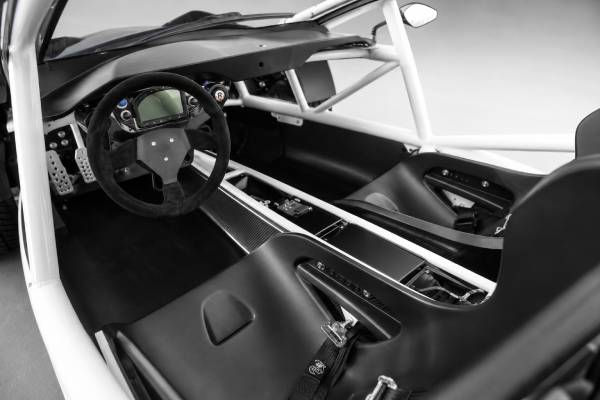
The Ariel Nomad R is the rare, road-and-track-biased extreme of the first-generation Nomad. Instead of simply adding more power to the regular 2.4-liter buggy, Ariel installed a supercharged 2.0-liter Honda K20Z3, a pneumatic-shift Sadev sequential gearbox, road-focused 18-inch tires, and specially developed dampers. The result is a five-car limited edition built around tarmac-rally priorities rather than the softer, rough-terrain balance of a normal Nomad. Its headline figures—335 bhp, 330 Nm, 0–60 mph in 2.9 seconds, and a 121 mph top speed—tell only part of the story. The R’s defining feature is how quickly it responds: the engine stays on boost, the gearbox changes ratio in milliseconds, and the lightweight chassis communicates every load change. This guide explains the exact specification, the engineering behind its performance, what ownership and maintenance demand, and how to inspect one of these exceptionally scarce cars without confusing it with an upgraded standard Nomad.
Table of Contents
- What Makes the Nomad R Different
- Nomad R Specifications and Technical Data
- Supercharged K20 and Sequential Gearbox
- Tarmac-Rally Chassis and Driving Character
- Maintenance for a Limited-Production R
- Ownership, Practicality, and Correct Use
- Buying and Authenticating a Nomad R
What Makes the Nomad R Different
The Nomad R is not a normal Nomad with an aftermarket tune. Ariel engineered it as a complete limited-edition package, using a different engine, a motorsport transmission, specific dampers, road-oriented tires, and revised cockpit hardware. That distinction matters for both driving expectations and future value.
Ariel announced the R after five years of first-generation Nomad development and described it as a tarmac-rally interpretation of the platform. The standard Nomad used a naturally aspirated 2.4-liter Honda K24 and a conventional six-speed manual. The R replaced that combination with a 2.0-liter K20Z3, Ariel’s Eaton-type twin-lobe supercharger system, water-cooled charge air, and an ST82-17 Sadev sequential gearbox. Only five cars were stated in the original launch announcement, although later factory sales material has described certain cars within a slightly wider group of special-edition examples. For a buyer, the chassis identity and factory build record are therefore more important than a seller’s casual production-count claim.
The R also changes the Nomad’s purpose. A regular car can be configured around mud, rough trails, low-speed articulation, or mixed touring. The R retains long-travel double-wishbone geometry, but its standard setup favors rapid response on paved roads, smooth gravel, and track surfaces. Yokohama A052 tires, 18-inch wheels, two-way adjustable dampers, stronger brakes, and short tarmac-rally gearing make it sharper and less forgiving than an off-road-biased build.
That focus creates three practical consequences:
- The R rewards accurate inputs more than dramatic ones. Abrupt throttle, steering, or brake commands produce immediate reactions.
- Its sequential gearbox needs informed use and specialist maintenance. It is not simply a faster version of an H-pattern road gearbox.
- Original specification carries unusual importance. With so few cars produced, undocumented changes can affect reliability, usability, and collectability.
The Nomad R should therefore be judged as a lightweight specialist car with rally-derived hardware, not as a miniature SUV or a casual beach buggy.
Nomad R Specifications and Technical Data
The Nomad R is a gasoline-only, rear-wheel-drive ICE vehicle with a supercharged Honda engine mounted behind the cockpit. Its critical technical features are the 335 bhp K20Z3, the air-to-water charge-cooling system, and the paddle-operated Sadev sequential transaxle. Some dimensions follow the first-generation Nomad platform, while individual cars may differ because Ariel offered extensive factory options.
| Specification | Value |
|---|---|
| Engine | Honda K20Z3 inline four-cylinder |
| Displacement | 2.0 liters |
| Construction | Aluminum-alloy block and cylinder head, DOHC, four valves per cylinder |
| Induction | Ariel Eaton-type twin-lobe supercharger |
| Boost pressure | 11 psi |
| Charge cooling | Fabricated aluminum air-to-water charge cooler |
| Maximum power | 335 bhp at 7,600 rpm |
| Maximum torque | 330 Nm (243 lb-ft) at 5,500 rpm |
| Specification | Value | Notes |
|---|---|---|
| Gearbox | Sadev ST82-17 six-speed sequential | Close-ratio, straight-cut, dog engagement |
| Shift operation | Electronically controlled pneumatic paddle shift | Pull for upshift, push for downshift |
| Published shift time | 40 ms up, 50 ms down | Automatic throttle blip on downshifts |
| Final drive | 12/53 | Tarmac-rally ratio set |
| Differential | Three-disc ramp-and-plate limited-slip differential | Externally adjustable preload |
| Drive type | Rear-wheel drive | Uprated Sadev driveshafts |
| Gearbox mass | 38 kg (84 lb) | Manufacturer figure for the unit described by Ariel |
| Specification | Value | Condition |
|---|---|---|
| 0–60 mph | 2.9 seconds | Ariel published figure |
| Top speed | 121 mph (195 km/h) | Standard tarmac-rally gearing |
| Power increase over the 235 bhp base Nomad | 100 bhp | Ariel comparison |
| Torque increase over the base Nomad | 90 Nm (66 lb-ft) | Ariel comparison |
| Specification | Value |
|---|---|
| Chassis | Bronze-welded steel tube frame with integrated occupant structure |
| Suspension layout | Double unequal-length wishbones front and rear |
| Dampers | Bilstein MDS two-way adjustable monotube units developed for the R |
| Springs | R-specific Eibach coil springs |
| Brakes | Four-piston Alcon calipers and two-piece ventilated discs front and rear |
| Brake adjustment | Driver-adjustable front/rear bias |
| Wheels | Lightweight 18-inch multi-spoke alloys |
| Tires | Yokohama A052 road-legal track-day tires |
| Specification | Value | Application |
|---|---|---|
| Length | 3,215 mm (126.6 in) | Nomad 1 platform |
| Width | 1,850 mm (72.8 in) | Nomad 1 platform |
| Height | 1,425 mm (56.1 in) | Nomad 1 platform before option-dependent changes |
| Wheelbase | 2,348 mm (92.4 in) | Nomad 1 platform |
| Track | 1,585 mm (62.4 in) front and rear | Nomad 1 platform |
| Approach angle | 71 degrees | Base platform geometry |
| Departure angle | 82 degrees | Base platform geometry |
Ariel’s option-led production means equipment can differ even among R cars. Windscreens, side panels, underbody protection, bumpers, harness types, damper substitutions, and road-registration equipment must be checked against the individual build sheet rather than assumed from photographs.
Supercharged K20 and Sequential Gearbox
The R’s performance comes from keeping the engine in its useful rev range and reducing interruption during shifts. The 335 bhp output is substantial, but the gearbox and charge-cooling system are what make that output repeatable and immediately accessible.
The K20Z3 begins as a high-revving Honda four-cylinder, then receives Ariel’s supercharger installation. An Eaton-type positive-displacement blower supplies boost without waiting for exhaust energy to build as a turbocharger would. That gives the driver a direct relationship between throttle movement and torque. At the same time, compressing intake air generates heat, so the fabricated air-to-water charge cooler is not decorative. It lowers intake temperature and helps the engine deliver consistent power during repeated acceleration.
A buyer should not reduce this system to “engine plus supercharger.” Reliability depends on the complete installation: belt drive, tensioning, charge-cooler pump and plumbing, coolant reservoir, intake joints, engine calibration, fuel delivery, oil cooling, and exhaust condition. A minor leak or weak pump may not show during a gentle test drive but can become obvious during sustained high-load running.
The Sadev gearbox changes how the car is driven. Dog-ring engagement allows extremely fast shifts, while pneumatic actuation carries out the movement commanded by the paddle. Upshifts can occur without lifting the accelerator, and automatic blipping smooths downshifts. The clutch is mainly required for moving away and stopping rather than every ratio change.
That speed should not be mistaken for indestructibility. A sequential racing transmission has different wear patterns from a road manual. Shift quality depends on correct pneumatic pressure, actuator calibration, sensor input, oil condition, dog-ring condition, selector components, and driver technique. Hesitation, repeated missed shifts, unexplained neutral selection, harsh engagement beyond the normal mechanical character, or a compressor that runs excessively deserve specialist investigation.
The gearbox also explains the R’s modest 121 mph top speed. Ariel chose ratios for acceleration and in-gear response, not for a large terminal-speed number. On a tight circuit or fast road, the benefit is obvious: the engine stays close to its power band, and each shift costs very little time. On a long motorway journey, the same gearing and straight-cut internals can make the car busier and louder than a conventional Nomad.
Tarmac-Rally Chassis and Driving Character
The Nomad R works best on high-grip surfaces where its steering response, brake capacity, and rapid power delivery can be used cleanly. It retains suspension travel, but the standard R setup is fundamentally different from a mud-tire Nomad prepared for slow, broken ground.
The Bilstein MDS dampers permit separate compression and rebound adjustment. Compression control influences how the chassis resists a bump or load application; rebound control governs how quickly the suspension extends afterward. On a light car, a few clicks can noticeably change traction and confidence. Excess compression can make the car skip over rough surfaces. Excess rebound can prevent the wheel from recovering quickly between bumps. Random adjustment is therefore a poor approach. Owners should record a known baseline, change one variable at a time, and use tire temperatures, surface condition, and driver feedback together.
The A052 is a road-legal track-focused tire with a firm performance bias. It offers much faster steering and stronger dry grip than a tall off-road tire, but it also gives the suspension less sidewall compliance. On loose stones, deep mud, standing water, or sharp-edged terrain, that tradeoff becomes clear. The tire choice is one reason the R should not be assumed to be the most capable Nomad in every environment. It is the quickest first-generation version on the surfaces for which it was designed, not the universal answer for difficult trails.
Braking hardware also moves the car toward sustained speed. Four-piston calipers and two-piece ventilated discs at both ends improve heat capacity and pedal consistency. Adjustable bias lets an experienced driver tailor front-to-rear balance, but it is a setup tool rather than a novelty control. Too much rear bias can cause instability under braking; too much front bias can lengthen stops and overload the front tires. Changes should be small, documented, and tested in a controlled area.
The open cockpit magnifies speed. There is little isolation from airflow, tire noise, stones, heat, or mechanical sound. The car can feel faster at 60 mph than a closed performance car does at much higher speed. That intensity is central to its appeal, yet it also increases fatigue. A properly fitted helmet or eye protection, suitable hearing protection where legal, secure clothing, and careful harness adjustment are practical necessities rather than theatrical accessories.
Maintenance for a Limited-Production R
Preventive maintenance is more important than mileage alone on a Nomad R. Low annual use does not stop brake fluid absorbing moisture, fuel aging, seals hardening, pneumatic components deteriorating, or exposed fasteners corroding.
Ariel’s service-kit information identifies interim, 4,500-mile/annual, and 18,000-mile/four-year service levels across the Nomad range, with transmission oil specifically relevant to the R. Factory used-car records also show running-in, interim, annual, and four-year work. The safest approach is to follow the schedule assigned to the individual chassis and to shorten inspection intervals when the car sees track work, heavy dust, water, or repeated high-temperature use.
Engine and supercharger checks
Engine oil deserves close attention because it lubricates a highly loaded, high-revving supercharged engine. Check the level frequently, especially before a track session, and investigate consumption trends rather than merely topping up. The correct oil grade, fill quantity, filter, and change procedure should come from Ariel documentation for the exact installation—not from a generic Honda K20 chart.
Inspect the supercharger belt for cracking, glazing, frayed edges, contamination, and abnormal tracking. Listen for changes in bearing noise. Examine charge-cooler hoses and clamps for staining or dried residue, and confirm that the pump operates. Intake leaks can cause poor running; coolant loss in the charge-cooling circuit can reduce performance before the dashboard gives a clear warning.
Sequential transmission care
Use the specified transmission oil and respect its change interval. Metal debris, shifting deterioration, or a change in oil appearance should be assessed by a technician familiar with Sadev units. The pneumatic system should build and hold pressure normally, complete shifts consistently, and avoid continuous compressor cycling. Battery condition also matters because low voltage can affect pumps, valves, controllers, and shift behavior.
The clutch may see fewer shifts than in a conventional manual, but launches can be demanding. Check for altered bite point, slip, judder, hydraulic leakage, or difficulty selecting a starting gear. Driveshaft boots, joints, fasteners, and differential seals should be inspected after hard use.
Chassis, brakes, and exposed hardware
After dirty or wet running, rinse contaminants without forcing high-pressure water into electrical connectors, bearings, the intake, or seals. Dry the car, operate the brakes carefully to remove surface moisture, and inspect the underside. Look for chipped powder coating, bent guards, cracked panels, loose fasteners, damaged brake hoses, and impact marks around suspension pickups.
Track use increases brake inspection needs. Measure pad and disc condition rather than judging through the wheel. Check for heat cracking, uneven deposits, fluid discoloration, pedal change, and caliper leakage. Inspect the A052 tires for heat cycling, inner-edge wear, flat spots, cuts, and age-related hardening. A lightly used car can still require tires because of age rather than tread depth.
Ownership, Practicality, and Correct Use
The Nomad R is usable on the road, but it is not convenient in the ordinary sense. Its value comes from mechanical involvement and access to unusual performance, while weather protection, luggage space, security, noise control, and long-distance comfort remain secondary.
Road equipment varies. Some cars have a full heated windscreen, wipers, side panels, road lighting, an immobilizer, and registration approval. Others may be configured more narrowly. A windscreen improves touring comfort but changes airflow around the cockpit. Side panels reduce spray and drafts yet can affect entry and heat management. Harnesses need careful adjustment every drive, and occupants should understand how to release them quickly.
Fuel planning deserves thought because performance driving can reduce range sharply. The open rear body and exposed hot exhaust also require disciplined luggage placement. Soft bags must be secured away from moving suspension, hot components, and intake openings. A spare wheel, front bumper, underbody guards, and other Nomad options add usefulness but also change weight distribution and the car’s intended balance.
Security is another realistic issue. The cockpit is open, the steering wheel may be removable, and visible controls attract attention. Use the immobilizer, battery isolation where appropriate, secure storage, and an enclosed garage. A weatherproof cover helps with dust but should not trap moisture against a dirty or wet car.
Owners should also choose venues carefully. The R can generate speed far more quickly than its minimal bodywork suggests. Track-day noise limits, tire rules, harness requirements, rollover policies, and vehicle eligibility vary. Off-road access is equally regulated; a road-registered Nomad does not automatically have permission to use private land, protected trails, or competitive stages.
The best use pattern alternates demanding driving with methodical checks. Warm fluids before heavy load, cool the car after sustained running, inspect it before putting it away, and record setup changes. This rhythm preserves both performance and the mechanical clarity that makes the R special.
Buying and Authenticating a Nomad R
The strongest purchase is the car with the clearest factory identity, build specification, service history, and condition—not necessarily the lowest mileage. A Nomad R can cover very few road miles yet still accumulate substantial track heat cycles, launches, and high-load shifts.
Start by confirming the chassis number directly with Ariel. Request the original order or build sheet, registration documents, invoices, and records of later factory work. The evidence should support the K20 engine, Sadev sequential installation, R-specific equipment, and original color or option configuration. Do not accept graphics, a 335 bhp claim, or a paddle shifter as proof by themselves.
Inspect the following areas closely:
- Cold start: The engine should start cleanly without prolonged cranking, smoke, unexplained warning lights, or persistent mechanical noise.
- Charge-cooling system: Check fluid level, pump operation, hose condition, leakage evidence, and heat-related discoloration.
- Sequential shift system: Test every gear under light and moderate load, plus controlled downshifts. Confirm stable pneumatic operation and no intermittent neutral selection.
- Chassis tubes and welds: Look for fresh paint, distortion, corrosion, impact marks, or repairs around suspension and bumper mounts.
- Suspension: Check rod ends, bushes, dampers, springs, uprights, wheel bearings, and adjusters. Unequal settings may indicate careless setup or an attempt to mask a problem.
- Brakes: Inspect disc faces, bells, fasteners, pads, hoses, calipers, pedal feel, and the operation of any bias control.
- Wheels and tires: Look for buckling, cracks, repaired rims, tire age, track wear, and mismatched specifications.
- Road equipment: Verify that lighting, wipers, immobilizer, instruments, horn, and registration equipment function as documented.
Ask how the car was transported and stored. Enclosed, dry storage is valuable. Trailer use is not negative—many careful owners avoid unnecessary road miles—but it can hide a history of intense circuit use. Request setup sheets, event invoices, gearbox work, oil-analysis records if available, and photographs before modifications.
Finally, budget for specialist recommissioning even when the car appears excellent. Fluids, battery, tires, belts, filters, brake inspection, geometry, pneumatic-system checks, and a factory or expert diagnostic review provide a reliable baseline. On a car this scarce, paying for a precise pre-purchase inspection is far cheaper than discovering that an apparently minor shift or cooling fault requires bespoke parts and specialist labor.
References
- Ariel Nomad R Release – Ariel Motor Company 2020
- Nomad 1 – Ariel Motor Company 2026 (Manufacturer Specifications)
- Ariel Nomad R – Ariel Motor Company 2025 (Factory Used-Vehicle Record)
- Nomad Service Kit – Ariel Motor Company 2026 (Service Parts and Intervals)
- Aftercare – Ariel Motor Company 2026 (Manufacturer Service Information)
- Our History – Ariel Motor Company 2026 (Manufacturer History)
Disclaimer
This article is for informational purposes and is not a substitute for professional diagnosis, maintenance, or repair. Specifications, torque values, service intervals, fluids, parts, and procedures can vary by chassis number, market, build specification, and later factory upgrades. Verify every technical detail against the official documentation for the individual vehicle and use an Ariel-authorized or appropriately qualified specialist for safety-critical work.
Please share this guide on Facebook, X/Twitter, or another enthusiast community if it helped you understand the Nomad R and supports careful ownership of these rare cars.