


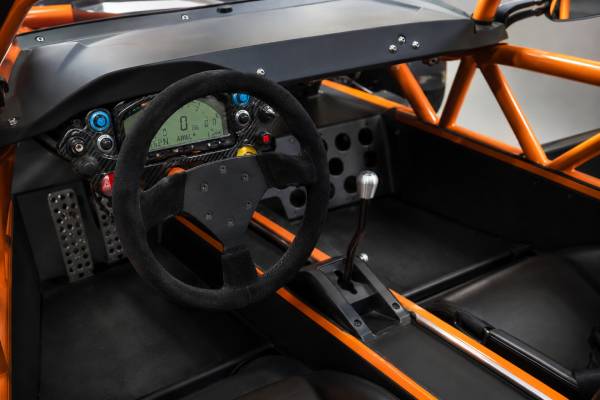
The North American Ariel Nomad Sport is the road-leaning version of the original Nomad, pairing a 230 hp Honda K24Z7 with 18-inch wheels, a close-ratio six-speed manual, and the same exposed tubular architecture that makes every Nomad instantly recognizable. It is still capable on gravel, dirt, and uneven ground, but the Sport’s factory specification emphasizes quick steering, low mass, and paved-road response rather than the winch, mud tires, heavy-duty uprights, and larger brakes associated with the Tactical model. That distinction is important because used cars were often personalized, and a Nomad advertised as a Sport may now wear Tactical-style hardware or a supercharger package. The naturally aspirated 2.4-liter version remains appealing because its power delivery is progressive, its mechanical layout is comparatively simple, and its performance is already far beyond what the 1,480-pound curb weight suggests. This article explains the verified specification, driving character, maintenance priorities, legal realities, and inspection steps that matter when buying a 2016–2022 North American Nomad Sport.
Table of Contents
- Sport Model Scope and Identity
- North American Nomad Sport Technical Specifications
- How the Naturally Aspirated K24Z7 Drives
- Road-Focused Chassis with Real Off-Road Ability
- Routine Care and High-Wear Areas
- Registration, Weather, and Day-to-Day Ownership
- Used Nomad Sport Inspection and Value
Sport Model Scope and Identity
The Sport was the cleaner, more road-oriented starting point in the North American Nomad 1 range. Its defining equipment included the 230 hp K24Z7, 18-inch alloy wheels, standard 240 mm ventilated brakes, lightweight fabricated uprights, and a conventional parking brake rather than the Tactical model’s full collection of off-road accessories.
North American production ran from 2016 through 2022. The cars were assembled in Virginia and differed in detail from UK-market Nomads, even though both used the first-generation Ariel concept and Honda K-series power. The Sport specification published by an Ariel dealer lists left-hand drive, a 13-gallon aluminum tank, a Thatcham immobilizer, road lighting, 18-inch wheels, and 1,480 pounds of weight. The separate North American Tactical specification later adopted equipment such as remote-reservoir dampers, 290 mm Alcon brakes, a winch, roof lights, a spare tire, and 16-inch mud-terrain tires.
Because Ariel built cars to order, trim labels alone do not tell the complete story. A Sport could be optioned with stronger brakes, alternate dampers, body protection, a windscreen, side panels, harness upgrades, or eventually a supercharger. Conversely, owners sometimes removed heavy accessories from Tactical cars. The most reliable identification method is a chassis number matched to the original build sheet and invoices.
The naturally aspirated Sport occupies a useful position in the range. It is less thermally demanding than the 300 hp supercharged package and less specialized than the Tactical. Its 230 hp output does not look extraordinary by modern performance-car standards, but the power-to-weight ratio is roughly 311 hp per metric tonne before occupants and options. More importantly, the engine’s response is predictable and the car gives the driver time to meter traction on imperfect surfaces.
Buyers should therefore treat the Sport as its own specification, not as a “base model” that requires upgrading. A correctly set up 230 hp car can be the better choice for road use, driver training, touring, and mixed-surface fun.
North American Nomad Sport Technical Specifications
The Nomad Sport is a rear-wheel-drive gasoline vehicle with a naturally aspirated 2.4-liter Honda K24Z7 mounted behind the two-seat cockpit. Power goes through a close-ratio six-speed manual and limited-slip differential. Its low mass, short wheelbase, fast steering, and exposed suspension are more important to its behavior than any single horsepower figure.
| Specification | Value |
|---|---|
| Engine | Honda K24Z7 inline four-cylinder i-VTEC |
| Displacement | 2,354 cc (2.4 liters) |
| Bore × stroke | 87 × 99 mm |
| Valvetrain | Chain-driven DOHC, four valves per cylinder |
| Induction | Naturally aspirated |
| Fuel injection | Indirect multi-port grouped injection |
| Maximum power | 230 hp at 7,200 rpm |
| Maximum torque | 220 lb-ft (298 Nm) at 4,300 rpm |
| Fuel tank | 13 US gal (49.2 L), aluminum |
| Specification | Value |
|---|---|
| Transmission | Six-speed close-ratio manual with reverse |
| Clutch | Hydraulically operated |
| Differential | Limited-slip differential |
| Drive type | Rear-wheel drive |
| Steering | Manual rack and pinion, 1.7 turns lock to lock |
| Steering wheel | 305 mm suede-covered motorsport wheel |
| Pedal box | Tilton aluminum racing pedal assembly |
| Brake balance | Twin master cylinders with adjustable front/rear bias |
| Specification | Value |
|---|---|
| Chassis | Bronze-welded steel tube frame, powder-coated finish |
| Bulkheads | Aluminum |
| Suspension | Double unequal-length wishbones front and rear |
| Uprights | Lightweight fabricated front and rear |
| Dampers | Outboard dampers front and rear |
| Brakes | 240 mm ventilated discs |
| Wheels | 7J × 18, 12-spoke alloy front and rear |
| Body panels | Rotationally molded toughened polyethylene and composite material |
| Specification | Value |
|---|---|
| Length | 3,215 mm (126.6 in) |
| Width | 1,850 mm (72.8 in) |
| Height | 1,425 mm (56.1 in) |
| Wheelbase | 2,348 mm (92.4 in) |
| Track | 1,585 mm (62.4 in) front and rear |
| Approach angle | 71 degrees |
| Departure angle | 82 degrees |
| Published weight | 1,480 lb (671 kg) |
| Measure | Value | Status |
|---|---|---|
| 0–60 mph | 3.4 seconds | Dealer-listed estimate |
| 0–100 mph | 8.7 seconds | Dealer-listed estimate |
| Top speed | 125 mph (201 km/h) | Dealer-listed estimate |
| Seating | Two individual adjustable seats | Four-point quick-release harnesses |
The listed figures describe the published Sport configuration, not every delivered car. Wheels, tires, dampers, brakes, screens, guards, and body accessories often changed at order time or later. Confirm the installed hardware before ordering parts or setting alignment and tire pressures.
How the Naturally Aspirated K24Z7 Drives
The 230 hp K24Z7 gives the Sport a broad, linear power curve that is easier to exploit than a sudden high-boost setup. It pulls cleanly at ordinary engine speeds, becomes more urgent as revs rise, and lets the driver adjust rear-tire load with small throttle movements.
The engine’s long 99 mm stroke helps produce useful midrange torque, while Honda’s i-VTEC valvetrain supports strong breathing at higher rpm. In a heavier sedan, those traits create a flexible road engine. In a 1,480-pound Nomad, they create immediate acceleration without requiring forced induction. The published 220 lb-ft peak arrives at 4,300 rpm, but the practical benefit is the area around the peak rather than one number: the engine does not need to be kept at redline to move the car quickly.
The close-ratio gearbox complements that delivery. The driver can keep the engine in its responsive range, yet the H-pattern manual remains familiar and mechanically transparent. A good example should have a defined clutch take-up, positive gate location, and clean engagement in every gear. A vague lever, resistance when warm, crunching on quick shifts, or a limited-slip differential that chatters excessively requires diagnosis rather than being dismissed as “race-car behavior.”
Traction is the limiting factor more often than power. The Nomad has rear-wheel drive, little mass over the front axle, and very fast steering. On cold tires or dusty pavement, full throttle in a low gear can rotate the car quickly. The naturally aspirated engine helps because torque builds progressively, but it cannot replace judgment. Smooth steering, progressive braking, and deliberate throttle application make the Sport faster and safer than abrupt inputs.
The car also teaches mechanical sympathy. It has no thick insulation to hide heat, vibration, or drivetrain sound. A new rattle, change in induction tone, altered shift feel, or steering vibration is easier to notice than in a conventional car. Owners who learn the normal soundtrack can detect problems early.
Road-Focused Chassis with Real Off-Road Ability
The Sport’s 18-inch wheel package sharpens response on pavement, while the long-travel double-wishbone suspension still gives it useful compliance on gravel and broken roads. Its capability is broad, but tire construction and ground contact—not the approach-angle figures alone—determine where it works well.
Compared with a Tactical on tall 16-inch mud-terrain tires, the Sport generally has less sidewall flex and a more immediate turn-in. That makes it satisfying on a winding road, where the manual steering communicates surface texture and front-tire load. It also means sharp potholes and rocks transfer more energy into the wheel, tire, upright, and driver. A road-biased tire can be damaged in terrain that a taller off-road tire absorbs easily.
The suspension’s exposed layout simplifies inspection. Wishbones, dampers, springs, rod ends, brake hoses, and uprights are visible without removing large body panels. That is an advantage only when owners actually look. Before and after rough-surface driving, check for bent tubes, scraped spring platforms, leaking dampers, loose locknuts, split boots, and witness marks showing that a tire or component has contacted something it should not.
The 240 mm brakes are appropriate to the standard 230 hp specification when maintained correctly and used within their thermal capacity. Repeated high-speed stops, sticky track tires, or a power increase can justify larger hardware, but brake upgrades should be treated as a system. Caliper piston area, master-cylinder sizing, pad compound, disc mass, bias, tire grip, and handbrake arrangement all affect the result. Installing one impressive component without considering the rest can worsen pedal feel or balance.
Off pavement, the Sport is at its best on maintained dirt roads, loose-surface circuits, grass, and moderate trails with adequate clearance. The open differential behavior is controlled by the limited-slip unit, which can help the loaded rear tire drive the car forward, but it does not create four-wheel drive. Deep mud, steep loose climbs, and cross-axle obstacles can stop the car. Momentum is tempting, yet impacts become more expensive as speed rises.
A sensible mixed-surface setup begins with the intended use. Owners who spend most of their time on road should preserve steering precision and braking confidence. Those moving toward rougher terrain may gain more from suitable tires, underbody protection, and careful damper setup than from extra engine power.
Routine Care and High-Wear Areas
A Nomad Sport needs frequent visual inspection even when annual mileage is low. Its components are exposed to water, grit, UV light, and temperature changes, while its performance encourages short periods of very high load.
Use the service schedule and fluid specifications assigned to the individual North American build. Ariel’s current Nomad service information identifies annual/4,500-mile servicing and a larger four-year/18,000-mile service for the family, but market-specific cars and earlier documentation may differ. A local Honda interval is not a complete substitute because the engine is installed in a different vehicle with different cooling, intake, exhaust, fuel, and drivetrain systems.
Checks before driving
Begin with tire condition and pressure, wheel security, fluid levels, visible leaks, harness function, brake-pedal firmness, throttle return, steering play, and loose objects in the cockpit. Check that the fuel cap seals and that the intake is clear. On a car stored for weeks, inspect for rodent damage, corrosion at electrical connections, and battery voltage before cranking.
The K24’s oil level matters especially during sustained cornering or rough running. Keep the car level, follow the specified checking procedure, and record consumption. Milky residue, fuel odor, metallic glitter, unexplained level rise, or repeated low-oil readings needs investigation. Do not assume a generic K24 oil capacity applies after oil-cooler or sump changes.
Cleaning after dirt use
Remove mud before it hardens around springs, joints, radiators, and brake components. Use controlled water flow rather than blasting seals, connectors, the foam air filter, or the cockpit electronics. Clean the radiator from the correct direction so debris is pushed out rather than deeper into the core. Dry the car thoroughly, then apply corrosion protection only where approved; overspray on brakes, tires, belts, or friction surfaces is dangerous.
The ITG foam filter requires the correct cleaning and re-oiling method. Too little filter oil can reduce dust capture, while too much can restrict airflow or contaminate nearby sensors. Twin fuel filters are part of the published system and should not be ignored, especially if the car has sat with old fuel.
Wear that reveals setup problems
Uneven front-tire wear can point to toe, camber, bearing, or steering-joint issues. Rear wear may show aggressive limited-slip action, excessive toe, repeated wheelspin, or alignment damage. A steering wheel that no longer sits centered after an impact deserves a full geometry check rather than a quick tie-rod adjustment.
Brake pad taper, heat spotting, a long pedal, or fluid seepage suggests more than routine consumption. Dampers should remain dry, move smoothly through their range, and retain matched settings side to side. Powder-coat chips on the frame should be cleaned and protected promptly because trapped moisture can start corrosion beneath surrounding finish.
Registration, Weather, and Day-to-Day Ownership
The Nomad Sport can be driven on public roads only where its individual title, registration, equipment, and local rules allow. Ariel North America explicitly notes that its vehicles are not federally certified as ordinary mass-production road cars, so a license plate in one state does not guarantee easy registration in another.
Prospective owners should contact their state motor-vehicle agency and insurer before purchasing, not after delivery. Ask how the car is titled, whether emissions or safety inspection applies, what documentation must transfer, and whether a move across state lines changes its status. Compare the chassis number on the vehicle, title, bill of sale, and build records.
Weather protection is optional and partial. A full windscreen, wiper, side panels, and suitable clothing can make touring realistic, but the cockpit is still open to drafts, rain, dust, and temperature swings. Water-resistant luggage must be tied down securely. Electronics, switches, harness webbing, and seat materials should be allowed to dry before the car is covered.
Noise and exposure influence route planning. Highway speeds create sustained wind load, and the engine sits close behind the occupants. Ear protection may be appropriate where legal, while eye protection is essential without a full screen. A helmet can increase safety in some environments but may also alter visibility and neck load in a road crash; use equipment suitable for the activity and local rules.
Fuel range varies dramatically with pace. The 13-gallon tank is generous relative to the car’s size, but remote routes still require planning because the Nomad has no conventional cargo area for carrying fuel safely. Never place an unsecured container near the exhaust, electrical equipment, or occupants.
Storage is best indoors on a clean, dry floor. Maintain battery charge with the approved connection method, prevent tire flat-spotting during long layups, keep rodents away from wiring and filters, and avoid sealing moisture beneath a cover. The car’s simplicity makes it robust, but only when exposure is managed deliberately.
Used Nomad Sport Inspection and Value
A well-documented, uncrashed, correctly maintained Sport is generally more desirable than a heavily modified car with a vague history. Mileage matters, but condition, build specification, legal documentation, and evidence of professional service matter more.
First establish what the car was when delivered. Obtain the original invoice, option list, chassis record, and photographs if possible. Identify any later installation of Tactical hardware, 300 hp supercharger equipment, alternate wheels, big brakes, dampers, engine management, or body protection. Modifications are not automatically negative; undocumented or poorly integrated modifications are.
Use a structured inspection:
- Confirm identity and title. Match every number and verify that the ownership document describes the car accurately enough for the buyer’s state.
- Inspect the frame in bright light. Look around suspension pickups, rollover structure, floor edges, bumper mounts, and engine cradle for distortion, repair, flaking finish, or fresh coating.
- Start the engine cold. Watch for smoke, unstable idle, oil-pressure concerns, coolant odor, fuel leaks, and warning lights that disappear suspiciously quickly.
- Test the clutch and gearbox. Drive at low speed first, then check each gear under load. Listen for bearing noise on acceleration and overrun.
- Evaluate the differential. Mild mechanical sound can be normal, but binding, banging, or inconsistent lockup needs specialist assessment.
- Check suspension and steering. Lift the car correctly and examine joints, bearings, dampers, wishbones, fasteners, and wheel runout.
- Measure brakes and tires. Record pad thickness, disc condition, tire date codes, tread pattern, pressure, and alignment wear.
- Review every accessory. Windscreen heat, wipers, lighting, immobilizer, dash, charging sockets, handbrake, and harness releases should work.
Ask where the car was used. Sand can invade joints and electrical connections. Mud can hide corrosion. Track use can consume brakes, tires, wheel bearings, and fluids without adding many miles. A trailer queen may have harder mechanical hours than a frequently toured car.
A pre-purchase inspection should be performed by Ariel North America, an experienced Ariel dealer, or a specialist familiar with lightweight tube-frame cars and Honda K-series installations. Generic diagnostic scanning is not enough. The inspection must include structure, geometry, exposed controls, custom fuel and cooling systems, and build-specific parts.
Budget for a baseline service immediately after purchase. Replace age-sensitive items as needed, document alignment and damper settings, photograph the car underneath, and create a parts list tied to the exact build. That record protects reliability and makes the next ownership transfer far easier.
References
- Ariel Nomad Sport – ACE Performance 2026 (Dealer Specifications)
- Ariel Atom, Ariel Nomad, Ariel North America Ariel Nomad Tactical – Ariel North America 2026 (North American Manufacturer Specifications)
- Ariel Atom, Ariel Nomad, Ariel North America History – Ariel North America 2026 (Production History)
- Nomad 1 – Ariel Motor Company 2026 (Manufacturer Specifications and Options)
- Nomad Service Kit – Ariel Motor Company 2026 (Service Parts and Intervals)
- Aftercare – Ariel Motor Company 2026 (Manufacturer Service Information)
Disclaimer
This article is for informational purposes and does not replace professional diagnosis, service, or repair. Specifications, torque values, fluids, maintenance intervals, legal status, and procedures vary by chassis number, state, market, installed options, and later modifications. Verify the individual car against its factory records and official service documentation before ordering parts or performing work.
Please share this article on Facebook, X/Twitter, or a relevant owners’ group if it helps another enthusiast evaluate and care for a Nomad Sport responsibly.