

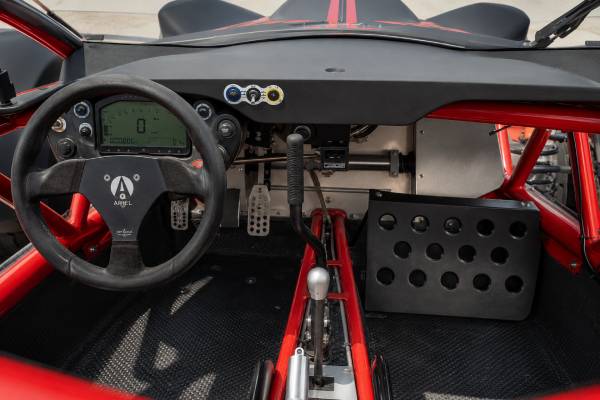

The Ariel Nomad Tactical was the North American Nomad 1 configured for owners who expected to leave pavement rather than merely tolerate it. Its 230 hp Honda K24Z7 remained naturally aspirated, but the surrounding car emphasized durability and self-recovery: reinforced suspension hardware, remote-reservoir dampers, larger brakes, protective guards, off-road lighting, bumpers, a winch, and taller all-terrain or mud-terrain tires appeared in published Tactical specifications and build descriptions. Those additions make the Tactical meaningfully different from the lighter, road-biased Sport, yet the model was still hand-built and highly configurable. Early dealer literature, later Ariel North America specifications, and individual cars do not always list the same weight, tire, damper, or body equipment. A buyer therefore needs to understand both the intended Tactical package and the exact chassis in front of them. This guide explains the verified engineering, model-year variation, trail behavior, cleaning and service priorities, recovery discipline, and inspection points for 2016–2022 naturally aspirated Tactical models.
Table of Contents
- Why the Tactical Is More Than a Nomad with a Winch
- Nomad Tactical Technical Data
- Equipment Changes Across North American Production
- How 230 hp Works on Loose and Broken Surfaces
- Recovery, Protection, and Load Management
- Post-Trail Cleaning and Service Priorities
- Buying a Used Tactical Without Guessing
Why the Tactical Is More Than a Nomad with a Winch
North American dealers described the Nomad Sport as the version for roads of almost any surface and the Tactical as the version for owners prepared to make their own route. That was not only marketing language. Published Tactical equipment added competition-strength wishbones and uprights, adjustable remote-reservoir dampers, larger four-piston brakes, rally-strength wheels, underbody protection, recovery bumpers, auxiliary lighting, and a front winch.
The naturally aspirated K24Z7 was a sensible match for this mission. Its response is immediate but progressive, so the driver can meter torque when a tire is on gravel, wet grass, rock, or a loose climb. There is no boost threshold to manage and less forced-induction heat to reject at low vehicle speed. In a car this light, 230 hp is still sufficient to overwhelm the rear tires, particularly with steering angle or an uneven surface.
The Tactical also carries more mass and aerodynamic hardware than a minimal Sport. Ariel North America’s later page lists approximately 1,750 pounds, whereas an earlier dealer specification lists 1,480 pounds. The difference should not be “corrected” by choosing whichever number seems more flattering. It reflects how configuration, production evolution, and the definition of a complete vehicle can change the published result. A winch, bumpers, full windscreen, spare wheel, roof lights, guards, larger tires, and heavy-duty suspension parts add real weight.
Ariel North America states that Nomad 1 production ran from 2016 through 2022. Within that period, later Tactical specifications show 16-inch TDM Pro Race wheels with BFGoodrich KM3 235/70R16 tires from 2021, while earlier dealer material lists 15-inch rally-strength wheels. JRi remote-reservoir dampers appear in the later North American presentation; ACE Performance’s older specification describes Öhlins adjustable dampers. Neither source should be used to declare every Tactical identical.
The model name therefore describes an intended capability set, not a substitute for a build sheet. Some cars were ordered with a supercharger, others with alternate brakes or dampers, and owners frequently changed tires and accessories. This article covers the naturally aspirated 230 hp configuration, but every service or purchase decision must return to the chassis number and installed parts.
Nomad Tactical Technical Data
The following values distinguish the verified powertrain fundamentals from equipment that changed during the production run. North American sources use slightly different output and performance figures, so the tables retain their context rather than merging them into an invented single specification.
| Specification | Published value |
|---|---|
| Engine | Honda K24Z7 inline four-cylinder i-VTEC |
| Displacement | 2,354 cc (2.4 liters) |
| Bore × stroke | 87 × 99 mm |
| Construction | Aluminum-alloy block, cylinder head, and sump |
| Valvetrain | Chain-driven DOHC, four valves per cylinder |
| Induction | Naturally aspirated |
| Dealer-listed output | 230 hp at 7,200 rpm; 220 lb-ft at 4,300 rpm |
| Later Ariel North America listing | 230 bhp at 7,500 rpm; 200 lb-ft at 4,400 rpm |
| Engine management | Hondata electronic management |
| Fuel delivery | Multi-port injection, twin filters, electric pump |
| Fuel capacity | 13 US gal (approximately 49.2 L) |
| Specification | Value |
|---|---|
| Gearbox | Six-speed close-ratio manual with reverse |
| Clutch | Hydraulic operation |
| Differential | Limited-slip differential |
| Driven wheels | Rear |
| Steering | Manual rack and pinion, 1.7 turns lock to lock |
| Brake system | Twin master cylinders with adjustable front/rear balance |
| Rally handbrake | Hydraulic system listed in Tactical dealer specification; separate from parking brake |
| Occupant restraints | Build-dependent multi-point harnesses |
| Area | Published Tactical equipment |
|---|---|
| Frame | Bronze-welded, powder-coated steel tube chassis with aluminum bulkheads |
| Suspension layout | Double unequal-length wishbones front and rear |
| Suspension hardware | Competition/high-strength wishbones and uprights |
| Dampers | Remote-reservoir adjustable units; brand and specification varied |
| Brakes | Four-piston Alcon calipers with 290 mm discs in dealer specification |
| Protection | Front suspension/body-tub guard, coolant-pipe guard, sump/bash plate |
| Recovery equipment | Front winch bumper, rear bumper/tow eyes, Warn winch in listed builds |
| Lighting | Auxiliary light bar/roof lighting, build dependent |
| Production context | Published fitment |
|---|---|
| Earlier dealer specification | 7J × 15 rally-strength wheels with mixed-surface tires |
| Later North American specification | 16 × 7 TDM Pro Race wheels |
| Later tire listing | BFGoodrich Mud-Terrain T/A KM3, 235/70R16, from 2021 |
| Windscreen | Full glass/heated windscreen with washers and wipers on many Tactical builds |
| Seating | Two adjustable individual seats |
| Body panels | Toughened polyethylene and composite panels |
| Spare wheel | Common Tactical equipment; carrier and tire specification varied |
| Measure | Earlier dealer data | Later North American data |
|---|---|---|
| Length | 3,215 mm | 3,556 mm with equipment |
| Width | 1,850 mm | 1,854 mm |
| Height | 1,425 mm | 1,499 mm |
| Wheelbase | 2,348 mm | Core platform remains Nomad 1 |
| Track | 1,585 mm front and rear | Not separately stated on later page |
| Weight | 1,480 lb | 1,750 lb |
| 0–60 mph | 3.4 seconds estimated | Approximately 3.5 seconds |
| 0–100 mph | 8.7 seconds estimated | Approximately 8 seconds |
| Top speed | 125 mph estimated | Approximately 120 mph |
The differing columns are useful evidence, not a flaw. They show why ordering tires, dampers, brake parts, guards, or body accessories by model name alone can be risky. Measure and identify the installed component first.
Equipment Changes Across North American Production
The earliest North American Tactical descriptions closely reflected the original Ariel option philosophy: start with the compact Nomad 1 platform and add hardware for rough use. The car could be configured with reinforced suspension pieces, adjustable dampers, Alcon brakes, a hydraulic handbrake, rally wheels, windscreen, winch bumpers, guards, lighting, and six-point harnesses.
Later Ariel North America material presents a more complete and heavier Tactical package. It lists JRi remote-reservoir dampers, heavy-duty uprights, Alcon 290 mm brakes, 16-inch wheels, mud-terrain tires, full lighting and recovery hardware, a 13-gallon tank, and dimensions that include the fitted external equipment. That later specification better describes some 2021–2022 cars, but it should not be applied backward automatically.
Tire evolution is particularly important. A 235/70R16 KM3 is tall, heavily treaded, and built for a different compromise than an 18-inch Sport tire. It adds compliance and puncture resistance on rough surfaces but can make steering slower, increase unsprung mass, and reduce dry-road braking precision. A 15-inch rally-strength package with a 50/50 tire creates another balance. Tire pressure recommendations must come from the actual tire, axle load, surface, and manufacturer guidance—not from a photo of another Nomad.
Dampers also need exact identification. Öhlins, JRi, FOX, and Bilstein units appear across Nomad literature and used-car specifications. Adjuster count, spring rate, reservoir pressure, service interval, and baseline settings differ. Counting clicks from fully closed without knowing the damper can damage an adjuster or produce an unsafe setup. Photograph labels and record left/right settings before making changes.
Brake descriptions vary in similar ways. Early Tactical dealer information identifies four-piston Alcon calipers and 290 mm discs, while the UK option page now describes AP Racing packages. The component physically installed on a North American car controls pad shape, disc dimensions, fluid procedure, wheel clearance, and rebuild parts. Brand assumptions based on a model badge are not sufficient.
Accessories may have changed after delivery. Winches are replaced, synthetic line can substitute for wire rope, LED lamps are updated, and owners fabricate racks or guards. Examine how every added load enters the frame. A strong accessory attached through weak or corroded brackets is not a safe recovery point.
How 230 hp Works on Loose and Broken Surfaces
The naturally aspirated engine is one of the Tactical’s strongest engineering choices. It responds directly to the throttle and builds power in a way that allows fine corrections. On a loose climb, the driver can add enough torque to maintain momentum without the sudden arrival of forced-induction output. On pavement, the car is still extremely quick because even a heavily equipped Tactical remains light by ordinary vehicle standards.
The long-stroke K24 produces useful midrange torque, but traction sets the pace. A limited-slip differential can prevent one rear tire from wasting all available torque, yet it cannot create grip. When both tires are on loose material, excessive throttle simply accelerates the slide. Smooth steering, early vision, and a gear that avoids unnecessary shifting are more effective than relying on wheelspin.
Tall off-road tires change the sensation. Their sidewalls absorb sharp impacts and allow the tread to conform, but they also move under steering and braking loads. The driver may feel a delay between input and response compared with the Sport. That movement is normal within limits; wandering, vibration, or a pull after an impact is not.
The Tactical’s manual steering communicates surface changes directly. Kickback can be strong when one front tire hits a rut or rock. Keep thumbs positioned safely, avoid a rigid death grip, and reduce speed before sharp obstacles. A steering wheel that suddenly sits off-center signals possible toe change, bent hardware, or wheel movement and should be inspected before continuing fast.
Ground clearance and approach/departure geometry are useful, but the center of the car and exposed components still need deliberate placement. The driver cannot assume a short overhang makes every obstacle harmless. Inspect the line, know where the sump and coolant pipes sit, and remember that a guard is sacrificial protection rather than permission to strike rocks at speed.
Braking on loose surfaces demands balance. The adjustable bias system can be valuable in expert hands, but an incorrect setting can lock the rear axle and rotate the car abruptly. Establish a documented baseline and make small changes only in a controlled environment. The hydraulic rally handbrake operates the service brakes and is not a parking brake; it should never be relied upon to secure the vehicle.
On pavement, mud-terrain tires may have longer stopping distances and less wet grip than their aggressive appearance suggests. Heat, pressure, age, and tread block movement all matter. The Tactical remains a lightweight high-performance car, so transition from trail pace to highway pace only after checking tires, wheels, brakes, steering, and trapped debris.
Recovery, Protection, and Load Management
Recovery equipment prevents a minor mistake from becoming an emergency only when it is used correctly. Start by confirming which points are structurally rated. A bumper with a tow eye may be designed for recovery, but an auxiliary-light bracket, suspension arm, roll structure tube, or convenient opening is not automatically safe.
Inspect the winch before a trip. Check mounting bolts, electrical isolation, cable condition, fairlead alignment, hook or shackle, remote control, and battery health. Synthetic rope should be clean, dry, and free of melted or abraded fibers. Wire rope should not have crushed strands, kinks, or broken wires. Re-spool under appropriate tension and use a damper or other safety practice recommended by the winch manufacturer.
Recovery loads can become enormous. Stand clear of the line, keep bystanders away, use rated connectors, and avoid shock-loading a point intended only for steady winching. A tree strap protects both anchor and line. A snatch block or pulley can alter load and direction, but it also multiplies forces at attachment points. Training is more valuable than buying more accessories.
The spare wheel and luggage carrier affect weight distribution. Secure every item against vertical and lateral movement because rough terrain applies repeated acceleration in all directions. Do not allow luggage to contact the exhaust, obscure lights, interfere with cooling, or overload a carrier. Verify its fasteners after the first rough section.
Underbody guards need inspection from both sides. A bash plate can look intact underneath while holding stones and mud against a pipe or frame rail above. Remove trapped material, check fasteners, and look for polished contact marks that show movement. A dented guard that touches the sump or coolant pipe has lost protective clearance.
Auxiliary lighting must be aimed and wired responsibly. High-output lamps can overload circuits, create heat at connectors, and dazzle other road users. Confirm relay, fuse, cable size, waterproofing, and switch logic. Road use may be restricted even when the lamp is legal off-road.
Plan for the Tactical’s limits. It is rear-wheel drive, not a four-wheel-drive crawler. Deep mud, cross-axle holes, water, and steep loose climbs can defeat it quickly. The raised intake location on some cars does not waterproof the engine, starter, alternator, ECU, or bearings. Never infer a wading depth that Ariel did not publish for this model.
Post-Trail Cleaning and Service Priorities
The best time to inspect a Tactical is immediately after use, while the route and impacts are still fresh in memory. Begin with a walkaround before washing. Note new scrapes, bent grass or branches, fluid tracks, damaged tire lugs, displaced springs, and areas where mud has accumulated. Photographs help identify changes over time.
Wash with patience rather than maximum pressure. Soften mud, remove large deposits by hand where safe, and direct water away from seals, electrical connectors, air-filter media, reservoirs, and cockpit instruments. Clean heat exchangers from the exit side where possible so debris is pushed back out. A pressure washer used too close can fold fins and force grit into joints.
The foam air filter needs the approved cleaner and oil. After dusty travel, inspect the clean side of the intake for contamination and check that clamps and ducting have not moved. A filter that appears clean outside can be loaded deep in its foam. Over-oiling is also harmful because it can restrict flow or contaminate sensors.
Remove or loosen guards as required to clear trapped material. Check the sump, coolant pipes, brake lines, fuel lines, and floor for impact. Look closely at wishbones, rod ends, upright welds, damper shafts, spring seats, steering joints, and wheel bearings. A small bend can change alignment enough to destroy a tire on the next road journey.
Brake cleaning is essential after mud or sand. Inspect pad thickness, disc faces, caliper boots, hoses, and handbrake mechanisms. A grinding sound after washing may be grit, but persistent noise, scoring, or poor pedal feel needs service. Flush contaminated fluid only with the correct procedure and specification.
Ariel’s current service information describes annual/4,500-mile service parts and a larger four-year/18,000-mile point for the Nomad family. Severe off-road use can justify checks much sooner. Calendar age remains important for brake fluid, tires, hoses, battery, filters, seals, and harnesses even if the car covers few miles.
Protect chipped powder coat after the metal is clean and dry. Inspect stainless and plated fasteners for galling or corrosion. Lubricate only approved joints; indiscriminate spray attracts grit and can contaminate brakes. Record alignment, damper settings, tire pressures, service dates, and any replaced fasteners so the next inspection has a baseline.
Buying a Used Tactical Without Guessing
A Tactical should be bought from its records outward. Request the original build sheet, chassis number, title, service invoices, accessory instructions, and photographs from earlier ownership. Determine whether it was delivered with the current wheels, dampers, brakes, winch, guards, windscreen, and engine calibration.
Confirm that the engine remains naturally aspirated if the assignment is a 230 hp car. Supercharged conversions were available and can be visually obvious, but pulley covers, intake routing, or incomplete paperwork can confuse a casual inspection. Scan the engine management, identify calibration hardware, and compare the installation with factory or dealer records.
Examine the frame before being distracted by cosmetics. Focus on suspension pickups, lower rails, floor edges, engine cradle, rollover structure, bumper interfaces, winch mount, and guard attachments. Uneven weld appearance, local heat discoloration, distorted tubes, fresh coating, or misaligned panels deserves explanation. Professional repair is not automatically disqualifying, but hidden repair is.
Check all four wheels for runout and impact damage. Read tire date codes, look between tread blocks for cuts, and inspect inner sidewalls. Compare tread wear across the axle. Mud-terrain tires can look deep while being old and hardened. Verify that wheel offset and brake clearance are appropriate and that spare-wheel hardware matches the road wheels.
Start the car cold. Listen for timing-chain or valvetrain noise, check the exhaust for smoke, and watch temperature behavior through a complete drive. Test every gear, clutch take-up, differential action, steering centering, brake balance, parking brake, and hydraulic handbrake where fitted. The winch should be tested under a safe controlled load, not merely spun with no tension.
Look for water and corrosion in connectors, switches, lighting, fuse boxes, battery terminals, and the cockpit. Test the heated windscreen, washers, wipers, auxiliary lamps, immobilizer, display, charging sockets, and master switch. Poor accessory wiring is a common source of future faults even when the core vehicle is healthy.
Verify road legality and insurance before purchase. Ariel North America notes that these specialty vehicles were not certified like ordinary mass-production cars, and registration treatment can vary by state. Match chassis numbers across the vehicle and documents, identify the title category, and confirm transfer, inspection, and emissions requirements in the buyer’s jurisdiction.
Use a specialist who understands Ariel structures, exposed suspension, Honda K-series installations, adjustable brake systems, and off-road damage. A generic pre-purchase inspection may note that the engine runs yet miss a bent wishbone, contaminated reservoir, incorrect recovery mount, or mismatched damper settings.
The best naturally aspirated Tactical is not necessarily the cleanest one. Honest use with complete maintenance, documented setup, straight structure, and correctly serviced recovery hardware is preferable to fresh cosmetics over trapped dirt and uncertain repairs. Buy the evidence, not the mud-splattered image.
References
- Ariel Nomad Tactical – ACE Performance – North East Ariel Dealer 2026 (North American Dealer Specifications)
- Ariel Atom, Ariel Nomad, Ariel North America Ariel Nomad Tactical – Ariel North America 2026 (Manufacturer Production and Later Tactical Data)
- Boutique Brands – Ariel Vehicles – Ariel Nomad – ACE Performance 2026 (Sport and Tactical Positioning)
- Ariel Atom, Ariel Nomad, Ariel North America History – Ariel North America 2026 (North American Production History)
- Nomad Service Kit – Ariel Motor Company 2026 (Manufacturer Service Parts and Intervals)
- Aftercare – Ariel Motor Company 2026 (Manufacturer Support Information)
Disclaimer
This guide is informational and cannot replace the build sheet, official service instructions, professional inspection, recovery training, or local legal advice. Specifications, parts, pressures, fluids, settings, service intervals, and registration status vary by chassis, production date, market, options, and later changes. Confirm the individual vehicle and all safety-critical procedures with Ariel or a qualified specialist.
Share this article with a trail partner or Ariel enthusiast who needs a clearer way to evaluate a naturally aspirated Nomad Tactical.