

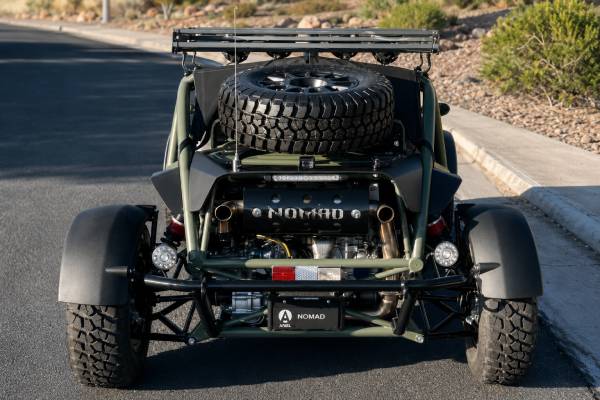
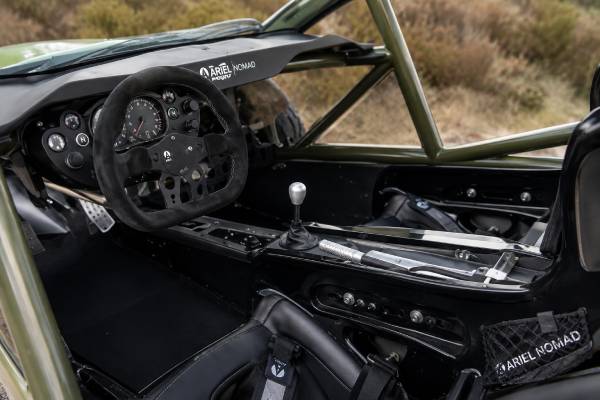
The 300 hp Ariel Nomad Tactical combines two demanding ideas: a supercharged Honda K24Z7 and a chassis equipped for rough, low-speed terrain. The result can be spectacular, but only when the whole build is treated as a system. Ariel required a heavy-duty clutch and oil cooler with the K24 supercharger package, recommended stronger brakes, and offered additional cooling, gearing, suspension, guard, wheel, and tire choices. North American Tactical cars already carried more equipment than a Sport, and later examples could include 16-inch mud-terrain tires, remote-reservoir dampers, 290 mm brakes, a winch, external lighting, and extensive protection. Those features improve capability while adding weight, airflow obstruction, heat exposure, and service points. No single used-car build sheet represents every 300 hp Tactical. This guide identifies the verified package, explains how boost changes trail and road behavior, and shows how to evaluate cooling, driveline, brakes, recovery hardware, maintenance history, and legality before buying a 2016–2022 supercharged Tactical.
Table of Contents
- The Tactical 300 Engineering Problem
- Verified Specifications and Build Variables
- Cooling, Lubrication, and Supercharger Health
- Managing 300 hp Away from Pavement
- Brakes, Dampers, Tires, and Recovery Hardware
- A Severe-Use Maintenance Program
- How to Buy a Real, Well-Sorted Tactical 300
The Tactical 300 Engineering Problem
Ariel’s 2016 supercharger option raised first-generation Nomad output to 300 bhp. On a Tactical, that power reaches the ground through a close-ratio six-speed manual and limited-slip differential while the car may be climbing slowly, spinning heavy tread blocks, carrying a winch and spare, or moving through dust and mud. The duty cycle is therefore different from a short paved-road acceleration run.
The package’s required supporting components reveal the priorities. Ariel states that the K24 supercharger system requires a heavy-duty clutch and oil cooler. The manufacturer also recommends upgraded brakes to match the increased speeds. Factory-documented Nomad 300 builds frequently add an aluminum radiator, raised intake, short final drive, larger four-piston brakes, hydraulic handbrake, and high-specification dampers. Those combinations are evidence of good engineering practice, but they are not proof that every North American Tactical received all the same parts.
The Tactical starting point also changed over time. Earlier dealer specifications listed 15-inch rally wheels, Öhlins dampers, Alcon 290 mm brakes, guards, bumpers, and a Warn winch. Ariel North America’s later Nomad 1 page lists JRi remote-reservoir dampers, 16-inch wheels, BFGoodrich KM3 tires from 2021, and an approximately 1,750-pound complete-vehicle weight. A supercharged car built in 2016 may therefore differ greatly from one completed near the end of production.
Power should not become the only authentication test. A chassis dyno is affected by tire construction, gearing, temperature, and correction method. A 300 hp factory claim refers to advertised engine output, while a wheel-horsepower figure measures something different. More important questions are whether the supercharger installation is documented, whether the calibration matches the hardware, and whether the car’s cooling, fuel, clutch, and brake systems were built for the intended use.
The best Tactical 300 feels integrated. It starts and idles cleanly, maintains temperatures, delivers power progressively, shifts without clutch slip, stops repeatedly, and remains controllable on its actual tires. A car that is thrilling for one pull but overheats, pushes fluid, throws belts, or locks its rear brakes is not “raw”; it is unfinished or unhealthy.
Verified Specifications and Build Variables
The tables separate stable K24Z7/Tactical fundamentals from options that require chassis-level confirmation. Output and some North American baseline figures differ between period sources; both are shown where the discrepancy helps identify production variation.
| Specification | Verified information |
|---|---|
| Engine | Honda K24Z7 inline four-cylinder i-VTEC |
| Displacement | 2,354 cc (2.4 liters) |
| Bore × stroke | 87 × 99 mm |
| Valvetrain | Chain-driven DOHC, four valves per cylinder |
| Induction | Ariel supercharger system for K24 |
| Advertised output | 300 hp/bhp |
| Naturally aspirated Tactical baseline | 230 hp in North American literature |
| Engine management | Hondata-based system in published Tactical specification |
| Fuel delivery | Electronic multi-port injection with twin fuel filters |
| Fuel capacity | 13 US gal (approximately 49.2 L) |
| Component | Package status | Practical significance |
|---|---|---|
| Heavy-duty clutch | Required with Ariel K24 supercharger | Increases torque and heat capacity |
| K20 flywheel | Commonly documented with factory heavy-duty clutch | Part of many Ariel Nomad 300 combinations |
| Oil cooler | Required with supercharger | Controls lubricant temperature under sustained load |
| Aluminum radiator | Optional but common on documented 300 builds | Additional coolant heat-rejection capacity |
| Short final drive | Optional | Approximately 7 percent lower overall gearing |
| Transmission | Six-speed close-ratio manual | Hydraulic clutch and limited-slip differential |
| Driven wheels | Rear | Traction is surface and tire dependent |
| System | Published or commonly documented specification |
|---|---|
| Frame | Powder-coated, bronze-welded steel tube structure with aluminum bulkheads |
| Suspension | Double unequal-length wishbones with heavy-duty/competition hardware |
| Dampers | Remote-reservoir adjustable units; Öhlins, JRi, FOX, and other build-specific systems appear |
| Brakes | Four-piston 290 mm packages commonly fitted; exact brand and axle specification must be checked |
| Brake balance | Twin master cylinders; cockpit-adjustable bias available |
| Hydraulic handbrake | Optional rally control acting on rear service brakes, not a parking brake |
| Protection | Sump, coolant-pipe, front suspension, and body-tub guards on Tactical builds |
| Area | Known Tactical configurations |
|---|---|
| Earlier wheel package | 15-inch rally-strength wheels |
| Later wheel package | 16 × 7 TDM Pro Race wheels |
| Later tire listing | BFGoodrich Mud-Terrain T/A KM3 235/70R16 from 2021 |
| Recovery | Front winch bumper, Warn winch, rear bumper/tow eyes |
| Visibility | Full windscreen, washers, wipers, and auxiliary lighting on many cars |
| Spare | Rear-mounted spare wheel and carrier commonly fitted |
| Restraints | Multi-point harnesses; exact approval and date depend on installed set |
| Measure | Published information |
|---|---|
| Core Nomad 1 wheelbase | 2,348 mm |
| Core track | 1,585 mm front and rear |
| Earlier overall dimensions | 3,215 × 1,850 × 1,425 mm |
| Later equipped Tactical dimensions | Approximately 3,556 × 1,854 × 1,499 mm |
| Published Tactical weight range | 1,480–1,750 lb depending on source and equipment context |
| Power-to-weight at 300 hp | Approximately 378–447 hp per metric tonne across that published range |
| Naturally aspirated 0–60 context | Approximately 3.4–3.5 seconds in period listings |
| Supercharged acceleration | No single validated figure covers every Tactical 300 build and tire |
Standing-start results are particularly sensitive to terrain tires. A tall mud-terrain carcass, short final drive, and loose surface can consume the extra engine output in wheelspin and tire deformation. The absence of a universal 0–60 number is more accurate than borrowing one from a different Nomad variant.
Cooling, Lubrication, and Supercharger Health
Low-speed off-road work is difficult for a cooling system because the engine can produce high load while vehicle speed supplies little ram air. A winch, lights, spare, guards, and mud can further disturb airflow. Supercharging adds heat at the same time. A Tactical 300 should therefore be judged by stable temperatures in its intended duty, not by a brief idle test.
Begin with the oil circuit. Identify the cooler, hose routing, fittings, thermostat arrangement if present, and the correct method for checking level. Lines must be supported away from exhaust heat, sharp edges, suspension travel, and debris. Wet fittings, rubbed braid, crushed hose, or a cooler packed with mud requires correction. Because the system may hold more oil than a standard K24 installation, generic capacities are unsafe.
The coolant circuit deserves a pressure test and airflow inspection. Check the radiator’s front and rear surfaces, fan operation, cap, expansion volume, hoses, clamps, bleed points, and evidence of dried coolant. An aluminum radiator may improve capacity, but a large core with bent fins or trapped debris performs poorly. Repeated topping up is not normal.
The supercharger drive should run true. With the engine off and cool, inspect pulley alignment, fasteners, belt ribs, tensioner position, bearing play, and dust patterns. A polished edge or black debris shows misalignment or slip. Listen during a cold start and as load changes; a healthy supercharger can make characteristic mechanical sound, but grinding, rumbling, or a sudden change in whine needs investigation.
Intake integrity is critical in dust. Examine the filter housing, seals, clamps, ducting, and the clean side of the tract. A raised intake reduces exposure in some situations but does not eliminate dust ingestion and does not establish a safe wading depth. Foam filters must be cleaned and re-oiled with the approved products and quantity.
Calibration and fuel quality protect the engine. Identify the ECU, calibration date, injector specification, pulley arrangement, spark plugs, and required octane. Ask what protections exist for high intake temperature, knock, low fuel pressure, or sensor failure. An engine that “runs fine” at light load may still be unsafe at full boost.
Monitor trends. Oil temperature, coolant temperature, intake temperature, fuel pressure, and knock-related data—where reliable channels exist—can reveal a problem before a warning lamp appears. Data should support mechanical inspection, not replace it. A sensor that reads implausibly constant can be as concerning as one that reads high.
Managing 300 hp Away from Pavement
The extra 70 hp over the naturally aspirated Tactical changes how quickly the rear tires cross from grip to spin. On dry road tires, the difference is strong acceleration. On mud-terrain tires over gravel, the power reserve can become a tool for maintaining momentum or a fast route to digging holes.
Use throttle position as a traction control. Feed torque in while the steering is opening and reduce it before a bump unloads the rear axle. A supercharger responds without the delay associated with many turbo systems, so a large pedal movement produces an immediate result. That responsiveness rewards smoothness and exposes abrupt technique.
Gear choice should reduce unnecessary torque multiplication. The short final drive can make the car more urgent in every ratio, but first gear may become less useful on a loose surface. Selecting a taller gear can calm wheelspin and reduce shift interruptions. Conversely, too tall a gear at low speed can load the engine and clutch heavily. The correct choice keeps the engine responsive without forcing the driver to slip the clutch.
The limited-slip differential helps when rear-tire grip differs, yet it also couples the axle behavior. If both tires break loose, the car can rotate quickly. Learn the car on a large, controlled surface with professional instruction before using power near trees, banks, spectators, or public traffic.
Climbs create a specific thermal problem. Vehicle speed falls, engine load rises, and dust can cover cooling surfaces. Build momentum before the steepest point where safe, avoid repeated failed attempts, and stop to inspect temperatures and tires. Spinning in place damages the route, heats the drivetrain, and rarely creates forward progress.
On pavement after a trail, the 300 hp car may feel transformed as grip returns. That is also when hidden damage becomes dangerous. Before increasing speed, inspect wheel nuts, tire sidewalls, steering centering, brake pedal, fluid leaks, and trapped mud. A cut tire or bent link that survived at 20 mph may fail at highway speed.
High-speed loose-surface driving requires more than power. Damper control, tire construction, bump travel, ride height, alignment, and surface reading determine stability. A Tactical 300 should not be driven at rally pace merely because it resembles a competition vehicle. Motorsport environments use route control, safety crews, helmets, cages designed for a rule set, and professional preparation.
Brakes, Dampers, Tires, and Recovery Hardware
Ariel’s recommendation for upgraded brakes with the supercharger is straightforward: the car can arrive at the next braking zone faster and repeat that cycle more aggressively. Many 300 bhp factory build sheets list four-piston calipers and 290 mm discs front and rear, often with cockpit bias adjustment.
Inspect the exact system. Identify caliper manufacturer, pad shape, disc thickness, bell hardware, hose routing, master-cylinder sizes, and parking-brake arrangement. Do not order “Nomad 300 pads” without verification. Check for pad taper, cracked dust boots, heat checks, disc runout, loose bobbins on two-piece rotors, and fluid discoloration.
Bias adjustment should have a marked baseline. Counted turns only make sense when the mechanism and starting point are known. A car with too much rear contribution may rotate under braking, especially on a split-grip surface. A car with too little may overload the front tires and lengthen stops. Changes belong in controlled testing, not on a public road.
Remote-reservoir dampers need equal discipline. Record spring identification, ride height, reservoir pressure requirements, and adjuster positions. Wash dirt from shafts before it reaches seals. A weeping body, damaged hose, bent shaft, or reservoir contact mark is a service issue. Rebuild intervals depend on damper type and use, not merely mileage.
Tires must match the mission. KM3 mud-terrain tires offer rugged construction and loose-surface traction but are not optimized for wet-road stopping or steering precision. Mixed-surface tires offer a compromise. Road tires provide greater asphalt response but less protection in rocks. Keep pressures appropriate to load and speed, and never use very low trail pressures without considering bead retention, heat, sidewall damage, and the trip back to pavement.
The winch and recovery mounts add concentrated loads to the chassis. Verify rated points, electrical cable size, isolator, fuse strategy, fairlead, rope, hook, and mounting bolts. Operate the winch periodically under a safe controlled load, then re-spool correctly. A no-load spin proves little about voltage drop or mount integrity.
Protection hardware also needs clearance. A bent guard can transfer impact into the sump, coolant pipe, or chassis. Remove trapped stones and mud, replace stretched fasteners, and confirm that suspension movement does not bring arms, hoses, or tires into contact with added parts.
A Severe-Use Maintenance Program
Treat a Tactical 300 as a performance machine with an off-road contamination problem. Mileage alone misses most of its wear. Track engine hours if possible, record demanding trips, and inspect after every event that involves dust, mud, water, hard impacts, repeated launches, or sustained high load.
Before departure, verify engine oil, coolant, brake fluid, clutch operation, belt condition, filter security, tire pressure, wheel security, steering free play, damper leaks, brake pedal, throttle return, lights, battery isolation, winch, recovery kit, and harnesses. A two-minute inspection can prevent a remote failure.
After the route, inspect before washing, then clean gradually. Photograph impact marks. Clear radiator and oil-cooler fins from the correct direction. Keep high-pressure water away from filter media, electrical connectors, bearings, seals, damper shafts, and instruments. Remove guards when necessary to release packed material and dry the chassis fully.
Service the air filter based on dust exposure, not appearance alone. Use the specified foam-filter cleaner and oil. Examine intake ducting for abrasion and the clean side for dust. Replace a damaged element rather than attempting to rescue it with excess oil.
Engine oil should follow the approved specification and interval for the conversion, with shorter service where analysis and duty justify it. Watch level and consumption trends. Fuel dilution, coolant contamination, metallic debris, persistent low pressure, or temperature excursions require diagnosis. Do not simply move to thicker oil to hide a symptom.
Inspect spark plugs at sensible intervals and after any suspected detonation, misfire, or fuel-quality event. Compare cylinders. Verify plug type and gap against the calibration. Check coil connectors and harness support because vibration and exposed wiring can create intermittent faults.
Transmission and differential oil experience repeated shock loads. Listen for changes in whine, backlash, engagement, or limited-slip behavior. A clutch that slips in a high gear under boost, smells after ordinary driving, or engages inconsistently should be addressed before it damages related parts.
Ariel’s current Nomad service kit outlines annual/4,500-mile and four-year/18,000-mile service levels for the family, but the individual North American car and supercharger installer may require additional work. Brake fluid, coolant, belts, tires, hoses, battery, harnesses, and damper service are also age-sensitive.
Maintain a detailed log with fluid brands, quantities, filter and belt numbers, damper settings, alignment, tire pressures, ECU calibration identity, and photographs. A complete record improves troubleshooting and resale value while preventing the next technician from guessing.
How to Buy a Real, Well-Sorted Tactical 300
Begin by proving three things separately: the car is a North American Tactical, the supercharger system is authentic and correctly installed, and the current chassis equipment matches the seller’s claims. One label or invoice does not establish all three.
Request the original build sheet, chassis number, sales invoice, supercharger installation record, heavy-duty clutch documentation, oil-cooler details, ECU calibration information, service history, title, and photographs. Ask whether the car was delivered at 300 hp or converted later. Later work can be legitimate, but it needs its own paper trail.
Inspect the frame and protection system for evidence of hard use. Focus on suspension pickups, lower rails, engine cradle, rollover structure, winch bumper, rear tow points, and guard mounts. Bent tubes, cracked coating, nonuniform welds, or fresh localized refinishing should be investigated by a specialist.
Trace the boosted powertrain visually. Confirm belt alignment, pulley security, oil-cooler lines, radiator condition, intake sealing, injector and wiring quality, heat shielding, and fluid leaks. Ask for a cold start. Observe idle, smoke, warning lamps, charging voltage, fan operation, and temperature rise before driving.
The road test should be staged. First evaluate steering, brakes, clutch, gearbox, differential, and cooling at light load. Then use moderate power. Full boost is appropriate only when the car is warm, legal conditions are safe, and no fault has appeared. Misfire, detonation-like noise, clutch flare, belt squeal, coolant odor, unstable temperature, or warning lights ends the test.
Check wheels and tires for date, damage, matching specification, and brake clearance. Inspect the spare too. Measure brake pads and discs, confirm parking-brake function, and verify that a hydraulic rally brake is not being used to hold the parked car. Review damper labels and settings side to side.
Test the winch and electrical accessories safely. Look for voltage drop, hot connectors, poor grounds, exposed splices, water intrusion, and unfused additions. Auxiliary lights, heated windscreen, wipers, pumps, master switch, immobilizer, display, and charging points should all work.
Confirm registration and insurance in the destination state before purchase. North American Ariels are specialty vehicles and may not transfer like mass-produced cars. Match every identification number and ask the motor-vehicle authority how the title category, emissions rules, and inspections apply.
Commission a specialist pre-purchase inspection. Useful checks may include compression or leak-down testing, scan data, calibration confirmation, cooling pressure, oil-system inspection, clutch load test, differential and gearbox evaluation, frame measurements, alignment, damper condition, brake-bias function, and recovery-mount integrity.
A good Tactical 300 should come with explanations, not mysteries. The seller should know its fuel, belt, oil level procedure, damper settings, tire pressures, service history, and recovery points. That operational knowledge is often the clearest sign that the car was treated as engineered equipment rather than a novelty.
References
- Ariel Nomad Tactical – ACE Performance – North East Ariel Dealer 2026 (North American Tactical Specifications)
- Ariel Atom, Ariel Nomad, Ariel North America Ariel Nomad Tactical – Ariel North America 2026 (Later North American Tactical Data)
- Nomad 1 – Ariel Motor Company 2026 (Manufacturer Supercharger and Supporting Options)
- Our History – Ariel Motor Company 2026 (Manufacturer Model Timeline)
- Ariel Nomad 300 – Ariel Motor Company 2026 (Factory-Documented 300 bhp Off-Road Build)
- Nomad Service Kit – Ariel Motor Company 2026 (Manufacturer Service Information)
Disclaimer
This article provides general information only. It does not replace the individual build sheet, official service manual, calibration documentation, professional mechanical inspection, recovery instruction, or legal advice. Specifications, settings, fluids, intervals, hardware, output, and registration status vary by chassis, market, production date, and modification. Verify every safety-critical detail before purchase, service, or use.
Share this article with an owner or buyer who needs to assess a supercharged Nomad Tactical as a complete system rather than by horsepower alone.