


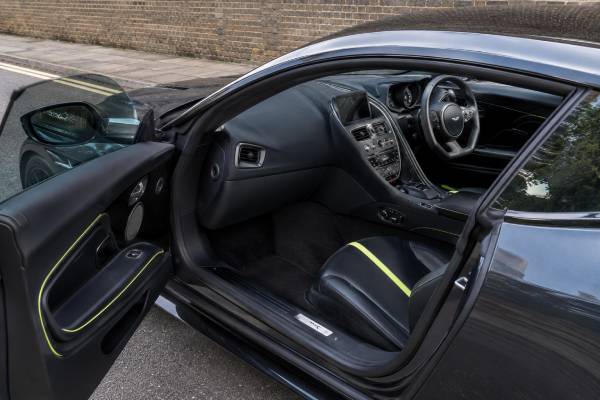
The 2018–2021 Aston Martin DB11 AMR is the 630 bhp evolution of the original V12 coupe and became the performance flagship of the DB11 range. Its 5.2-litre twin-turbo AE31 engine still produces 700 Nm, but Aston Martin increased peak power, revised the eight-speed transaxle calibration, sharpened chassis responses, and gave the exhaust a stronger voice. The official claims moved to 3.7 seconds from 0–62 mph and 208 mph at the top end. Those numbers are dramatic, yet the AMR remains a luxury 2+2 designed to travel far, not a stripped circuit car. Used examples vary widely because customers could choose restrained or highly sporting specifications, and many standard DB11s have since acquired AMR-style wheels, dark trim, badges, or software. Buying well therefore requires exact identification, a full diagnostic and cooling assessment, tire and brake measurement, and proof that campaigns and annual maintenance were completed. A healthy AMR is the most focused factory V12 DB11 of its period; a neglected one concentrates the platform’s highest heat, speed, and running costs into a tempting purchase price.
Table of Contents
- What AMR changed in the V12 DB11
- The 630 bhp V12, cooling, and rear transaxle
- DB11 AMR specifications
- Performance on road and the meaning of 208 mph
- Trim, options, and separating AMR from lookalikes
- Service needs of the faster V12
- Pre-purchase diagnosis and cost planning
- AMR ownership compared with other DB11 versions
What AMR changed in the V12 DB11
AMR replaced the 600 bhp V12 rather than sitting beside it as a separate track package. The upgrade combined a 30 bhp power increase with revised transmission logic, suspension calibration, exhaust tuning, and visual differentiation. The objective was a more immediate flagship while retaining the comfort and luggage ability expected from a DB11.
The torque figure stayed at 700 Nm, so the change is most apparent as revs rise and in the way the gearbox responds. The engine holds its effort farther toward the 6,500 rpm power peak, while the transmission delivers firmer, quicker shifts in its more aggressive settings. Around town, GT mode should still be smooth and discreet.
Aston Martin also altered the chassis calibration to improve precision and connection. The AMR did not become lightweight; it remained approximately 1,870 kg on the published EU kerb basis. Its achievement is controlling that mass with greater confidence without making the car constantly busy.
Visual cues included darker treatments, exposed carbon options, distinctive forged wheels, AMR branding, and more assertive cabin combinations. The launch-only Signature Edition used a fixed Stirling Green and lime theme and was limited to 100 cars. Regular AMRs could be ordered in many colours and should not be judged as lesser simply because they lack the Signature scheme.
The production boundary matters. AMR arrived in 2018 and continued through the 2021 model year. For 2022, Aston Martin removed the AMR badge from the V12 DB11 but retained the higher output and dynamic attributes. A late 630 bhp car without AMR identification is therefore not necessarily underpowered or incorrectly badged; it belongs to the revised naming strategy.
Conversely, an early 600 bhp DB11 with an AMR body kit is not a factory AMR. Confirm powertrain coding, VIN specification, build sheet, original invoice, model year, and factory equipment. Cosmetic resemblance has become common enough that badges alone are weak evidence.
The AMR is best valued as a complete calibration. Engine software, gearbox behaviour, dampers, tires, exhaust, and aerodynamics were intended to work together. Piecemeal modifications can produce a louder or faster-feeling car while reducing the balance that justified the badge.
The 630 bhp V12, cooling, and rear transaxle
The AE31 is an Aston Martin-designed, all-alloy, quad-cam V12 with two turbochargers, water-to-air charge cooling, variable cam timing, stop-start, and cylinder deactivation. Its defining road characteristic is large torque from low engine speed combined with a smooth rise toward the power peak.
Cylinder deactivation can close one bank during suitable light-load operation and alternate banks to manage temperatures. The transition should not create a persistent misfire, unstable idle, or warning. An Aston-capable scan tool is required to interpret combustion, boost, temperature, and deactivation-related data accurately.
The engine is positioned behind the front axle line and connected through a torque tube to the rear-mounted ZF eight-speed automatic. This transaxle arrangement helps the 51:49 distribution and makes the DB11 feel less nose-led than its proportions imply. It also means driveline diagnosis spans the front engine, torque tube, rear gearbox, differential, mounts, and control software.
Cooling is a system rather than a single radiator. Engine coolant, charge-cooling circuits, air-conditioning condenser, transmission demands, turbo heat, fans, ducts, and stacked heat exchangers share a confined front package. Debris lodged between cores can reduce capacity while the visible grille face appears clean.
A pre-purchase check should inspect reservoirs, caps, hose joints, pump behaviour where testable, fan stages, radiator and condenser damage, dried residue, undertray staining, and temperature stability after sustained load. A dashboard gauge that remains centred does not reveal every local temperature or marginal pressure issue.
Oil level and condition must be checked by the prescribed method. Undertrays can conceal seepage or spread it away from the source. Inspect cam-cover regions, turbo feed and return areas, sump zones, the rear of the engine, and any previous repair. Record consumption over distance instead of relying on one snapshot.
The transaxle should select promptly, creep cleanly, and shift without flare or harsh impact. Evaluate it cold and fully hot, using light throttle, manual paddles, kickdown, steady cruise, and overrun. A software update can improve calibration, but recurring thumps, delayed engagement, or a speed-related whine require mechanical investigation.
Because the AMR is often driven harder than a standard GT, history should explain fluid service, heat-related repairs, and any track use. A pristine exterior cannot show how often the car was launched, overheated, or run on unsuitable tires.
DB11 AMR specifications
The DB11 AMR couples the 630 bhp AE31 V12 to a revised rear transaxle calibration in a front-mid-engine, rear-drive chassis. Its specifications describe a faster development of the V12 grand tourer, not a separate all-wheel-drive or track-only layout. The published figures below apply to the regular 630 bhp AMR coupe as well as the mechanically identical Signature Edition. Dry and EU kerb values are different measurement conventions and must not be treated as interchangeable.
| Specification | Value |
|---|---|
| Engine | Aston Martin AE31, all-alloy 5.2-litre twin-turbocharged V12 |
| Displacement | 5,204 cc |
| Fuel | Premium unleaded gasoline |
| Maximum power | 630 bhp (639 PS / 470 kW) at 6,500 rpm |
| Maximum torque | 700 Nm (516 lb-ft) from 1,500 rpm |
| Specification | Value |
|---|---|
| Transmission | Rear-mounted ZF eight-speed automatic transaxle with revised calibration |
| Drive and differential | Rear-wheel drive; mechanical limited-slip differential; brake-based torque vectoring |
| Front and rear suspension | Independent double wishbones front; multi-link rear; adaptive damping with V12/AMR calibration |
| Steering | Electric power-assisted rack-and-pinion |
| Brakes | Ventilated steel discs, six-piston front and four-piston rear calipers |
| Specification | Value | Standard or condition |
|---|---|---|
| 0–100 km/h (0–62 mph) | 3.7 seconds, manufacturer 0–100 km/h (0–62 mph); 3.5 seconds to 60 mph | Manufacturer claim |
| Top speed | 334 km/h (208 mph) | Manufacturer claim |
| Fuel-tank capacity | 78 L (20.5 US gal) | Nominal capacity |
| U.S. fuel economy | 2022–2023 U.S. rating: 14 mpg city, 22 mpg highway, 17 mpg combined | EPA cycle; exact year and body style should be checked |
| Specification | Value |
|---|---|
| Length | about 4,750 mm (187.0 in) |
| Width | about 1,950 mm body; 2,060 mm including mirrors |
| Height | about 1,290 mm (50.8 in) |
| Wheelbase | 2,805 mm (110.4 in) |
| Kerb weight | 1,870 kg (4,123 lb), EU kerb; 1,765 kg published dry weight |
| Weight distribution | 51:49 front/rear |
| Specification | Value |
|---|---|
| Body and seating | 2+2 coupe |
| Wheel format | 20-inch forged staggered wheels on AMR; later cars offered several 20-inch designs |
| Typical factory tire sizes | 255/40 ZR20 front; 295/35 ZR20 rear |
| Luggage capacity | 270 L (about 9.5 cu ft) |
Performance on road and the meaning of 208 mph
The 208 mph claim tells buyers about thermal, aerodynamic, tire, and stability capability, not where the car should be tested. On public roads, the more useful measure is how easily the AMR accelerates from ordinary speeds while remaining settled and predictable.
In GT mode, throttle and transmission response should be progressive. The engine can make a rapid overtake without a theatrical downshift, and the dampers should permit useful movement over rough surfaces. Sport increases urgency and exhaust presence; Sport Plus tightens the relationship between pedal, gear, and body control.
Full performance depends on correct temperature and fuel. Avoid heavy load until fluids are warm, use the required premium gasoline, and treat repeated boost as a thermal event. After a hard section, a gentler run allows temperatures to stabilise before shutdown.
The steering remains relatively light but should be accurate. Check whether the car takes a consistent set in a bend, whether the wheel returns cleanly, and whether the front axle follows road crowns excessively. Tire pressure, construction, alignment, wheel damage, bearings, and suspension joints can all alter feel.
Rear traction is substantial on warm, correct tires and limited on cold, old, or wet rubber. Seven hundred newton-metres can overwhelm grip without any engine fault. Matching tire model, approval, size, age, and wear across the staggered set is one of the most important safety checks.
The brake system uses large ventilated steel discs. It should provide a firm, repeatable pedal and straight stops. Measure disc thickness and inspect inner faces for corrosion, heat checking, or cracks. A car stored after washing can develop pad imprints or roughness even with low mileage.
Ride quality should remain recognisably grand touring. Constant crashing, tramlining, or vibration is not proof of a sporting setup. Verify wheel roundness, tire age, pressures, alignment, damper function, suspension links, and whether aftermarket spacers or springs are fitted.
At motorway speed, listen for wind noise around frameless glass and mirrors, tire roar that changes with surface, and driveline vibration that changes with throttle. The AMR’s speed can mask developing faults because the car reaches high velocity with little effort. A disciplined test uses legal speed, varied load, and careful observation rather than a dramatic acceleration run.
The best examples feel integrated. The engine, transaxle, exhaust, steering, dampers, differential, brakes, and stability control all change intensity together. A car that is extremely loud but slow to shift, or very stiff but vague in steering, may have lost that integration through maintenance gaps or modification.
Trim, options, and separating AMR from lookalikes
AMR identification begins with the VIN-linked build record. External badges and black trim are useful clues, but many standard DB11s have received similar parts. Confirm the factory model designation, output, original wheels, body components, cabin specification, and delivery invoice.
Regular AMRs were available in a broad palette, including subtle luxury colours. Do not expect every genuine car to have lime accents or a racing-inspired interior. The 100-unit Signature Edition is the fixed green-and-lime launch version; it should be authenticated as a separate limited specification.
Inspect forged wheels for correct part numbers, dimensions, finish, cracks, bends, and previous machining. Refinished dark wheels can hide poor repairs. Confirm centre caps and tire-pressure sensors, and make sure all four wheels share the intended design rather than a visually similar aftermarket set.
Carbon-fibre exterior pieces need scrutiny at lower edges and mounting points. Look for cloudy clear coat, resin damage, distorted weave, stress cracks, repairs beneath film, and non-original replacement patterns. Genuine documented replacement after road damage is preferable to a concealed repair or an unknown reproduction.
Inside, check AMR logos, seat design, leather or Alcantara-type materials, stitching, carbon trim, and sill details against the build sheet. Wear should be consistent with mileage. Recolouring can make seats appear fresh while burying contrast thread or changing sheen and grain.
Equipment differs by car and market. Test premium audio if fitted, cameras, parking sensors, navigation region, Bluetooth, memory seats, ventilation, blind-spot functions, alarm, tracker, and both keys. The older infotainment interface is normal; instability, dead pixels, lost camera views, or repeated rebooting is not.
Body condition must be assessed with knowledge of bonded aluminium and composites. Measure paint, examine panel alignment and fasteners, inspect the clamshell bonnet and catches, and look underneath for jacking damage. High-quality cosmetic paint may be acceptable, but structural or poorly documented repair should affect price materially.
Ask about wraps, paint-protection film, ceramic coatings, badge changes, exhaust modifications, tunes, and suspension alterations. The seller should be able to explain when, why, and by whom work was completed, with the original parts included where practical.
Service needs of the faster V12
The AMR requires an ownership budget appropriate to a hand-built 630 bhp V12, regardless of depreciation. Annual service, battery support, clean cooling systems, premium tires, large brakes, and specialist diagnostics are baseline needs rather than optional pampering.
Follow the exact owner and service documentation for the VIN, market, and build date. Confirm oil specification and quantity, filters, plugs, coolant, brake fluid, transmission and differential procedures, belts, and inspection intervals. Do not copy a schedule from the 600 bhp car or a later DBS without checking applicability.
Battery condition influences the whole vehicle. Maintain it with the correct conditioner, test capacity and charging performance, and investigate parasitic drain. Low voltage can create multiple communication and actuator faults, but it should not become an excuse to ignore warnings that return after stable power is restored.
Cooling maintenance includes cleaning between heat exchangers, checking stone damage, examining reservoirs and joints, testing for pressure loss when indicated, and confirming fans after heat soak. Record any coolant addition. Repeated top-ups without a traced leak are not routine maintenance.
Ignition or combustion faults should be diagnosed promptly. Continuing to drive with a misfire can overheat catalytic converters and create much greater expense. Read cylinder-specific data, plugs, coils, injectors, fuel quality, compression or leak-down information as appropriate rather than replacing parts by guesswork.
Brake and tire costs should be forecast before purchase. Measure remaining material and note tire dates, not merely tread depth. A complete set may be due because of age even on a garage-kept car. Wheel alignment should follow tire replacement and any suspension work.
Inspect adaptive dampers and suspension links for leaks, play, damaged boots, and noise. The car’s mass and performance can accelerate wear when used on poor roads. Replace parts in a way that preserves axle balance, then document geometry.
Keep factory campaign checks separate from routine servicing. An experienced independent specialist may provide excellent mechanical care, while an authorised dealer confirms software and campaign status. Strong ownership uses both capabilities where appropriate.
Records should be itemised and chronological. Diagnostic scans, battery tests, fluid details, alignment, tire invoices, paintwork, and photographs of major repairs give future technicians and buyers a far better baseline than stamps alone.
Pre-purchase diagnosis and cost planning
A proper inspection is a financial tool. It should convert symptoms and wear into a prioritised estimate before the buyer is committed, rather than produce a generic list of possible supercar failures.
The car must be cold. Observe cranking speed, smoke, idle, noises, warning messages, exhaust smell, and fluid behaviour from the first start. Scan all modules before clearing history and record voltage, mileage, active faults, stored faults, readiness information, and software details available to the tool.
Inspect the car on a lift. Check cooling cores, engine and turbo plumbing, exhaust and catalysts, torque tube area, transaxle, differential, suspension, dampers, brakes, tire inner shoulders, wheel barrels, undertrays, jacking points, and evidence of impact or leakage.
Road-test long enough to reach full temperature. Use GT, Sport, and Sport Plus; manual and automatic shifting; steady cruise; controlled acceleration; several braking loads; and broken road surfaces. Test cameras, sensors, climate control, windows, seats, handles, lighting, and audio during the same drive.
After heat soak, look and smell again. Confirm fan operation, check reservoirs without opening a hot system, inspect the ground and undertrays, and re-scan. Compare which faults are new, which returned, and which were merely historic.
Categorise costs as immediate safety, required service, active diagnosis, near-term wear, cosmetic restoration, and optional improvement. A worn tire set is predictable; an intermittent network fault may need diagnostic hours before parts can be priced. Keeping categories separate makes negotiation fairer.
Verify history against physical evidence. Claimed recent brakes should match disc and pad condition. A documented alignment should match tire wear and steering-centre position. Repeated battery invoices may suggest storage or parasitic draw. A cooling repair should explain the fluid and parts used.
Reject vague assurances such as “all Astons show lights” or “the gearbox just needs learning.” Some faults are minor, but they need evidence. The AMR’s complexity makes professional diagnosis cheaper than optimism.
AMR ownership compared with other DB11 versions
Choose the AMR when twelve-cylinder character, the final 2018–2021 performance calibration, and a sharper response matter more than minimum running cost. It is faster and more expressive than the original V12, yet more luxurious and less extreme than the DBS Superleggera.
The 600 bhp DB11 V12 has a softer launch-era personality and may appeal to buyers who value historical importance or relaxed tuning. The V8 coupe is about 110 kg lighter, feels more agile, uses less fuel, and usually costs less to maintain. The Volante offers open-air travel but adds roof systems, weight, and water-management responsibilities.
The later 2022–2023 V12 retains 630 bhp without the AMR badge. Buyers choosing between them should compare specification, condition, price, and desired identity rather than assuming the badge always means greater performance. The late car may have newer production, while the AMR has the clearer named sub-model.
Within AMRs, a standard car in an elegant colour can be more satisfying than a compromised Signature Edition bought solely for rarity. Conversely, a complete Signature Edition carries a finite 100-car story that a standard AMR cannot reproduce. Decide whether visual collectability or freedom of specification matters more.
Condition outranks the hierarchy. A fully serviced V8 on fresh tires can be a better grand tourer than an AMR with cooling residue, old rubber, and recurring faults. Purchase price is only the entry point; the maintenance baseline determines the real first-year cost.
For the right owner, the AMR offers an unusual combination: immense low-speed torque, a genuinely high-revving top-end increase, rear-transaxle balance, 2+2 practicality, and a cabin suited to long travel. Preserve the factory integration, use the car through full heat cycles, document its care, and the 208 mph headline becomes what it should be—a symbol of engineering headroom rather than the only reason to own it.
References
- DB11 AMR – NEW PERFORMANCE FLAGSHIP OF THE DB11 RANGE 2018 (Official Launch)
- Aston Martin DB11: the latest in an illustrious bloodline 2017 (Platform Engineering)
- Owner’s Guides | Aston Martin 2026 (Owner Documentation)
- Aston Martin Luxury Car Servicing | Aston Martin 2026 (Service Information)
- Fuel Economy of the 2021 Aston Martin DB11 V12 2021 (EPA Fuel Economy)
Disclaimer
Treat this as informational guidance, not a diagnostic verdict. AMR specifications, procedures, campaigns, parts, and software must be confirmed for the individual VIN, production date, equipment, and market through official documentation and qualified expertise.
Please share the article on Facebook, X/Twitter, or another service if its AMR checks prove useful to another owner.